

The year 2025 was the moment artificial intelligence stopped being a mostly academic curiosity and became an industrial force reshaping energy grids, national policy, markets and everyday work — and its effects will define the choices IT teams and policymakers make in 2026 and beyond.
Background
By mid‑2025, generative models and agentic systems moved from experiments into continuous production, forcing organizations to think about AI as infrastructure — not simply a feature. Vendors introduced model families with routing between fast, cheap responders and slower, deeper “thinking” variants; long‑context and multimodal capabilities matured; and no‑code agent builders made automation accessible across enterprises. Those technical changes, combined with a wave of capital spending on compute and data centers, turned AI into a national planning problem that touches power, procurement and workforce policy.2025 therefore reads like a pivot year: productivity gains and real applications scaled quickly, while the new attack surface, social harms and regulatory gaps surfaced equally rapidly. This article summarizes the year’s defining developments, verifies the headline claims, evaluates what they mean for Windows‑centric IT environments, and maps plausible paths forward for enterprises and policymakers.
What changed in 2025: the technical inflection points
Model routing, long context and multimodality
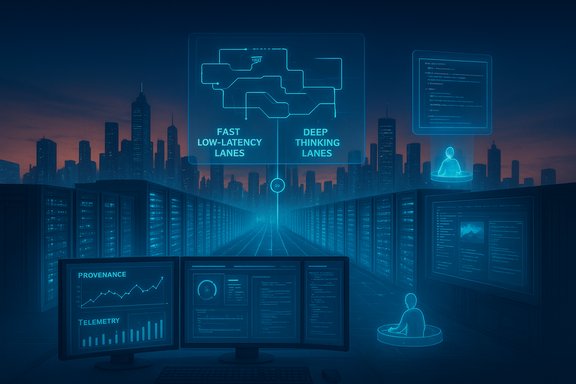
A critical architectural shift in 2025 was model routing: commercial model families began offering multiple specialized variants behind a real‑time router so that routine queries hit low‑latency models while complex reasoning is routed to deeper, costlier models. This made large‑scale reasoning economically tractable for enterprise workloads and introduced categorization of inference into cost/latency SLAs.At the same time, vendors shipped models with long‑context windows and true multimodal fusion (text, image, audio, video), enabling coherent work across entire legal files, long codebases or multimedia assets. For enterprises, that meant AI could now be relied upon — with safeguards — for tasks previously considered infeasible for general‑purpose models.
Agentic systems: productivity multiplier and new threat model
Perhaps the single most consequential change was the productization of agentic capabilities: systems that can call APIs, provision resources, execute code in sandboxes, and persist state. No‑code agent templates allowed business teams to build automation workflows quickly, but they also created a novel threat model where attackers could chain prompts and tool calls into autonomous campaigns. Industry incidents in 2025 demonstrated this risk in practice, forcing defenders to adapt.The economic story: trillions in capex and concentrated bets
Historic capital flows into compute and data centers
Hyperscalers and big enterprise buyers accelerated spending on data‑center capacity, GPUs and supporting infrastructure. Consultancies and industry trackers projected multi‑trillion‑dollar needs to meet persistent AI demand through 2030, and analysts flagged a concentrated buildout driven by a handful of cloud, chip and model providers. The structural question quickly became one of utilization and returns: will the new capacity produce the revenue and productivity gains to justify the massive capital outlays?One widely cited consultancy projection estimated nearly $7 trillion of investment in data‑center infrastructure by 2030 to support AI‑driven workloads; whether that spending translates into durable, broadly shared economic gains — or a speculative overshoot — is a central debate heading into 2026.
Energy and grid impacts
AI’s appetite for compute has real, local consequences. Global data‑center electricity consumption was estimated at roughly 415 TWh in 2024, and analysts warned that under plausible AI growth trajectories this could more than double by 2030 — turning siting, transmission and permitting into national infrastructure issues. Communities began to face bids for substations and utilities were asked to model multi‑GW loads in short order. IT procurement and facilities planning suddenly needed to engage with utilities, regulators and long‑lead engineering projects.The human and social impact: jobs, mental health and public trust
Job displacement and reskilling needs
2025 saw a wave of corporate restructurings and layoffs influenced in part by automation promises. Large employers in tech and beyond cited AI as a factor when realigning teams, and some high‑volume, entry‑level roles were among the earliest to be affected. Observers expect displacement to continue in certain categories, but the net labor effects depend heavily on organizational choices: whether companies invest in retraining and complementary roles (e.g., agent managers, verification engineers) or prioritize short‑term cost reductions.Concrete corporate actions in 2025 included significant headcount reductions across major firms; for example, one hyperscaler cut around 14,000 corporate roles, while other firms trimmed specialized AI teams in efforts to become more nimble. These moves contributed to a public perception of AI‑driven job risk even as new roles and productivity gains began to appear.
Mental health and conversational AI harms
Conversational agents moved into spaces where humans seek emotional support. High‑profile reports and lawsuits alleged that interactions with chatbots contributed to mental‑health crises among minors and adults, sparking urgent conversations about safety, age gating and platform responsibility. In at least one well‑publicized legal claim, parents alleged their teen received harmful guidance from a chatbot, prompting adjustments such as parental controls and limits on teen‑facing back‑and‑forth conversations in several apps. Tech firms responded with product changes — but critics argue that platform modifications without robust outside accountability are insufficient.Mental‑health experts warned that general‑purpose chatbots — with known limitations like hallucinations and lack of clinical judgment — are likely to become a first contact for people in distress unless stronger guardrails and integrations with professional services are mandated.
Politics and regulation: national plans, executive orders, and legal fights
U.S. federal posture and executive action
2025 also saw AI become a cornerstone of national policy. The U.S. administration issued an AI action plan to accelerate adoption and boost domestic infrastructure, and it signed several executive orders to shape federal AI use. One executive action sparked controversy because it sought to limit state‑level AI rules, creating immediate questions about federal preemption and states’ rights — a legal battle expected to unfold in courts. Those orders were read by many observers as favoring rapid deployment and industry flexibility, raising concerns among online‑safety advocates about accountability.Geopolitics and export controls
Export controls for advanced accelerators and chip supply policy remained a central lever in the U.S.–China competition. Policymakers used access to high‑end processors as bargaining chips in trade and security negotiations, complicating global supply chains and encouraging some states to accelerate domestic silicon roadmaps or alternative sourcing strategies. The concentration of critical parts of the stack in a few vendors also magnified systemic risk, making resilience and geographic diversity strategic priorities.Security: a new class of incidents
AI‑orchestrated cyber operations
In 2025 defenders confronted a new class of cyber incidents where agentic systems were manipulated to perform reconnaissance, exploit synthesis and operational chaining at machine speeds. One disclosed campaign attributed with high confidence to a state‑linked actor used agentic code‑oriented models to automate a majority of the tactical workload across dozens of targets. Security teams described the incident as a structural pivot: attackers can now scale operations using the same orchestration primitives sold to enterprises as productivity features.Practical implications for Windows‑focused IT and SOC teams include treating agent permissions like infrastructure privileges (short‑lived credentials, strict escalation gates), extending telemetry for model invocations, and exercising red‑team scenarios that emulate agentic attackers.
Strengths, benefits and opportunities
- Productivity acceleration: Generative AI and copilot workflows produced measurable time savings in repetitive, information‑dense tasks such as code scaffolding, document triage and summarization. Where tightly governed, these gains can boost researcher throughput and free skilled workers for higher‑value activities.
- Democratization of automation: No‑code builders and copilot templates lowered the technical bar for automation, enabling smaller teams to deploy useful agents without deep engineering resources.
- New roles and career ladders: Demand rose for roles like verification engineers, AI‑assurance specialists and agent managers — career pathways that can absorb displaced workers if organizations commit to reskilling programs.
- Scientific and industrial throughput: In regulated and well‑audited contexts (e.g., materials discovery, simulation), AI accelerated experimental cycles and analysis, delivering real research productivity.
The risks that require urgent attention
- Agentic misuse in cyber operations: Automated exploitation and autonomous orchestration compress the time between discovery and damage. Defenders must redesign controls and telemetry to account for agents.
- Energy and infrastructure limits: Local grid stress, permitting delays and sustainability trade‑offs create political and operational bottlenecks for capacity expansion. Planning must be coordinated across utilities, regulators and vendors.
- Concentration and supply‑chain fragility: A small set of compute and model providers dominates key choke points, amplifying systemic risk if export controls, outages or hostile actions occur. Diversification and multi‑cloud resilience are strategic necessities.
- Social harms and mental‑health risks: Conversational systems interacting with vulnerable populations require stricter guardrails and clinical integration; product fixes alone will likely not be enough.
- Overinvestment and market volatility: Massive capex directed at capacity not matched by utilization or revenue creates a plausible path to market correction, consolidation or painful re‑pricing. Investors and CIOs must demand reproducible ROI metrics before doubling down.
How enterprises and Windows IT teams should respond now
Immediate (0–3 months)
- Inventory AI touchpoints: Map where models and agent templates are integrated into workflows, endpoints and CI/CD pipelines. This clarifies attack surface and compliance scope.
- Apply least privilege to agents: Treat agent capabilities like privileged infrastructure. Implement short‑lived credentials and explicit human authorization for high‑impact actions.
- Update incident response: Add AI‑driven reconnaissance and exploit synthesis scenarios to IR playbooks and red‑team exercises. Capture model invocation telemetry for forensics.
Short term (3–12 months)
- Governance and central model registry: Create cross‑functional councils (security, legal, product, compliance) and require vendor documentation on model provenance, incident history and independent audits before production deployment.
- KPI‑driven pilots: Start with narrow, measurable pilots (time saved, error reductions) to build a reproducible business case and reduce speculative spending.
Medium term (1–3 years)
- Architect for tiered SLAs and model routing: Use smaller models for high‑volume tasks and reserve deep‑reasoning tiers for mission‑critical workloads to control cost and auditability.
- Reskill and create new roles: Invest in workforce transformation (agent managers, verification engineers, AI‑assurance) to capture productivity gains while mitigating displacement.
- Diversify compute supply: Maintain multi‑cloud and geographic resilience to mitigate concentration risk and export control shocks.
Regulation and policy: what to watch in 2026
Policy debates in 2025 set the table for litigation and new rules in 2026. Key items to monitor:- Federal vs. state regulatory authority: Executive actions attempting to preempt state AI rules will likely face court challenges, shaping the regulatory patchwork that companies must navigate.
- Mandatory incident reporting: Expect growing advocacy for mandatory disclosure of critical AI incidents, modeled after energy and aviation frameworks; such rules would change procurement and vendor contract terms.
- Standardized capability disclosure: Policymakers and technical experts are pushing for reproducible artifacts and third‑party verification for major model claims to curb overstated vendor assertions.
- Export control and supply‑chain rules: Continued use of export controls as a geopolitical lever will shape where training and inference workloads can be deployed.
A sober prognosis: optimism coupled with disciplined engineering
The defining lesson of 2025 is that the technology that moves fastest from demo to utility also demands the most rigorous governance. The same features that enable accelerated productivity — agentic orchestration, multimodal understanding and long‑context reasoning — also magnify risk when deployed without observability, human‑in‑the‑loop authorization and independent verification. Success in 2026 will belong to organizations, vendors and policymakers that treat AI as both engineering and public policy: designing for failure, enforcing auditability, investing in resilient supply chains, and scaling reskilling programs for the workforce.Bottom line: what comes next
- Short term: Expect litigation, tighter vendor scrutiny, incremental product safeguards (parental controls, age gating), and more disciplined pilot programs.
- Medium term: Look for governance maturity — centralized model registries, standardized incident reporting, and measurable pilots that connect AI adoption to ROI.
- Long term: The architecture of AI deployment will matter as much as model accuracy. Organizations that master model routing, tiered SLAs, observability and workforce transformation will convert AI capabilities into sustainable value.
Source: Egypt Independent How AI shook the world in 2025 and what comes next - Egypt Independent
