

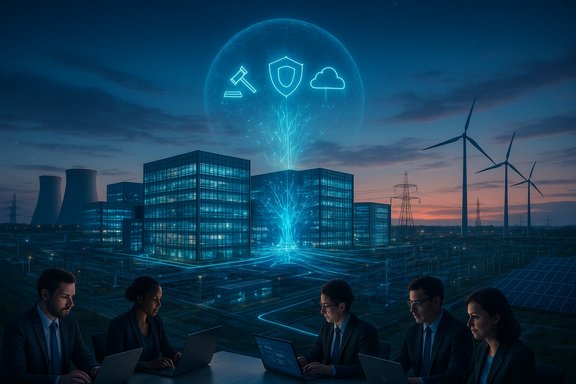
The Messari-backed “State of AI 2025” picture is blunt: artificial intelligence has stopped being an experimental technology and has become a strategic layer of national industry — with adoption, capital, and compute capacity all racing upward at once, and with the principal battles now being fought over energy, hardware, and data‑center infrastructure rather than just model architectures.
AI adoption has moved from pilot projects into everyday operations across education, healthcare, finance, media, software development, energy, and defense. A raft of surveys and industry metrics compiled in 2025 show adoption rates and commercialization that dwarf the early internet years: GenAI is present in classrooms and clinics, agents are already starting to run real workflows in finance and enterprise, and major publishers and platforms have signed commercial agreements to integrate AI into content pipelines. This cross‑sector momentum gets amplified by an extraordinary wave of capex and private funding that is reshaping how computing, power, and physical real estate are provisioned for AI workloads. The result is two simultaneous dynamics: (1) industrialization — multi‑gigawatt data campuses, long‑term cloud leases and structured finance for compute — and (2) geopolitics — national plans, export controls and alternative governance frameworks that aim to lock in or contest “AI sovereignty.” The United States and China are the central competitors, but the map is global and includes new major players and sovereign financings. These themes are the core of the State of AI 2025 thesis and the reason CIOs, infrastructure planners, and public officials are treating AI as national infrastructure on the scale of power grids and telecoms.
For IT leaders and Windows ecosystem professionals this moment demands practical steps: make AI projects measurable; plan for portability and governance; and treat power, permitting and procurement as first‑order fundamentals. For policy makers, the task is to balance national competitiveness with the global public goods that enable cross‑border cooperation — from standards and audits to trusted export regimes.
The next major frontier is not purely technical: it is the fight over verifiability, privacy and coordination — how models are audited, how provenance is guaranteed, and whether a hybrid architecture (centralized scale plus decentralized verification and markets) will emerge as the dominant fabric for a safe and productive AI century.
Source: The Cryptonomist State of AI 2025: Infrastructure, Adoption, and the Geopolitical Race between the USA and China
 Background / Overview
AI adoption has moved from pilot projects into everyday operations across education, healthcare, finance, media, software development, energy, and defense. A raft of surveys and industry metrics compiled in 2025 show adoption rates and commercialization that dwarf the early internet years: GenAI is present in classrooms and clinics, agents are already starting to run real workflows in finance and enterprise, and major publishers and platforms have signed commercial agreements to integrate AI into content pipelines. This cross‑sector momentum gets amplified by an extraordinary wave of capex and private funding that is reshaping how computing, power, and physical real estate are provisioned for AI workloads. The result is two simultaneous dynamics: (1) industrialization — multi‑gigawatt data campuses, long‑term cloud leases and structured finance for compute — and (2) geopolitics — national plans, export controls and alternative governance frameworks that aim to lock in or contest “AI sovereignty.” The United States and China are the central competitors, but the map is global and includes new major players and sovereign financings. These themes are the core of the State of AI 2025 thesis and the reason CIOs, infrastructure planners, and public officials are treating AI as national infrastructure on the scale of power grids and telecoms.The adoption story: AI is everywhere, simultaneously
What adoption looks like in practice
- Education: Large, continuing uptake among teachers and university faculty for GenAI tools; many schools and higher‑education institutions are embedding AI assistance into curricula, assessment and student support.
- Healthcare: Clinical adoption has accelerated; surveys show a majority of clinicians using AI‑assisted tools for diagnostics, clinical documentation and research workflows compared to a much lower baseline just two years earlier.
- Finance & Software: AI agents and copilots are being deployed in trading, customer support, and software development teams — developer tooling adoption is now mainstream.
- Media: Major newsrooms and publishers have signed licensing and partnership deals with AI vendors to power summarization, personalization, and content workflows.
Why this matters for enterprise IT and Windows ecosystems
The shift from experimentation to operational use changes procurement, governance, security and endpoint management. Enterprises are now negotiating recurring inference and retrieval fees, integrating AI into identity and lifecycle management, and stressing backup/DR and endpoint privacy in ways that ripple directly into Windows management, Microsoft 365, and Azure planning. The practical consequence for IT teams is straightforward: AI is not a feature box to tick — it’s an operations problem with capacity, security, and compliance consequences.The new industrial layer: compute, power, and data centers
Compute demand has become a physical constraint
What once looked like a software problem is now an engineering and power problem. Industry analyses and energy agencies converge on a stark number: global data‑center electricity consumption was on the order of 415 TWh in 2024 and is projected to more than double by 2030 under base‑case scenarios — with AI workloads the main driver of the increase. That projection comes from comprehensive energy‑sector modeling and independent technical literature and frames compute as a strategic resource (land, fiber, substations, and GW‑scale power) rather than a flexible cloud SKU.- Scale examples that make the point:
- Hyperscalers and labs are planning multi‑gigawatt campus builds; OpenAI’s Stargate program and related partnerships describe plans for contiguous gigawatt‑scale capacity across multiple sites and partners.
- Analysts place multi‑trillion‑dollar capex requirements for large‑scale AI infrastructure over the coming half‑decade, with Citigroup and other banks publishing forecasts in the low‑trillions range for cumulative AI infrastructure spending through the decade.
The finance of compute
The financing models are changing: multi‑year cloud leases, project finance for data campuses, bond and loan packages for power and site build‑outs, and triangular equity/debt investments involving chipmakers, cloud operators, sovereign funds, and utilities. These deals have been characterized by both enormous headline figures and considerable opacity about the timing and conditionality of cash flows; many commitments are ceilings or staged arrangements rather than immediate cash outlays. Independent coverage shows large commitments and structured partnerships across major players, but the precise accounting and timing are often complex and contingent.The big‑lab consolidation: models are important, but scale is the new moat
Large US labs (OpenAI, Google, Microsoft-backed stacks, Anthropic) dominate today’s headlines because they combine model research with distribution and deep enterprise reach. The market structure shows two reinforcing advantages:- Distribution & product integration — embedding models into search, productivity apps, and developer tools creates sticky revenue.
- Control of scale — access to large contiguous pools of GPUs, specialized networking and the ability to underwrite multi‑GW builds is a structural advantage that raises the bar for new entrants.
The geopolitical contest: USA vs China (and the governance divergence)
U.S. strategy: accelerate, secure, export
In July 2025 the U.S. federal plan commonly styled “Winning the Race: America’s AI Action Plan” laid out more than 90 federal actions focused on three pillars: accelerate innovation; build domestic AI infrastructure (including permitting and federal investments in compute and secure clouds); and lead in international AI diplomacy and security. The U.S. approach emphasizes private frontier labs, exportable stacks, and rule‑making that privileges market leadership and allied exports while maintaining export controls for sensitive hardware. That plan has been widely publicized and adopted as an organizing framework for domestic policy.China’s response: state‑led capacity and alternative governance
Three days after the U.S. action plan, China published a “Global AI Governance Action Plan” oriented around technological self‑sufficiency, state‑led open‑weight models, domestic hardware development (including the Huawei Ascend family), and multilateral cooperation models that emphasize sovereignty and inclusive development. China’s plan stresses building interoperable, sovereign infrastructure and exporting an alternative governance narrative at international fora. The two countries now run different playbooks: the U.S. favors market competition plus targeted controls; China favors domestic industrial policy and open‑weights/sovereign stacks.Export controls and the market impact
Export controls over advanced accelerators — and the policy churn around them — materially shape the global supply chain. Restrictions on the highest‑end accelerators, licensing regimes, and country‑specific carve‑outs have pushed Chinese firms to shift training offshore, to accelerate domestic silicon roadmaps, or to exploit third‑country data centers to source compute capacity. At the same time, chipmakers and cloud vendors must navigate complex licensing and geopolitical compliance. That interaction — policy shaping supply, and supply shaping policy options — is a core feature of the 2025 landscape.Money and markets: VC, capex and the risk of a reshuffle
Unprecedented flows, but concentrated and conditional
- Venture capital and capex flows into AI have surged: Q3 and yearto‑date 2025 periods show funding that exceeds prior years by large margins in many datasets, and capex forecasts for hyperscalers and labs run into the high hundreds of billions across a multi‑year horizon. Yet much of the value hinge is concentrated in a few labs and hyperscalers, which raises systemic risk if utilization or monetization lags.
Bubble, correction, or consolidation?
The industry now faces a plausible middle path: real, durable technological progress collides with speculative excess. Analysts argue the most defensible expectation is consolidation rather than a systemic crash — buildout of durable infrastructure will leave behind useful capacity even after a repricing — but individual startups and over‑levered infrastructure plays remain vulnerable if revenues and utilization fail to materialize as expected. Many commentators warn that the mismatch between capex and visible revenue today creates a fragile investment narrative.Energy, sustainability, and the environmental dimension
AI’s appetite for power has turned electricity contracts and permitting into strategic levers. Gigawatt‑class sites require long lead times with utilities, large capital for substations and resilience features, and often trigger local debates about water use, land, and community impact. The energy burden also reframes sustainability debates: efficiency and carbon sourcing now become procurement levers and political bargaining chips for data‑center siting and national policy. The IEA and peer analyses underline that energy demand from AI is large but still a minority of global power — the question is the local stress points and pacing of grid upgrades.National security and defense: AI as a strategic capability
The defense sector is an early large enterprise customer of AI for intelligence, logistics and operational decisioning. In mid‑2025 the U.S. Army consolidated multiple software buys into an enterprise agreement with a major AI vendor with a ceiling of up to $10 billion over a decade, illustrating how militaries are treating AI stacks as long‑term strategic procurements rather than episodic buys. That move underscores the view held by many policymakers: AI is a national capability whose control matters for readiness and sovereignty.Crypto and Web3: complementary, not competing
Messari’s report and a number of industry analyses argue that blockchain technologies are not rivals to AI but complementary infrastructure for several use cases:- Provenance & model integrity: cryptographic attestations and immutable logs allow verifiable model provenance and tamper‑evident audit trails.
- Coordination & marketplaces: tokenized markets can coordinate decentralized compute networks and enable micropayments for inference or data access.
- Identity & reputation: decentralized identity systems can underwrite agent reputations and multi‑party accountability.
Strengths, weaknesses and risks — a critical appraisal
Notable strengths
- Rapid commercialization and real ROI cases: Certain verticals (drug discovery, enterprise automation, developer productivity) are already showing measurable returns, supporting continued investment.
- Concentration of resources creates speed: When compute, research talent and enterprise distribution cluster, productization speeds up; that’s why labs attached to hyperscalers can move fast.
- New financing vehicles and sovereign participation: Sovereign capital and structured project finance can close the gap between billion‑dollar infrastructure needs and private returns in a way venture rounds cannot.
Structural risks and blind spots
- Supply and permitting chokepoints: GPUs, interconnects, energy and grid permits create real physical bottlenecks. If permitting or supply chains break, projects stop, and stranded capacity risks grow.
- Monetization gap: Many pilots do not yet convert to measurable P&L gains for clients. The risk is capital is deployed ahead of enterprise operationalization capacity.
- Geopolitical fragmentation: Export controls, national procurement rules and sovereign cloud preferences can fragment the global market, raising costs and increasing duplication.
- Environmental and social pushback: Large GW builds have community impacts and will provoke environmental scrutiny, which can delay or block projects in key regions.
- Opacity of large headline commitments: Many $‑figures reported in public discourse (multi‑hundred‑billion project totals, bond issues, and circular finance deals) can be ceilings, staged commitments, or conditioned on future arrangements. These require careful due diligence. Several large headline figures reported in industry roundups are not fully traceable in public filings and should be treated with caution.
Practical guidance for CIOs, IT buyers and Windows‑centric organizations
- Design for portability and governance. Adopt architecture patterns that avoid single‑vendor lock‑in: containerized inference, model‑agnostic orchestration, and strict observability for data lineage.
- Treat agent and copilot deployments like production software. Apply CI/CD for prompts, model‑versioning, provenance logging and runtime governance.
- Negotiate cost transparency. Push vendors for per‑token, retrieval and egress pricing clarity and SLA terms tied to measurable business KPIs.
- Plan energy & location contingencies. If you host on‑premise or colocate inference, incorporate power resilience plans and demand‑response clauses.
- Harden identity and audit trails for AI. Make decisions auditable and preserve immutable logs for any actioning agents.
- Pilot narrowly, measure rigorously. Business pilots must show revenue uplift, cost savings or measurable productivity gains before scale‑up.
Unverifiable or contested claims — caution flags
Some of the largest headline numbers circulating in the ecosystem (multi‑hundred‑billion dollar “mega‑deals,” single‑run power draws for future models, or specific bond issuances attributed to individual vendors) are often summarized from a mix of press releases, staged investor decks and conditional financing commitments. Several public accounts describe multi‑partner commitments and letter‑of‑intent arrangements that look large on paper but require staged capital disbursements, regulatory approvals, or debt financing to actually be realized. Where possible, rely on primary filings (SEC, company 8‑Ks, government procurement notices) or multi‑party confirmations; treat single‑source press figures as “claimed” rather than fully executed until they appear in definitive filings. Examples of items meriting caution include certain bond issuance claims attributed to cloud vendors and some circular‑finance deal descriptions that blend equity, in‑kind GPU commitments and contingent infrastructure leases.Conclusion — AI as infrastructure, and what that implies
State of AI 2025 presents a repeated message: AI is no longer a feature or a novelty. It is an industrial layer that touches energy systems, national security, supply chains, capital markets and sovereign policy. That shift forces a change in how organizations and governments plan: from software procurement cycles to multi‑decadal infrastructure planning. The winners in the next phase will be those who combine technical excellence with disciplined economics, transparent governance, and resilient supply chains — not just the labs that build the biggest models.For IT leaders and Windows ecosystem professionals this moment demands practical steps: make AI projects measurable; plan for portability and governance; and treat power, permitting and procurement as first‑order fundamentals. For policy makers, the task is to balance national competitiveness with the global public goods that enable cross‑border cooperation — from standards and audits to trusted export regimes.
The next major frontier is not purely technical: it is the fight over verifiability, privacy and coordination — how models are audited, how provenance is guaranteed, and whether a hybrid architecture (centralized scale plus decentralized verification and markets) will emerge as the dominant fabric for a safe and productive AI century.
Source: The Cryptonomist State of AI 2025: Infrastructure, Adoption, and the Geopolitical Race between the USA and China
