

2025 closed as a year in which information technology stopped being an incremental operating expense and instead became a strategic, capital‑intensive layer that reshaped energy‑industry planning, hiring, procurement and risk management. The short, widely circulated Top‑10 list by Yogi Schulz captured that sentiment cleanly — AI as the dominant conversation, generative models moving from toy projects into engineering and operations, data‑centre booms, IoT scale‑up, and the practical consequences for cybersecurity, cloud/edge architecture and vendor risk.
This feature unpacks those ten reflections, verifies the major technical claims where they matter most, and offers a critical analysis for Windows‑centric IT teams and energy sector leaders who must turn 2025’s disruptions into durable operational advantage. Wherever a numeric or technical claim can be checked, it has been verified against independent sources; where claims are aspirational or unverified, that will be flagged.
2025 was the year AI moved from platform story to infrastructure story. Large language and multimodal models matured, hyperscalers and specialist “neocloud” data‑centre builders accelerated capital projects, and regulators and national agencies began to treat compute and power as part of strategic infrastructure planning. Those dynamics intersected directly with energy producers: AI workloads require power and proximity; IoT and edge devices require robust OT–IT integration; and generative AI tools changed how engineers, operators and administrators do everyday work. The pieces that follow summarize the top ten themes, validate the most consequential claims, then assess strengths, risks and practical steps.
Concrete short‑term moves will deliver outsized returns:
AI reshaped the technology landscape in 2025 — not as an incremental productivity tool, but as an infrastructure layer that touches power, regulation, procurement, and risk. Yogi Schulz’s Top‑10 reflections captured the year’s texture and urgency; the independent facts we can verify show a mixture of real, operational advances and persistent governance gaps. The practical winners in 2026 will be organizations that combine domain discipline (energy, grid, operations) with rigorous data engineering, vendor governance and crypto‑aware security planning.
Source: EnergyNow TOP 10 RELECTIONS on Information Technology Developments in 2025 - Yogi Schulz - Canadian Energy News, Top Headlines, Commentaries, Features & Events - EnergyNow
This feature unpacks those ten reflections, verifies the major technical claims where they matter most, and offers a critical analysis for Windows‑centric IT teams and energy sector leaders who must turn 2025’s disruptions into durable operational advantage. Wherever a numeric or technical claim can be checked, it has been verified against independent sources; where claims are aspirational or unverified, that will be flagged.
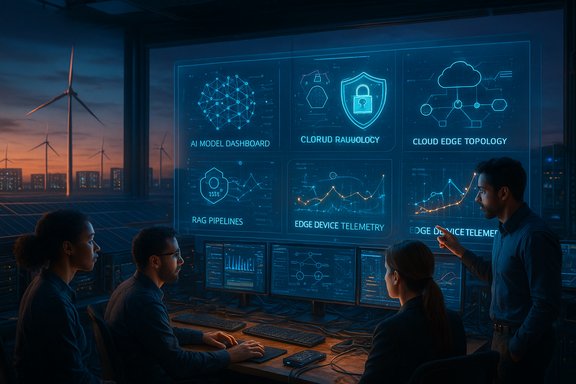 Background / Overview
2025 was the year AI moved from platform story to infrastructure story. Large language and multimodal models matured, hyperscalers and specialist “neocloud” data‑centre builders accelerated capital projects, and regulators and national agencies began to treat compute and power as part of strategic infrastructure planning. Those dynamics intersected directly with energy producers: AI workloads require power and proximity; IoT and edge devices require robust OT–IT integration; and generative AI tools changed how engineers, operators and administrators do everyday work. The pieces that follow summarize the top ten themes, validate the most consequential claims, then assess strengths, risks and practical steps.Quick summary of Yogi Schulz’s Top‑10 themes
- AI dominated conversation and planning across enterprise and operations.
- Generative AI matured into tools for automation, ideation and advanced analytics, with new frontier models released in 2025.
- Historic data‑centre investment surged to support model training and inference at scale.
- Widespread AI experimentation exposed gaps: poor data quality, mediocre ROI for many pilots, and talent shortages.
- IoT proliferation increased telemetry volume and made AI a necessary analytics tool.
- Low‑code/no‑code platforms continued to democratize app delivery, with attendant governance trade‑offs.
- Vendors infused AI into SaaS across domains from subsurface modelling to emissions tracking.
- Cybersecurity transformed, adopting AI defence tooling and beginning migration to post‑quantum cryptography (PQC).
- Blockchain found real enterprise niches (traceability, identity, contracts) even as high‑profile pilots showed mixed commercial outcomes.
- Cloud + edge integration matured as a pragmatic architecture for latency, resilience and cost control.
1) AI dominated every conversation — what that actually meant
Verification and context
By 2025 enterprise procurement, boardroom planning, and national policy treated AI as a core operating layer rather than a set of point products. Independent industry tracking confirms the scale: the IEA and other energy/tech authorities framed data centres and AI compute as infrastructure‑scale challenges requiring decades‑scale planning, not short software projects.Analysis
- Strength: Treating AI as infrastructure forces organizations to plan for power, cooling, site permits and long‑term vendor relationships — all areas where energy producers have domain knowledge and negotiating power.
- Risk: Political and financing cycles can produce headline commitments that are large on paper but conditioned on financing, permits and long procurement chains; CIOs must demand contract‑level clarity on funding and timelines.
2) Generative AI advanced processes and creativity — model landscape check
Verified model releases (key claims)
- OpenAI moved ChatGPT/enterprise users to GPT‑4o as a successor to GPT‑4 during 2025. Release notes and product updates confirm GPT‑4o’s deployment and ongoing refinements.
- Anthropic publicly launched Claude 3.7 (Sonnet) in 2025 with “hybrid reasoning” / extended thinking modes; the rollout was widely covered and made available through major clouds.
- Google expanded the Gemini family, shipping meaningful updates to Gemini 2.5 and later 2.5 Pro / Flash builds that targeted multimodal reasoning and developer workflows.
Analysis
These releases are not merely marketing — they materially change what teams can automate:- Productivity and engineering: Copilot‑style integrations compress time for repeated engineering tasks (code reviews, test scaffolding, document drafting).
- Operational risk: LLM hallucination remains a live problem; organizations require grounding/RAG pipelines and retrieval controls before trusting model outputs for safety‑critical engineering decisions.
- Procurement reality: Model choice is procurement‑grade: latency, cost‑per‑query, tokens, data‑residency, and guardrail behaviours determine ROI more than raw benchmark numbers.
3) Massive data‑centre expansion — scale and numbers
Verified facts
- The IEA reported data‑centre electricity consumption at roughly 415 TWh in 2024 (about 1.5% of global electricity), and highlighted rapid investment growth and local grid impacts.
- Industry trackers and trade reporting documented record investment activity in 2024–2025, with asset transactions, hyperscaler campus plans and neocloud fundraises scaling up. Estimates vary by definition, but public reporting and market commentary put global data‑centre capex and related investment in the tens to hundreds of billions annually, with multi‑trillion long‑range needs projected by some consultancies through 2030.
Analysis
- Strength: Energy firms and utilities can monetize this trend — PPAs, grid upgrades, substation work and permitting become profit centres.
- Risk: Concentration risk — a small set of hyperscalers, chip vendors and data‑centre builders control the buildout. The energy sector must avoid single‑counterparty dependency for long‑term revenue streams.
- Practical note: Treat vendor capex commitments as conditional — require binding milestones and transparency on project financing before making large operational bets.
4) AI experimentation — what pilots reveal in energy contexts
Common pilot findings (verified patterns)
- Poor enterprise data quality causes hallucinations or useless outputs in retrieval‑augmented setups. Real pilots consistently report that cleaning and data engineering are the majority of work.
- Talent shortages persist for model engineering, MLOps and hybrid cloud operations. Public hiring trends and vendor disclosures confirm aggressive compensation and churn.
Practical takeaways
- Treat AI pilots as engineering projects — include data engineering, monitoring, CI/CD and incident playbooks.
- Define measurable KPIs (time saved, error reduction, cost avoidance) and require pilots to meet them before scale.
- Build an internal talent pipeline (skilling, vendor partnerships) rather than relying exclusively on external contractors.
5) IoT and smart devices — data volume and verification
Numbers and verification
- Estimates for connected IoT devices in 2025 vary by methodology; IoT Analytics (widely used for industry forecasting) projects roughly 27.1 billion connected IoT devices by 2025, while other older forecasts (and broader definitions) cite higher figures. Use the more conservative, active‑endpoint estimates for planning.
Analysis
- Strength: Real‑time telemetry enables predictive maintenance, emissions monitoring and distributed asset management at scale.
- Risk: Volume and heterogeneity create data governance debt — sensor firmware, time‑series fidelity, labeling, and provenance must be disciplined, or AI outputs will be untrustworthy.
- Guidance: Instrumentation contracts must include firmware lifecycle, security patching, telemetry SLAs and exportable raw data formats (standardized files or streams).
6) Low‑code / No‑code developer platforms — gains and governance traps
Verification
- Independent research and market reports show continued strong growth for low‑code/no‑code platforms, with enterprise adoption rates and large market forecasts. Analysts have repeatedly argued that a majority of new apps will use LCNC tooling by the mid‑2020s.
Pros and cons
- Pros: Faster delivery, citizen developer enablement, rapid prototype‑to‑production for internal workflows.
- Cons: Vendor lock‑in risk, fragility for high‑throughput workloads, and governance challenges (who owns the code, who patches it, how are credentials managed?.
- Recommendation: Establish a low‑code Center of Excellence (CoE) with architecture guardrails, security signoffs, and lifecycle ownership before broad roll‑out.
7) AI‑infused vendor solutions — signal vs noise
Observations
- Every major SaaS vendor added “AI” features in 2025; some are genuinely useful (contextualized retrieval, RAG for domain documents), others are marketing‑heavy. Independent practitioner reviews find variable outcomes by domain and data maturity.
Assessment
- Strength: Domain‑specific copilots (e.g., process supervision, emissions management) can cut specialist review time substantially if grounded in trustworthy data.
- Risk: Over‑reliance on vendor agents without dataset provenance, versioning and explainability will create audit failures and safety incidents. Demand vendor model cards, dataset provenance statements and SLAs tied to measurable business KPIs.
8) Cybersecurity reinvented with AI and quantum‑safe tools
Verifications
- NIST published PQC standards (CRYSTALS‑Kyber, CRYSTALS‑Dilithium, SPHINCS+) and urged organizations to prepare migration plans; CISA and NSA issued guidance recommending active preparation for the PQC transition. Vendor offerings added support for hybrid PQC / classical schemes as implementations matured in 2024–2025.
- AI‑driven defensive tooling (anomaly detection, automated incident responses, adaptive IAM) became standard in modern security stacks and is recommended in industry practice.
Analysis
- Strength: AI can dramatically improve detection latency and reduce manual triage burden.
- Risk: Attackers also use AI; automated adversarial tactics scale attacks and personalize lures. The combination of AI‑enabled attacks and the lag in PQC migration means organizations must prioritize crypto inventories and quantum‑readiness now.
- Immediate actions: inventory cryptographic assets, segment high‑value long‑lived data for PQC migration priority, insist on crypto‑agility in vendor contracts, and adopt zero‑trust identity and device posture controls.
9) Blockchain beyond cryptocurrency — enterprise reality check
Verifications
- Blockchain projects produced meaningful, operational results in some sectors (e.g., food traceability via permissioned networks like IBM Food Trust), but other headline pilots failed or were discontinued (TradeLens was wound down after commercial challenges). This mixed record underlines the technology’s niche fit rather than universal applicability.
Analysis
- Strength: Permissioned DLTs with strong governance can materially shorten traceability and recall time in supply chains where many independent parties must share verifiable events.
- Weakness: Network governance, economics and integration costs explain why not every pilot succeeds; interoperability and standards remain critical.
- Guidance: Treat blockchain as a tool for specific problems (multi‑party provenance, notarized events, verifiable identity) rather than a universal replacement for transactional systems.
10) Explosion of cloud and edge computing integration — verified direction
Numbers and sources
- Edge computing spending and market forecasts show strong growth; IDC and other analysts estimate hundreds of billions in edge spending in the mid‑to‑late 20200s as AI and IoT workloads push compute to the data source. Gartner/IDC forecasts confirm rapid adoption of hybrid and multi‑cloud topologies and significant edge investment.
Analysis
- Strength: Edge reduces latency and egress costs for industrial telemetry and local inference. It also improves resilience for intermittently connected sites common in energy production.
- Risk: Edge architectures create operational overhead — distributed patching, remote monitoring, and security at scale are nontrivial. Standardize on orchestration, image signing and remote remediation frameworks before large edge rollouts.
Strengths, systemic risks and the verification checklist
Notable strengths from 2025
- Rapid improvements in model capability and multimodal reasoning that unlock new workflows.
- A growing industrial supply chain for AI – specialized colo operators, chipmakers and hyperscalers expanding options for capacity.
- Clear progress on PQC standards and industry guidance for transition planning.
Systemic risks that demand attention
- Concentration risk: a few cloud and hardware providers control frontier compute — diversify procurement and insist on portability.
- Energy / permitting bottlenecks: data‑centre power needs can conflict with local grid capacity and permitting timelines — build contingency plans.
- Governance shortfalls: rushed AI features in vendor SaaS without explainability or audit trails; insist on model‑level governance.
- Blockchain realism: enterprise results are mixed — vet governance and economic viability carefully.
Practical checklist for Windows IT leaders in the energy industry
- Data inventory and readiness
- Catalog time‑series sources, document schemas, and retention policies. Require vendors to export raw telemetry on standard formats.
- Model governance & procurement guards
- Require model cards, dataset provenance, deterministic SLAs (latency/cost), egress pricing detail and incident handling contracts from AI vendors.
- Power & site contingency planning
- For any colocated or on‑prem inference capacity, confirm firm power arrangements, backup generators and demand‑response clauses.
- Crypto and quantum roadmap
- Complete a cryptographic asset inventory, prioritize long‑lived data for PQC migration, and require crypto‑agility from suppliers.
- Edge security baseline
- Enforce secure boot, signed images, certificate lifecycle automation and remote remediation for all edge nodes.
- Low‑code governance
- Establish a CoE, CI/CD gates, security signoff and portability standards for low‑code applications.
- Pilot design discipline
- Define measurable KPIs, cost models and an exit criterion before scaling pilots.
Where the claims are robust — and where to be cautious
- Robust (well‑verified): Data‑centre energy impact (IEA and Gartner projections), major model releases (OpenAI GPT‑4o, Anthropic Claude 3.7, Google Gemini 2.5), and NIST PQC standardization are verifiable facts.
- Caution warranted: headline dollar figures for multi‑year buildouts and some vendor‑reported ROI numbers — many are aspirational, depend on staged funding, or are vendor‑sourced without independent audits. Treat these as claims to be validated in contract negotiations.
Final assessment — how to convert 2025’s turbulence into advantage
2025 crystallized a simple strategic reality: AI, data centres, and distributed computing are now central to enterprise architecture and energy planning. For energy firms and Windows‑centric IT teams, the path forward is pragmatic: invest in data quality and governance, build explicit model governance and procurement disciplines, treat power and permitting as first‑order infrastructure problems, and prioritize security and crypto‑agility.Concrete short‑term moves will deliver outsized returns:
- Tighten telemetry provenance and schema governance to reduce hallucination risk in AI pilots.
- Negotiate vendor contracts with port‑out/export clauses for data and portable model formats.
- Create a cross‑functional AI steering group (IT, OT, legal, security, operations) to approve pilots against measurable KPIs.
- Start post‑quantum readiness work now: inventory keys, identify long‑lived secrets, and engage vendors on PQC roadmaps.
AI reshaped the technology landscape in 2025 — not as an incremental productivity tool, but as an infrastructure layer that touches power, regulation, procurement, and risk. Yogi Schulz’s Top‑10 reflections captured the year’s texture and urgency; the independent facts we can verify show a mixture of real, operational advances and persistent governance gaps. The practical winners in 2026 will be organizations that combine domain discipline (energy, grid, operations) with rigorous data engineering, vendor governance and crypto‑aware security planning.
Source: EnergyNow TOP 10 RELECTIONS on Information Technology Developments in 2025 - Yogi Schulz - Canadian Energy News, Top Headlines, Commentaries, Features & Events - EnergyNow
