

This week’s short, sharp take from First Ring Daily — amplified in a Petri roundup — crystallizes a simple truth the developer world has been living for months: the industry’s most influential engineers are already using AI as part of their coding toolchain, but they’re doing it cautiously and pragmatically. Petri’s coverage of Brad Sams and Paul Thurrott’s episode notes how comments from Mark Russinovich and Linus Torvalds prompted a wide conversation about how elite engineers integrate large language models (LLMs), code assistants, and “vibe coding” into real work. (petri.com)
Major outlets and tech outlets picked up the README and framed it the same way: this was not Torvalds outsourcing kernel work, it was a seasoned engineer using a productivity tool for an ancillary task. Coverage emphasized context — hobby project, peripheral component, Torvalds’ continued insistence that kernel and infrastructure code demand rigor.
The Petri post that kicked this conversation off simply flagged the podcast moment — Brad Sams and Paul Thurrott used it as a lens to discuss how the elite programmers are approaching AI — but the underlying evidentiary trail (Linus’ GitHub README admitting a vibe-coded visualizer; Russinovich’s interviews describing daily LLM usage and Copilot) is what actually teaches teams how to proceed: selectively, pragmatically, and with strong human checks. If your organization is building an AI-for-coding policy, model the pattern you see here: use AI to accelerate, but keep human expertise and governance firmly in the loop. (petri.com)
Source: Petri IT Knowledgebase First Ring Daily: The Top Programmers - Petri IT Knowledgebase
 Background
Where this conversation came from
First Ring Daily’s hosts flagged two high-profile examples that crystallize a broader shift: Mark Russinovich, Azure CTO and longtime Microsoft engineer, has described day-to-day use of LLMs and Copilot-style assistants for coding tasks; and Linus Torvalds, the creator of Linux, updated a personal GitHub project and explicitly admitted that an ancillary Python visualizer in that project was produced via an AI tool he calls “Google Antigravity,” calling the process vibe coding. Those two anecdotes — one from an enterprise cloud leader, one from an open-source icon — became shorthand for two complementary use-cases: disciplined, review-driven AI assistance for professional work, and pragmatic, low-risk AI-assisted scripting for hobby/auxiliary tasks. (github.com)Key terms explained
- AI-assisted development — Using LLMs, Copilot-style code completions, or code-specific models to speed up coding tasks, produce boilerplate, suggest fixes, or draft tests.
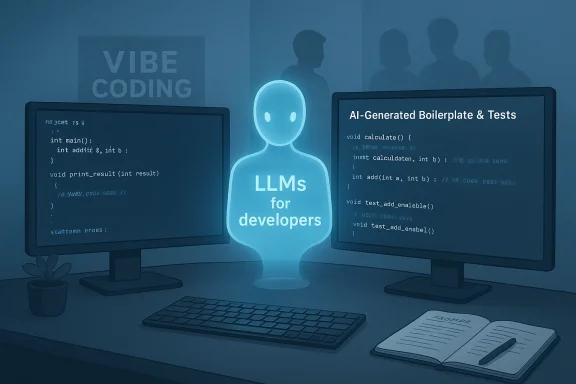
- LLMs for developers — Large language models that have been adapted (or fine-tuned) to reason about code, documentation, and developer workflows.
- Vibe coding — A colloquial phrase (popularized in recent months) describing an approach where a developer expresses the desired outcome at a high level and lets an AI produce the implementation; works well for prototyping, glue code, and UI/UX scripting, but is risky for critical systems.
- Copilot / Antigravity / coding agents — Product names and shorthand for the many forms these assistants take, including GitHub Copilot, Google-branded agents, and in-house models.
What Linus Torvalds actually did — and why it matters
The facts
Linus Torvalds published an experimental repository (AudioNoise) that contains two notable points of evidence. First, the project keeps its core audio-processing logic in C — the code Torvalds owns and understands. Second, the repository’s README plainly states that the Python visualizer used to show audio samples was “basically written by vibe-coding” using a tool Torvalds references as Google Antigravity; he frames the choice as pragmatic because Python and GUI work are outside his primary focus. The GitHub repo is the primary source for that admission. (github.com)Major outlets and tech outlets picked up the README and framed it the same way: this was not Torvalds outsourcing kernel work, it was a seasoned engineer using a productivity tool for an ancillary task. Coverage emphasized context — hobby project, peripheral component, Torvalds’ continued insistence that kernel and infrastructure code demand rigor.
Why it matters beyond the headline
- It undercuts a binary narrative that “AI = replacement” and replaces it with a pragmatic one: AI as selective augmentation. Torvalds used AI where it reduced friction (Python visualizer) while preserving manual control where correctness, performance, and maintainability matter (the C audio filters).
- The admission came from someone famous for strict standards. That lends credibility to the idea that responsible AI usage is about choosing where to apply the tool, not whether to use it at all.
- It normalizes a pattern many teams already apply: keep core domain logic tightly controlled; outsource peripheral or repetitive tasks to helpers (whether libraries, code generators, or LLMs).
What Mark Russinovich said — and how big-company engineering treats AI
The facts
Mark Russinovich has repeatedly discussed AI’s role in Microsoft’s engineering culture. In interviews and technical presentations he explains that he uses LLMs for coding and experimentation — both cloud-hosted models and Copilot-style assistants — and that he uses them for practical, day-to-day tasks such as quick searches, drafting code snippets, and exploring ideas. In a podcast/transcript, he said plainly: “I use LLMs for coding … that’s my, by far, the way that I use it the most,” and he also noted using Microsoft Copilot and ChatGPT as part of his daily toolkit.Corporate engineering implications
- At scale, Microsoft is treating LLMs as both tooling and platform: they power productivity features in IDEs, integrate with CI/CD for automated code suggestions, and are incorporated into security/analysis workflows (e.g., automated triage and red-team tests).
- Russinovich’s stance reflects enterprise risk management: use LLMs for speed and information retrieval, but pair their outputs with human review, guardrails, and safety testing — especially where security and correctness are non-negotiable.
Patterns emerging from these examples
From Torvalds’ hobby repo and Russinovich’s daily use, we can extract practical patterns that translate to any engineering organization:- Separation of concern — Use AI for peripheral, well-bounded tasks (UI glue, data transformation, tests), reserve human expertise for core systems and architecture.
- Human-in-the-loop — Treat AI output as a draft: validate with tests, formal review, and static analysis.
- Selective automation — Apply AI to repetitive and error-prone chores (linting fixes, formatting, spec-to-boilerplate generation).
- Experimentation and learning — Senior engineers often use AI to prototype quickly; the prototype either becomes production code after rigorous hardening, or it’s replaced by hand-written, high-quality code once the shape is nailed down.
Benefits: Why top programmers choose AI assistants
- Speed and focus — AI can remove low-value friction (boilerplate, bindings, small glue code), letting experts focus on design and correctness.
- Onboarding and cross-language work — Senior devs can work in unfamiliar stacks faster by having AI generate working scaffolding that can be audited and hardened.
- Large-scale maintenance — AI can help refactor or update many files quickly (e.g., API migrations), reducing time spent on monotonous upgrades.
- Idea iteration — Use LLMs to sketch alternatives, suggest test cases, or translate pseudocode into executable prototypes.
- Democratization — When used responsibly, AI lowers the barrier for non-specialists to produce useful tools and automations, accelerating teams.
Risks and hard limits: Where caution is mandatory
The hype cycle has obscured important practical limitations; the Torvalds/Russinovich examples remind us of the non-negotiables:- Hallucinations and silent errors — LLMs will sometimes generate plausible-but-wrong code. Undetected, those errors create fragile artifacts and security holes.
- Maintainability — AI-generated code can be syntactically correct but poorly structured for long-term maintenance; if the team can’t read or trust it, technical debt rises.
- Licensing and provenance — Generated code may unintentionally mirror copyrighted sources; provenance policies and scanning are essential.
- Over-reliance and skill erosion — Junior engineers who accept AI output without deep verification risk losing foundational knowledge; this was a core concern in community reactions to "vibe coding."
- Security context — For safety-critical or security-sensitive systems, AI suggestions must be second-guessed; attackers can also exploit model outputs (prompt injection, poisoned RAG documents).
How engineering teams should adopt AI — a practical, audited approach
If your team is deciding how to use AI for coding, follow a disciplined rollout that mirrors the safe, pragmatic examples above.- Start small and bounded.
- Pilot AI for well-contained tasks (script generation, test scaffolding, refactor helpers).
- Require unit tests and code review for all AI-produced code.
- Define a human-in-the-loop policy.
- Mandate reviewer sign-off for any code that touches production or critical systems.
- Create templates for what reviewers must check (security, perf, licensing).
- Enforce provenance, licensing, and scanning.
- Use tools to scan generated code for potential license conflicts and source similarity.
- Maintain an artifact log with prompts and model metadata for traceability.
- Integrate with CI/CD.
- Treat AI outputs as inputs to your normal CI: run static analysis, fuzz tests, and security scans automatically.
- Block merges that fail baseline checks.
- Train and upskill developers.
- Invest in prompt engineering, model-appropriate workflows, and AI-aware code review practices.
- Protect apprenticeship: require junior devs to explain and modify AI suggestions to prove understanding.
- Review model governance and privacy.
- Decide whether to use cloud-hosted LLMs, on-premise models, or a hybrid depending on sensitive data considerations.
- Lock down RAG (retrieval-augmented generation) sources and vet the knowledge base for bias or stale data.
- Monitor and iterate.
- Collect metrics on time saved, defects introduced, and review time spent.
- Iterate policies based on empirical results.
Practical examples: Where AI actually shines (and where to avoid it)
- Good use cases
- Generating boilerplate code (API clients, serialization helpers).
- Writing unit-test scaffolding and property tests.
- Converting data formats or producing small transformation scripts.
- Rapid prototyping of UIs or visualizers (exactly Torvalds’ Python visualizer scenario).
- Automated migration tasks (e.g., upgrading library calls across a codebase).
- Use with caution
- Core algorithm implementations for performance-critical code.
- Security-sensitive code paths (authentication, authorization).
- Low-level systems work (kernel modules, firmware).
- Anything without robust testing or domain expert review.
Cultural and talent effects: What managers should watch for
- Redefinition of seniority — Senior engineers will spend less time typing trivial code and more time on architecture, review, and orchestration. That’s a shift in deliverables and performance metrics.
- Interview and hiring signals — Expect screening to emphasize problem framing, code review ability, and security awareness over line-by-line coding speed.
- Training debt — If junior devs rely heavily on AI for answers without internalizing fundamentals, teams will accumulate cognitive debt — a softer but real risk to long-term capability.
- Process transformation — Code review workflows, QA cycles, and documentation practices must adapt to include prompts, model outputs, and provenance artifacts.
A realistic view of the near-term future
The takeaway from the Petri recap of First Ring Daily, plus the underlying primary sources, is a straightforward one: AI is a tool that top programmers are using selectively. Torvalds’ “vibe coding” admission and Russinovich’s day-to-day LLM usage show how that looks in practice: selective, bounded, and always paired with human judgment. Coverage by mainstream tech outlets amplified both the novelty (Torvalds using an AI tool for a personal project) and the normalization (Russinovich and enterprise engineers using LLMs in daily workflows). For teams wondering whether to adopt AI for coding, the evidence suggests a measured, policy-driven integration is the safest, most productive path. (petri.com)Final analysis: strength, risk, and recommended posture
Strengths
- Productivity wins are real — For many routine tasks the time-to-first-draft is dramatically lower.
- Better prototypes, faster — Teams can iterate quickly, validating design before investing in hardening.
- Accessibility — More people can build useful automations and tools, improving cross-functional productivity.
Risks (brief recap)
- Silent defects, licensing exposure, and maintainability issues remain the central hazards.
- Skill erosion if training and review practices are not enforced.
Recommended posture (one-liner)
Adopt AI for coding by default for low-risk, high-friction tasks; require human expertise, testing, and provenance controls for anything that becomes part of critical infrastructure.The Petri post that kicked this conversation off simply flagged the podcast moment — Brad Sams and Paul Thurrott used it as a lens to discuss how the elite programmers are approaching AI — but the underlying evidentiary trail (Linus’ GitHub README admitting a vibe-coded visualizer; Russinovich’s interviews describing daily LLM usage and Copilot) is what actually teaches teams how to proceed: selectively, pragmatically, and with strong human checks. If your organization is building an AI-for-coding policy, model the pattern you see here: use AI to accelerate, but keep human expertise and governance firmly in the loop. (petri.com)
Source: Petri IT Knowledgebase First Ring Daily: The Top Programmers - Petri IT Knowledgebase
