

The Cheating Panic Is Really an Assessment Panic
The easiest version of this story is moral decline: students are lazy, ChatGPT arrived, cheating exploded. That version is emotionally satisfying and analytically thin. Students have always used whatever tools were available to reduce friction, from calculators and spellcheckers to essay mills and group chats; the difference is that generative AI collapses the distance between “help me understand” and “do it for me.”
That collapse matters because education has long treated the written assignment as a proxy for thought. A polished essay, a tidy lab report, or a properly formatted literature review was assumed to represent a student’s effort, comprehension, and judgment. AI breaks that chain of inference. A student can now produce plausible academic prose without having wrestled with the material in any serious way.
But the reverse is also true, and it is where many institutions are getting tangled. A student may use AI to clarify a reading, organize notes, translate difficult phrasing, or test an argument without outsourcing the intellectual work. The same tool can be a tutor, a thesaurus, a ghostwriter, or a laundering machine for copied ideas. The misconduct problem is not located in the software alone; it sits in the intent, the assignment design, and the rules students are given.
That is why the numbers feel alarming but not always self-explanatory. Surveys showing high rates of AI use do not automatically prove high rates of cheating. They prove that AI has become part of the ordinary study environment faster than universities could define what ordinary should mean.
Students Did Not Wait for Permission
The striking pattern across recent reports is how little institutional hesitation mattered. Students adopted AI because it was cheap, available, and useful. They did not need a university procurement cycle, a staff training day, or a policy committee to tell them that a chatbot could summarize a dense reading or generate a first draft at midnight.
The Digital Education Council’s global student survey put AI use at 86 percent among respondents in 2024, and later regional surveys suggested adoption had only widened. In the UK, the Higher Education Policy Institute and Kortext found student AI use rising from 66 percent in 2024 to 92 percent in 2025, with later 2026 reporting pushing the figure still higher. Those numbers are not a marginal behavior. They describe a new default.
Australia shows the same shift in a more enforcement-heavy light. A large survey across four universities found that more than eight in ten students had used AI tools in relation to their studies, with frequent use becoming normal rather than exceptional. Significant shares of students also believed AI made cheating easier, which is both obvious and important: the technology did not merely create new misconduct opportunities, it changed students’ perception of how enforceable the old rules were.
Canada’s campus picture is similar, with surveys indicating that many students have used AI in assignments. South Africa’s University of Cape Town moved in another direction, deciding to discontinue Turnitin’s AI Score after concerns that the detector was not sufficiently reliable or valid for measuring student learning. The geography changes; the institutional dilemma does not.
The Detector Era Is Already Losing Credibility
For a brief moment, AI detection looked like the neat administrative answer. If software could generate the suspicious text, perhaps other software could detect it. That promise was seductive because it preserved the old assessment model: keep assigning the same essays, keep collecting the same files, and let a score flag the questionable ones.
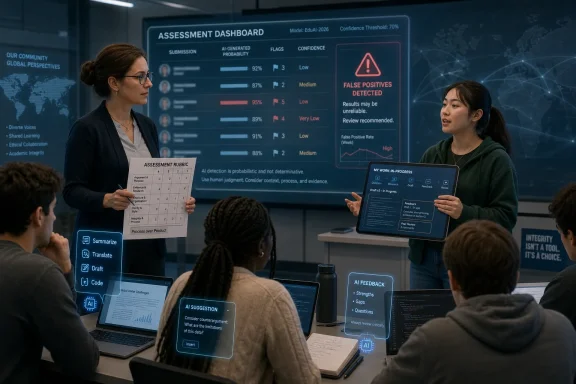
The problem is that detection is a probabilistic guess dressed in disciplinary clothing. AI detectors do not read intention. They estimate patterns. They may identify text that looks statistically machine-generated, but they can also misfire on formulaic human writing, non-native English, heavily edited prose, or text that has passed through ordinary writing tools.
That is not a minor technical defect when the output can trigger an academic misconduct investigation. A false positive is not just an inconvenience; it can mark a student as dishonest, consume staff time, and corrode trust in the institution. Reports from Australia, where large numbers of AI-related cases were later dismissed, show why universities are growing more cautious about treating detector scores as evidence rather than signals.
Turnitin itself has framed its AI writing indicator as something to be interpreted, not a standalone verdict. Yet the institutional temptation is obvious. When thousands of assignments arrive and staff are under pressure, a percentage score can become a shortcut for suspicion. The machine does not need to be formally decisive to become practically decisive.
The Global Numbers Hide Local Cultures
The rise in AI-assisted academic work is global, but it is not uniform. Exam cultures, grading systems, language environments, and labor markets shape how students use these tools and how institutions respond. A country where high-stakes testing dominates will experience AI differently from one built around continuous coursework and take-home essays.
The UK’s debate has centered heavily on assessed work, policy clarity, and whether universities are giving students mixed messages. Students are being told that AI is both a workplace skill and a misconduct risk, sometimes in the same semester and sometimes by different instructors in the same course. That ambiguity does not excuse cheating, but it does create a fog in which students make their own rules.
Australia’s story has been more visibly tied to enforcement scale. Reported misconduct cases at some universities rose sharply after 2023, and institutions faced the awkward problem of processing large volumes of suspected AI misuse while also confronting doubts about the tools used to identify it. The Australian Catholic University episode, in which thousands of alleged AI-related cases were recorded and a substantial portion were reportedly dismissed, became a warning about overconfidence.
South Korea’s challenge sits closer to the culture of competitive exams and mass online courses. When AI use affects large cohorts, the institution’s response can become drastic: investigate, nullify results, redesign the exam, or accept that the assessment format has become brittle. The stakes are not merely academic honesty; they are social trust in credentialing.
AI Is Both the Shortcut and the Skill
It would be a mistake to treat AI only as a cheating engine. The same tools that can fabricate an essay can also explain a proof, generate practice questions, translate a technical passage, compare arguments, or help a dyslexic student structure a draft. For many learners, AI is not a replacement for education but a new interface to it.
This is why blanket bans often fail in practice. They push use underground, reward students who are better at hiding it, and leave honest students unsure whether normal study support is forbidden. Worse, bans can widen inequity. Students with private tutors, stronger networks, or better digital literacy may still get help, while others are denied access to tools that could make learning more accessible.
The more serious question is whether students are building durable skills while using AI. If a chatbot summarizes every reading, the student may become efficient but shallow. If it challenges a thesis, explains a difficult concept, or helps compare sources, it may deepen understanding. The educational outcome depends less on whether AI touched the work than on what the student had to do before, during, and after using it.
That distinction demands more sophisticated rules than “AI allowed” or “AI banned.” Institutions need to specify permitted uses by task, course, and learning objective. A programming class may allow AI debugging but require students to explain every line. A writing course may allow brainstorming but not generated prose. A history seminar may permit translation support but require annotated source analysis.
The Old Essay Is Not Dead, but It Has Lost Its Monopoly
The traditional take-home essay is not obsolete, but it can no longer carry the burden it once did. If an assignment can be completed well by a general-purpose chatbot with minimal student input, the assignment is measuring access and prompting skill as much as subject knowledge. That does not mean writing no longer matters. It means writing must be embedded in processes that reveal thinking.
Universities are already moving toward oral defenses, in-class writing, staged drafts, reflective commentaries, live problem-solving, and project-based assessment. These are not foolproof either. Students can use AI to prepare for oral exams or generate draft reflections. But process-based assessment makes outsourcing harder because the student must show a trail of judgment over time.
This shift will be uncomfortable for staff. Authentic assessment is labor-intensive. Oral discussions require scheduling. Iterative drafts require feedback. Project work can be harder to grade consistently than a conventional essay. Institutions that tell faculty to “redesign assessment” without giving them time, training, or workload relief are outsourcing the AI crisis to already stretched instructors.
There is also a scalability problem. Elite seminars can adapt more easily than large first-year survey courses with hundreds or thousands of students. The future may therefore be uneven: richer institutions and smaller programs will redesign assessment more quickly, while mass education leans on automated proctoring, detector scores, or standardized in-person exams.
Microsoft, Google, and OpenAI Are Already in the Classroom
For WindowsForum readers, the education story is not separate from the wider platform story. AI is no longer just a website students visit; it is being woven into operating systems, browsers, office suites, search engines, and learning platforms. Microsoft Copilot, Google Gemini, OpenAI’s ChatGPT, and a growing field of specialized tools are turning the student desktop into an AI-assisted workspace.
That matters because institutional policy often assumes AI is a discrete tool that can be permitted or prohibited. In reality, AI is becoming a feature layer. It appears in document editors, email clients, PDF tools, coding environments, note-taking apps, and search experiences. The line between “I used AI” and “I used normal software” will keep getting blurrier.
Sysadmins and IT leaders will be pulled into this whether they want to be or not. Schools will need tenant-level controls, audit policies, data protection rules, approved tool lists, and guidance on whether student work can be processed by third-party AI systems. Privacy and compliance questions will sit alongside academic integrity questions. A university cannot responsibly tell students to use AI without asking where prompts go, how long data is retained, and whether sensitive material is being fed into commercial models.
There is also a device-management angle. If exams move back into controlled environments, institutions will lean harder on lockdown browsers, managed devices, network restrictions, and identity verification. But that approach has limits. Students have phones, secondary devices, remote desktops, browser extensions, and offline model access. The arms race model of AI enforcement will get expensive quickly.
Academic Integrity Needs a New Vocabulary
One reason the debate feels stuck is that the word cheating is doing too much work. It covers blatant substitution, minor editing, unauthorized collaboration, poor citation practice, accidental rule-breaking, and legitimate support that an instructor failed to define. When one word spans everything from grammar correction to submitting an AI-written dissertation, policy becomes both too broad and too vague.
A better vocabulary would distinguish between assistance, augmentation, substitution, and deception. Assistance might include summarizing a reading or explaining a concept. Augmentation might include using AI to critique a draft or generate alternative structures. Substitution occurs when the tool performs the core learning task. Deception occurs when a student hides prohibited use or represents machine output as personal work.
That framework will not solve every case, but it gives instructors a more useful way to write rules. It also helps students understand why the same tool may be acceptable in one context and prohibited in another. AI can be allowed in a course without being allowed for every task in that course.
The citation question is similarly underdeveloped. Some institutions require students to disclose AI use, but disclosures vary wildly. “I used ChatGPT” is not enough if the tool shaped the argument, generated language, or suggested sources. Students need practical models for documenting AI assistance, and faculty need to decide when disclosure is meaningful versus performative.
The Skills Gap Will Not Look Like Laziness
The long-term risk is not simply that students cheat their way through college. It is that they graduate with credentials that overstate their independent ability. A student who repeatedly delegates reading, synthesis, drafting, debugging, and revision may pass courses while failing to develop the mental muscles those courses were designed to build.
That skills gap may be hard to detect at first. AI-polished work can look competent, and students may perform well on tasks that allow tool use. The weakness appears when they must reason under uncertainty, defend a position, diagnose an unfamiliar problem, or produce work without scaffolding. Employers may then discover that the graduate can operate an AI tool but cannot judge its output.
This is not an argument for nostalgia. The workplace will use AI, and education that pretends otherwise will become less relevant. Students should learn how to prompt, verify, critique, and integrate AI output. But those are higher-order skills built on foundations, not replacements for them.
The danger is a generation of students who become fluent in AI-mediated productivity without becoming fluent in the underlying disciplines. In software, that means code that runs until it fails in a way the author cannot explain. In law, it means plausible argument without doctrinal understanding. In medicine, it means summarized information without clinical judgment. In journalism, it means confident prose without reporting.
The Detector Will Not Save the Degree
The concrete lesson from the past two years is that universities cannot buy their way out of the AI problem with a dashboard. Detection tools may have a limited role as one signal among many, especially when paired with human review and clear procedural safeguards. But they cannot restore the old world in which submitted text could be assumed to be a transparent window into student cognition.
Institutions that understand this will redesign courses around evidence of learning. They will ask students to show drafts, explain choices, respond to feedback, solve variants, present orally, and connect work to local or personal contexts that generic AI cannot easily fabricate. They will teach AI literacy as part of academic literacy, not as a separate compliance module tacked onto orientation week.
The harder part is cultural. Universities must stop sending contradictory messages: AI is essential for your future career, but shameful if it appears in your coursework; AI is banned, except when staff quietly use it; AI is detectable, except when detectors are unreliable. Students are very good at spotting institutional incoherence.
Near the close, the practical shape of the issue is becoming clearer:
- AI use in education is now mainstream, not a fringe misconduct behavior.
- High student adoption does not automatically equal cheating, but it does make old assessment assumptions less reliable.
- AI-detection scores are too fragile to serve as standalone proof of academic dishonesty.
- Assessment design will matter more than surveillance in preserving meaningful credentials.
- Institutions need clear, task-specific AI rules that distinguish support from substitution.
- The most important graduate skill may be knowing when AI output is useful, wrong, incomplete, or intellectually hollow.
The universities that adapt well will not be the ones that pretend AI is harmless, nor the ones that treat every chatbot prompt as a disciplinary offense. They will be the ones that rebuild academic integrity around demonstrable learning rather than document purity, accepting that the future classroom will include AI while insisting that the student’s judgment remains the thing being educated.