

Law firm Littler Mendelson’s 2026 Annual Employer Survey, published Wednesday, found that artificial intelligence has become U.S. employers’ top workplace policy and regulatory concern, with 54% of respondents using AI in HR and 68% reporting formal workplace AI governance policies. That sounds like progress until you notice what is missing behind the headline number. Employers have learned to write AI policies faster than they have learned to operate AI governance. The result is a workplace technology boom in which the paperwork is finally arriving, but the controls, audits, training, and accountability structures are still chasing the tools down the hallway.
The Littler findings capture a familiar corporate rhythm: first comes adoption, then anxiety, then policy. What makes AI different is that the adoption phase has moved with unusual speed, especially inside HR departments that handle sensitive decisions about hiring, promotion, discipline, scheduling, productivity, and termination.
A formal AI policy is no longer exotic. Two years ago, many organizations were still deciding whether generative AI belonged in the workplace at all. Now, according to Littler, only 6% of surveyed employers said they were not using AI for any function. That is less a technology trend than an operational fact of life.
But policy is the easy part of governance. A written rule can tell employees not to paste confidential data into an AI chatbot, but it cannot determine whether a recruiting vendor’s screening model has a disparate impact. It can warn managers not to rely blindly on automated recommendations, but it cannot create the logs, review rights, training materials, and escalation paths that make oversight real.
That gap is the report’s most important finding. Employers are not ignoring AI risk anymore. They are recognizing it, documenting it, and still failing to build enough machinery around it.
That is why Littler’s 54% figure for employers using AI in HR functions matters. The technology is no longer sitting at the edge of the enterprise as a clever assistant for office workers. It is entering the institutional systems that mediate power between employer and employee.
Candidate screening, interview analysis, workforce analytics, employee sentiment monitoring, scheduling tools, productivity scoring, compensation benchmarking, and internal mobility platforms all sit inside the danger zone. These systems can produce efficiencies, but they can also launder old biases through new interfaces. A manager might know not to ask an unlawful interview question; an algorithm trained on historical hiring data may still reproduce the preference embedded in decades of past decisions.
The legal risk follows the human consequence. If an AI tool screens out older applicants, penalizes candidates with disabilities, misreads speech patterns, or flags workers for opaque productivity reasons, the employer will not get far by blaming the vendor. In employment law, delegation rarely means disappearance of responsibility.
Littler’s report suggests that fewer than half of surveyed organizations had adopted some deeper governance measures, including procedures for vetting third-party AI vendors, tool-specific AI training, or an internal AI oversight committee. That is the real catch-up problem. Many companies have moved from “we need an AI policy” to “we have an AI policy,” but not yet to “we can prove this AI system is appropriate for this employment use.”
Vendor vetting cannot be reduced to a procurement checkbox. Employers need to know what data the system uses, what decisions it supports, whether humans can override outputs, how the tool is tested, what documentation exists, and how the vendor handles updates. A model that changes quietly in the background can turn yesterday’s reviewed process into tomorrow’s unmanaged risk.
The harder question is institutional ownership. HR may buy the product, legal may review the contract, IT may approve the integration, procurement may handle the vendor, and business managers may use the outputs. If nobody owns the full risk lifecycle, everybody owns a fragment and nobody owns the system.
AI systems are hungry for context. HR systems are full of context. The collision is obvious.
A chatbot that helps draft job descriptions may present relatively limited risk if it is used carefully. A tool that evaluates video interviews, analyzes employee communications, or predicts attrition from personnel data is operating in a different universe. The more intimate the data, the more employers need to ask not only whether the tool works, but whether the organization should be using it at all.
Privacy also exposes the weakness of generic governance. A single “AI acceptable use” policy cannot adequately cover all AI tools because the risk turns on use case, data type, jurisdiction, vendor design, retention practices, and human reliance. The same underlying technology can be low-risk in one context and legally combustible in another.
That creates a familiar American compliance problem with an AI twist. Multi-state employers may face different notice, audit, documentation, anti-discrimination, and transparency obligations depending on where applicants or employees are located. The compliance map is not static, either. It changes as states pass laws, agencies issue guidance, courts interpret statutes, and administrations shift enforcement priorities.
The Trump administration has pushed for a more centralized, industry-friendly federal AI approach and has sought to limit the ability of states to regulate the technology. But even if Washington succeeds in narrowing some state authority, employers cannot responsibly treat that as a substitute for governance. Political preemption may reduce certain compliance burdens; it will not eliminate discrimination claims, privacy expectations, contract duties, employee relations fallout, or reputational risk.
This is the trap in waiting for regulatory certainty. AI adoption is happening now. Litigation risk is forming now. Employees are being evaluated now. Candidates are being screened now. A company that delays governance until lawmakers finish arguing over jurisdiction is not avoiding uncertainty; it is accumulating unmanaged exposure inside uncertainty.
The more interesting changes are quieter: reduced hiring, reassessed job responsibilities, redesigned workflows, and shifting expectations for what employees must be able to do. AI may eliminate some jobs outright, but for many organizations its first large effect will be to blur jobs, compress tasks, and alter performance baselines.
That creates a second-order HR problem. If AI changes what a role requires, employers must decide whether to retrain workers, rewrite job descriptions, change evaluation criteria, adjust compensation, or restructure teams. Those are not merely operational choices. They are employment decisions with fairness, morale, and legal consequences.
There is also a hidden management risk. If AI allows one employee to produce more output, employers may be tempted to redefine “normal” productivity without understanding how much of that output depends on tool access, training, data quality, or the employee’s ability to supervise automated work. The productivity dividend can quickly become a workplace pressure system.
This does not mean governance is impossible. It means governance has to become more operational and less ceremonial. Employers need inventories of AI tools, classifications by risk, approval processes for new deployments, monitoring of vendor changes, documented human review, and practical training tied to the actual systems workers use.
The difference between policy and governance is evidence. If regulators, plaintiffs, employees, or executives ask how an AI tool was approved, who reviewed it, what risks were identified, what data it processes, and how humans oversee it, a mature organization can answer. An immature one can point to a policy PDF.
That distinction will matter more as AI moves from optional assistant to embedded infrastructure. Once AI is built into common workplace software, employers may not even experience adoption as a discrete decision. Features arrive through upgrades, dashboards, copilots, analytics modules, and vendor bundles. Governance must catch the feature before the feature becomes habit.
Scale multiplies both capability and exposure. A flawed hiring tool at a small employer may affect dozens of candidates. The same flaw at a national employer can affect thousands and produce the kind of pattern that turns a complaint into a systemic investigation.
Large employers also face internal coordination problems that smaller organizations may avoid. AI governance cannot live only in legal, only in HR, or only in IT. It has to connect all three, plus procurement, compliance, security, finance, and business leadership. The larger the company, the easier it is for a tool to be locally useful and centrally invisible.
Small and midsize employers have the opposite problem. They may have fewer AI deployments, but they also have fewer specialists to evaluate them. For them, the danger is buying a “compliant” product and assuming the vendor’s marketing language substitutes for internal judgment.
That requires a stronger partnership with IT than many HR departments have historically had. It also requires legal teams to move beyond reactive review and into design-stage consultation. If AI is changing hiring, promotion, training, performance management, and staffing models, then HR is not simply a user of AI. It is a governance owner.
This may be uncomfortable. HR teams are already burdened by return-to-office disputes, DEI policy shifts, immigration compliance, wage-and-hour risk, and employee relations complexity. AI arrives not as a replacement for those issues but as an accelerant across them.
The companies that handle this best will not be the ones with the longest AI policy. They will be the ones that can answer a practical question: when an AI system affects a worker or applicant, who inside the organization is accountable for making sure that effect is lawful, fair, documented, explainable, and reviewable?
The less comforting reading is that adoption still appears to be outrunning control. If more than half of employers are using AI in HR but fewer than half have some of the deeper governance structures that make AI oversight meaningful, the market is entering a predictable phase: normalized use, uneven controls, and rising litigation.
That phase rarely lasts quietly. Employment law tends to reveal weak systems through disputes. A rejected applicant asks how a screening decision was made. An employee challenges a productivity score. A regulator asks for documentation. A vendor’s model update produces unexplained outcomes. A manager relies on a recommendation without understanding its limits.
The “catch-up” language is polite, but the implication is blunt. Employers have a limited window to convert AI policy into AI control before the first wave of AI employment disputes defines the standards for them.
The most concrete implications are also the least glamorous:
AI is now moving through the workplace faster than the institutions built to govern work, and Littler’s survey shows employers beginning to understand the size of the mismatch. The next phase will not be defined by whether companies have AI policies, because most serious employers soon will. It will be defined by whether those policies harden into real governance before automated decisions, state regulation, privacy claims, and employee distrust turn today’s efficiency experiment into tomorrow’s compliance crisis.
Source: HR Dive Employers ‘still playing catch-up’ on AI risk management, Littler report finds
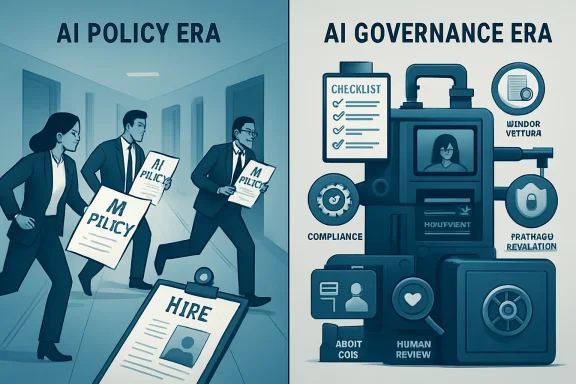 The AI Policy Era Has Arrived Before the AI Governance Era
The Littler findings capture a familiar corporate rhythm: first comes adoption, then anxiety, then policy. What makes AI different is that the adoption phase has moved with unusual speed, especially inside HR departments that handle sensitive decisions about hiring, promotion, discipline, scheduling, productivity, and termination.A formal AI policy is no longer exotic. Two years ago, many organizations were still deciding whether generative AI belonged in the workplace at all. Now, according to Littler, only 6% of surveyed employers said they were not using AI for any function. That is less a technology trend than an operational fact of life.
But policy is the easy part of governance. A written rule can tell employees not to paste confidential data into an AI chatbot, but it cannot determine whether a recruiting vendor’s screening model has a disparate impact. It can warn managers not to rely blindly on automated recommendations, but it cannot create the logs, review rights, training materials, and escalation paths that make oversight real.
That gap is the report’s most important finding. Employers are not ignoring AI risk anymore. They are recognizing it, documenting it, and still failing to build enough machinery around it.
HR Is Where AI Risk Stops Being Abstract
AI in the workplace is often discussed as though it were a productivity enhancer: faster emails, summarized meetings, automated reports, cleaner spreadsheets. HR is different. In HR, AI does not merely accelerate work; it can influence who gets work, who keeps work, and how workers are evaluated.That is why Littler’s 54% figure for employers using AI in HR functions matters. The technology is no longer sitting at the edge of the enterprise as a clever assistant for office workers. It is entering the institutional systems that mediate power between employer and employee.
Candidate screening, interview analysis, workforce analytics, employee sentiment monitoring, scheduling tools, productivity scoring, compensation benchmarking, and internal mobility platforms all sit inside the danger zone. These systems can produce efficiencies, but they can also launder old biases through new interfaces. A manager might know not to ask an unlawful interview question; an algorithm trained on historical hiring data may still reproduce the preference embedded in decades of past decisions.
The legal risk follows the human consequence. If an AI tool screens out older applicants, penalizes candidates with disabilities, misreads speech patterns, or flags workers for opaque productivity reasons, the employer will not get far by blaming the vendor. In employment law, delegation rarely means disappearance of responsibility.
The Vendor Excuse Is Wearing Thin
One of the weakest points in many corporate AI programs is the third-party tool. Employers buy software with reassuring dashboards, modern branding, and vendor assurances about fairness or compliance. Then they deploy it into workflows where the employer, not the vendor, faces the employee, the applicant, the regulator, and the plaintiff’s lawyer.Littler’s report suggests that fewer than half of surveyed organizations had adopted some deeper governance measures, including procedures for vetting third-party AI vendors, tool-specific AI training, or an internal AI oversight committee. That is the real catch-up problem. Many companies have moved from “we need an AI policy” to “we have an AI policy,” but not yet to “we can prove this AI system is appropriate for this employment use.”
Vendor vetting cannot be reduced to a procurement checkbox. Employers need to know what data the system uses, what decisions it supports, whether humans can override outputs, how the tool is tested, what documentation exists, and how the vendor handles updates. A model that changes quietly in the background can turn yesterday’s reviewed process into tomorrow’s unmanaged risk.
The harder question is institutional ownership. HR may buy the product, legal may review the contract, IT may approve the integration, procurement may handle the vendor, and business managers may use the outputs. If nobody owns the full risk lifecycle, everybody owns a fragment and nobody owns the system.
Data Privacy Is the Litigation Fear That Explains the Rest
Littler found that data privacy was the top AI-related litigation concern among respondents. That is unsurprising, but it is also revealing. Privacy is where AI risk becomes easiest for executives to understand because the sensitive inputs are visible: employee records, candidate files, performance data, images, video, voice, biometric identifiers, and workplace communications.AI systems are hungry for context. HR systems are full of context. The collision is obvious.
A chatbot that helps draft job descriptions may present relatively limited risk if it is used carefully. A tool that evaluates video interviews, analyzes employee communications, or predicts attrition from personnel data is operating in a different universe. The more intimate the data, the more employers need to ask not only whether the tool works, but whether the organization should be using it at all.
Privacy also exposes the weakness of generic governance. A single “AI acceptable use” policy cannot adequately cover all AI tools because the risk turns on use case, data type, jurisdiction, vendor design, retention practices, and human reliance. The same underlying technology can be low-risk in one context and legally combustible in another.
The Patchwork Is Not a Future Problem; It Is the Operating Environment
Employers would prefer one clean national AI rulebook. They are not getting one, at least not yet. In the absence of comprehensive federal AI legislation, states and localities have stepped into the gap, particularly around automated employment decision tools and algorithmic discrimination.That creates a familiar American compliance problem with an AI twist. Multi-state employers may face different notice, audit, documentation, anti-discrimination, and transparency obligations depending on where applicants or employees are located. The compliance map is not static, either. It changes as states pass laws, agencies issue guidance, courts interpret statutes, and administrations shift enforcement priorities.
The Trump administration has pushed for a more centralized, industry-friendly federal AI approach and has sought to limit the ability of states to regulate the technology. But even if Washington succeeds in narrowing some state authority, employers cannot responsibly treat that as a substitute for governance. Political preemption may reduce certain compliance burdens; it will not eliminate discrimination claims, privacy expectations, contract duties, employee relations fallout, or reputational risk.
This is the trap in waiting for regulatory certainty. AI adoption is happening now. Litigation risk is forming now. Employees are being evaluated now. Candidates are being screened now. A company that delays governance until lawmakers finish arguing over jurisdiction is not avoiding uncertainty; it is accumulating unmanaged exposure inside uncertainty.
Headcount Anxiety Is Real, but Redesign Is the Bigger Story
The report’s job displacement numbers are notable but not apocalyptic. Fifteen percent of employers said they had eliminated or were planning to eliminate head count due to AI, while 63% said they had not and were unlikely to do so. That finding complicates the simplest version of the AI jobs narrative.The more interesting changes are quieter: reduced hiring, reassessed job responsibilities, redesigned workflows, and shifting expectations for what employees must be able to do. AI may eliminate some jobs outright, but for many organizations its first large effect will be to blur jobs, compress tasks, and alter performance baselines.
That creates a second-order HR problem. If AI changes what a role requires, employers must decide whether to retrain workers, rewrite job descriptions, change evaluation criteria, adjust compensation, or restructure teams. Those are not merely operational choices. They are employment decisions with fairness, morale, and legal consequences.
There is also a hidden management risk. If AI allows one employee to produce more output, employers may be tempted to redefine “normal” productivity without understanding how much of that output depends on tool access, training, data quality, or the employee’s ability to supervise automated work. The productivity dividend can quickly become a workplace pressure system.
The Old Compliance Model Is Too Slow for Model-Driven Work
Traditional employment compliance assumes that policies, training, audits, and legal reviews can be updated on a relatively manageable cycle. AI breaks that rhythm. Tools change, vendors update models, employees experiment, and new use cases appear before committees have met twice.This does not mean governance is impossible. It means governance has to become more operational and less ceremonial. Employers need inventories of AI tools, classifications by risk, approval processes for new deployments, monitoring of vendor changes, documented human review, and practical training tied to the actual systems workers use.
The difference between policy and governance is evidence. If regulators, plaintiffs, employees, or executives ask how an AI tool was approved, who reviewed it, what risks were identified, what data it processes, and how humans oversee it, a mature organization can answer. An immature one can point to a policy PDF.
That distinction will matter more as AI moves from optional assistant to embedded infrastructure. Once AI is built into common workplace software, employers may not even experience adoption as a discrete decision. Features arrive through upgrades, dashboards, copilots, analytics modules, and vendor bundles. Governance must catch the feature before the feature becomes habit.
Large Employers Are Ahead, but Size Is Not a Shield
Littler noted that large employers appear further along in making AI-related workplace changes. That makes sense. Big companies have larger legal departments, mature procurement functions, security teams, privacy offices, and more leverage over vendors. They also have more to lose.Scale multiplies both capability and exposure. A flawed hiring tool at a small employer may affect dozens of candidates. The same flaw at a national employer can affect thousands and produce the kind of pattern that turns a complaint into a systemic investigation.
Large employers also face internal coordination problems that smaller organizations may avoid. AI governance cannot live only in legal, only in HR, or only in IT. It has to connect all three, plus procurement, compliance, security, finance, and business leadership. The larger the company, the easier it is for a tool to be locally useful and centrally invisible.
Small and midsize employers have the opposite problem. They may have fewer AI deployments, but they also have fewer specialists to evaluate them. For them, the danger is buying a “compliant” product and assuming the vendor’s marketing language substitutes for internal judgment.
HR Needs to Become the Adult in the AI Room
For years, HR technology was sold as a way to make HR more efficient. AI changes the mandate. HR now has to become one of the enterprise’s main AI risk stewards because many of the highest-stakes use cases run directly through people operations.That requires a stronger partnership with IT than many HR departments have historically had. It also requires legal teams to move beyond reactive review and into design-stage consultation. If AI is changing hiring, promotion, training, performance management, and staffing models, then HR is not simply a user of AI. It is a governance owner.
This may be uncomfortable. HR teams are already burdened by return-to-office disputes, DEI policy shifts, immigration compliance, wage-and-hour risk, and employee relations complexity. AI arrives not as a replacement for those issues but as an accelerant across them.
The companies that handle this best will not be the ones with the longest AI policy. They will be the ones that can answer a practical question: when an AI system affects a worker or applicant, who inside the organization is accountable for making sure that effect is lawful, fair, documented, explainable, and reviewable?
The Littler Numbers Point to a Narrow Window for Discipline
The encouraging reading of the survey is that employers are waking up. Formal AI governance policies rose sharply from the prior year, and AI is now being treated as a central workplace risk rather than a novelty. Awareness has improved.The less comforting reading is that adoption still appears to be outrunning control. If more than half of employers are using AI in HR but fewer than half have some of the deeper governance structures that make AI oversight meaningful, the market is entering a predictable phase: normalized use, uneven controls, and rising litigation.
That phase rarely lasts quietly. Employment law tends to reveal weak systems through disputes. A rejected applicant asks how a screening decision was made. An employee challenges a productivity score. A regulator asks for documentation. A vendor’s model update produces unexplained outcomes. A manager relies on a recommendation without understanding its limits.
The “catch-up” language is polite, but the implication is blunt. Employers have a limited window to convert AI policy into AI control before the first wave of AI employment disputes defines the standards for them.
The Workplace AI Reckoning Will Be Won in the Boring Details
The lesson from Littler’s report is not that employers should stop using AI. That is neither realistic nor necessarily desirable. The lesson is that AI must be treated less like software adoption and more like a new layer of employment infrastructure.The most concrete implications are also the least glamorous:
- Employers need an inventory of AI tools used across HR, recruiting, management, productivity, analytics, and employee communications.
- Employers need formal approval and review processes before AI systems are used in decisions affecting applicants or workers.
- Employers need vendor-vetting procedures that examine data use, bias testing, documentation, model updates, audit rights, and human oversight.
- Employers need training that is specific to the tools employees actually use, not generic warnings about responsible AI.
- Employers need internal ownership structures that make clear who can approve, pause, modify, or retire an AI system.
- Employers need documentation that can survive scrutiny from regulators, courts, employees, applicants, and boards.
AI is now moving through the workplace faster than the institutions built to govern work, and Littler’s survey shows employers beginning to understand the size of the mismatch. The next phase will not be defined by whether companies have AI policies, because most serious employers soon will. It will be defined by whether those policies harden into real governance before automated decisions, state regulation, privacy claims, and employee distrust turn today’s efficiency experiment into tomorrow’s compliance crisis.
Source: HR Dive Employers ‘still playing catch-up’ on AI risk management, Littler report finds
