

Microsoft Copilot’s Week 13 NFL picks for USA TODAY underline an important truth about AI in sports journalism: the technology can deliver fast, coherent, and often surprisingly accurate single-score forecasts, but those outputs are inherently snapshot‑dependent and require disciplined human oversight before they are publication‑ready.
USA TODAY’s editors ran a simple, repeatable experiment: prompt Microsoft Copilot with a natural‑language question for each Week 13 matchup — essentially, “Can you predict the winner and the score of Team A vs. Team B?” — and publish the assistant’s winner and single final‑score projection alongside a short human read that corrected or contextualized any obvious errors. That minimal workflow produced a full slate rapidly and produced readable rationales that tracked conventional handicapping signals (quarterback form, run‑fit, pass‑rush vs. protection, roster availability).
The concrete outcomes published in the Week 13 package mirrored the pattern seen in prior weeks: Copilot produced strong hit rates on paper (for example, the experiment reported an 11–3 Week 12 ledger and a season record presented in the piece as a large positive aggregate), but the process also revealed recurring failure modes — stale injury context, deterministic point forecasts without probabilistic framing, and occasional over‑precision in advanced‑metric claims. Those limitations are not theoretical footnotes; they materially change how a newsroom should treat and present AI‑generated picks.
But the experiment also made the necessary limits plain: LLM outputs are snapshot‑dependent, often overconfident, and sometimes inconsistent about advanced‑metric claims. Responsible publication requires converting point predictions into probabilistic summaries, locking down prompt templates and model provenance, and insisting on human verification of all time‑sensitive claims before publication. Failure to do so risks misleading readers, moving betting markets inadvertently, or publishing unverifiable analytics.
For WindowsForum readers — whether you’re an editor, an IT manager, or a sports‑tech developer — the path forward is clear: use Copilot and similar LLMs as editorial assistants that accelerate production, but deploy them with strict verification, logging, and probabilistic framing so outputs are informative without being misleading. When those guardrails are in place, AI becomes an editor’s assistant, not a forecasting oracle.
Use Microsoft Copilot NFL predictions as a conversation starter, a rapid first draft, and a way to surface plausible narratives — but always attach provenance, show the uncertainty, and verify the last‑minute facts before your readers make decisions based on an AI’s single-number forecast.
Source: USA Today NFL Week 13 predictions by Microsoft Copilot AI for every game
 Background / Overview
USA TODAY’s editors ran a simple, repeatable experiment: prompt Microsoft Copilot with a natural‑language question for each Week 13 matchup — essentially, “Can you predict the winner and the score of Team A vs. Team B?” — and publish the assistant’s winner and single final‑score projection alongside a short human read that corrected or contextualized any obvious errors. That minimal workflow produced a full slate rapidly and produced readable rationales that tracked conventional handicapping signals (quarterback form, run‑fit, pass‑rush vs. protection, roster availability).The concrete outcomes published in the Week 13 package mirrored the pattern seen in prior weeks: Copilot produced strong hit rates on paper (for example, the experiment reported an 11–3 Week 12 ledger and a season record presented in the piece as a large positive aggregate), but the process also revealed recurring failure modes — stale injury context, deterministic point forecasts without probabilistic framing, and occasional over‑precision in advanced‑metric claims. Those limitations are not theoretical footnotes; they materially change how a newsroom should treat and present AI‑generated picks.
How the USA TODAY–Copilot experiment worked
The prompt and editorial workflow
- One canonical prompt per game: editors fed Copilot the matchup and asked for a winner and final score.
- Copilot returned a deterministic prediction (e.g., “Team X 27, Team Y 24”) plus a short textual rationale.
- Human editors reviewed outputs and re‑prompted the assistant when it used stale or incorrect facts (most commonly injuries or last‑minute starter changes), then paired the AI output with a human‑crafted follow‑up that corrected or qualified risky claims.
The data‑freshness problem
Copilot’s most consequential failure mode in these tests was data freshness. LLMs and retrieval‑augmented systems can lag behind the real‑time signals sports consumers and bettors rely on: Sunday morning scratches, final practice reports, or last‑minute lineup changes. When an AI’s pick hinges on the availability of a key player, a stale or incorrect injury claim can flip the expected outcome. USA TODAY’s editors explicitly re‑prompted Copilot when such errors appeared — a necessary human‑in‑the‑loop safety valve.The overprecision problem
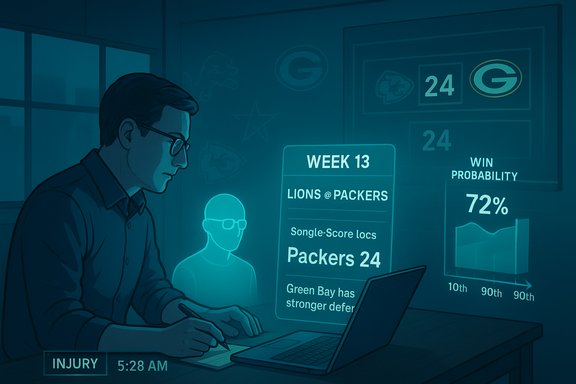
Copilot outputs a single score for a multi‑outcome event. That deterministic presentation implies a precision that isn’t justified by available data. Responsible forecasting requires calibrated distributions (win probability, percentile score ranges, and scenario summaries) rather than a single point estimate. The experiment’s authors recommend converting Copilot’s point forecasts into probabilistic outputs or presenting them with an explicit confidence meter.What Copilot picked in Week 13 — a concise summary
USA TODAY published Copilot’s Week 13 picks with a short human read for each game. Highlights from the slate included:- Detroit Lions 27, Green Bay Packers 23 — Copilot leaned on Detroit’s running game and explosive playmakers while flagging uncertainty about Green Bay’s Josh Jacobs availability.
- Kansas City Chiefs 27, Dallas Cowboys 24 — the model trusted Patrick Mahomes against a Cowboys secondary described as “shaky”, and cited Dallas’ left‑tackle absence as a pressure point.
- Baltimore Ravens 31, Cincinnati Bengals 23 — Copilot expected Lamar Jackson and Derrick Henry to be decisive against a Bengals defense it labeled a liability.
- San Francisco 49ers 23, Cleveland Browns 13 — the pick emphasized Christian McCaffrey and George Kittle’s matchup advantages and questions around rookie QB Shedeur Sanders.
- A handful of other projections followed similar logic — home‑field edges, run‑fit advantages, pass‑rush vs. protection mismatches, and last‑week momentum were repeatedly cited as the primary drivers of the AI’s scorelines.
Strengths: where Copilot reliably adds value
Speed and scale
Copilot can produce a full weekly slate of picks in minutes, with coherent, human‑readable explanations that reduce rewriting time for busy sports desks. This makes it an effective content accelerator for newsletters, social posts, and quick preview copy.Narrative alignment with expert heuristics
The assistant tends to amplify the same signals experienced handicappers use — quarterback form, pass‑rush matchup, run‑fit advantages, and roster health. That alignment produces outputs that feel expert and are often directionally correct, which is why editors found the raw outputs useful as a starting point.Readability and usability
Because Copilot writes in natural language, its picks come with tidy rationales editors can reuse. For time‑pressed editors, that usability is more than convenience — it’s a production multiplier.Risks and limitations — what to watch out for
1) Stale or incorrect injury and roster information
This is the single biggest publishing risk. An LLM that lacks direct, real‑time access to official active/inactive lists will occasionally misstate player availability. Editors must verify injuries against the NFL’s official injury report, team inactives, and beat reporting before publishing.2) Overprecision and false confidence
A single-score prediction masks the true uncertainty of a game and can mislead readers who treat the number as a deterministic outcome. The experiment recommends converting point forecasts into win probabilities, percentile ranges, and scenario summaries to convey uncertainty.3) Hallucinations and unverifiable metric claims
When prompted for analytic detail, Copilot can assert ordinal metric claims (e.g., “No. 1 in defensive EPA per play”) that depend on provider snapshots and timestamps. Those claims must be checked against the specific data provider and timestamped before publication. Failure to do so risks publishing inaccurate or non‑reproducible analytics.4) Market impact and ethical concerns
Widely published deterministic AI picks can affect betting lines and create feedback loops that influence future data used by other models. Outlets should label AI outputs as editorial/entertainment and avoid presenting them as betting advice without probabilistic framing and provenance.5) Prompt sensitivity and auditability
Small changes to the prompt can meaningfully change outputs. Newsrooms must lock down canonical prompt templates, store model version details, and maintain an auditable prompt log for reproducibility and governance.Practical production checklist — a recommended newsroom workflow
- Standardize and log the prompt template and model version used for every run.
- Cross‑check roster/injury claims against three primary sources: the NFL active/inactive list, team injury reports, and beat reporters’ in‑game updates.
- Convert single‑score outputs to probabilistic summaries (win probability, 10th–90th percentile score range) before publishing.
- Add a confidence label (Low / Medium / High) and a short human‑read that explains unresolved variables.
- Maintain a prompt/model/version audit trail and store any re‑prompts and editorial corrections.
- Clearly label AI‑derived picks as editorial content and not betting advice; include a dated data‑cutoff timestamp for any statistics cited.
Cross‑checking claims and verification notes
- Copilot’s week‑by‑week hit rates (the experiment reported high single‑week accuracy several times) are snapshot claims and vary across different published summaries. USA TODAY’s experiment has published multiple week summaries (Week 7, Week 11, Week 12) with differing per‑week and seasonal aggregates; those numbers can differ depending on which weekly roundup you read and when the snapshot was taken. Treat season‑to‑date tallies as time‑sensitive and verify the ledger with the date attached.
- Advanced‑metric statements (EPA, pressure rate, yards per carry) that Copilot sometimes makes are provider‑sensitive. One analytics snapshot might show Team A as top‑ranked while another places them lower — always publish the metric provider and the timestamp when making such claims. The experiment explicitly warns against presenting ordinal claims (No. 1, No. 2) without provider provenance.
- When Copilot referenced specific player availability issues (e.g., “Josh Jacobs status” or “Alvin Kamara questionable”), USA TODAY editors corrected or conditioned those claims when needed. That editorial pattern demonstrates the proper workflow: assume AI availability claims are provisional until verified against primary sources.
What this means for readers, bettors, and fantasy managers
- Use AI picks as a starting point, not a single source for wagering or lineup decisions. Copilot is effective at surfacing plausible outcomes and explanations, but it does not replace real‑time data checks.
- Request probability distributions instead of single scores. Ask the model (or the production pipeline) to provide a win probability and a plausible score range (e.g., median score and interquartile range). That converts a deterministic headline into a calibrated forecast that better communicates risk.
- Combine AI outputs with market signals. Line movement, implied probability from betting markets, and consensus public‑bet percentages frequently contain timely information that an LLM without a live feed will miss. Treat those signals as checks on the model’s output.
Governance, legal, and security considerations for technology teams
For editorial technologists and IT teams thinking about deploying Copilot or similar tools at scale, the USA TODAY experiment offers concrete recommendations:- Maintain an auditable prompt and model‑version log to support provenance, reproducibility, and regulatory review.
- Require human‑in‑the‑loop verification for any claims that affect financial outcomes (betting) or consumer behavior (fantasy lineups).
- Monitor and label outputs that could move markets (e.g., widely syndicated deterministic bets) and apply stricter governance around such distributions.
- Integrate real‑time data feeds (official injury reports, practice reports, betting odds) into the prompt pipeline to reduce staleness risk.
Final takeaways
Microsoft Copilot demonstrated its core strengths in the USA TODAY Week 13 experiment: speed, narrative coherence, and alignment with commonly used handicapping heuristics. When paired with human editors who verify injury and roster facts, the tool becomes a powerful content accelerator for sports desks.But the experiment also made the necessary limits plain: LLM outputs are snapshot‑dependent, often overconfident, and sometimes inconsistent about advanced‑metric claims. Responsible publication requires converting point predictions into probabilistic summaries, locking down prompt templates and model provenance, and insisting on human verification of all time‑sensitive claims before publication. Failure to do so risks misleading readers, moving betting markets inadvertently, or publishing unverifiable analytics.
For WindowsForum readers — whether you’re an editor, an IT manager, or a sports‑tech developer — the path forward is clear: use Copilot and similar LLMs as editorial assistants that accelerate production, but deploy them with strict verification, logging, and probabilistic framing so outputs are informative without being misleading. When those guardrails are in place, AI becomes an editor’s assistant, not a forecasting oracle.
Use Microsoft Copilot NFL predictions as a conversation starter, a rapid first draft, and a way to surface plausible narratives — but always attach provenance, show the uncertainty, and verify the last‑minute facts before your readers make decisions based on an AI’s single-number forecast.
Source: USA Today NFL Week 13 predictions by Microsoft Copilot AI for every game
