

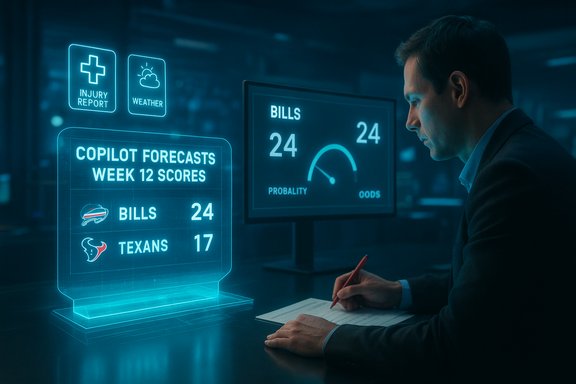
USA TODAY’s experiment — asking Microsoft Copilot to predict every NFL Week 12 game and publish a winner plus a precise final score for each matchup — landed more headlines than controversy: the chatbot finished Week 11 at 12–3, extended its season ledger into triple digits, and delivered readable, matchup‑driven rationales that made for fast editorial copy. The test, however, also highlighted every structural weakness LLMs bring to real‑time sports forecasting: stale injury context, deterministic single‑score outputs that imply false precision, and an overreliance on public narratives unless human editors intervene.
Background
The USA TODAY workflow was intentionally simple. Editors fed Microsoft Copilot the same natural‑language prompt for each game — essentially, “Can you predict the winner and the score of Team A vs. Team B for NFL Week X?” — and the model returned a winner and a single final‑score projection. Those outputs were then published alongside brief human commentary that corrected or contextualized obvious errors when necessary. The method scales fast: a full 14‑game slate can be produced in minutes, with each pick accompanied by a short, readable explanation suitable for preview copy or social cards.That speed and consistency are the experiment’s selling point. Copilot reliably aggregates familiar handicapping signals — quarterback form, running‑game matchups, pass‑rush advantages, and roster health — into coherent prose. But editorial reviewers warned that the outputs must be paired with real‑time verification before readers treat them as decision‑grade guidance for betting or fantasy.
What USA TODAY asked Copilot to do — and how the model answered
- Prompt pattern: one canonical natural‑language question per matchup asking for the winner and a final score.
- Output: deterministic single‑score predictions (e.g., “Bills 24, Texans 17”) plus a short rationale explaining the choice.
- Editorial handling: human editors re‑prompted Copilot when the assistant used stale injury or roster facts; they then paired the model’s raw pick with a short human read explaining where the AI’s reasoning aligned with or diverged from conventional wisdom.
Summary of Copilot’s Week 12 slate (the model’s picks and the human read)
Below is a concise summary of Copilot’s Week 12 winners and the human editorial checks that accompanied the USA TODAY publication. Each pick is presented in the same format used by the experiment: the model’s score, a short “AI’s take,” and the human‑crafted follow-up that corrects or qualifies model claims.- Buffalo Bills 24, Houston Texans 17 — Copilot praised Buffalo’s explosive offense and Josh Allen’s recent MVP‑level form while recognizing Houston’s stout defense; editorial caveat: time‑of‑possession and matchup metrics are snapshot‑dependent and should be timestamped.
- Chicago Bears 23, Pittsburgh Steelers 20 — Copilot rode Caleb Williams’ three‑game surge and Ben Johnson’s balanced scheme; editorial note: quarterback availability and defensive form make this a tight road test.
- New England Patriots 31, Cincinnati Bengals 17 — Model leaned into New England’s eight‑game run and road strength; human read: verify Bengals’ inactives (Ja’Marr Chase suspension was a factor in the original write‑up).
- Detroit Lions 34, New York Giants 17 — Copilot highlighted a favorable Lions run‑game matchup; editorial check: quarterback status and snap distribution matter for the final projection.
- Green Bay Packers 23, Minnesota Vikings 16 — Model preferred Green Bay despite offensive wobbles; human caveat: injuries to key running backs and tight ends change the expected scoring load.
- Seattle Seahawks 27, Tennessee Titans 13 — Copilot expected Seattle to leverage pressure and force rookie mistakes; editorial verification: sack/pressure rates are provider‑sensitive and should be cross‑checked.
- Kansas City Chiefs 27, Indianapolis Colts 24 — Model invoked “urgency” for KC at home; human note: rest, altitude, and a fresh addition to the Colts’ defense make this a coin‑flip; small situational edges can swing the result.
- Baltimore Ravens 31, New York Jets 17 — Copilot favored Baltimore’s rushing attack and continuity with Lamar Jackson; editorial read: confirm the starter and any last‑minute personnel changes.
- Las Vegas Raiders 20, Cleveland Browns 16 — Model doubted Shedeur Sanders’ early throws and tilted slightly toward Geno Smith’s steadier play; human caveat: rookie QBs often improve markedly with a full week of prep.
- Jacksonville Jaguars 28, Arizona Cardinals 23 — Copilot liked Jacksonville’s run game and opportunistic defense; editorial note: confirm starter status for Arizona (Kyler Murray vs. Jacoby Brissett) before treating the score as definitive.
- Philadelphia Eagles 27, Dallas Cowboys 23 — Model trusted the Eagles’ defense to win the day despite an offense that sputtered recently; human note: the Cowboys’ defensive reinforcements make this a potential upset.
- Atlanta Falcons 20, New Orleans Saints 17 — Copilot projected Cousins/Bij an era to hold in place of a hurt Michael Penix Jr.; editorial caveat: starting‑QB changes materially change win expectation.
- Los Angeles Rams 30, Tampa Bay Buccaneers 23 — Model backed Matthew Stafford’s passing ceiling; human note: injuries to Tampa’s skill group alter shootout risk.
- San Francisco 49ers 27, Carolina Panthers 23 — Copilot leaned on Brock Purdy’s efficiency and Shanahan’s play‑calling; editorial read: contain the Panthers’ home‑field edge and force Bryce Young to beat them through the air.
Why the approach works — and where it fails
Strengths
- Speed and scalability: Copilot can produce a full slate in minutes, ready for editors who need quick preview copy and social assets. That makes it a powerful content accelerator for busy sports desks.
- Readability: The assistant produces human‑like rationales that are immediately usable, reducing rewriting time.
- Heuristic alignment: Copilot reliably amplifies the same signals experienced analysts use — e.g., quarterback form, pass‑rush vs. protection matchups, and run‑fit advantages — which creates outputs that often mirror mainstream handicapping.
Weaknesses and risks
- Data freshness: The single biggest failure mode is relying on stale or missing week‑of injury reports. An LLM trained on public text or a snapshot index will not, by default, know a Sunday morning scratch unless the retrieval pipeline includes live feeds. Editors in the USA TODAY experiment re‑prompted Copilot when such errors were found; that human‑in‑the‑loop step is non‑negotiable.
- Overprecision and lack of calibration: Delivering a single score implies more certainty than exists. The model does not provide win probabilities, percentile score ranges, or uncertainty bands — all of which are essential for responsible public use in betting or fantasy contexts.
- Hallucinations: When asked for justifying detail, Copilot can invent plausible but unsupported facts or overstate confidence in tenuous claims (e.g., precise rankings on EPA or other advanced metrics without a timestamped data provider). Those claims must be verified.
- Market impact and ethics: Widely published deterministic AI picks can move betting markets and create reflexive feedback loops; publishers should label AI outputs as editorial and avoid presenting them as betting advice without probabilistic framing and provenance.
Practical verification checks — what editors did and should always do
When Copilot made a roster or metric claim, USA TODAY editors followed a short verification checklist before publishing. The same checklist should be standard operating procedure in any newsroom using LLM‑generated sports picks:- Check the NFL active/inactive list and official team injury reports for the exact game day. If a source disagrees, escalate to the beat reporter.
- Confirm any advanced‑metric claim (EPA, pressure rate, yards per carry) against the provider and timestamp the snapshot (e.g., “EPA per play, via Provider X, updated through Week 11”). Claims about ordinal ranks (No. 1, No. 2) are snapshot‑sensitive and must be flagged.
- If the AI’s pick depends on a starter who is questionable, publish the pick conditionally and present alternate scenarios (starter‑in vs. starter‑out).
- Convert single scores to calibrated outputs: ask the model (or an ensemble statistical engine) for win probability, a 10th–90th percentile score range, and best/worst scenario bullets. Present these alongside the point prediction.
- Maintain prompt and model‑version logs for auditability: store every query and the model used, plus any re‑prompts and editorial corrections.
How newsrooms should evolve an LLM‑powered NFL picks workflow
To make AI picks responsibly useful, outlets should treat LLMs like fast research assistants rather than forecasting oracles. Recommended technical and editorial upgrades:- Integrate real‑time data feeds: practice reports, official active lists, betting‑market odds, and snap counts should be standard prompt inputs. This reduces the largest failure mode — stale injury information.
- Output probabilistic forecasts: require win probability and percentile score bands in addition to a single median score. Log calibration metrics (Brier score) so performance is measurable.
- Ensemble the LLM with a structured statistical model: combine human‑readable rationales with a numeric model that weights team strength, situational variables, and market signals. Treat the LLM output as a narrative overlay to the numbers.
- Publish provenance and timestamping: explicitly show the model used (Copilot), the prompt template, and the data‑cutoff timestamp for all statistics cited. This protects readers and the publisher from mistaken confidence.
- Add editorial confidence labels: low/medium/high confidence badges tied to unresolved variables (injury uncertainty, weather, starter status).
The broader context: what Copilot’s Week‑by‑week hit rate actually means
AI’s high week‑to‑week accuracy in conservative contexts often results from favorite bias — models tend to pick the favorite, and favorites win more often. That raises two points:- Headlines that emphasize raw record (e.g., “Copilot 12–3 in Week 11” or “season record 109–54–1”) are attention‑grabbing but incomplete. They obscure how much the picks relied on favorites, health assumptions, and human corrections. Treat aggregated records as a starting point for evaluation, not a seal of statistical robustness.
- For bettors and fantasy players, the meaningful metric is calibration and value: did the AI surface positive‑expected‑value picks against the market? Deterministic single scores do not provide that information. Convert model outputs into implied probabilities and compare them to market odds before attaching financial weight.
What readers should take away
- Use AI picks for conversation and hypothesis generation, not as single‑source betting or roster advice. The outputs are great starting points for human analysts but require real‑time verification.
- Demand transparency: outlets publishing AI picks should include model provenance, prompt descriptions, data cutoff times, and a short disclosure about human verification. Labels protect both readers and publishers.
- Prefer probabilistic forecasts: a win probability and a plausible score range are far more honest and useful than a single precise final score.
Quick checklist for using Copilot‑style picks responsibly (for editors and data teams)
- Log the prompt and model version every time.
- Cross‑check all roster/availability claims against three sources (team inactives, NFL injury report, local beat reports).
- Require probability + range output (median score, 10th–90th percentile).
- Timestamp and cite advanced‑metric providers for any claims about ordinal rankings.
- Add a human confidence meter and a one‑line editorial caveat when uncertainty is unresolved.
Conclusion
The USA TODAY–Copilot Week 12 experiment is a useful case study in what modern newsroom AI can — and cannot — do. Copilot proved it can produce: fast, coherent slates of picks and readable rationales that are ready for editorial refinement. The experiment also proved the indispensable role of human judgment: verifying injuries, contextualizing advanced metrics, and converting deterministic point forecasts into calibrated probability statements.When paired with a robust data pipeline (live injury feeds, market odds) and an editorial workflow that enforces provenance, calibration, and explicit uncertainty labels, LLM assistants like Copilot are powerful accelerants for sports coverage. Without those guardrails, however, they risk publishing misleading precision and amplifying stale or hallucinated claims. The responsible path forward is not to banish these models but to build the infrastructure — editorial, technical, and ethical — that turns “AI picks” from a provocative headline into a trustworthy product for readers, bettors, and fantasy managers alike.
Source: USA Today NFL Week 12 predictions by Microsoft Copilot AI for every game
