

Check Point Research’s demonstration that web-accessible AI assistants can be turned into covert command-and-control relays is a practical wake-up call: by using browsing and URL-fetch features exposed in services such as Grok and Microsoft Copilot, attackers can hide C2 traffic inside otherwise ordinary enterprise AI usage, and those same AI channels can evolve into external “brains” that drive adaptive, prompt‑driven malware. ([research.checkpoinch.checkpoint.com/2026/ai-in-the-middle-turning-web-based-ai-services-into-c2-proxies-the-future-of-ai-driven-attacks/)
AI assistants are no longer niche tools hidden behind developer consoles; they live in browsers, collaboration apps, and even system shells. That ubiquity gives them a major operational advantage for defenders: their domains are often allowed by default, traffic looks legitimate, and many enterprises do not treat AI egress as sensitive. Check Point Research (CPR) shows how those facts create an attacker opportunity: an AI assistant that can fetch and summarize arbitrary web pages becomes a de facto relay that can shuttle data out (victim → attacker-controlled page via AI fetch) and shuttle commands in (attacker-controlled page → AI response → malware). The proof-of-concept used public web interfaces and required no API key or registered account in certain configurations, meaning classic killswitches like revoking API keys are ineffective against this class of abuse.
This report links two trends that defenders must treat as a single problem: (1) the steady weaponization of AI for development and operational tasks (code generation, phishing content, rapid tooling), and (2) the rise of runtime, model-driven decision-making where an implant consults a model during execution to triage, prioritize, and adapt. When combined, those trends deliver not merely faster attackers, but attackers who are more flexible, harder to model, and able to blend into legitimate enterprise AI traffic.
The defensive response must be systemic and practical: treat AI domains as sensitive egress, harden provider-side browsing features, restrict and monitor embedded browser usage on endpoints, and prepare detection rules that link local reconnaissance events to AI fetch activity. Vendors and enterprises both have work to do; the good news is that many of the mitigations are operational rather than research‑level: authentication, observability, rate-limiting, and tight application control will significantly raise the bar.
Finally, this moment is a reminder that convenience features—prefilled prompts, deep links, and agent connectors—can have outsized security consequences. The community must balance productivity against attack surface with urgency. Understanding and acting on the paths CPR shows now will make it far harder for attackers to use AI services as a stealthy transit layer, and will buy time as the arms race between attackers and defenders moves from code to prompts.
Source: CPR - Check Point Research AI in the Middle: Turning Web-Based AI Services into C2 Proxies & The Future Of AI Driven Attacks - Check Point Research
 Background / Overview
AI assistants are no longer niche tools hidden behind developer consoles; they live in browsers, collaboration apps, and even system shells. That ubiquity gives them a major operational advantage for defenders: their domains are often allowed by default, traffic looks legitimate, and many enterprises do not treat AI egress as sensitive. Check Point Research (CPR) shows how those facts create an attacker opportunity: an AI assistant that can fetch and summarize arbitrary web pages becomes a de facto relay that can shuttle data out (victim → attacker-controlled page via AI fetch) and shuttle commands in (attacker-controlled page → AI response → malware). The proof-of-concept used public web interfaces and required no API key or registered account in certain configurations, meaning classic killswitches like revoking API keys are ineffective against this class of abuse.This report links two trends that defenders must treat as a single problem: (1) the steady weaponization of AI for development and operational tasks (code generation, phishing content, rapid tooling), and (2) the rise of runtime, model-driven decision-making where an implant consults a model during execution to triage, prioritize, and adapt. When combined, those trends deliver not merely faster attackers, but attackers who are more flexible, harder to model, and able to blend into legitimate enterprise AI traffic.
How the abuse works: AI-as-a-proxy, in plain terms
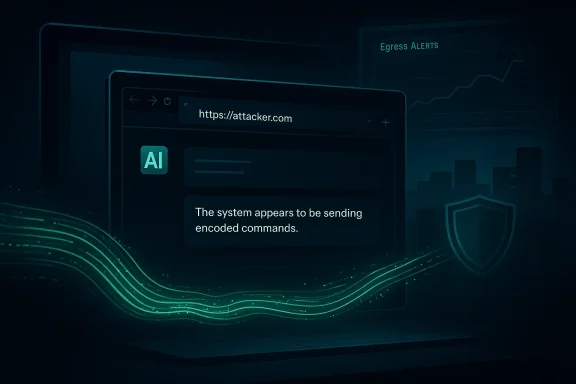
At its simplest, the attack chain CPR demonstrates looks like this:- A host is compromised and a lightweight implant is deployed.
- The implant opens a hidden embedded browser session (for example, using WebView2 on Windows) and navigates to an AI web assistant page (such as Grok or Copilot).
- The implant supplies a prompt that instructs the assistant to fetch an attacker-controlled HTTPS URL and summarize or extract a particular element — with victim data appended to the URL as query parameters.
- The AI fetches the content, reads the response (which can be crafted by the attacker to contain an encoded command), and returns a natural‑language output from which the implant extracts and executes the command.
Why WebView2 matters
The PoC used WebView2, Microsoft’s Chromium‑based embedded browser control, to emulate an ordinary user browser session from native code. WebView2 is a common way for Windows native apps to render web content and is widely available (the runtime is distributed and often present where modern Microsoft 365 components or Edge are installed). That ubiquity makes it a convenient vector for malware authors who want to produce legitimate-looking web traffic from an infected endpoint without calling raw HTTP libraries that might trigger network anomaly detection. Microsoft’s WebView2 distribution and runtime documentation shows multiple supported deployment patterns, and WebView2 is actively used by many enterprise applications.Proof-of-concept details and immediate implications
CPR’s PoC surfaced several operational realities defenders should not ignore:- The attack can carry victim data in URL query parameters; even when model-side filters/screens attempt to block obvious sensitive content, attackers can encode or encrypt high-entropy blobs to bypass simple pattern-matching redactions. The AI will still fetch the page and can return the encoded response, which the implant can decode.
- Different AI services enforce different constraints: for instance, some services block plain HTTP or direct IPs, but permit HTTPS domain fetches. These subtleties matter for an attacker constructing a robust relay.
- The WebView approach simulates a browser, reducing the likelihood of triggering rate-limits or CAPTCHA checks designed to detect scripted non-browser HTTP clients. That makes the channel more stable and stealthy compared with raw HTTP API calls from a backdoor.
- Because the AI web UI returns natural-language text instead of structured binary, attackers can hide encoded commands in benign-looking summaries or tables. The implant parses the returned text to extract the payload.
How this fits into a larger evolution: AI-Driven (AID) malware
CPR frames a near-term evolution where malware shifts from fixed decision trees to prompt-driven, adaptive logic. In this model, the implant does not just report raw artifacts; it prepares a compact “situation report” (host metadata, installed software, domain membership, geographic indicators, etc.) and queries a model to decide what to do next. The model’s response can determine:- Whether to escalate, stay dormant, or self-delete (anti-sandbox checks).
- Which lateral-movement tools or credentials to attempt.
- Which files or databases to prioritize for theft or encryption.
- API-based integration: The implant queries a remote model via an API (mainstream provider or attacker-hosted). This keeps the implant lightweight but generates network telemetry.
- Embedded model: The implant includes a model locally. This increases payload size and complexity but reduces network exposure.
Concrete future use cases and adversary benefits
CPR highlights several particularly concerning AID use cases where model-driven logic materially improves attacker outcomes:- Anti‑sandbox and environment validation: Instead of brittle local heuristics, an implant could send collected system metadata to a model and ask “Is this a sandbox?” The model could use broader heuristics learned from many telemetry sources to make a better call, causing the implant to remain dormant in analyst environments. This would degrade sandbox-based detection and forensic investigation.
- C2 triage and prioritization: A central AIOps-C2 server could run models that score and prioritize infected hosts based on business context, PII value, or likely access rights. High-scoring hosts receive hands-on, manual lateral-movement instructions; low-scoring ones receive inert payloads (e.g., miners). This selective approach increases ROI per intrusion while reducing noisy telemetry.
- Targeted ransomware and exfiltration: Models can analyze file metadata and content to determine the most valuable files to steal or encrypt — dramatically reducing the number of file operations needed to achieve leverage. Historically, mass-encryption speed was the limiting factor; model-driven targeted selection could allow attackers to accomplish devastating outcomes using a small, stealthy set of operations that evade volume-based detection heuristics. Splunk’s prior measurements of real-world ransomware speeds show that modern strains can be very fast at bulk encryption, and targeted selection only increases the attacker’s chance of success by reducing detection windows.
Corroborating incidents and contextual evidence
Three independent threads reinforce CPR’s thesis that agentic and web-accessible AI introduces new systemic risks:- Varonis’ “Reprompt” disclosure showed that prefilled prompt parameters in Microsoft Copilot could be chained into a single-click exfiltration pipeline, where an attacker-controlled URL and repeat‑request orchestration bypassed safety logic and siphoned session data. That research underscores how innocent-looking convenience features—URL prefill, repeated requests, chained server follow-ups—can be recombined to exfiltrate data.
- AppOmni’s “BodySnatcher” disclosure against ServiceNow (CVE-2025-12420) and other findings around agent-to-agent interactions demonstrate the systemic risk of permissive defaults in agent connectors and account-linking. These issues are conceptually adjacent: when agents can act autonomously and call other services, the blast radius multiplies.
- Microsoft’s WebView2 runtime is a standard, supported embedded browser control with several distribution models, and is commonly present in modern Windows environments—making the path CPR used (native app → WebView2 → AI web UI) plausible on many enterprise endpoints. The WebView2 documentation and distribution guidance explain the many ways the runtime can be present or installed, which is why CPR’s choice of WebView2 is operationally significant.
Defensive measures and immediate mitigations
Stopping this class of service-abuse requires changes at several layers. CPR recommends, and defenders should adopt, a multi-pronged approach:- Treat AI domains as high-value egress: Update enterprise egress policies and DNS/URL allowlists to classify AI assistant domains as sensitive. Monitor and alert on anomalous volumes or unusual patterns of requests to AI web UI domains. This shifts AI traffic from “allowed by default” to a monitored category.
- Harden web‑fetch features on the provider side: AI vendors must enforce stricter controls around web-fetching and browsing; mitigate anonymous fetching where feasible; apply per-client rate-limits and stricter provenance checks; and add robust content sanitization for fetched pages. CPR advised providers to require authentication for web-fetch features and to give enterprises control and observability over their model’s external URL access.
- Restrict embedded browser usage in endpoints: Where possible, limit the ability of arbitrary native applications to instantiate headless or hidden WebView sessions. Application allow/deny policies, code signing enforcement, and application control can reduce risk. Enterprises using AppLocker or similar controls should verify which executables are permitted to host WebView2 and restrict unexpected binaries from creating browser contexts.
- Detect prompt‑channeling patterns: Build detection logic that recognizes the telltale sequence of events — local enumeration followed by an unusual (and perhaps encrypted) blob appended to an external domain that’s subsequently queried by a known AI web UI. Hunt for WebView process instantiation patterns, embedded browser navigation sequences, and repeated summarization/fetch operations targeted at the same external domain.
- Operational safeguards and least privilege for agents: Enterprises must apply principle-of-least-privilege to agent connectors and provide visibility and rate-limiting for agent-to-agent interactions. The ServiceNow and connected agents incidents show the consequences of permissive linking.
- Sidebar: patch and configuration hygiene — keep Copilot and other AI integrations updated. The chain of research on “Reprompt” shows timely mitigations can close a practical exploit path.
Detection playbook (practical steps for SOC teams)
- Inventory all AI-related domains and web endpoints used in your environment. Classify them as sensitive egress.
- Monitor for unexpected WebView2 process launches by non-whitelisted binaries; log parent/child relationships and command-line arguments. Flag hidden/GUI-less WebView sessions.
- Create analytics to detect:
- Repeated summarization/fetch prompts issued from individual endpoints to the same external host.
- Outbound URL queries containing long, high-entropy query parameters shortly after process enumeration or file‑system scanning events.
- Unexpected chains of web requests to AI web UI domains that coincide with local reconnaissance activity (process list enumeration, credential dump attempts, etc.).
- Enforce egress filtering to limit which endpoints can access public AI web UIs; where AI tools are needed, funnel them through monitored, authenticated proxies that add observability and rate-limiting.
- Include AI service domains in threat-hunting rules and endpoint detection signatures, and exercise tabletop scenarios that simulate AID-driven ransomware or triage workflows.
Strategic considerations and vendor responsibilities
This is fundamentally a service-abuse problem rather than a single exploitable memory bug. That means the responsibility is shared:- AI vendors must assume that browsing features and external URL fetches are high-risk surfaces and design default-deny behaviors, authenticated flows, or enterprise controls that let tenants enforce policies.
- Endpoint OS and application vendors should make it easier for administrators to control embedded browser capabilities and to elevate WebView instances that present significant risk.
- Security vendors and SOC teams must expand their model of “sensitive egress” to include AI assistants and incorporate AI traffic into detection and response playbooks.
Limitations and caveats (what we don’t know for sure)
- Extent in the wild: CPR’s PoC is a documented lab demonstration; public reporting of Reprompt and related disclosures confirms similar patterns against other assistants, but the prevalence of operational campaigns exploiting AI-as-proxy at scale is not fully observable in public telemetry today. Treat the risk as immediate and plausible, but not yet quantified in mass compromise reports.
- Model-side filtering evolution: Vendors are rapidly iterating on safety classifiers and URL redaction heuristics. Some of the straightforward PoC techniques (clear-text query parameters with sensitive labels) may be blocked quickly, while more subtle encodings will remain a cat-and-mouse game between attackers and defenders. Expect iterative mitigations and recurring novel bypasses.
- Embedded vs. API models: There is a trade-off between stealth and convenience. While embedded models eliminate network telemetry, packaging large models inside malware increases complexity and binary size. For now, API-based AID approaches — sometimes proxied through legitimate-looking services — are the more pragmatic attacker choice. That may change as tiny but capable models become easier to embed.
What security teams should do this week (prioritized checklist)
- Add AI web UI domains (Copilot, Grok, and others in use) to your egress monitoring and begin capturing baseline traffic patterns. Treat deviations as high-priority.
- Audit application control: identify binaries allowed to host WebView2; restrict or whitelist only known, trusted applications.
- Deploy hunting rules for the sequence: local enumeration → outbound AI web UI navigation → returned natural‑language payloads containing high-entropy blobs or encoded markers.
- Engage SaaS and AI vendors: request enterprise controls that provide per-tenant observability into any external URL fetches initiated by models, and insist on authenticated fetch policies where feasible.
- Exercise tabletop scenarios that simulate an AID-driven ransomware campaign to validate detection and response playbooks (include backup and triage decisions that assume targeted, not mass, file operations).
Conclusion
Check Point Research’s “AI in the Middle” work is more than a clever C2 trick: it maps a clear road from today’s web-accessible assistant features to tomorrow’s adaptive, model-driven implants. The ingredients are simple and realistic: browsing-capable AI assistants, ubiquitous embedded browser runtimes such as WebView2, and lightweight implants that can emulate ordinary browser sessions. Combined, they allow an attacker to blend C2 into common AI traffic and to outsource decision-making to remote models that can prioritize targets, choose payloads, and evade sandboxes.The defensive response must be systemic and practical: treat AI domains as sensitive egress, harden provider-side browsing features, restrict and monitor embedded browser usage on endpoints, and prepare detection rules that link local reconnaissance events to AI fetch activity. Vendors and enterprises both have work to do; the good news is that many of the mitigations are operational rather than research‑level: authentication, observability, rate-limiting, and tight application control will significantly raise the bar.
Finally, this moment is a reminder that convenience features—prefilled prompts, deep links, and agent connectors—can have outsized security consequences. The community must balance productivity against attack surface with urgency. Understanding and acting on the paths CPR shows now will make it far harder for attackers to use AI services as a stealthy transit layer, and will buy time as the arms race between attackers and defenders moves from code to prompts.
Source: CPR - Check Point Research AI in the Middle: Turning Web-Based AI Services into C2 Proxies & The Future Of AI Driven Attacks - Check Point Research
