
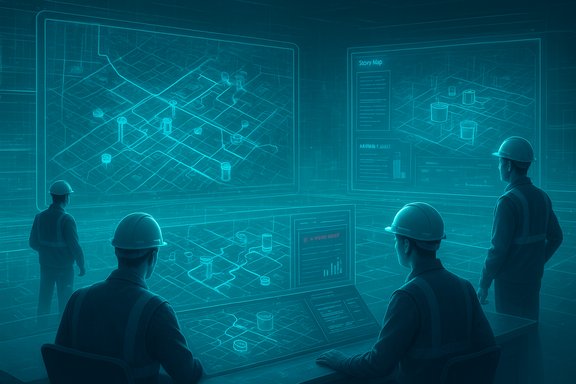
Artificial intelligence is no longer an experiment on the margins of engineering teams — it is being stitched into the workflows that move raw telemetry and model outputs into operational decisions for water systems, from distribution network design to public-facing community engagement, and firms such as Barge Design Solutions report compressing weeks of analysis into hours by pairing generative assistants with hydraulic modeling and GIS storytelling.
Background
AI in water management sits at the intersection of three long-running trends: the exponential growth of sensor and model data, the maturity of large language and generative models, and urgent pressure on water utilities and planners to deliver resilient, efficient services under constrained budgets and climate-driven extremes. Engineers have always translated data into decisions; AI promises to accelerate that translation, surface patterns buried in gigabytes of outputs, and automate repetitive production tasks that historically consumed senior technical time.This shift is already visible in multiple domains. Utilities and city agencies are building digital twins that fuse hydraulic models with live telemetry and anomaly detection to shorten leak‑detection windows, while consultants use Copilot‑style assistants and large language models to speed document review, craft stakeholder narratives, and produce visualizations that nontechnical audiences can act on. Practical pilots in places such as Singapore and Jakarta demonstrate measurable operational improvements when models are tightly coupled to operations and human oversight is enforced.
Converting data into insights: what AI adds to hydraulic modeling
Hydraulic modeling generates dense output: thousands of node/pipe time series, pump schedules, scenario runs for growth or drought, and sensitivity sweeps for control strategies. Traditionally, turning those outputs into an actionable recommendation — say the optimal location for a storage tank or the critical pipeline causing head loss under peak demand — requires hours of scripting, filtering, plotting, and report writing.AI changes three parts of that pipeline:
- Rapid analysis: LLMs augmented with domain-aware connectors can parse model output tables, summarize anomalies, and propose candidate hypotheses (e.g., pressure zones that suggest a booster pump or tank). This reduces exploratory time dramatically for a trained engineer.
- Automated visualization: Prompt-driven generation of charts, annotated maps, and StoryMap outlines converts technical evidence into stakeholder-ready artifacts quickly.
- Knowledge retrieval: Copilot‑style assistants that search internal document stores (master specifications, quality-control checklists, prior projects) reduce time spent re-finding precedent or firm standards.
Why validation still matters
AI can accelerate the how but not replace the why. Engineering judgment remains critical to:- Evaluate model assumptions (demand patterns, boundary conditions).
- Confirm that optimization suggestions are physically feasible and meet regulatory constraints.
- Detect hallucinations — plausible-sounding but incorrect outputs — from generative models.
Tools of the trade: ChatGPT, Microsoft Copilot, ArcGIS StoryMaps and beyond
Generative assistants and visualization platforms form a practical toolkit for modern water projects.- ChatGPT and comparable LLM interfaces excel at drafting text, generating explainer outlines, and producing image prompts for conceptual visuals. They are often used during the ideation and narrative phases of project communications.
- Microsoft Copilot integrates LLM capability directly into Microsoft 365 and can access organization‑scoped content, enabling rapid extraction of specifications, meeting summaries, and knowledge from internal documents while inheriting enterprise security posture.
- ArcGIS StoryMaps and related storytelling platforms transform model outputs and GIS layers into accessible web narratives for councils, regulators, and the public.
Case studies and independent precedents
The benefits and limits claimed by consulting teams are reinforced — and tempered — by larger municipal and utility deployments.- Singapore’s national water utility (PUB) has built a high‑fidelity digital twin that fuses hydraulic models with daily sensor recalibration and AI-based anomaly detection; the system improves leak localization and moves utilities from scheduled surveys to continuous, data‑driven monitoring. These implementations demonstrate the practical gains of combining models and live telemetry.
- Jakarta’s implementation of integrated forecasting and operational triggers shows how short‑horizon predictive models can convert a few hours of lead time into concrete operations — closing gates, deploying pumps, and issuing public alerts — materially reducing flood impacts when governance and human-in-the-loop rules are clear. That project makes explicit the pattern: well-scoped forecasting + operational playbooks = measurable outcome improvements.
- In the U.S. energy sector, Evergy’s wide rollout of automated solutions on low‑code platforms produced documented time savings at scale; while not a water project, it points to organizational models utilities can adopt: Centers of Excellence for governance, citizen developers for rapid automation, and a catalog of reusable templates for common tasks.
Ethical, security and environmental considerations
Introducing AI into water infrastructure projects raises three categories of risk that must be addressed in procurement, governance, and design.1) Data security and client confidentiality
Using consumer-grade LLMs for sensitive utility data is risky unless the platform guarantees enterprise data residency, access controls, and auditable logs. Migrating to enterprise Copilot instances or company‑hosted LLMs reduces exposure and simplifies compliance with client confidentiality and regulatory requirements.2) Operational risk and accountability
Automated recommendations must not become automatic actions. Municipal and utility mechanisms should require a human-in-the-loop for safety‑critical decisions, with explicit sign‑off trails, bias and performance audits, and retraining plans tied to model degradation. Governance playbooks used by city programs highlight Proof-of‑Value gates, human override mechanisms, and procurement clauses that demand portability and egress rights for models and data.3) Environmental footprint
Large AI models and continuous inference in production have a nontrivial energy and water footprint — an issue of particular relevance when water systems are also stakeholders in sustainability objectives. Data-center cooling and AI compute can draw significant water unless mitigated; policy discussions are increasingly recommending mandatory metrics such as WUE (Water Usage Effectiveness) and PUE (Power Usage Effectiveness), public metering, and binding water budgets for large compute campuses. These governance steps are crucial where AI adoption interacts with scarce local water resources.Where claims about compute-driven water usage are precise, they must be auditable. Broad headline numbers about “per-query water use” are highly sensitive to assumptions and should be treated cautiously; independent verification and facility-level disclosure provide the only defensible way to assess local impacts.
Integration with hydraulic modeling, GIS and existing toolchains
AI’s highest-value role is rarely to replace hydraulic solvers; it is to augment the model lifecycle and decision-making flow:- Preprocessing: Automate data cleaning, meter data reconciliation, and demand pattern extraction before model calibration.
- Scenario generation: Use AI to parameterize scenario runs (growth, drought, failure modes) from high-level prompts, then run those scenarios in established hydraulic engines.
- Postprocessing: Parse model outputs into ranked design options, create annotated maps and StoryMaps for stakeholder review, and create reports with traceable calculations.
- Digital twins: Pair hydraulic solvers with streaming telemetry and AI-based anomaly scoring to enable near‑real-time situational awareness and prioritized crew dispatch.
Governance and procurement: practical guardrails
To move from appealing pilots to durable, auditable programs, public agencies and firms should adopt a pragmatic playbook:- Start with a high‑value, bounded problem (leak detection in critical pressure zones; prioritizing pipe renewals).
- Require a Proof‑of‑Value gate: measurable KPIs, documented assumptions, and independent performance checks.
- Mandate human-in-the-loop controls for safety-critical recommendations.
- Insist on data portability: exportable datasets and model artifacts as a contract requirement to avoid lock-in.
- Publish public-facing KPIs when projects materially affect constituents (reduction in lost water, repair lead time, or avoided outages).
- Budget for ongoing model maintenance: retraining, sensor refresh cycles, and data‑ops staffing.
A practical checklist for water professionals adopting AI
- Form a small cross-discipline focus group to share prompts, successes, and failure modes internally.
- Begin with noncritical tasks: meeting summarization, literature review, or chart creation.
- Create an AI‑use policy that specifies allowed platforms, data handling rules, and client confidentiality steps.
- Instrument AI-assisted outputs: label sections of reports that were AI-generated and require verification checkboxes for QC reviewers.
- Validate model-driven recommendations with independent hydraulic checks and peer reviews.
- Monitor environmental footprints when using cloud compute for large retraining runs and prefer cloud regions with transparent energy and water metrics.
What's next: intelligent agents, embedded assistants, and the future of decision support
The near-term evolution will see AI move from ad hoc assistance to embedded agents that proactively support engineers:- Design optimization agents will explore trade-offs across budget, resilience, and environmental metrics to present ranked, auditable options.
- Operational agents will ingest streaming telemetry and propose prioritized actions (dispatch crews, change control setpoints), with human supervisors approving interventions.
- Public-facing agents will generate accessible explainers and interactive StoryMaps to build consensus for capital projects.
Strengths, limitations and risks — an editorial assessment
Strengths- Time-to‑insight: AI accelerates exploratory analysis and report generation, freeing engineers to focus on higher-order decisions.
- Communication: Tools that turn dense model outputs into narrative StoryMaps significantly lower barriers with stakeholders.
- Scalability: Automations and assistive agents can standardize repetitive QC tasks and scale institutional knowledge across offices.
- Data quality dependency: AI suggestions are only as reliable as the inputs; gaps in sensor coverage or metadata will produce brittle outputs.
- Operational complacency: Overreliance on automated recommendations without robust human oversight can degrade safety and accountability.
- Vendor and environmental lock‑in: Cloud compute and proprietary stacks increase lock-in and can concentrate environmental burdens; procurement must guard against this.
- Equity and transparency: Uneven sensor deployment risks privileging areas with more data and amplifies service disparities unless equity audits are standard practice.
Practical recommendations for editors and managers
- Treat AI adoption as an organizational change program, not merely a software purchase.
- Invest in data ops and sensor quality before automating analytics.
- Create clear sign‑off routes for AI-assisted design deliverables.
- Require pilots to publish before/after KPIs (time saved, error reduction, public outcomes) after independent verification.
- Build cross-sector partnerships to address shared environmental and governance challenges associated with compute infrastructure.
Conclusion
AI is reframing how water professionals convert data into decisions: it reduces friction, broadens communication options, and can strengthen operational responsiveness when deployed with discipline. The gains are tangible — faster analytics, clearer stakeholder engagement, and smarter prioritization — but they are not automatic. Durable value demands good data, explicit governance, environmental accountability, and insistence on human oversight.Pipeline-to-decision speed and better visual storytelling are compelling, but the sector’s next phase must balance innovation with auditability and sustainability. With thoughtful procurement, transparent KPIs, and human-in-the-loop rules baked into workflows, AI can be a practical, responsible tool that helps water systems deliver more resilient, equitable, and efficient services.
Source: Water Online From Data To Decisions: AI's New Role In Water Management
