

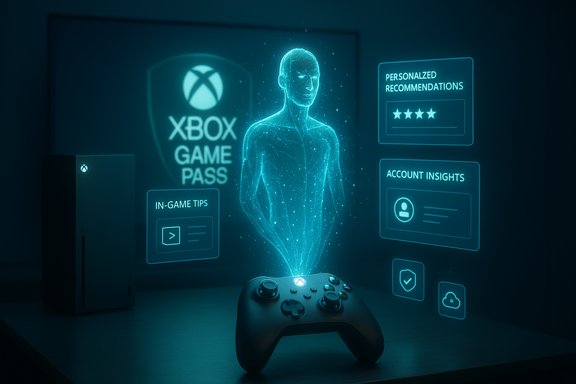
Microsoft is quietly surveying Xbox users about bolting AI straight into Xbox Game Pass — and the options it floated tell you a lot about where Microsoft thinks gaming services should go next: in‑game assistance, post‑game performance analysis, voice interaction with Copilot, personalised discovery, and account‑level insights are all on the table. The survey — surfaced on Reddit and reported by Pure Xbox — asked users which of these five AI capabilities they’d actually use, and the early reaction from the community was revealing: skepticism and resistance sit alongside cautious interest.
Microsoft’s Copilot branding has been moving from productivity suites into Windows and Xbox ecosystems for more than a year, and the company has already shipped a Gaming Copilot experience in the Game Bar and the Xbox mobile app as part of a staged beta. That existing Copilot footprint is relevant context for this Game Pass survey: it shows Microsoft is testing the market for service‑level AI features — not just device overlays — that could become part of a subscription product rather than a single app. Independent coverage and Microsoft rollout notes confirm Copilot’s Game Bar and mobile presence and the kinds of features Microsoft has been experimenting with. The Pure Xbox report reproduces the survey text and a small community poll of readers, which lists the five candidate features and a sixth option — “None of these.” That small poll (51 votes) skewed heavily toward “None,” with 27% of respondents rejecting all five options, while in‑game assistance and personalised recommendations registered the most interest among supporters. These early numbers are anecdotal and limited in scale, but they provide a useful snapshot of sentiment among an engaged Xbox audience.
Source: Pure Xbox https://www.purexbox.com/news/2025/...atures-that-could-be-added-to-xbox-game-pass/
 Background / Overview
Microsoft’s Copilot branding has been moving from productivity suites into Windows and Xbox ecosystems for more than a year, and the company has already shipped a Gaming Copilot experience in the Game Bar and the Xbox mobile app as part of a staged beta. That existing Copilot footprint is relevant context for this Game Pass survey: it shows Microsoft is testing the market for service‑level AI features — not just device overlays — that could become part of a subscription product rather than a single app. Independent coverage and Microsoft rollout notes confirm Copilot’s Game Bar and mobile presence and the kinds of features Microsoft has been experimenting with. The Pure Xbox report reproduces the survey text and a small community poll of readers, which lists the five candidate features and a sixth option — “None of these.” That small poll (51 votes) skewed heavily toward “None,” with 27% of respondents rejecting all five options, while in‑game assistance and personalised recommendations registered the most interest among supporters. These early numbers are anecdotal and limited in scale, but they provide a useful snapshot of sentiment among an engaged Xbox audience. What the survey actually asked
The survey phrasing reproduced by Pure Xbox is straightforward and framed as a simple selection task: “Imagine that Game Pass introduced some AI capabilities and features. Which of these would you be most likely to use? (select all that apply.” The five candidate capabilities were:- In‑game assistance (tips, walkthroughs)
- Post‑game performance analysis
- Voice mode (interacting with Copilot using voice commands)
- Personalised game recommendations
- Game & account insights (achievements, Gamerscore, Game Pass status)
- None of these
Why Microsoft would ask this — strategic rationale
Microsoft is building an ecosystem where discoverability, retention and value‑added services matter as much as first‑party titles. The architecture makes sense if you view Game Pass as the core of a larger engagement funnel:- Game Pass is a subscription platform where improved discovery and personalised suggestions can increase playtime and perceived value.
- AI‑driven in‑game assistance reduces friction for new players and lowers churn on complex games.
- Post‑game analysis and account insights create tangible metrics of value for completionists and competitive players.
- Voice Copilot interactions fit Microsoft’s broader Copilot push across Office, Windows and the Xbox mobile app, creating a consistent brand experience.
Feature‑by‑feature analysis: what each option would mean in practice
1. In‑game assistance (tips, walkthroughs)
In‑game assistance is the most literal application of Copilot for players who want low‑friction help. Tactics could include context‑aware hints, screenshot analysis, or step‑by‑step walkthroughs accessible without alt‑tabbing.- Benefits:
- Keeps players immersed by avoiding external searches.
- Helps newcomers learn complex systems faster.
- Supports accessibility through voice and visual explanations.
- Risks:
- Spoilers: poorly calibrated hints can spoil narrative beats.
- Hallucinations: generative models can produce incorrect or misleading instructions if not grounded in verified data.
- Competitive fairness: in multiplayer or speedrun contexts, live assistance may be controversial.
2. Post‑game performance analysis
Post‑game analysis envisions Game Pass using recorded play data or session summaries (kills, accuracy, objectives completed, build choices) to offer coaching and comparative metrics.- Benefits:
- Valuable to competitive and improvement‑focused players.
- Can drive retention by showing measurable progress and goals.
- Enables community comparison features (how do you stack up against similar players).
- Risks:
- Data privacy concerns about storing or analyzing gameplay and account activity.
- Misleading comparisons if the dataset isn’t sufficiently representative or anonymised.
- Potentially heavy server and storage costs for processing gameplay telemetry at scale.
3. Voice mode (interacting with Copilot using voice commands)
Voice interaction would let players ask Copilot real‑time questions via a headset or controller microphone without breaking immersion.- Benefits:
- Hands‑free queries during gameplay.
- Natural, fast access to help and discovery.
- Aligns with Microsoft’s broader Copilot voice ambitions.
- Risks:
- Ambient noise and voice detection reliability across devices and microphones.
- Latency: cloud‑based recognition and inference might introduce delays.
- Privacy concerns around always‑listening features or misrouted voice data.
4. Personalised game recommendations
This is the least controversial of the five on the surface: smarter discovery built from play history, genres, and achievement patterns.- Benefits:
- Better suggestions increase perceived value of Game Pass.
- Can reduce choice paralysis in large libraries.
- Can surface niche titles users would otherwise miss.
- Risks:
- Poor recommendations damage trust; “bad” personalization harms retention.
- Overfitting to short sessions or certain metrics can produce bland, echo‑chamber suggestions.
- Transparency needs: users should understand why the system recommended a title.
5. Game & account insights (achievements, Gamerscore, Game Pass status)
This covers dashboards and contextual nudges: achievement tracking, completion goals, and Game Pass account status or tier recommendations.- Benefits:
- Clear metrics for completionists.
- Consolidates account information in one conversational interface.
- Can surface tier benefits, upcoming expirations, or suggested upgrades.
- Risks:
- Can feel like feature bloat if presented as mandatory overlays.
- Privacy and data aggregation concerns if third parties can access or infer PII.
- Duplication of existing UI if not designed to add unique value.
Community reaction: why the survey results matter (and why they don’t)
The Pure Xbox reader poll was small (51 votes) but meaningful as a sentiment snapshot: more than one quarter answered “None of these,” indicating a strong contingent that doesn’t want AI grafted onto Game Pass by default. The Reddit thread referenced by the article shows a similar split — vocal opposition to AI being “wedged into everything” is common across gaming communities. That skepticism is rational. Gamers are protective of their hobby’s social rituals: built communities around wikis, shared knowledge, and the thrill of discovery. AI features that short‑circuit those rituals (for example, instantly revealing secrets) can feel like a loss. On the other hand, accessibility advocates and players who want efficient onboarding welcome context‑aware help. Microsoft faces the familiar balancing act: offer optional, clearly controlled AI that augments rather than replaces the community experience.Technical and privacy realities: what needs verification
Several implementation details remain unclear and must be resolved before any Game Pass AI features ship at scale:- Local vs cloud inference — Will analyses and voice recognition run locally on a user’s device (leveraging NPUs where available), in Microsoft’s cloud, or as a hybrid? Hybrid models preserve capability at the cost of sending more telemetry to servers, while local inference reduces data egress but fragments experience across hardware tiers. Early Microsoft messaging and beta tests suggest a hybrid approach for Gaming Copilot, but the exact balance is not public.
- Data retention and training — Will screenshot captures, voice snippets, and performance data be used to train models? Microsoft’s Copilot family documentation has historically offered opt‑outs for training, but retention windows and deletion pathways must be explicit and easy to use if Game Pass features will rely on account data. Until Microsoft publishes a clear privacy summary for any Game Pass AI features, those claims remain provisional.
- Anti‑cheat and competitive policy — How will AI features be restricted in ranked or tournament settings? Tournament organizers and anti‑cheat vendors will need concrete guidance. Microsoft’s Beta gating and age/region restrictions reduce immediate risk but don’t solve policy questions for competitive play.
- Performance and battery — For handhelds and low‑power devices, any always‑on assistant or voice capture system introduces CPU/GPU and battery costs. Microsoft has cited optimizations for handheld partners (e.g., ROG Xbox Ally), but device fragmentation could leave some players with poor experiences.
Practical recommendations for Microsoft (and players)
- Microsoft should adopt an explicit “opt‑in by default” posture for any Game Pass AI features, with clear toggle states exposed at first use and in account privacy settings.
- Provide a concise privacy summary and retention dashboard: exactly what is captured, where it’s stored, and how to delete it.
- Offer granular controls per feature: voice interactions off, screenshot analysis off, personalized recommendations on, etc.
- Create developer/publisher opt‑outs for competitive titles or tournament modes so that AI assistance is not available where it would create fairness issues.
- Prioritise local inference for latency‑sensitive use cases on Copilot+ hardware while maintaining cloud fallback for devices without NPUs.
- Build a “no‑spoiler” mode for narrative titles that limits the specificity of hints and prioritises non‑spoiler guidance.
What this means for Game Pass subscribers
If Microsoft moves from surveying to rolling out Game Pass AI features, members should expect:- New optional UI elements in the Xbox app and Game Bar that surface Copilot‑style assistance.
- Conversation and voice interactions accessible via the Xbox mobile app as a second‑screen option to avoid overlay clutter.
- Optional analytics dashboards for completionists and competitive players — if Microsoft proceeds with post‑game analysis.
- A staged, regional beta rollout initially rather than a global flip — Microsoft has used this approach with Gaming Copilot.
Strengths and risks — final assessment
- Strengths
- Microsoft has the platform control and account signals to make personalised, context‑aware AI genuinely useful at scale.
- Existing Copilot work in Game Bar and mobile provides a tested base of functionality that could be adapted to subscription features.
- Properly implemented, these features can improve accessibility, reduce newcomer friction, and increase Game Pass lifetime value.
- Risks
- Community backlash against forced AI can erode trust and perceived value if features are intrusive or mandatory.
- Privacy, data retention, and training choices must be crystal clear to avoid regulatory and reputational problems.
- Competitive fairness and anti‑cheat compatibility are unresolved and could limit adoption in multiplayer and esports contexts.
- Performance trade‑offs on handheld and lower‑end devices risk fragmenting the experience.
Conclusion
The Pure Xbox‑reported survey is a small but meaningful signal: Microsoft is actively probing the appetite for AI features inside Xbox Game Pass, and the proposed items map tightly to what Copilot already experiments with in Game Bar and the Xbox mobile app. The community reaction is mixed, and rightly so — the balance between convenience, privacy, and the social rituals of play is delicate. If Microsoft turns these survey concepts into product features, success will depend on choice, clarity and restraint: make AI optional, document data use, and build sensible limits for competitive contexts. That way Game Pass can gain genuinely useful, subscription‑level AI without eroding the things players already love about gaming.Source: Pure Xbox https://www.purexbox.com/news/2025/...atures-that-could-be-added-to-xbox-game-pass/
