

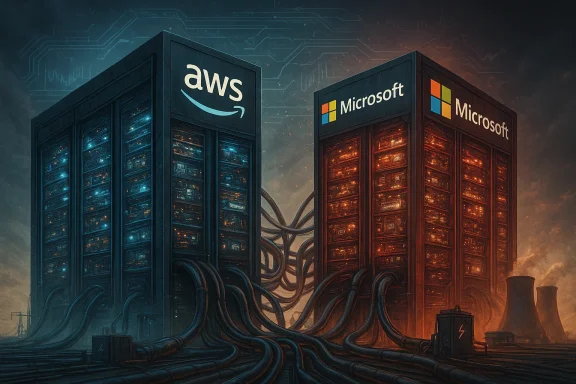
Doug O’Laughlin’s blunt verdict landed like a line-drive: “Microsoft’s not in the race. Where are they? They’re getting owned.” That soundbite — from a full interview O’Laughlin gave on TBPN earlier this month — has rippled through the tech and investor communities because it packages a wider, urgent argument: the AI era is now an infrastructure arms race, and in that contest Microsoft’s partnership with OpenAI may not be enough to offset rivals’ massive spending and raw data‑center scale.
The debate that O’Laughlin stirred isn’t just punditry. Over the last year hyperscalers have escalated capital expenditure to build the physical backbone for generative AI: datacenters, liquid‑cooling systems, power hookups measured in megawatts and gigawatts, and custom silicon. The scale of that commitment hit a new headline figure in early February when Amazon announced it expects to invest about $200 billion in capital expenditures in 2026 — a jumbo bet on AI, chips, logistics automation and satellites that rattled markets and pushed investors to reassess winners and losers in the next decade of computing.
That spending wave has two immediate effects. First, it creates a pronounced advantage for the company that can reliably execute multi‑gigawatt datacenter builds and keep them on schedule. Second, it stresses the semiconductor supply chain — especially advanced AI accelerators and advanced packaging — raising the chance that compute becomes the bottleneck rather than software. Both of those dynamics are central to O’Laughlin’s critique of Microsoft and his praise for AWS.
O’Laughlin’s specific praise — that “every example we track in the data center, they are on time and can scale to levels that are crazy” — is rooted in SemiAnalysis’s datacenter monitoring. He framed AWS as the one hyperscaler that can routinely execute gigawatt‑scale deployments on schedule, an advantage that compounds over time because steady construction avoids the stop‑start inefficiencies that hobble rivals during high‑demand cycles. If AWS can keep projects “ish on time” while others slip, the operational edge quickly translates into capacity, customer commitments, and sunk‑cost rigor.
But O’Laughlin’s critique is surgical: he isn’t saying Microsoft lacks software savvy; he’s saying Microsoft may be underinvesting (or under‑executing operationally) on the raw infrastructure front relative to Amazon and perhaps Google. In an environment where physical GPU capacity and data‑center density shape who can train the biggest, most performant models fastest, product wins may hinge on unglamorous engineering — racks, power, and procurement.
But the race is not a single‑front winner‑take‑all contest. Amazon’s $200 billion capex reveals a willingness to stake the company’s future on scale and custom silicon; Microsoft’s higher free cash flow and its commercial integration with OpenAI give it resilience and alternative routes to market. Both strategies carry upside and real risks.
The next 12–24 months will be defined by who converts capital into reliably cheaper, faster compute and who can translate compute advantage into enduring, profitable customer relationships. Keep watching execution metrics — datacenter timelines, train‑time availability, chip commitments and utilization — because in this phase of AI, the devil is in the wires, the transformers, and the server racks.
Source: AOL.com SemiAnalysis President Says Microsoft Is 'Getting Owned' In AI Race, Praises AWS Scale
 Background
The debate that O’Laughlin stirred isn’t just punditry. Over the last year hyperscalers have escalated capital expenditure to build the physical backbone for generative AI: datacenters, liquid‑cooling systems, power hookups measured in megawatts and gigawatts, and custom silicon. The scale of that commitment hit a new headline figure in early February when Amazon announced it expects to invest about $200 billion in capital expenditures in 2026 — a jumbo bet on AI, chips, logistics automation and satellites that rattled markets and pushed investors to reassess winners and losers in the next decade of computing.That spending wave has two immediate effects. First, it creates a pronounced advantage for the company that can reliably execute multi‑gigawatt datacenter builds and keep them on schedule. Second, it stresses the semiconductor supply chain — especially advanced AI accelerators and advanced packaging — raising the chance that compute becomes the bottleneck rather than software. Both of those dynamics are central to O’Laughlin’s critique of Microsoft and his praise for AWS.
What O’Laughlin actually said — and why it matters
The quote, in context
Doug O’Laughlin — president of SemiAnalysis, a firm that tracks semiconductors and datacenter construction — was interviewed on TBPN by John Coogan and Jordi Hays. His central thrust: Microsoft’s strategy looks misaligned to the current phase of the race. He claimed Microsoft has allowed product focus (Copilot and other integrated experiences) to overshadow building the raw infra muscle necessary to win sustained generative‑AI market share, calling Microsoft’s pace of model deployment a “skill issue” and saying Satya Nadella has effectively taken the role of “product manager of co‑pilot” rather than operating as a CEO with a multi‑front infrastructure playbook. Those words were emphatic on a public tech podcast and they reflect a view widely debated in analyst circles.Why the quote landed
O’Laughlin’s remarks are consequential because they’re not directed at user features or marketing finesse — they’re about the supply chain and physical execution that underpin AI. In an era where training ever‑larger models consumes tens of petaflop‑days and requires dense racks of accelerators, the ability to build and power datacenters at scale — and to secure chips to populate them — can determine which provider offers the best price/performance and uptime to enterprise and AI customers. That’s the level at which O’Laughlin argues Microsoft is being “owned.”AWS’s scale: execution, power, and the $200 billion bet
AWS: a capacity advantage turned into an economic lever
Amazon’s $200 billion capex guidance for 2026 is the most visible expression of the big‑tech chase for AI infrastructure. The pledge isn’t pure flash: it follows a quarter where AWS reported accelerating growth and said its custom silicon business (Graviton + Trainium) exceeded a multibillion‑dollar run rate. From Amazon’s perspective, building ahead of demand makes sense when customers contract for backbone capacity and long‑term commitments exist — but it also forces the company to assume near‑term earnings risk while it provisions long‑lived assets. Markets reacted to that risk as much as to the scale: shares sold off on the announcement.O’Laughlin’s specific praise — that “every example we track in the data center, they are on time and can scale to levels that are crazy” — is rooted in SemiAnalysis’s datacenter monitoring. He framed AWS as the one hyperscaler that can routinely execute gigawatt‑scale deployments on schedule, an advantage that compounds over time because steady construction avoids the stop‑start inefficiencies that hobble rivals during high‑demand cycles. If AWS can keep projects “ish on time” while others slip, the operational edge quickly translates into capacity, customer commitments, and sunk‑cost rigor.
The numbers: $200B is both a moat-builder and a balance‑sheet stressor
Amazon’s announcement sits at the heartbreak point of any capital‑intensive strategy: it can accelerate market share and lock customers into a superior cost structure, but it pressures free cash flow and invites blunt investor questions about returns. The company defended the plan by pointing to strong AWS demand and a growing backlog of commitments; critics worry it could amplify margin and cash‑flow volatility if utilization or monetization doesn’t match the pace of build. That tension is real and will shape AWS’s competitive posture through 2026 and beyond.Trainium, NVIDIA, and the compute tug‑of‑war
Custom silicon as a strategic fulcrum
Amazon’s bet includes a bigger role for its in‑house silicon: Trainium (for training) and Inferentia/Graviton (for inference and CPU workloads). AWS argues these chips give it better price/performance for certain AI workloads, and the company has repeatedly said much of Bedrock’s inference is already running on Trainium. But there’s a nuance: cloud providers still need GPUs — particularly NVIDIA — for high‑end training and certain model types, and those GPUs remain in extremely tight supply. O’Laughlin’s warning that “a meaningful amount” of Amazon’s spending will flow to NVIDIA because of Trainium constraints captures this two‑track reality: custom silicon is scaling fast, but it won’t — and probably shouldn’t — replace GPUs overnight for some workloads.Supply constraints and the market ripple
Multiple vendor briefings and industry reporting suggest Trainium3/Trainium2 supply constraints are real: AWS says much of its Trainium3 supply is committed into mid‑2026, and other sources report high demand for NVIDIA’s Blackwell/H-series GPUs and limited advanced packaging capacity at foundries. The result is a classic supply‑demand squeeze: hyperscalers that can secure advanced accelerators early gain the ability to run bigger pre‑emption‑resistant training campaigns and offer differentiated economics to model builders. This squeeze benefits incumbents who either have direct alliances with chip vendors, advanced foundry relationships, or very deep pockets to outbid others.Microsoft’s position: partnership with OpenAI versus raw infra scale
Two layers of Microsoft’s strategy
Microsoft’s strength in the last two years has been a hybrid approach: a deep commercial partnership with OpenAI, integration of GPT‑style models into Microsoft 365 and its developer stack, and Azure as the enterprise cloud with global reach. That strategy has produced strong product momentum and meaningful pricing leverage for Microsoft’s software suite.But O’Laughlin’s critique is surgical: he isn’t saying Microsoft lacks software savvy; he’s saying Microsoft may be underinvesting (or under‑executing operationally) on the raw infrastructure front relative to Amazon and perhaps Google. In an environment where physical GPU capacity and data‑center density shape who can train the biggest, most performant models fastest, product wins may hinge on unglamorous engineering — racks, power, and procurement.
The OpenAI wild card
Microsoft’s relationship with OpenAI is a commercial and strategic asset that can shortcut some of the competitive problems O’Laughlin describes: access to leading models, distribution into enterprise suites, and a shared roadmap for applied AI. Yet that relationship does not obviate the need for Microsoft to ensure it has the infra flexibility and vendor diversification that a multi‑model world demands. If OpenAI or other partners expand relationships with multiple clouds, or if their compute appetite outstrips what Microsoft can deliver, the partnership’s advantage could erode. Analysts and investors are watching closely for signs Microsoft is hedging that risk or doubling down on infra.Money and discipline: the BNP Paribas counterpoint
Cash flow counts in a capital race
Not everyone agrees that raw capex alone will decide the race. BNP Paribas analyst Stefan Slowinski’s note — picked up in financial press — argues Microsoft’s free cash flow discipline gives it a defensive advantage. Slowinski projects Microsoft’s free cash flow margins could be near 22%, compared with ~5% or lower for many peers, implying Microsoft can sustain heavy software‑led product bets and navigate capex volatility more safely than rivals. That counterbalances the narrative that the biggest spenders will automatically win: efficient capital allocation and high margins matter too.How to balance the two views
The truth probably sits between the extremes. Scale and timeliness in building compute matter — but so do disciplined economics and profitable service monetization. Amazon can out‑build rivals, but if utilization or pricing proves weaker than expected, the same scale becomes a drag. Microsoft can stay more financially conservative, but if it repeatedly cannot supply the compute its customers require, market share in certain AI segments (large‑model training, low‑latency agent orchestration at hyperscale) could slip. Investors will price both scenarios aggressively, hence the market volatility around these stories.Technical realities for enterprises and model builders
Practical constraints that shape adoption
- Power and cooling. High‑density GPU clusters need new electrical substations, advanced cooling — sometimes liquid immersion — and grid agreements that take months to negotiate. A company with established relationships and construction discipline converts these physical constraints into faster deployment.
- Advanced packaging and foundry capacity. Cutting‑edge accelerators rely on scarce CoWoS/advanced packaging slots. Vendors with preferential foundry access or early slot reservations have a throughput advantage.
- Model portability and orchestration. Enterprises increasingly prefer cloud‑agnostic training workflows (orchestration layers, model sharding across sites). But multi‑datacenter training is complex: network topologies, straggler mitigation, and fault tolerance add engineering burden. Providers that reduce that integration cost win developer mindshare.
The developers’ perspective
For AI platform teams, the key questions are straightforward:- Where can we get compute that is cost‑effective today?
- Where will that compute be reliably available for multi‑month training runs?
- How portable will our models be if we need to move between clouds to chase capacity or pricing?
Strengths and risks: a candid assessment
Strengths on each side
- AWS/Amazon
- Execution at scale. SemiAnalysis and other trackers credit AWS with consistent on‑time datacenter execution — an operational moat in a capital‑intensive race.
- Custom silicon momentum. Trainium and Graviton give AWS price/performance advantages for many workloads and reduce GPU dependence over time.
- Full‑stack leverage. E‑commerce revenue and advertising monetization provide Amazon optionality to cross‑subsidize infra buildouts if needed.
- Microsoft
- Commercial integration. Deep integration of OpenAI’s models into Microsoft 365, developer tooling, and enterprise agreements creates stickiness and recurring revenue streams.
- Financial discipline. Higher free cash flow margins give Microsoft greater optionality to invest strategically without destabilizing its balance sheet.
Risks and blind spots
- AWS/Amazon
- Capex gamble. $200 billion is enormous: if utilization, pricing, or monetization disappoints, Amazon faces a multi‑year drag on free cash flow and investor trust.
- Supply chain exposure. Heavy reliance on third‑party GPUs and foundry packaging can create bottlenecks that delay capacity realization.
- Microsoft
- Possible underinvestment in raw infra. If Microsoft’s deployment cadence lags and OpenAI (or customers) demand multi‑gigawatt training environments, it risks being a distribution and software leader without the deepest compute moat.
- Partnership concentration risk. A strategy narrowly built around one model provider (OpenAI) can be powerful — until counterparties diversify or change terms. Microsoft needs hedges to avoid vendor concentration risk.
Likely scenarios and what to watch next
Scenario A — AWS converts scale into market share (probable moderate)
If AWS continues to execute datacenter builds on schedule, monetizes Bedrock and Trainium aggressively, and keeps supply lines for GPUs steady, it will win a larger share of model training contracts and become the de facto infrastructure partner for many large labs and companies. That outcome rewards the $200 billion bet — but only if utilization follows. Watch AWS utilization rates, Bedrock token economics, and long‑term contract penetration.Scenario B — Microsoft defends through product and economics (probable moderate)
Microsoft doubles down on product integration, exclusive models, enterprise bundles and price/performance optimizations that let it retain and grow high‑value corporate accounts. Financial discipline and sticky software revenue allow Microsoft to outmaneuver slower rivals when the dust settles. Watch indicators like Azure AI capacity announcements, multi‑datacenter training benchmarks, and Microsoft’s disclosures about hardware procurement or third‑party alliances.Scenario C — Splintered market and vendor specialization (plausible)
We could end up with a fractured market where different clouds win in different workloads: AWS for ultra‑large training and enterprise inference at scale; Microsoft for productivity AI and enterprise SaaS integration; Google for model research and specialized TPU workloads; and niche players serving vertical markets with specialized hardware. This outcome would favor interoperability, open orchestration layers, and model portability. Watch industry moves toward cross‑cloud model standards and the emergence of orchestration vendors.Practical takeaways for IT leaders and investors
- For IT leaders: prioritize hybrid strategies that avoid single‑cloud lock‑in while negotiating firm capacity commitments with your cloud providers. Expect price and availability fluctuations; plan training calendars with buffer windows.
- For procurement: insist on concrete SLAs around capacity, maintenance windows, and preemption. If a provider claims “gigawatt readiness,” get the build‑schedule and proof points.
- For investors: watch free cash flow trajectories, backlog/revenue conversion rates for long‑term capacity deals, and the mix of in‑house versus third‑party accelerators. A capital‑heavy lead can produce returns, but only if monetization follows.
Conclusion
Doug O’Laughlin’s assertion that Microsoft is “getting owned” is a useful provocation: it reframes the AI competition from being only about models and algorithms to being about the plumbing beneath them. Execution on datacenter construction, access to advanced accelerators, and the ability to monetize that capacity are just as critical as product innovation.But the race is not a single‑front winner‑take‑all contest. Amazon’s $200 billion capex reveals a willingness to stake the company’s future on scale and custom silicon; Microsoft’s higher free cash flow and its commercial integration with OpenAI give it resilience and alternative routes to market. Both strategies carry upside and real risks.
The next 12–24 months will be defined by who converts capital into reliably cheaper, faster compute and who can translate compute advantage into enduring, profitable customer relationships. Keep watching execution metrics — datacenter timelines, train‑time availability, chip commitments and utilization — because in this phase of AI, the devil is in the wires, the transformers, and the server racks.
Source: AOL.com SemiAnalysis President Says Microsoft Is 'Getting Owned' In AI Race, Praises AWS Scale
