

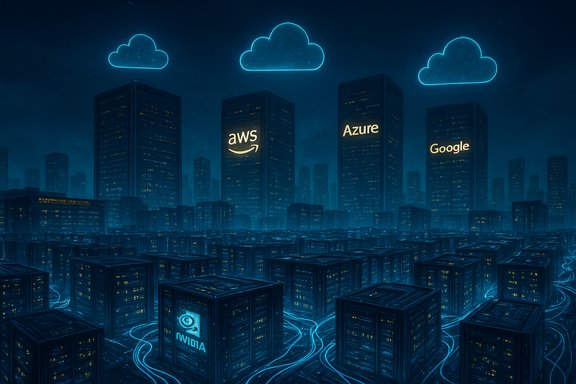
The AI infrastructure wars are no longer a forecast — they are the single largest capital race in modern technology, and the companies that supply the compute, the clouds, and the specialized silicon are already reshaping markets, policy and investor portfolios around the world.
Background: what the TechGraph piece argues — and why it matters
The provided analysis frames the AI opportunity as a “picks-and-shovels” story: while generative models and end-user apps headline the headlines, the fundamental value and long-term returns will accrue to the infrastructure layer — GPUs, custom AI accelerators, hyperscale clouds and the data centers that host them. The piece singles out four U.S. giants — Nvidia, Amazon (AWS), Microsoft (Azure) and Google (Cloud + TPUs) — as the core winners with the biggest moats and the most runway. It argues that despite stretched valuations, each company still has room to run because of entrenched ecosystems, massive capital expenditure plans, and structural demand for compute.That framing is useful for investors and technologists alike: infrastructure is less visible but more durable than hype-driven applications. It also raises the practical question behind every allocation decision: are the market prices already discounting future growth, or is there still meaningful upside given the scale of the AI opportunity?
Overview: the current state of play in AI infrastructure
The industry has moved past proof-of-concept spending into full-scale buildouts. Over the past 18 months the hyperscalers and chip makers shifted from experimentation to heavy industrialization — ordering fleets of accelerators, building new datacenter regions, and committing programmatic capital to AI-first architectures.- Nvidia remains the dominant supplier of general-purpose AI accelerators for training and many inference workloads; its developer platform and software stack create deep switching costs.
- AWS and Microsoft Azure remain the two largest cloud builders, each tying infrastructure investments to enterprise distribution and model deployment services.
- Google is pursuing vertical integration — pairing its own silicon (TPUs) with Gemini models and Google Cloud capacity as a vertically optimized alternative to GPU-first stacks.
- Capital spending across the largest technology firms escalated into the high hundreds of billions in 2025, with industry tallies showing combined AI and datacenter capex in the early hundreds of billions for the year.
Nvidia: the modern steam engine — scale, software, and the limits of competition
Nvidia’s position: hardware + ecosystem
Nvidia sits at the center of most AI compute conversations for two reasons: its accelerators power an overwhelming share of large-model training, and its CUDA ecosystem ties workloads, libraries and developer tooling to its hardware. That combination — hardware ubiquity plus software lock-in — is what industry participants call a moat.- The company’s share of the most relevant AI GPU segments has repeatedly been reported in the high 80s to 90s percent range, depending on the metric and time window. Those figures reflect shipments and revenue concentration in modern training and inference workloads.
- Nvidia has also expanded from silicon into systems, software frameworks, networking, and partnerships with cloud providers that install and resell its GPUs as managed services.
Why that dominance matters
- Network effects in development: frameworks, tuned kernels and ecosystem integrations accumulate. Enterprises and researchers building and optimizing model stacks typically build on widely supported runtimes, making migration expensive.
- Pricing power and supply leverage: for much of the AI ramp Nvidia’s products were capacity-limited, which accentuated pricing power and created long-term customer commitments.
- Rapid product cadence: architectures optimized for tensor compute and very large models (multiple generational leaps in performance) have kept Nvidia ahead on benchmarks that most hyperscalers care about.
But the moat isn’t absolute
- Export controls, geopolitics and national-level chip programs matter. Restrictions on certain high-end exports to specific markets (notably China) have changed demand flows and opened room for localized alternatives.
- Competitors like AMD or Arm-based accelerators, plus specialized ASIC or FPGA players, are investing aggressively. While they are small today in the highest-end training segment, they can claim niches (cost-sensitive inference, edge, domain-specific accelerators).
- Software ecosystems and model architectures evolve. If an efficient new runtime or cross-platform standard reduces switching costs, Nvidia’s dominance could be eroded over time.
Amazon Web Services and Microsoft Azure: the cloud duopoly that fuels scale
The cloud layer is the new real estate
If GPUs are the engines, AWS and Azure are the global distribution and delivery platforms. They offer elastic capacity, managed services, model deployment pipelines and enterprise relationships that convert compute into recurring revenue.- Market share measurements vary by methodology — but across major market trackers AWS and Microsoft Azure together control a clear majority of global cloud infrastructure revenue. The precise shares vary across IaaS, PaaS and cloud service definitions, but both companies lead with wide gaps vs. smaller providers.
- Both companies are not just leasing GPUs; they are building software stacks (model marketplaces, model inferencing services, MLOps tooling), custom chips and strategic partnerships that integrate AI into enterprise customer contracts.
Financial and strategic investments
- Hyperscalers moved from defensive to offensive capex in 2025: multi-year budgets scaled to tens of billions per company for AI-focused datacenter, networking and energy upgrades.
- AWS announced multi‑billion-dollar plans to expand AI and supercomputing offerings for government and commercial customers; Microsoft’s fiscal commitments also moved into the tens of billions to underpin Azure capacity and enterprise AI bundles.
The competitive implications
- AWS’s breadth and neutral-platform positioning give it wide enterprise adoption, while Microsoft’s tight integration of AI with Microsoft 365 and enterprise software creates stickiness within business workflows.
- Both companies benefit from diversified revenue bases (they can cross-sell AI services to existing customers), reducing execution risk relative to pure-play AI vendors.
Risks and constraints
- Cloud pricing pressure: greater competition and enterprise cost sensitivity may compress margins on GPU rental services even as utilization rises.
- Regulatory and antitrust attention: combined market power invites scrutiny that can increase compliance costs or limit business flexibility in certain jurisdictions.
Google: vertical integration and the TPU play
The strategy: co-design models and silicon
Google’s strategy diverges from the GPU-first world. It builds TPUs (Tensor Processing Units) — custom accelerators designed for the specific arithmetic patterns of large language and multimodal models — and pairs them tightly with Gemini models and Google Cloud. This vertical integration offers two structural advantages:- Performance per dollar and energy: TPUs are tuned to Google’s model architectures; for certain training and inference workloads they can be more energy-efficient and cost-effective than general-purpose GPUs.
- Control over the stack: owning both model and silicon allows Google to optimize across software, data center design, networking and even cooling — squeezing out efficiency that third-party hardware can’t match.
TPU technical trajectory
- TPU generations (v5p and successors) increased per-chip FLOPS, HBM (high-bandwidth memory) capacity and interconnect performance, enabling large-scale pods optimized for very large models.
- Google’s TPU roadmap is focused on system-level scaling (pods, optical interconnects, power and cooling design) and algorithmic optimizations to lower total training cost of ownership for the models it trains.
Market and enterprise implications
- Google can offer unique value to customers who want Gemini-class models and low-latency inference tightly coupled to Google Cloud services.
- For enterprises that want to avoid vendor lock-in to Nvidia’s CUDA ecosystem, the TPU + Gemini stack creates an alternative that is compelling for certain workloads.
Limits to the approach
- Vertical integration is capital and execution intensive. Success depends on Google’s ability to continue running best-in-class models and to make TPU access attractive for external customers.
- Cross-platform migration costs still exist: customers entrenched in GPU-based workflows will not transition overnight.
Market dynamics, capex and the macro backdrop
Massive spending, long time horizons
The hyperscalers and chipmakers escalated capex in 2025: industry tallies placed combined lab and datacenter spending in the high hundreds of billions. That scale matters — it both builds durable competitive advantages and loads balance sheets with long-duration investments.- Capital intensity creates a barrier to entry: building modern hyperscale GPU/TPU farms requires real estate, power infrastructure, specialized networking, supply agreements and multiyear contracts with hardware vendors.
- The spending wave also has multiplier effects: power demand, data-center construction, networking gear and associated services all grow alongside compute capacity.
Macro: interest rates, Fed moves and valuation sensitivity
Short-term public market moves remain sensitive to macro liquidity. Expectations for central bank easing historically lift risk assets; conversely, tighter-than-expected monetary policy can produce sharp volatility in richly valued names. During late-2025 the Federal Reserve’s decisions and markets’ pricing of rate cuts materially influenced equities and tech multiples.- Markets priced different probabilities for policy moves; the Fed’s December 10 policy decision in 2025 materially affected sentiment around growth names.
- For long-term investors, policy-induced volatility is an opportunity to focus on fundamentals: cash flows, margin sustainability, capital efficiency, and product differentiation.
Investment thesis for long-term investors — reasons to own (and reasons to be cautious)
Why the case to own these companies remains compelling
- Structural demand: every modern enterprise and government wants scaled AI capability. That creates durable demand for compute and cloud services that can feed growth for years.
- Moats and network effects: CUDA and Nvidia’s software stack, Azure’s enterprise integrations, AWS’s breadth, and Google’s vertical co-design are real economic moats that justify premium valuations for companies that sustain them.
- Dollar-denominated diversification: for non-U.S. investors, long-term holdings in these giants provide a hedge against local-currency depreciation and exposure to global innovation cycles.
- Real revenue growth: unlike earlier tech bubbles centered on promise rather than profit, today’s AI leaders are posting sizable revenue and margin improvements driven by real orders and customer commitments.
Why the valuations demand scrutiny
- Price already reflects the future: markets have bid up valuations to levels that assume sustained, very high growth. Mistakes in execution, regulatory setbacks, or slower-than-expected enterprise adoption would force re-pricing.
- Concentration risk: Nvidia, AWS and Azure are big enough that a portion of market upside requires continued dominance. Competitive shocks or commoditization in some layers would magnify downside.
- Execution risk on capex: large buildouts can be costly and delayed; poor utilization or demand mismatches could compress returns on invested capital for years.
- Geopolitics and export controls: restrictions on high-end accelerators to specific countries materially change addressable markets and growth trajectories.
Practical framework for portfolio-minded investors
When allocating to the AI infrastructure layer, consider a disciplined, multi-vector approach rather than a binary bet on a single name.- Core-plus-satellite: place core allocations in broader, diversified exposures (leading cloud providers, or broad technology ETFs) and use satellite positions for concentrated bets (Nvidia, specialized chipmakers).
- Valuation discipline: prefer incremental purchases over lump-sum buys and avoid paying top-of-cycle premiums for multi-year returns.
- Time horizon: this is a long-duration trend. Expect volatility and adopt a multi-year investment horizon if targeting infrastructure winners.
- Risk controls: position size limits, periodic rebalancing and scenario analysis (e.g., slower enterprise adoption) help manage drawdown risk.
- Monitor the inputs: watch capex guidance, hyperscaler utilization rates, supply chain indicators (TSMC capacity, packaging lead times) and regulatory developments that can change competitive dynamics quickly.
Critical analysis: strengths, blind spots and open questions
Notable strengths in the current landscape
- Real monetization today: cloud providers and chipmakers are not betting on a distant future — large contracts, service revenue and enterprise deployments show tangible monetization now.
- Multiple competitive moats: each major player has distinct defensible assets — Nvidia’s compute software stack, AWS’s ecosystem breadth, Microsoft’s enterprise software integration, and Google’s hardware-software co-design.
- Scale advantage: scale begets more scale in AI: larger datasets, more efficient model training, and deeper sales relationships create positive feedback loops.
Important blind spots and risks
- Over-concentration in a single hardware paradigm: the market is still adjusting to whether GPU-centric stacks or vertically integrated TPU-like approaches become the dominant standard for large-model training.
- Economic sensitivity of capex: when macro conditions deteriorate, hyperscalers could slow expansion, creating short-term demand shocks for chip makers and data center builders.
- Regulatory fragmentation: stricter export controls, antitrust probes or local data-sovereignty rules could fragment global markets and raise compliance costs.
- Commoditization of parts of the stack: commoditization risk exists for lower-margin services (GPU rental, basic inference), potentially compressing profitability even as overall revenue grows.
Unverifiable or rapidly changing claims — flagged
- Any single-point estimate of market share or market capitalization is a snapshot and can change by the day. Reported figures for share (e.g., “92% of the data center GPU market”) depend on the metric used (shipments vs. revenue vs. active installed base) and the measurement window. Treat single-number claims as indicative rather than definitive.
- Price targets and probability estimates tied to specific policy events (e.g., odds of a particular Fed cut on a given date) are inherently ephemeral; they are useful for contextualizing short-term risk but do not substitute for company-level fundamentals.
Where the contest moves next: plausible scenarios for the next 24 months
Scenario A — “Consolidation and scale”: Nvidia, AWS, Microsoft extend leadership
In this outcome, demand for large-model training and inference remains robust, capacity utilization stays high, and enterprises accelerate model deployment. Hyperscalers monetize AI services well, and Nvidia retains strong pricing power. Result: continued multiple expansion for high-quality names, with moderate-to-high revenue growth over the next two years.Scenario B — “Fragmentation and competition”: vertical stacks gain ground
Google’s TPU-led stacks, ARM-based alternatives, or regional suppliers capture meaningful pockets of demand. Customers adopt multi-vendor strategies to reduce vendor risk. Result: improved supplier competition, pressured component pricing, and a re-rating for the highest multiple names — good for customers, mixed for investors.Scenario C — “Policy shock or macro retrenchment”
Geopolitical export restrictions intensify, or global macro conditions push hyperscalers to pause expansion. Capex slows, utilization falls and revenue growth decelerates. Result: rapid multiple compression and higher volatility; long-term winners still survive but returns are delayed.Conclusion: a pragmatic verdict for listeners and readers
The AI infrastructure wars are not a binary contest with a single winner. Instead, they are an industrialization of compute that creates multiple durable franchises: the silicon layer (Nvidia and challengers), the hyperscale cloud layer (AWS and Azure), and vertically integrated model-and-silicon stacks (Google). Each franchise offers a different risk-reward profile.For long-term investors and technologists the key takeaway is straightforward: ownership of the infrastructure layer is a legitimate way to participate in the AI revolution — but it requires discipline. Market valuations have priced in a great deal of good news; the path to multi-year capital appreciation depends on continued execution, efficient deployment of massive capex, and the ability to navigate geopolitics and regulation.
Buying today means buying a stake in the factories, data centers and platform ecosystems that will run the next generation of software. The winners will be those that combine technical leadership with predictable monetization and capital efficiency. The risks are real, but so is the scale of the opportunity. The prudent play is not to chase novelty, but to measure moat durability, balance exposure across hardware and cloud layers, and remain ready to adapt as the architecture of AI compute itself continues to evolve.
Source: TechGraph AI Infrastructure Wars: Do Nvidia, Amazon, and Microsoft Still Have Room to Run? | TechGraph
