

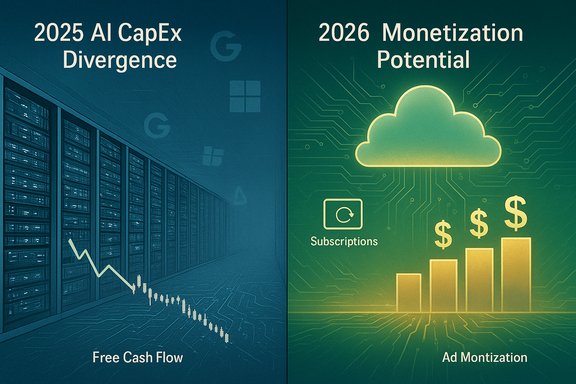
The Magnificent Seven’s 2025 story ended in two distinct tracks: a handful of mega-cap AI beneficiaries surged, while four heavyweights—Apple, Microsoft, Meta and Amazon—looked more like laggards after front‑loaded AI investments depressed near‑term cash flow and stretched investor patience. That divergence is not the same as failure. Instead, it creates a set of measurable inflection points that could turn those 2025 laggards into 2026 winners if capital spending converts into recurring AI revenue, cloud utilization improves, and managements deliver clearer monetization roadmaps.
Markets in 2025 were dominated by an AI investment cycle that blew hot and cold across the Magnificent Seven. The S&P 500 posted a strong gain for the year — roughly mid‑teens territory — yet leadership was heavily concentrated in a small set of names that delivered outsized returns. That left Apple, Microsoft, Meta and Amazon trailing the index in total return terms even as they deployed record capital into data centers, chips and other AI infrastructure. The core dynamic was simple: companies that front‑loaded capital expenditures (CapEx) to build AI capacity impaired near‑term free cash flow and margins, which markets penalized. Conversely, chipmakers and certain ad‑driven platforms that directly benefited from AI workloads and ad monetization enjoyed the opposite effect. The key question for 2026 is whether the balance of evidence will shift from “investment mode” to “monetization mode.”
Strengths:
Strengths:
Investors should therefore treat the next 6–12 months as a rules‑based interrogation of corporate execution. The trade is simple in concept but hard in execution: buy the laggard only after the company proves monetization, and treat headline‑level metrics with skepticism until they are corroborated by company filings and durable revenue recognition patterns. If the infrastructure investments in 2024–2025 convert into sticky, high‑margin, recurring services in 2026, the very stocks that looked like laggards could re‑emerge as multi‑year winners. If they don’t, the market will price them accordingly — quickly and ruthlessly.
In sum, 2026 will be a year for evidence rather than exhortation. The path from build to monetize is wide and well‑lit: look for cash‑flow recovery, enterprise contracts that produce recurring revenue, and clear improvements in unit economics on inference services. Those are the signals that will distinguish the firms that merely invested heavily from the ones that will translate that investment into sustainable shareholder value.
Source: Investing.com How the Mag 7’s 2025 Laggards Could Turn Into 2026 Winners | investing.com
 Background / Overview
Markets in 2025 were dominated by an AI investment cycle that blew hot and cold across the Magnificent Seven. The S&P 500 posted a strong gain for the year — roughly mid‑teens territory — yet leadership was heavily concentrated in a small set of names that delivered outsized returns. That left Apple, Microsoft, Meta and Amazon trailing the index in total return terms even as they deployed record capital into data centers, chips and other AI infrastructure. The core dynamic was simple: companies that front‑loaded capital expenditures (CapEx) to build AI capacity impaired near‑term free cash flow and margins, which markets penalized. Conversely, chipmakers and certain ad‑driven platforms that directly benefited from AI workloads and ad monetization enjoyed the opposite effect. The key question for 2026 is whether the balance of evidence will shift from “investment mode” to “monetization mode.”Why AI CapEx mattered in 2025 — and why it still matters for 2026
The math of front‑loaded infrastructure
When a company spends tens of billions to expand data‑center capacity, design custom accelerators, or pre‑pay for GPU capacity, the accounting impact is immediate: cash outflows spike, and free cash flow can swing negative even while revenue continues to grow. That reality explained much of the 2025 underperformance among several Magnificent Seven names. Investors looking for clean EPS beats and margin expansion were left waiting while companies built the capacity that will host inference workloads in years to come.- CapEx can lead to temporarily negative free cash flow.
- Construction, power provisioning and local permitting introduce execution risk and timing uncertainty.
- The payoff depends on enterprise adoption of metered inference services and high‑margin, seat‑based SaaS models.
Aggregate CapEx and the “AI arms race”
Multiple reports estimated that Big Tech collectively committed hundreds of billions to chips, data centers and storage in 2025 as the AI race accelerated. Amazon publicly signaled a 2025 cash CapEx figure in the ~$125 billion range, a level that structurally compresses quarterly free cash flow until utilization and higher‑margin services ramp. Amazon’s investor materials and supplemental disclosures show that the company’s trailing‑twelve‑month free cash flow fell sharply as purchases of property and equipment ramped. Industry trackers (Synergy/Canalys/CRN reporting) show the hyperscalers preserved dominant cloud shares while growth rates and shares shifted slightly quarter to quarter as Microsoft and Google maintained faster percentage growth rates than AWS in some periods, even as AWS remained the largest provider by revenue. Those market‑share dynamics matter because the cloud monetization pathway depends on scale, customer lock‑in, and the ability to charge for inference.Company-by-company: why each laggard struggled in 2025 — and what would flip the script in 2026
Amazon: infrastructure-heavy, diversified, but cash‑flow‑sensitive
Amazon’s 2025 narrative was dominated by AWS capacity builds, custom silicon (Trainium) investments and mammoth data‑center projects. Management guided full‑year cash CapEx in the ballpark of $125 billion for 2025 — a figure disclosed in company filings and repeated in quarterly commentary — and explained that much of that spend was directed at AI‑grade infrastructure. Those investments depressed trailing free cash flow and produced quarterly swings in FCF metrics that alarmed some investors. Strengths:- AWS remains the largest cloud provider by revenue, and Q3 2025 AWS revenue prints (around $33.0B) show strong top‑line scale.
- Amazon also benefits from multiple, high‑quality revenue engines: retail, advertising, subscriptions and cloud — a diversification that reduces single‑point risk.
- Capital intensity and timing: if demand for inference slows or pricing declines, the returns on these long‑lived assets will be disputed by the market.
- Execution friction on multi‑site data‑center deployments (permits, utilities, local grid capacity).
- Short‑term free cash flow volatility that fuels negative headlines.
- Clear sequential improvement in free cash flow (quarter‑over‑quarter narrowing of CapEx intensity).
- Evidence of sustained AWS margin recovery as GPU utilization rises.
- Concrete enterprise inference contracts and commercial milestones tied to Trainium/Bedrock offerings.
Apple: buybacks, device‑first AI and a cautious infrastructure stance
Apple’s 2025 stock performance lagged the index for a different set of reasons. The company was comparatively conservative on hyperscale AI CapEx in public messaging, emphasizing on‑device AI and its M‑series silicon. That conservatism hurt sentiment among high‑growth investors who favored hyperscaler bets. At the same time, Apple leaned heavily into capital returns. Industry buyback trackers show Apple remains one of the largest repurchasers, but single‑year buyback tallies vary by reporting method — company filings show very large repurchases over rolling 12‑month windows, while some secondary reports have cited single‑year figures that appear to conflate multi‑year totals. Investors should treat unusually large single‑year buyback claims as unverified until confirmed against official SEC filings.Strengths:
- Strong services ecosystem and recurring revenue streams that can be augmented by paid device AI features.
- Immense balance sheet and capacity to deploy opportunistic buybacks to support EPS.
- Tariff and supply‑chain friction in China/India that reduce visibility on unit sales.
- Perception gap: relative lack of hyperscale spending vs. competitors can be read as underinvestment in AI infrastructure, even if Apple’s on‑device path can yield high ARPU outcomes.
- A successful Apple Intelligence rollout that generates clear, monetizable subscription outcomes (higher services ARPU).
- Evidence of a durable iPhone upgrade cycle tied to AI features and new silicon that materially raises device ASPs.
Meta: heavy AI spending, resilient ad engine, and a monetization bet
Meta’s 2025 was perhaps the most dramatic illustration of the trade‑off between front‑loaded investment and near‑term profitability. The company materially increased CapEx and data‑center builds while continuing to invest in Reality Labs and generative AI infrastructure. Reported net income on a headline basis plunged in certain quarters because of those investments and some one‑time accounting items, but core ad revenue growth remained resilient. The market’s reaction was severe, but analysts generally retained constructive views because they expect Meta’s AI investments to improve ad targeting and create new monetizable products (e.g., WhatsApp and Threads monetization, Advantage+ AI tools).Strengths:
- High ad yields, massive user engagement and strong ARPU potential from AI‑driven ad efficiency improvements.
- Heavy analyst support relative to other large caps (consensus opinions remain broadly positive on Meta’s path to monetization).
- Near‑term margin erosion if infrastructure costs persist without offsetting ad pricing improvements.
- Monetization execution risk for new products (Threads, WhatsApp, Reality Labs).
- Stabilizing adjusted profitability metrics (excluding one‑offs).
- Documented adoption and ARPU lift from Advantage+ and other AI ad products.
- Indexed monetization of messaging platforms at scale.
Microsoft: Copilot adoption, Azure AI volumes and steady enterprise monetization
Microsoft’s 2025 performance was muted by visible AI investments — but its position as a platform owner, combined with a deep enterprise footprint and a structured commercial approach to Copilot, makes it the most defensible monetization candidate in the group. Microsoft reported substantial Copilot seat growth and disclosed high levels of enterprise adoption across Fortune customers; by late 2025 the company claimed broad penetration of its Copilot offerings into large enterprises. That combination of distribution and monetizable seat economics is the central argument for Microsoft being a 2026 winner. Strengths:- Distribution advantage: Windows, Microsoft 365, Azure identity stack and enterprise contracts create a durable flywheel for seat‑based monetization.
- Structural balance: Azure captures inference spend while Copilot creates steady recurring revenue per seat.
- Timing mismatch between capex and monetization; Copilot seat economics must scale to offset infrastructure costs.
- Competitive pricing pressure for inference services as other clouds push appliance economics.
- Evidence that Copilot adoption translates into measurable ARPU and customer‑level upsell.
- Azure AI inference volumes rising as a share of cloud revenue, with gross margins improving.
- Clear enterprise case studies that quantify productivity uplift and justify payback.
Hard signals to watch in early 2026 (an investor’s playbook)
Investing in these laggards requires discipline. Here are the measurable confirmation signals that should precede large position increases:- Sequential improvement in free cash flow or a clear narrowing of CapEx intensity for each company. (Trailing‑12‑month FCF trends are the highest‑signal metric for converted infrastructure investments.
- Documented enterprise contract wins or multi‑year AI commitments tied to inference consumption (e.g., named customers with committed $/hour or $/seat volumes).
- Segment margin expansion in cloud or AI product lines (AWS gross margins, Azure gross margins, Meta ad margins).
- Management commentary that tightens CapEx cadence with explicit monetization timelines (not fuzzy “benefits over the long term”).
- No new regulatory or macro shocks that materially alter cross‑border supply chains or product distribution.
Scenario analysis: realistic outcomes for 2026
To frame risk and reward, use three disciplined scenarios per company:- Bull case (fast monetization): AI demand and enterprise adoption scale quickly; CapEx normalizes and margins expand. Result: 20–40% total return driven by EPS growth and multiple expansion.
- Base case (gradual monetization): Monetization occurs but lags; spending normalizes over several quarters; multiple expansion is modest. Result: 5–20% total return.
- Bear case (execution failure): Monetization disappoints, pricing for inference compresses, or regulatory constraints bite. Result: negative returns and possible multiple contraction.
Critical analysis — strengths, blind spots and cautionary flags
Notable strengths across the four laggards
- Deep balance sheets and the ability to fund multi‑year investments without immediate solvency risk.
- Built‑in distribution and sticky enterprise contracts (Microsoft, Apple device ecosystem, Amazon’s retail + AWS + ads, Meta’s ad network).
- Multiple monetization vectors: seat‑based AI (Microsoft Copilot), inference hours (AWS/Azure), ad efficiency gains (Meta), device+services bundles (Apple).
Where claims are overstated or require verification
- Single‑year buyback tallies cited in secondary press can be inconsistent with S&P Dow Jones and company filings. Notably, widely circulated figures for Apple’s 2025 buybacks appear to conflate rolling 12‑month totals with one‑off single‑year numbers; verify against SEC filings and S&P Dow Jones buyback summaries. Flagged as unverified until reconciled with company 10‑Q/10‑K data.
- Precise analyst‑count claims (e.g., “58 of 61 analysts assign Buy to AMZN”) are dynamic and differ across data providers; treat them as directional unless verified through a live FactSet/Refinitiv snapshot. Flagged as variable.
- Exact quarterly free cash flow swings reported by secondary outlets should be cross‑checked to the company’s supplemental earnings worksheets or Form 10‑Q/8‑K filings. Amazon’s IR materials show the broad deterioration in trailing‑12‑month free cash flow, but some single‑quarter negative FCF numbers circulating in commentary need reconciliation with the company’s own definitions and supplemental tables.
Structural risks that could derail a rebound
- Overcapacity: If hyperscale AI capacity growth outpaces demand or model efficiency improvements significantly reduce inference dollars per workload, cloud pricing could compress and undercut infrastructure returns.
- Regulatory pressure: Export controls, antitrust action or restrictions tied to data residency could limit monetization paths for global services.
- Model efficiency: Breakthroughs that drastically lower GPU‑hours per query would alter the beneficiaries; chipmakers and hyperscalers could see a big change in value capture.
Practical guidance for WindowsForum readers and long‑term investors
- For technologists and CIOs: treat Copilot and hyperscaler AI offerings as procurement items that require total‑cost‑of‑ownership modeling. Negotiate reserved capacity, egress terms, and data‑governance clauses. Build governance for model provenance and human‑in‑the‑loop controls.
- For investors:
- Maintain position sizing discipline: don’t let FOMO push a concentrated bet into an outsized allocation.
- Use pairs or hedges: consider pairing a long position in a laggard you like with a short against an overextended leader to hedge market direction risk.
- Prefer milestone‑based additions: add to positions only when high‑signal KPIs (Copilot ARPU, AWS margin recovery, Meta ad ARPU improvement, Apple services ARPU) clear predetermined thresholds.
- Tactical watchlist for Q1–Q2 2026:
- Microsoft: Copilot seat growth, Copilot ARPU, Azure AI inference‑hour growth and cloud gross‑margin trends.
- Amazon: Sequential AWS operating margins, free cash flow stabilization, and commercial adoption of Trainium/Bedrock.
- Meta: ad revenue stability, monetization lifts from Advantage+ and Threads/WhatsApp rollouts.
- Apple: Services ARPU acceleration, any new AI‑centric hardware + software bundles, and verified buyback disclosures.
Final assessment — practical odds and an evidence‑first approach
The Magnificent Seven’s 2025 laggards are not casualties; they are large incumbents in the process of repositioning for a decade‑scale paradigm shift. The most credible pathway to a 2026 re‑rating is straightforward and testable: convert CapEx into recurring AI revenue, demonstrate margin leverage at scale, and produce clearer guidance that normalizes spending cadence. These are measurable outcomes — not slogans — and they can be validated quarter by quarter.Investors should therefore treat the next 6–12 months as a rules‑based interrogation of corporate execution. The trade is simple in concept but hard in execution: buy the laggard only after the company proves monetization, and treat headline‑level metrics with skepticism until they are corroborated by company filings and durable revenue recognition patterns. If the infrastructure investments in 2024–2025 convert into sticky, high‑margin, recurring services in 2026, the very stocks that looked like laggards could re‑emerge as multi‑year winners. If they don’t, the market will price them accordingly — quickly and ruthlessly.
In sum, 2026 will be a year for evidence rather than exhortation. The path from build to monetize is wide and well‑lit: look for cash‑flow recovery, enterprise contracts that produce recurring revenue, and clear improvements in unit economics on inference services. Those are the signals that will distinguish the firms that merely invested heavily from the ones that will translate that investment into sustainable shareholder value.
Source: Investing.com How the Mag 7’s 2025 Laggards Could Turn Into 2026 Winners | investing.com
