

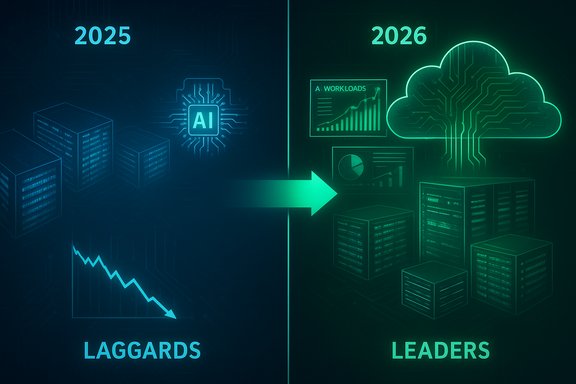
The Magnificent Seven’s narrative for 2025 ended not with a clean sweep but with notable divergences: a handful of the group — Apple, Microsoft, Meta, and Amazon — underperformed broad benchmarks despite pouring unprecedented capital into artificial intelligence and infrastructure, while NVIDIA, Alphabet, and Tesla posted outsized gains. That split leaves these 2025 laggards poised for a potential re-rating in 2026 if AI monetization, cloud scale, and policy clarity fall into place. This feature examines what held those stocks back, what could turn them into winners next year, and the practical risk trade-offs investors must weigh before assuming a “bounce-back” is baked in.
Why that matters: Amazon’s valuation depends on AWS margins and cash generation. Large, upfront spending can temporarily reduce free cash flow and distort near‑term multiples even if the long‑term return on those assets is compelling.
Key point: The spending cadence is intentional — Amazon is building compute capacity at hyperscaler scale to house large models and inference fleets. Those assets are long‑lived, but they take time to monetize.
Caveat: Heavy CapEx implies execution risk. If model demand or pricing for cloud compute softens, Amazon’s returns on this massive outlay would be lower and the stock could remain under pressure.
Two forces pressured sentiment:
Caveat: Some public claims about Apple’s buyback totals for 2025 are inconsistent across outlets. Company filings and quarterlies show heavy repurchases, but multi‑hundred‑billion single‑year buyback figures cited in secondary reports merit scrutiny and, in some cases, appear to conflate cumulative multi‑year repurchases with a single‑year number. Treat unusually large single‑year buyback claims as unverified until confirmed by company filings.
But beneath the headline, advertiser demand remained resilient and Meta continued to report high revenue growth in its core Family of Apps. The market punished the stock because investors feared the heavy AI and Reality Labs outlays would delay margin recovery.
Important nuance: Meta’s results in 2025 included tax and accounting items that amplified the income decline in reported headlines. Adjusted profitability metrics painted a less severe picture for the business’s underlying ad engine.
Investors should approach the 2026 opportunity set with disciplined skepticism. Look for verifiable inflection points — improving free cash flow, durable enterprise deals, and segment margin expansion — before assuming a full re‑rating. At the same time, ignore sensational single‑year figures published without clear supporting filings; always validate headline claims against company releases and quarterlies.
If AI monetization follows the infrastructure cycle, the very companies that looked like 2025 laggards could be among 2026’s big winners. The catch: optimism must be tethered to hard evidence, not wishful thinking.
Source: Finviz https://finviz.com/news/264879/how-the-mag-7s-2025-laggards-could-turn-into-2026-winners/
 Background
The Magnificent Seven in 2025: a two-track market
Markets in 2025 were dominated by AI-driven bets. The S&P 500 finished the year with a strong gain, but leadership concentrated heavily in a few names. Some of the MAG7 — notably NVIDIA, Alphabet, and Tesla — outpaced the index, while others lagged despite large strategic investments. That divergence was driven by several structural forces:- Front-loaded AI capital expenditures (AI CapEx) that depressed near-term free cash flow.
- Record-high valuations that increased expectations and compressed the margin for error on execution.
- Macro uncertainty (interest rates, trade policy) and company-specific hiccups (tariffs, one-time charges).
- Investor rotation dynamics that periodically reward earnings visibility over strategic spending.
Why the 2025 laggards stumbled
Amazon: front-loaded infrastructure and compressed free cash flow
Amazon’s 2025 story was dominated by the infrastructure binge to support generative AI and global cloud demand. AWS investments expanded rapidly — large multi‑billion dollar data center projects, custom silicon (Trainium) deployments, and new regional campuses were announced throughout the year. The net effect: capital expenditures surged, and trailing free cash flow fell sharply in the quarters where spending spiked.Why that matters: Amazon’s valuation depends on AWS margins and cash generation. Large, upfront spending can temporarily reduce free cash flow and distort near‑term multiples even if the long‑term return on those assets is compelling.
Key point: The spending cadence is intentional — Amazon is building compute capacity at hyperscaler scale to house large models and inference fleets. Those assets are long‑lived, but they take time to monetize.
Caveat: Heavy CapEx implies execution risk. If model demand or pricing for cloud compute softens, Amazon’s returns on this massive outlay would be lower and the stock could remain under pressure.
Apple: conservative AI spending and supply-chain noise
Apple’s relative underperformance in 2025 was more subtle. Historically a cash-flow juggernaut with disciplined capital returns, Apple had been slower than some peers to publicize large AI infrastructure spending; its emphasis has been on device-level AI (on‑device models, silicon like the M‑series) and Apple Intelligence initiatives rather than hyperscale data‑center builds.Two forces pressured sentiment:
- Perception of underinvestment in cloud-scale AI compared with Microsoft and Meta, leading growth investors to question Apple’s AI roadmap.
- Operational noise, including tariff uncertainty and supply‑chain sensitivities in key markets, which weighed on near‑term revenue visibility.
Caveat: Some public claims about Apple’s buyback totals for 2025 are inconsistent across outlets. Company filings and quarterlies show heavy repurchases, but multi‑hundred‑billion single‑year buyback figures cited in secondary reports merit scrutiny and, in some cases, appear to conflate cumulative multi‑year repurchases with a single‑year number. Treat unusually large single‑year buyback claims as unverified until confirmed by company filings.
Meta: AI spending, one‑time charges, and ad monetization questions
Meta’s 2025 had a dramatic headline: prior quarter net income figures collapsed relative to the prior year after large, sometimes one‑off charges and unusually high infrastructure spending tied to AI and Reality Labs. The combination produced a sharp year‑over‑year net income swing that alarmed some investors.But beneath the headline, advertiser demand remained resilient and Meta continued to report high revenue growth in its core Family of Apps. The market punished the stock because investors feared the heavy AI and Reality Labs outlays would delay margin recovery.
Important nuance: Meta’s results in 2025 included tax and accounting items that amplified the income decline in reported headlines. Adjusted profitability metrics painted a less severe picture for the business’s underlying ad engine.
Microsoft: AI rollout costs and expectations friction
Microsoft’s 2025 performance relative to the index was muted by substantial, visible AI investments — data center capacity, Azure expansions, and enterprise product integrations like Microsoft 365 Copilot. The company has been evangelistic about Copilot adoption inside the enterprise, and Microsoft executives disclosed high penetration among large firms. Yet investors asked two questions:- Will Copilot and Azure AI translate into persistent, high‑margin revenue growth quickly enough to offset CapEx and R&D?
- How durable is Microsoft’s cloud growth advantage against AWS and Google Cloud when both competitors scale AI offerings aggressively?
What could flip laggards into 2026 winners
Transformation from laggard to leader depends on a handful of repeatable, verifiable catalysts. Below are the most credible paths for each company.1) AI monetization accelerates — conversion of CapEx into revenue
- Companies that invested in 2024–2025 stand to benefit if enterprise adoption of LLM‑driven services and inference workloads expands meaningfully in 2026.
- Practical indicators to watch in early 2026: enterprise bookings tied to AI services, average revenue per customer for cloud/AI contracts, and higher utilization rates in published cloud metrics.
2) Cloud scale and differentiated services
- AWS and Azure both have structural advantages: customer lock‑in, broad service portfolios, and global presence.
- Market share gains or better pricing power on inference workloads would directly lift the operating leverage of Amazon and Microsoft.
3) Product lifts and distribution power (Apple & Microsoft)
- Apple can leverage device sales + services + on‑device AI to increase ARPU and services margins. A large, well‑received upgrade cycle or a new AI‑centric hardware product (e.g., AI silicon in Macs/iPads) would catalyze re‑rating.
- Microsoft’s strength is distribution (Office, Windows, GitHub) and enterprise contracts. Faster-than‑expected Copilot seat growth and large corporate deployments can turbocharge revenue.
4) Buybacks and capital returns (Apple and others)
- Large repurchase programs reduce float and can lift EPS even with modest revenue growth. If buybacks are opportunistic and sustained, they support shareholder returns while strategic investments mature.
5) Macro and market breadth rotation
- If 2026 brings lower rates or broader cyclical growth, investor appetite could shift toward names that underperformed in late‑cycle growth surges.
- A rotation into laggards often coincides with a broader participation across sectors — industrials, financials, and cyclicals — but it can also lift large-cap tech if earnings momentum improves.
Company-by-company 2026 playbook
Amazon — What to watch
- Metrics: AWS revenue growth, gross margins on cloud, incremental margins on Trainium deployments, and free cash flow turning positive as capex cadence normalizes.
- Catalyst: commercialization of inference services and new enterprise AI contracts.
- Risk: overcapacity and lower-than-expected cloud pricing.
Apple — What to watch
- Metrics: Services ARPU growth, iPhone upgrade cycle strength, and progress on Apple Intelligence rollouts across devices.
- Catalyst: a successful hardware + software AI initiative that differentiates on privacy and on‑device performance.
- Risk: supply‑chain or regulatory disruptions in China/India and unverified buyback claims (verify through official filings).
Meta — What to watch
- Metrics: ad revenue growth stabilization, monetization of Threads/WhatsApp, adjusted net income (excluding one‑offs), and Reality Labs cost‑to‑revenue improvements.
- Catalyst: improved ad targeting and new AI products that materially raise ad prices or volumes.
- Risk: prolonged heavy CapEx without commensurate ad monetization.
Microsoft — What to watch
- Metrics: Azure AI workloads as percentage of Azure revenue, Copilot paid seats, and enterprise retention/upsell rates.
- Catalyst: large, multi‑year enterprise deployments and evidence that Copilot materially increases customer spend.
- Risk: slower adoption than projected or margin compression as Microsoft competes on price for AI workloads.
Valuation context and scenario planning
Properly pricing a MAG7 laggard in 2026 requires scenario analysis. Below is a concise three‑scenario framework that investors and portfolio managers can use.- Bull case (fast monetization)
- Assumptions: AI monetization ramps, incremental margins return quickly, macro supports re‑rating.
- Outcome: 20–40% total return for a laggard name as both multiples and earnings rise.
- Base case (gradual monetization)
- Assumptions: Monetization occurs but with lag; capital spending normalizes; multiple expansion modest.
- Outcome: 5–20% total return driven by EPS growth and moderate multiple expansion.
- Bear case (slow/no monetization or execution failures)
- Assumptions: Demand softens, pricing pressure on inference, regulatory or supply shocks.
- Outcome: Negative returns and potential multiple contraction; buybacks insufficient to offset revenue shortfalls.
Risks and red flags
- Execution risk on data center projects: Projects that promise enormous compute capacity depend on local approvals, utility upgrades, and predictable power pricing; any hiccup delays revenue timelines.
- Monetization risk: Use cases that look compelling in demos may not translate to large, recurrent revenue in enterprise procurement cycles.
- Valuation complacency: High multiples priced for perfection leave little room for delays; disappointing guidance will magnify downside.
- Regulatory and geopolitical risk: Trade policies, export controls, and data privacy rules can blunt AI’s scale advantages, especially for companies with heavy China exposure.
- Accounting noise: Large one‑time charges (tax items, restructuring) complicate headline comparisons; investors should focus on adjusted operating metrics while not ignoring cash‑flow reality.
- Unverified claims: Secondary market reporting sometimes misstates single‑year repurchase or capex totals. Always confirm blockbuster numbers against company filings and quarterlies.
Tactical investor playbook — steps and checkpoints
- Re‑evaluate exposure to each MAG7 member using a three‑month check: cloud metrics, AI product KPIs, and cash flow conversions.
- Maintain position sizing discipline: allocate incremental capital to a laggard only if confirmation signals (see step 4) appear.
- Monitor five confirmation signals for each name:
- Sequential improvement in free cash flow or narrowing CapEx intensity.
- Clear enterprise contract wins or multi‑year AI commitments.
- Margins on cloud/AI segments expanding quarter over quarter.
- Management commentary tightening CapEx cadence with clearer monetization timelines.
- No new regulatory or supply‑chain shocks.
- Use stop limits and defined downside thresholds to protect gains or limit capacity-related downside.
- Consider pairs or relative‑value trades: long a laggard vs. short an overextended leader to hedge market‑direction risk.
Why tech diversification still matters
Even within the MAG7, exposures differ: some stocks are primarily infrastructure plays (NVIDIA), others are platforms (Microsoft, Alphabet), while some combine consumer hardware and services (Apple). 2026 is likely to reward companies that transition from investment mode to monetization mode. That makes diversification across the AI stack — chips, cloud, software, and endpoints — more attractive than concentrated bets on momentum alone.- Chips and infrastructure benefit from secular demand if AI workloads remain compute-intensive.
- Cloud providers benefit if they can secure sticky enterprise contracts and competitive differentiated offerings.
- Endpoint and services providers benefit from distribution and high‑ARPU ecosystems.
Final assessment
The MAG7’s 2025 laggards are not dead. They are capital‑heavy, strategically repositioning incumbents that have the balance sheets to make long‑duration bets on AI. The most credible path to a 2026 rebound is straightforward: convert CapEx into recurring AI revenue, demonstrate margin leverage, and quiet investor concerns about cash‑burn through clearer guidance or normalized spending.Investors should approach the 2026 opportunity set with disciplined skepticism. Look for verifiable inflection points — improving free cash flow, durable enterprise deals, and segment margin expansion — before assuming a full re‑rating. At the same time, ignore sensational single‑year figures published without clear supporting filings; always validate headline claims against company releases and quarterlies.
If AI monetization follows the infrastructure cycle, the very companies that looked like 2025 laggards could be among 2026’s big winners. The catch: optimism must be tethered to hard evidence, not wishful thinking.
Source: Finviz https://finviz.com/news/264879/how-the-mag-7s-2025-laggards-could-turn-into-2026-winners/
