

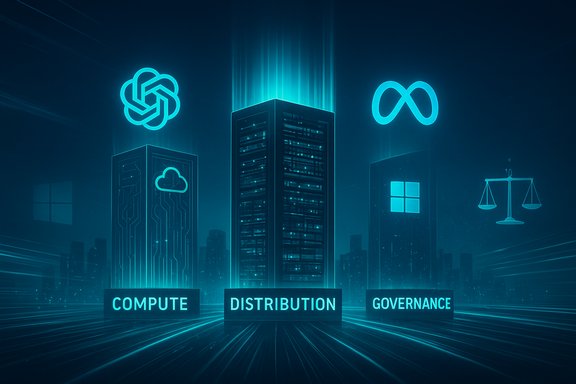
OpenAI’s big moves and Meta’s platform play have pushed the AI market from a scramble for models into a complex web of turf wars, multi‑billion‑dollar partnerships, and regulatory flashpoints—an industry shift that’s visible in three compact themes: compute and infrastructure, distribution and product placement, and the legal/economic rules that will decide winners and losers. What looks like competing headlines and corporate theatre is actually a coherent market restructuring: companies are locking in chips, deals, and distribution channels to convert model capability into durable revenue and control. This piece parses those themes, verifies the major numbers and contractual shifts, and explains what they mean for Windows users, enterprise IT teams, and the broader AI ecosystem.
Background
The generative‑AI era began with model demos and APIs; it has moved quickly toward industrial‑scale deployments and infrastructure commitments. The early winner‑takes‑attention phase—led by OpenAI’s developer momentum—has given way to a hard, capital‑intensive contest over GPUs, data‑center capacity, and who controls distribution. The recent corporate maneuvers expose that contest: OpenAI has launched the Stargate infrastructure program and signed very large cloud agreements, Microsoft has retooled its long‑standing relationship with OpenAI while hardening its product integrations into Windows and Microsoft 365, and Meta has used WhatsApp’s distribution to try to bootstrap its assistant—triggering regulatory action in Europe. These developments are not isolated: they form interlocking strategies that define the early architecture of AI as a commercial market. Several industry summaries and forum analyses have traced the same arc.Three charts worth a thousand words: the structural axes of the AI contest
1) Compute and infrastructure: the race to own capacity
The first big axis is compute. Modern foundational models are extremely costly to train and operate; winning at scale requires access to large, efficient fleets of accelerators plus ample power and datacenter real estate. OpenAI’s response—Stargate—is a direct bet on guaranteed, owned or co‑developed capacity.- OpenAI’s Stargate initiative publicly targets multi‑gigawatt campuses and partnerships that would push the company into a co‑owner/operator role for AI‑specific data centers. The Stargate program, as described by OpenAI, includes commitments that scale to multiple gigawatts and partnerships with Oracle, NVIDIA, SoftBank and others.
- Practical evidence: OpenAI announced a 4.5‑gigawatt expansion with Oracle as part of Stargate and has already begun operating capacity in Abilene, Texas; multiple news outlets have verified new data‑center sites and multi‑GW plans. The 4.5 GW figure and the public announcements are verifiable on OpenAI’s own Stargate updates and reporting by major outlets.
- OpenAI also signed a very large multi‑year cloud consumption agreement with AWS that industry reporting places at roughly $38 billion over seven years; OpenAI and AWS public statements confirm a deep strategic arrangement to provide immediate and growing access to Amazon’s infrastructure and Nvidia‑based racks. That deal underscores how OpenAI is pursuing both owned campus capacity and multi‑cloud contracts to secure short‑ and medium‑term compute.
Verification and caveats: The publicly announced GW figures, partner names, and the AWS $38B headline are documented in vendor press releases and major outlets. Yet headline macro figures (like $500 billion Stargate commitments or multi‑hundred‑billion partner claims in aggregated reporting) are company‑framed projections and should be treated as strategic targets rather than audited, irrevocable expenditures. Independent financial statements and regulatory filings will take longer to clarify exact capital commitments and financing arrangements.
2) Distribution and product placement: where users actually meet AI
The second axis is distribution: how AI is surfaced to end users. A model’s commercial value depends on how easily it can be embedded into products and capture user attention.- Microsoft’s strategy has been to embed AI into the productivity layer—Windows, Office, Microsoft 365, and Graph services—creating a seat‑based monetization that ties AI to enterprise budgets and identity. Microsoft’s investments and integrations with OpenAI’s models (and its evolving internal model efforts) make it a dominant distribution platform for enterprise copilots. This play remains distinct from OpenAI’s neutral‑API origins because it emphasizes bundled value in Office and Windows.
- Meta’s distribution move is different and immediately consequential: it shipped Meta AI into WhatsApp and later adjusted WhatsApp Business terms in a way that would block third‑party, general‑purpose chatbots from using that channel—effectively reserving privileged placement for Meta’s own assistant. That shift triggered regulatory scrutiny in Europe. The Italian Competition Authority (AGCM) ordered Meta to suspend the contractual changes because, in the regulator’s assessment, the terms risked excluding rivals and causing irreparable harm to competition. Reuters and TechCrunch reported the AGCM’s interim order and the coordination with the European Commission.
- The upshot: distribution power is a structural lever. A platform that can decisively favor its assistant inside a ubiquitous messaging app creates immediate user‑acquisition advantages and potential “winner‑take‑most” dynamics—precisely the outcome regulators fear in early platform markets. Forum commentary and industry analysis have flagged this dynamic as central to why competition authorities stepped in.
- Pre‑installation and platform placement can accelerate reach but creates lock‑in and regulatory risk.
- API neutrality supports competition, but neutral APIs may be slower to capture mainstream attention without product integrations.
3) Monetization, contracts and governance: the new rules of the game
The third axis combines legal rights, revenue sharing, and governance guardrails. The details of who owns IP, where APIs run, and how AGI‑adjacent milestones are handled will determine the commercial economics of AI.- Microsoft and OpenAI’s partnership evolved to preserve deep commercial ties while introducing flexibility: Microsoft retained rights to use OpenAI IP in its products and continued exclusivity on the OpenAI API for Azure in specific categories, while the parties modified exclusivity and added mechanisms such as a right of first refusal (ROFR) for new compute capacity in certain forms—allowing OpenAI more freedom to partner with other cloud providers while keeping Microsoft in the financial and product loop. Microsoft’s public blog summarizes the key elements of the revised partnership.
- Contractual guardrails extend to far‑reaching concepts: certain reporting has indicated adjustments around AGI‑related terms, independent verification panels, and how revenue/IP sharing will shift if a major milestone is declared. These provisions reshape incentives in frontier research and create governance checkpoints for breakthrough declarations. Industry threads and analyses have parsed the same contractual contours.
- Financial mechanics are central. OpenAI’s shift toward infrastructure co‑building and multi‑vendor cloud purchases is motivated in part by the crushing economics of frontier training runs, which drive enormous recurrent costs. The move to lock in capacity—through Stargate partners and cloud deals—aims to convert fixed capital into either lower unit cost or new revenue lines (e.g., selling AI‑optimized compute). Reporting on the AWS contract and Stargate campuses documents this commercial logic.
What the numbers actually say (verified)
- OpenAI announced Stargate publicly and described specific GW targets and partner projects; the company disclosed a 4.5 GW Oracle expansion and public materials and press reporting confirm active deployments in Abilene, Texas. These are direct company statements and corroborated by outlets.
- OpenAI and AWS announced a multi‑year partnership that has been widely reported as representing roughly $38 billion of cloud consumption over seven years. OpenAI’s announcement and major reporting outlets confirm the headline deal and its strategic purpose: immediate access to AWS racks to widen compute capacity.
- The Italian Competition Authority (AGCM) adopted interim measures ordering Meta to suspend WhatsApp Business terms that would exclude third‑party AI chatbots while its investigation proceeds. The AGCM’s decision and contemporaneous press coverage make this regulatory action verifiable.
Critical analysis: strategic strengths and systemic risks
Strengths and strategic logic
- Securing compute is rational. The cost and scarcity of high‑end accelerators make long‑term, large‑scale contracts and owned campus builds a necessary strategy to support continuous model improvement and latency‑sensitive product features. OpenAI’s mix of Stargate campuses plus cloud deals hedges supplier risk and buys runway for both R&D and productization.
- Productized distribution unlocks durable customer relationships. Microsoft’s product embed strategy—bundling copilots into Office and Windows—creates a recurring revenue logic for AI in enterprises. This is a monetization model less dependent on token pricing volatility and more on seats and identity.
- Competition fosters infrastructure investment. The big bets—whether Azure expansions, Oracle‑OpenAI projects, or AWS consumption—bring fresh capital into data‑center construction, chip supply chains, and cooling and power innovations that have community economic impacts (jobs, local investment) where campuses land.
Systemic risks and downsides
- Concentration and lock‑in. Large platform owners can use distribution advantages—pre‑installation, privileged API terms, or bundled enterprise licensing—to entrench their assistants and deny rivals crucial reach. The AGCM’s decision on WhatsApp shows regulators are already reacting to that risk. If left unchecked, distribution concentration can reduce competition and innovation.
- Financial overreach and financing opacity. The GW and dollar totals being discussed (hundreds of billions to trillions in some public narratives) create the risk of a capacity bubble—lots of committed infrastructure capacity bought at scale with speculative demand assumptions. Some financing approaches (special purpose vehicles, private credit) obscure real balance‑sheet liabilities and concentrate risk in quasi‑off‑balance arrangements. Recent financial reporting highlights how firms are using complex financing to accelerate buildouts, which can hide contingent liabilities.
- Regulatory fragmentation. Different regions treat platform conduct and data differently; what a company can do in the U.S. may be forbidden in the EU. The AGCM interim order and the Commission’s parallel inquiry into Meta’s changes demonstrate that regulatory risk is material and immediate. Companies that rely on platform‑level distribution must prepare for different outcomes across jurisdictions.
- Technical fragility in agentic systems. Public commentary by industry insiders and technical communities warns that agentic assistants and high‑autonomy agents remain brittle in long‑horizon planning and tool use. Commercializing agentic assistants at scale requires reliable memory, precise tool‑use APIs, and robust alignment—challenges the industry is still resolving. Reporting on Altman’s agent‑first vision and the underlying technical gaps underscores this risk.
What enterprises and Windows users should do now
- Prioritize portability and multi‑cloud planning. Given compute concentration and vendor hedging, enterprises should insist on portability (containerization, model interchange formats, and clear data export policies) to avoid being locked into a single provider’s economics or distribution choices.
- Demand contractual governance: SLAs, audit logs, data residency clauses. When buying AI capabilities, require traceable provisioning, test datasets for benchmarking, and explicit guarantees around data handling—especially in regulated sectors.
- Run controlled pilots and measure full cost‑per‑task. Don’t assess AI costs by token or API call alone; measure real‑world task costs (time saved, error rates, human oversight), including the infra and integration work required to make copilots useful.
- Watch distribution policy changes. Messaging platforms and OS vendors are increasingly strategic battlegrounds. If your workflow or customer engagement depends on a channel such as WhatsApp, export data and plan contingencies now (app clients, web widgets, alternative messaging partners). The Italian regulator’s timeline shows that changes can be ordered and implemented on aggressive schedules.
The geopolitics and market structure question
Two broader themes deserve attention:- National industrial policy intersects with private infrastructure. Large campus builds, GW targets, and partnerships with national champions (Oracle, SoftBank) are not just commercial choices—they interact with energy grids, local politics, and supply chains. Regulators and local communities will influence where capacity is sited and how acceptable it is. The capital intensity changes the political economy of AI infrastructure.
- The market will likely fragment along complementary strengths. One plausible long‑run outcome: Google (and Alphabet) leverage integrated ad and device distribution and custom TPUs; Microsoft focuses on enterprise seat economics and bundling; OpenAI pursues product velocity and hybrid compute ownership; and specialist providers/OSS projects compete on cost or niche features. Firms that manage compute economics, governance, and distribution will capture sustainable margins. This interpretation aligns with multiple industry analyses that break down the contest across compute, distribution, and monetization axes.
Flags and unverifiable claims
- Be skeptical about single‑day market moves or headline valuation math that ties a product announcement to market capitalization claims without audited filings.
- Treat long‑range headline targets (multi‑hundred‑billion or trillion investments) as strategic signals. These are often conditional, based on partner commitments, private financing, or staged project milestones; they are not the same as firm, auditable capital outlays on day one. Multiple analyses and forums explicitly caution readers about conflating intent with executed spend.
- Quotes reported in secondary coverage can lose nuance. When a company leader’s comments are widely circulated, prefer original transcripts or company releases for exact wording; paraphrases in press coverage are useful but sometimes incomplete.
Bottom line: what this consolidation means for WindowsForum readers
- Expect AI to become a platform‑level battleground where distribution and compute control matter as much as model quality. Microsoft’s bundling of copilots into Windows and Office means Windows‑centric workflows will likely see earlier, deeper AI features than some competitors—so enterprises anchored to Microsoft will have strong native pathways to adopt copilots.
- But that convenience comes with tradeoffs: vendor lock‑in risk, data governance complexity, and regulatory uncertainty—especially in Europe where authorities are actively policing platform favoritism in nascent AI markets. The WhatsApp/Meta dispute is a concrete instance of the latter and signals that European authorities will act quickly if they see distribution practices that exclude rivals.
- For power users and IT leaders: test, measure, and insist on exit paths. If a vendor’s AI assistant becomes core to your workflows, ensure you can retain control of your data, replicate critical models or workflows elsewhere, and maintain business continuity if distribution channels or contractual terms change.
Conclusion
The Information’s framing—three charts tracing turf wars and partnerships—captures a real structural shift: capacity, channels, and contracts now define the competitive battleground for AI. OpenAI’s push to secure compute through Stargate and multi‑cloud deals, Microsoft’s product integration and contractual negotiation to preserve product advantages, and Meta’s platform placement experiment that triggered European regulator action are not isolated headlines. They are interdependent moves in a market becoming defined by enormous capital commitments, strategic distribution control, and active regulatory scrutiny. For practitioners, enterprises, and Windows‑focused users, the immediate playbook is pragmatic: emphasize portability, insist on governance, measure true cost and value, and prepare contingencies for distribution changes. The companies that combine technical capability with careful commercial execution—and who can navigate the legal and political hazards of platform economics—will be the durable winners in this next phase of the AI era.Source: The Information OpenAI, Meta and Their AI Rivals Ramp Up Turf Wars and Partnerships, in Three Charts
