

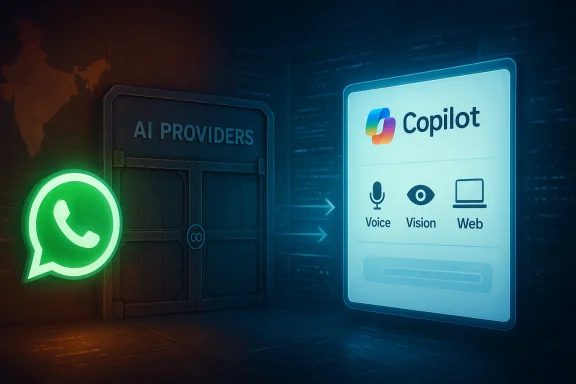
Microsoft’s decision to remove Copilot from WhatsApp marks a sudden end to one of the most frictionless entry points for consumer AI assistants — and it crystallizes a larger tussle over platform control, infrastructure load, and competitive strategy that will shape how users access LLM-based services going forward. Starting January 15, 2026, Copilot will no longer function inside WhatsApp after a policy change by Meta that bars third‑party general-purpose chatbots from using the WhatsApp Business API. The move forces millions of users — particularly in regions where WhatsApp is the primary digital interface — to migrate to Microsoft’s standalone Copilot apps, the web client, or the Windows-integrated experience, and it raises immediate questions about access, data portability, competition, and the technical trade-offs of platform-level gatekeeping.
WhatsApp has long been more than an instant messenger; in many markets it functions as a default operating layer for communication, commerce and discovery. Over recent years, developers and AI companies began using the WhatsApp Business API to distribute chat-based assistants directly to consumers, exploiting WhatsApp’s ubiquity and simple UX to reach users without additional installs or account friction.
Meta’s October policy update — effective January 15, 2026 — introduces a new “AI Providers” clause that prohibits providers of large language models and related generative AI systems from using the WhatsApp Business Solution when those systems are the primary functionality being offered. The policy preserves use cases where AI is ancillary to a broader customer-support workflow, but it draws a clear line between business automation and general-purpose chatbot distribution.
Microsoft launched Copilot on WhatsApp in late 2024 as a low-friction way for users to interact with its assistant: no Microsoft account was required, and conversations could start inside the app users already relied on every day. The integration made Copilot accessible to millions who might otherwise not install a separate app — a particular boon in markets such as India, Southeast Asia and parts of Latin America.
This is not a blanket ban on AI inside WhatsApp. Businesses may still deploy AI-driven automation for customer service, bookings, verification and other commerce-oriented flows so long as the AI is ancillary to the broader business purpose. The prohibition targets consumer-facing assistants that use WhatsApp as a distribution front for open-ended chat functionality.
Managing that load requires different scaling and moderation approaches. When AI chatbots generate huge volumes of messages and unpredictable content, the operational burden on WhatsApp’s routing, moderation, and delivery systems increases. From Meta’s perspective, tightening the rules preserves system reliability for businesses that depend on low-latency, high-availability messaging.
This motive is an interpretation supported by industry observers: limiting distribution of rival assistants on a platform that reaches billions can be an effective way to steer users to a company’s own AI ecosystem while mitigating competitive pressures. Because the policy’s language gives Meta discretion to define what qualifies as “AI Providers” and “primary functionality,” the company retains leeway to shape the competitive landscape on its terms.
Microsoft’s statement positions the change as an operational necessity driven by Meta’s revised policy, and it frames the shift as an opportunity for users to access more advanced Copilot features on native apps and Windows.
The WhatsApp integration’s appeal there was twofold: it required no additional accounts or app installs, and it lowered barriers for users with limited device storage or intermittent connectivity. Removing Copilot from WhatsApp therefore narrows the reach of Microsoft’s assistant precisely where it had the most effortless growth potential.
For users in these regions, migrating to Copilot apps implies one or more of the following frictions:
Businesses that relied on consumer-facing assistants — for example, distributors offering an on-WhatsApp companion for discovery and rich conversation — must rework their approach. Options include:
Platform lock-in risk increases: when a dominant messaging platform restricts distribution, the bargaining power shifts to the platform owner. Developers need to diversify distribution and invest in identity/authentication strategies to avoid single-point failures.
Key regulatory questions include:
There are strategic upsides: moving users to authenticated, feature-rich surfaces opens revenue and product pathways that may be more defensible long term. Richer modalities and Windows integrations can deepen user engagement and allow Microsoft to offer integrated productivity scenarios unattainable within the constraints of a third‑party messaging API.
However, the move raises competitive and reputational risk. Regulators and developers may view the rule as anti-competitive, prompting investigations. Users who valued the openness and choice of third-party assistants may be dissatisfied, especially where Meta AI lags behind rivals in capabilities or privacy assurances.
Possible long-term trends include:
For Microsoft and other AI providers, the path ahead requires adapting distribution strategies, leaning into native authenticated experiences and accepting a higher friction onboarding model in exchange for deeper, more integrated capabilities. For users, particularly in WhatsApp-first regions, the change imposes new steps to retain access to conversational AI, but it also opens the door to richer features that standalone apps can provide.
The episode crystallizes an essential truth about the modern internet: platform policies now carry product-level consequences. How companies navigate these rules — and how regulators respond — will determine whether conversational AI remains a distributed, competitive field or becomes concentrated under the control of a few platform gatekeepers.
Source: The Tech Portal Microsoft to pull Copilot from WhatsApp following Meta policy shift - The Tech Portal
 Background
WhatsApp has long been more than an instant messenger; in many markets it functions as a default operating layer for communication, commerce and discovery. Over recent years, developers and AI companies began using the WhatsApp Business API to distribute chat-based assistants directly to consumers, exploiting WhatsApp’s ubiquity and simple UX to reach users without additional installs or account friction.Meta’s October policy update — effective January 15, 2026 — introduces a new “AI Providers” clause that prohibits providers of large language models and related generative AI systems from using the WhatsApp Business Solution when those systems are the primary functionality being offered. The policy preserves use cases where AI is ancillary to a broader customer-support workflow, but it draws a clear line between business automation and general-purpose chatbot distribution.
Microsoft launched Copilot on WhatsApp in late 2024 as a low-friction way for users to interact with its assistant: no Microsoft account was required, and conversations could start inside the app users already relied on every day. The integration made Copilot accessible to millions who might otherwise not install a separate app — a particular boon in markets such as India, Southeast Asia and parts of Latin America.
What changed: the policy and its immediate effects
The rule in plain terms
Meta’s revised Business API terms add a categorical restriction: if an AI system — including large language models, generative platforms, or general-purpose assistants — is the primary function being delivered through the Business API, it cannot be provided via WhatsApp Business Solution. The change takes effect January 15, 2026.This is not a blanket ban on AI inside WhatsApp. Businesses may still deploy AI-driven automation for customer service, bookings, verification and other commerce-oriented flows so long as the AI is ancillary to the broader business purpose. The prohibition targets consumer-facing assistants that use WhatsApp as a distribution front for open-ended chat functionality.
Immediate consequences
- Major third‑party chatbots that relied on the Business API to deliver general-purpose conversational services must shut down on WhatsApp by January 15, 2026.
- Microsoft has announced that Copilot on WhatsApp will be discontinued on that date and is directing users to Copilot’s mobile app, web client and Windows integrations.
- Users who wish to retain records of their conversations within WhatsApp must export chat history using WhatsApp’s built-in export tools before January 15, 2026; after that date, the service will stop operating and historical chats with the assistant may become inaccessible via the integration.
- Companies that used WhatsApp as their primary distribution channel for their assistants will need to pivot to alternative channels or re-architect their bots as customer-support tools that comply with the updated terms.
Why Meta likely made the change
Infrastructure and operational strain (Meta’s stated rationale)
Meta cites rising message volumes generated by AI chatbots as a strain on the Business API infrastructure. The Business Solution was designed for business-to-customer flows — notifications, support, and transactional messages — and not for the high-frequency, open-ended interactions typical of general-purpose AI assistants.Managing that load requires different scaling and moderation approaches. When AI chatbots generate huge volumes of messages and unpredictable content, the operational burden on WhatsApp’s routing, moderation, and delivery systems increases. From Meta’s perspective, tightening the rules preserves system reliability for businesses that depend on low-latency, high-availability messaging.
Strategic control and monetization (a credible inference)
Beyond infrastructure, the policy has clear strategic implications. Restricting third‑party assistants consolidates control of the consumer AI experience on Meta-owned platforms and channels traffic toward Meta AI. That gives Meta greater control over content moderation, latency management, and potentially the ability to monetize AI interactions through ad targeting or product integration.This motive is an interpretation supported by industry observers: limiting distribution of rival assistants on a platform that reaches billions can be an effective way to steer users to a company’s own AI ecosystem while mitigating competitive pressures. Because the policy’s language gives Meta discretion to define what qualifies as “AI Providers” and “primary functionality,” the company retains leeway to shape the competitive landscape on its terms.
Regulatory and competition risk
The change has already drawn regulatory attention. Competition and antitrust authorities in Europe and other jurisdictions are likely to scrutinize whether the policy constitutes exclusionary behaviour that harms competition. The potential for regulatory probes elevates the stakes of Meta’s decision and opens a parallel debate over platform gatekeeping in the AI era.Microsoft’s response and user transition plan
Microsoft announced the discontinuation of Copilot on WhatsApp and outlined transition options for users. The company will maintain Copilot access through:- Copilot mobile apps for iOS and Android
- Copilot on the web (copilot.microsoft.com)
- Copilot integrated into Windows
Microsoft’s statement positions the change as an operational necessity driven by Meta’s revised policy, and it frames the shift as an opportunity for users to access more advanced Copilot features on native apps and Windows.
What users will lose (and what they’ll gain)
Features and benefits that disappear with the WhatsApp integration
- Zero-install convenience: the WhatsApp contact required no separate app, account or onboarding. That one-click accessibility is now gone.
- Native simplicity for low-end devices and constrained networks: WhatsApp’s lightweight interface and ubiquity made Copilot usable on devices and networks where standalone apps may be less practical.
- Seamless integration into everyday conversations: users could keep Copilot in the same channel as friends and family, lowering cognitive friction.
Capabilities unlocked by migration to native Copilot surfaces
- Authenticated experiences: native apps and web clients support signed-in accounts, enabling personalized history, cross-device continuity and synced settings.
- Richer modalities: Copilot Voice and Vision provide spoken interactions and image understanding that were restricted or impossible within the WhatsApp integration.
- Deeper Windows integration: Copilot on Windows can connect to OS-level workflows, files and apps with finer-grained permissions.
- Expressive companions and advanced UI: features like Mico provide visual, multimodal interactions beyond text-only chat.
Regional impact: why this matters most in WhatsApp-first markets
WhatsApp is the default communication layer across populous, high-growth markets: India, many Southeast Asian countries, and large parts of Latin America. In these regions, consumers routinely use WhatsApp for banking, commerce, appointment bookings and more.The WhatsApp integration’s appeal there was twofold: it required no additional accounts or app installs, and it lowered barriers for users with limited device storage or intermittent connectivity. Removing Copilot from WhatsApp therefore narrows the reach of Microsoft’s assistant precisely where it had the most effortless growth potential.
For users in these regions, migrating to Copilot apps implies one or more of the following frictions:
- Installing and maintaining another app
- Creating or signing into a Microsoft account
- Accepting broader telemetry or sync settings
- Potential data usage increases with richer modalities
Impact on businesses and developers
For enterprises using the Business API
The policy preserves business uses where AI is incidental to customer service. Companies that used LLMs to power transactional workflows — confirmations, status updates, FAQs — can continue to do so under the updated terms, provided the AI is integrated into a broader business process.Businesses that relied on consumer-facing assistants — for example, distributors offering an on-WhatsApp companion for discovery and rich conversation — must rework their approach. Options include:
- Re-architect the assistant as a support tool with a clearly defined transactional scope.
- Move distribution to other messaging platforms with more permissive policies (Telegram, SMS, proprietary apps).
- Encourage users to adopt the business’s native mobile app or web portal.
For AI developers and smaller creators
Third-party AI developers lose a low-cost channel to reach end users. That raises the barrier to entry for consumer AI products and could reduce competition in the short term. Smaller companies may pivot to other messaging platforms, tighten their own app offerings, or build browser-first experiences.Platform lock-in risk increases: when a dominant messaging platform restricts distribution, the bargaining power shifts to the platform owner. Developers need to diversify distribution and invest in identity/authentication strategies to avoid single-point failures.
Legal and regulatory dimensions
The change has already prompted regulatory scrutiny in Europe and elsewhere. When a platform with multi‑billion users restricts distribution of rival services, competition authorities often investigate whether the policy constitutes an abuse of dominance.Key regulatory questions include:
- Does limiting third‑party assistants unfairly disadvantage competitors?
- Is the policy a legitimate technical response to infrastructure strain, or a pretext for consolidating market power?
- Are users’ privacy and data portability rights being respected when integrations are discontinued?
Technical realities and migration checklist
For users and businesses preparing for January 15, 2026, here’s a practical checklist to minimize disruption.- Export WhatsApp conversations you want to keep.
- Use WhatsApp’s chat export feature to download conversation records before the integration stops functioning.
- Sign up for authenticated Copilot experiences.
- Create a Microsoft account and sign in to Copilot on mobile or web to gain history syncing and personalized features.
- Prepare alternative channels.
- If you’re a developer or business, configure your assistant on other messaging platforms or build a web/app entry point.
- Reassess privacy and data handling.
- Understand what data persists in exported chats versus data stored in authenticated Copilot accounts.
- Test customer-support bot compliance.
- For businesses, ensure your bot workflows remain strictly commerce- or support-centered if you plan to keep using the Business API.
Strategic implications for Microsoft and Meta
For Microsoft
Microsoft loses a lightweight distribution channel that lowered friction for mass adoption of Copilot. In markets where WhatsApp was the onboarding path, growth momentum may slow. The company must now double down on native experiences and invest in localized outreach to capture former WhatsApp users.There are strategic upsides: moving users to authenticated, feature-rich surfaces opens revenue and product pathways that may be more defensible long term. Richer modalities and Windows integrations can deepen user engagement and allow Microsoft to offer integrated productivity scenarios unattainable within the constraints of a third‑party messaging API.
For Meta
Meta’s policy consolidates user attention on Meta’s own AI offerings across WhatsApp, Instagram and Facebook, giving the company more control over AI experiences and their monetization. It also reduces external load on its API infrastructure.However, the move raises competitive and reputational risk. Regulators and developers may view the rule as anti-competitive, prompting investigations. Users who valued the openness and choice of third-party assistants may be dissatisfied, especially where Meta AI lags behind rivals in capabilities or privacy assurances.
Risks and downsides: what could go wrong
- Reduced consumer choice: restricting third‑party assistants concentrates power in Meta’s hands and risks stifling innovation and competition.
- Regulatory backlash: antitrust authorities may require changes, fines, or remedies if the policy is judged exclusionary.
- User frustration and churn: customers who relied on WhatsApp’s convenience may resist installing additional apps or creating new accounts, which could hurt both rivals and Meta if users abandon services that become less convenient.
- Fragmentation and security trade-offs: migrating chatbots to alternative platforms or native apps may fragment user experiences and introduce uneven security and moderation landscapes.
- False justification risk: if Meta’s infrastructure claims are disproven or exaggerated, the policy could be perceived as a pretext for competitive exclusion.
What this means for the future of conversational AI distribution
The WhatsApp policy shift is a watershed moment for chatbot distribution strategy. Major messaging platforms will increasingly act as gatekeepers for AI experiences, and their policy choices will materially shape who can reach consumers and how.Possible long-term trends include:
- Greater emphasis on authenticated, cross-device native experiences where companies control identity and data.
- Diversification of distribution channels: developers will invest more heavily in web-first, app-first and alternative messaging platforms.
- Increased regulatory attention to platform-level controls over AI distribution.
- New business models for AI distribution that do not rely on third‑party messaging gateways.
Practical recommendations
- Export important conversations from WhatsApp before January 15, 2026.
- For power users: sign up for authenticated Copilot surfaces to enable synced history and cross-device continuity.
- For businesses: audit your bot workflows now and determine whether they qualify as permissible support use cases, or if you need to pivot distribution.
- For developers: diversify distribution, invest in identity and email/phone-based sign-in strategies, and consider building for web and alternative messaging ecosystems.
- For policymakers and regulators: monitor whether platform restrictions reduce competition, and consider proportionate remedies that balance technical constraints with fair access.
Conclusion
The removal of Copilot from WhatsApp is far more than a product change; it’s a flashpoint in the evolving relationship between platform owners, AI providers, developers and end users. Meta’s policy redraws the boundary between what constitutes acceptable business automation and what counts as a general-purpose AI product, and it does so in a way that favors platform-centralized control.For Microsoft and other AI providers, the path ahead requires adapting distribution strategies, leaning into native authenticated experiences and accepting a higher friction onboarding model in exchange for deeper, more integrated capabilities. For users, particularly in WhatsApp-first regions, the change imposes new steps to retain access to conversational AI, but it also opens the door to richer features that standalone apps can provide.
The episode crystallizes an essential truth about the modern internet: platform policies now carry product-level consequences. How companies navigate these rules — and how regulators respond — will determine whether conversational AI remains a distributed, competitive field or becomes concentrated under the control of a few platform gatekeepers.
Source: The Tech Portal Microsoft to pull Copilot from WhatsApp following Meta policy shift - The Tech Portal
