• Thread Author
Microsoft has confirmed that its Copilot chatbot will stop responding inside WhatsApp on January 15, 2026, a direct consequence of WhatsApp’s revised Business API rules that bar general-purpose AI assistants — a change that forces users onto Microsoft’s own Copilot apps, the web, and Windows and raises urgent questions about data portability, platform control, and where conversational AI should live.

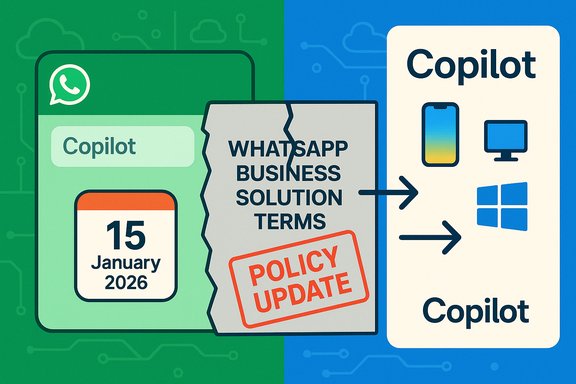
Neon icons show WhatsApp connecting to Copilot across devices.Overview​

WhatsApp’s parent company, Meta, updated the WhatsApp Business Solution terms in October 2025 to add an explicit “AI Providers” clause that prohibits developers of large language models and general-purpose AI assistants from using the Business API when those assistants are the primary functionality being offered. The policy takes effect on January 15, 2026, and is aimed at reserving the Business API for enterprise-to-customer workflows rather than consumer-facing chat assistants. Microsoft’s Copilot on WhatsApp — a lightweight, unauthenticated contact-based integration that launched in late 2024 and reached millions of users — will be discontinued on that date. Microsoft’s official Copilot blog confirms the shutdown, advises users to export any WhatsApp Copilot conversations they wish to keep before the cut-off, and directs people to the Copilot mobile app, Copilot on the web, and the Copilot experience on Windows as the supported alternatives.

Background​

How third-party assistants arrived on WhatsApp​

Messaging platforms have long been attractive distribution channels for conversational AI because they lower the friction of onboarding: users already have a chat app, a phone number, and a familiar UX. That dynamic encouraged companies from startups to large cloud providers to expose assistants through WhatsApp’s Business API as a quick path to reach billions of users. But those early experiments treated the Business API as a de facto consumer channel rather than the enterprise messaging tool it was designed to be. WhatsApp’s Business Solution historically focused on transactional messages: appointment reminders, order updates, customer support flows and invitations. Over time, the volume and pattern of open-ended AI conversations proved atypical for those workflows — raising engineering, moderation, and monetization challenges that Meta says motivated the change. The updated terms explicitly allow AI to be incidental or ancillary to business automation but forbid AI providers from using the API as the primary distribution channel for general-purpose assistants.

What Microsoft offered on WhatsApp​

Microsoft positioned Copilot on WhatsApp as a convenient, conversational surface for quick prompts — drafting messages, summarizing content, producing images, or answering questions within a familiar chat thread. The WhatsApp integration intentionally avoided deep account ties: interactions were unauthenticated and did not provide direct access to Microsoft 365 data, persistent identity, or cross-device sync available on Microsoft’s owned surfaces. That simplicity was the feature and the liability: frictionless access at the cost of portability and continuity.

What actually changes on January 15, 2026​

  • Copilot on WhatsApp will stop responding and the Copilot contact will cease to accept messages after January 15, 2026. Microsoft confirmed that date publicly on its Copilot blog.
  • Users must export WhatsApp chat history they wish to preserve because the WhatsApp integration was unauthenticated and Microsoft cannot migrate those threads into Copilot’s account-backed history. Microsoft explicitly instructs users to use WhatsApp’s export tools prior to the cutoff.
  • Third-party LLM providers that ran consumer-facing assistants through the Business API — including OpenAI’s ChatGPT, Perplexity and several startups — are being forced to wind down those channels or migrate to alternate surfaces. News reporting and vendor statements indicate similar exit plans or migration guidance for other providers.

Immediate user-facing consequences​

  • If you used Copilot inside WhatsApp, you have an explicit deadline to extract any information you care about from that chat. Use WhatsApp’s Export Chat function and store exports securely.
  • Conversations will not be automatically ported into Microsoft’s Copilot app, the Copilot web experience, or Copilot on Windows. Exported WhatsApp archives are archival text (and media) — they are not convertible into account-linked chat history inside Copilot.
  • Microsoft is steering users to first-party surfaces that provide authenticated accounts, synchronized history, richer multimodal features (voice, vision), and subscription options; those surfaces are intended to replace the convenience of chat-in-WhatsApp with features and controls Microsoft can govern.

Why Meta changed the rules — stated reasons and strategic implications​

Meta’s official rationale​

Meta frames the change as a realignment of the Business API with its original purpose: reliable, enterprise-grade communications and commerce workflows. Meta told reporters that third-party AI assistants created unusual message volumes and operational burdens that the Business API was not designed to carry. The policy aims to protect business customers and the stability of the API.

Analysts’ and industry interpretations​

Beyond operational concerns there are clear strategic incentives. Restricting general-purpose assistants from the Business API concentrates distribution of conversational AI inside players’ own apps and grants Meta greater control over who gets prime access to WhatsApp’s massive user base. That tightening also makes Meta’s own assistant offerings comparatively advantaged inside WhatsApp, Messenger, and Instagram. Multiple outlets and industry observers have highlighted this consolidation risk. The policy’s broad wording (“as determined by Meta in its sole discretion”) gives WhatsApp discretion to classify what counts as an “AI Provider,” creating uncertainty for developers.

Risk analysis: privacy, portability, and platform power​

Data portability and user risk​

The most immediate and concrete risk is data loss. Unauthenticated chat-based integrations — prized for their ease of use — do not create account-linked histories that vendors can migrate. That means users who relied on Copilot inside WhatsApp must proactively export conversations before the January 15 deadline if they want an archive. Exports are plaintext or zipped media dumps and are not importable into Copilot’s account-backed history, so the move creates a discontinuity in continuity. Microsoft warned users to export chats; WhatsApp’s export tool also has caveats around encryption and file formats that users should understand. Exported archives are no longer protected by WhatsApp’s end-to-end encryption once you move them out of the app, so that process introduces tangible security risks if exported files are mishandled. Store exports in encrypted personal storage, limit copies, and delete temporary files after archiving.

Platform gatekeeping and competitive effects​

Meta’s decision demonstrates how platform owners can reshape downstream markets by selectively opening or closing API channels. Narrowing third‑party access to a dominant messaging surface amplifies the value of in‑house assistants and pressures competitors to build and maintain their own apps or find alternative distribution channels (Telegram, web, SMS, standalone mobile apps). That dynamic raises competition concerns: platform policies that fortify first‑party products can reduce consumer choice and increase switching costs for users who had become accustomed to the convenience of embedded assistants. Industry watchers will likely scrutinize the move for anticompetitive effects.

Operational costs and moderation​

Meta’s operational argument is not speculative. Open‑ended LLM interactions produce high message density, longer sessions, and unpredictable moderation flags compared with structured business templates. Those workloads can materially increase infrastructure and content‑moderation costs for messaging services that were engineered for short, transactional exchanges. The rule change can therefore be read as a pragmatic approach to reallocating finite platform resources. Still, the decision’s timing and breadth mean operational rationale and strategic advantage operate in tandem.

What vendors and developers should do​

For Microsoft and other AI providers​

  • Harden first-party surfaces: ensure Copilot mobile, web, and Windows experiences are robust, support authenticated migration flows, and give users reliable continuity options.
  • Add clear export/import guidance: because exports are archival, vendors should offer tools to help users reconstitute important context in the new app wherever possible (for example, import prompts or bookmarks).
  • Provide enterprise options: for business customers, support authenticated, auditable integrations that comply with regulatory and data residency needs.

For businesses that used WhatsApp for AI-assisted workflows​

  • Audit your usage: determine whether your bots were using the Business API as a general-purpose assistant or providing AI as incidental to a business workflow. The latter remains permissible under the new rules.
  • Re-architect where required: move general-purpose capabilities to web or app destinations; keep customer-service automations within the Business API but ensure they are scoped and documented as business processes.
  • Communicate with customers and partners: provide migration timelines and instructions, and design alternatives if WhatsApp was the primary channel.

Developer checklist (technical)​

  • Map every WhatsApp endpoint your solution calls and label whether it is “business-ancillary” or “general-purpose.”
  • If general-purpose, plan for deprecation of that channel by January 15, 2026: switch to authenticated webhooks, web apps, or third-party messaging channels.
  • Instrument telemetry to detect any migration friction and track user retention when moving channels.
  • Update legal and privacy notices to reflect new storage, export, and retention procedures that users must follow.

How consumers should act now (practical steps)​

  • Export chats now: open the Copilot WhatsApp chat, tap the contact info, choose “Export chat,” and decide whether to include media. Save the exported file to encrypted cloud storage or local encrypted disk. Exports taken after January 15, 2026 will not capture Copilot interactions that are no longer available.
  • Move to Copilot first‑party surfaces: install the Copilot mobile app on iOS or Android, sign in to copilot.microsoft.com via your Microsoft account, or enable Copilot on Windows to restore authenticated continuity, richer features, and (where applicable) synced conversation history.
  • For ChatGPT users: follow OpenAI’s published guidance to link accounts or migrate to the ChatGPT app before the deadline (OpenAI has published migration instructions and has publicly stated it will discontinue WhatsApp support on the same date). Note that company-reported user numbers (for example, claims about tens of millions of WhatsApp users for a given assistant) are self-reported and should be treated as company statements unless independently verified.

Broader implications for the AI and messaging ecosystems​

Consolidation of AI on first‑party surfaces​

This episode accelerates an industry trend: major AI providers and platform owners increasingly prefer to host assistant experiences on first-party apps and websites where identity, telemetry, monetization, and moderation can be tightly controlled. That model delivers better continuity and richer features for authenticated users, but it also increases friction for casual users who valued the low-friction convenience of messaging-based access.

Emergence of migration patterns​

Expect a multi-pronged migration strategy across the industry: vendors will push native apps and web experiences, maintain presence on alternative messaging platforms with permissive policies (Telegram, GroupMe, Viber), and offer incremental import tools or prompt libraries to help users rebuild context. Startups that built businesses around WhatsApp distribution face meaningful operational and user-acquisition headwinds.

Regulatory and policy scrutiny​

The change invites regulatory attention on platform gatekeeping. Competition authorities in multiple jurisdictions have previously scrutinized how dominant platforms favor first‑party services; this policy shift could trigger similar inquiries or at least formal complaints by affected vendors. Separately, privacy watchdogs will be interested in how exported chat archives are handled and whether users are adequately warned about the loss of encryption and portability constraints.

Strengths, weaknesses, and key takeaways​

Strengths of the policy change (from Meta’s perspective)​

  • Reduces engineering and moderation burden from unstructured LLM traffic.
  • Protects Business API’s original intent and monetizable enterprise flows.
  • Gives Meta more control to integrate and scale its own assistant experiences in its ecosystem.

Weaknesses and risks​

  • Harsh cutover: short lead time and unauthenticated integrations cause fragmentation and possible data loss for users who don’t export chats.
  • Competitive concerns: the change advantages Meta’s own AI products and restricts competitors from leveraging a massive messaging channel.
  • User friction: casual users lose a convenient access point and may not adopt vendor apps, reducing overall AI reach and possibly increasing digital exclusion in regions where WhatsApp dominates.

Key takeaways for readers​

  • January 15, 2026 is a firm deadline: Copilot on WhatsApp will stop working after that date, and Microsoft recommends exporting chats before the cutoff.
  • This is both an operational and strategic move that reshapes where conversational AI will live — leaning toward first‑party, authenticated surfaces instead of third‑party messaging channels.
  • Users and businesses should act proactively: export any important Copilot conversations now, migrate critical workflows off WhatsApp if they depended on general-purpose assistants, and plan for the costs and complexity of building owned channels.

Practical “what to do” checklist (step‑by‑step)​

  • Open WhatsApp and locate the Copilot chat.
  • Tap the contact name → Export chat → choose “Include media” if you need images or attachments.
  • Save the exported file to an encrypted cloud folder or a local encrypted drive; avoid leaving exports in unprotected inboxes or shared folders.
  • Install the Copilot mobile app (iOS/Android) or bookmark copilot.microsoft.com and sign in with your Microsoft account to start building an authenticated conversation history.
  • If you rely on Copilot for business workflows, coordinate with IT: connect Copilot to corporate Microsoft 365 accounts, validate compliance controls, and update any customer‑facing flows previously tied to WhatsApp.
  • For ChatGPT users on WhatsApp, follow OpenAI’s migration guidance — link your account where supported — before January 15, 2026. Treat any large user-number claims (e.g., tens of millions) as company statements unless confirmed by independent measurement.

Conclusion​

Meta’s decision to restrict general-purpose AI on the WhatsApp Business API and Microsoft’s subsequent withdrawal of Copilot from WhatsApp are more than a product change — they mark a structural pivot in how conversational AI is distributed. The practical fallout is immediate: users must export chat history before January 15, 2026, and move to authenticated Copilot surfaces for continuity. Strategically, the move accelerates a migration away from third‑party messaging integrations to first‑party apps and web experiences that prioritize identity, moderation, and monetization control.
The episode crystallizes competing imperatives in today’s digital ecosystem: platform stability and enterprise focus on one hand, and openness, convenience, and broad reach for AI on the other. Consumers and businesses who relied on the simplicity of messaging-based assistants face a short migration window — and a longer debate about whether messaging platforms should be neutral conduits for AI or curated walled gardens run in the interest of platform owners.
Source: Moneycontrol https://www.moneycontrol.com/techno...eta-s-new-rules-kick-in-article-13695658.html

 

Microsoft’s Copilot will disappear from WhatsApp on January 15, 2026, as a direct result of WhatsApp’s updated Business API rules that bar general-purpose AI assistants from using the platform — a change that forces Microsoft, OpenAI, Perplexity and other AI providers to reroute users to their own apps and web experiences.

Transferring WhatsApp chats to the Copilot app.Background​

WhatsApp’s owner, Meta Platforms, quietly revised the WhatsApp Business API terms in October 2025 to introduce an explicit prohibition on “AI Providers” using the Business Solution to distribute general-purpose large language model (LLM) chatbots. The new clause takes effect on January 15, 2026 and draws a line between businesses that use AI incidentally for customer service and companies whose primary offering on WhatsApp is an AI assistant. The result: major AI assistants that relied on WhatsApp as a high-friction, high-reach distribution channel — including Microsoft’s Copilot, OpenAI’s ChatGPT interface, Perplexity, and several startups — must stop operating on WhatsApp after the cut-off date. Several vendors have already published transition notices and migration guidance to affected users.

What changed in WhatsApp’s Business API policy​

The rule in plain language​

WhatsApp’s updated Business API terms add a dedicated “AI Providers” section that, in essence, says: if your core product on WhatsApp is a general-purpose AI assistant (LLM/chatbot), you cannot use the WhatsApp Business Solution to provide it. The prohibition covers large language models, generative AI platforms, and “similar technologies,” with Meta reserving the right to decide what falls within that scope. Businesses that use AI for customer service or other ancillary tasks remain allowed.

Effective date and enforcement​

The policy was published in mid‑October 2025 and goes into effect on January 15, 2026. That date is now the operational deadline for AI providers to wind down WhatsApp-based assistants and steer users toward native apps or web portals. The new rule has already triggered public notices from affected vendors.

Meta’s rationale — official explanation​

Meta’s public rationale emphasizes intent and capacity: the WhatsApp Business API was built for businesses to serve customers (support, order notifications, etc., not as an open distribution layer for high-volume, interactive AI assistants. Meta also cited infrastructure strain from unexpected chatbot usage patterns and the need to preserve the Business Solution’s original purpose. That said, the language gives Meta broad discretion to determine enforcement.

How Microsoft announced Copilot’s removal — and what it means for users​

The announcement​

Microsoft posted a formal notice confirming that Copilot on WhatsApp will cease functioning on January 15, 2026, and urged users to migrate to the official Copilot mobile apps or the Copilot web experience to continue using the AI assistant. Microsoft framed the move as compliance with WhatsApp’s updated platform policies and emphasized that Copilot will remain accessible across Microsoft-owned surfaces: Copilot mobile (iOS/Android), Copilot on the web, and Copilot on Windows.

Data and chat history — a critical distinction​

Microsoft explicitly warned that chat histories will not carry over from the WhatsApp integration to the Copilot apps or web because the WhatsApp integration was unauthenticated — conversations were not linked to a Copilot user account. As a result, Microsoft recommends that users who want to keep conversation records must export them using WhatsApp’s export tools before January 15, 2026. This is a key operational point for users relying on WhatsApp as their persistent Copilot channel.

Microsoft’s migration path​

Microsoft’s FAQ lists three supported Copilot surfaces after the WhatsApp cutoff:
  • Copilot mobile app (iOS and Android)
  • Copilot on the web (copilot.microsoft.com)
  • Copilot integrated into Windows
Microsoft also highlighted additional features available on those platforms — including Copilot Voice, Vision, and its "Mico" presence — positioning the official apps and web interface as the long-term home for richer Copilot capabilities.

How other AI providers reacted​

OpenAI published its own transition guidance and acknowledged the platform-level change: ChatGPT on WhatsApp will end on January 15, 2026, and OpenAI urged its WhatsApp users (reported to number over 50 million) to link their WhatsApp phone number to a ChatGPT account to preserve conversation history inside ChatGPT prior to the cut-off. This is a contrast with Microsoft’s unauthenticated approach, which prevents direct migration of chat history to Microsoft’s Copilot accounts. Other AI companies affected by the policy change — including Perplexity, Luzia, and smaller startups that used WhatsApp as a distribution mechanism — are likewise evaluating or implementing takedowns and migration strategies. Several publishers and industry outlets have reported that these providers are moving users toward native apps, web UIs, or alternative messaging channels.

Why the change matters: distribution, reach, and user convenience​

WhatsApp became a surprisingly powerful channel for AI adoption. For many consumers, texting a number to get instant access to an LLM felt easier than downloading an app, creating an account, and learning a new UI. WhatsApp’s ubiquity turned it into a low-friction growth engine for AI assistants.
By closing that channel for general-purpose assistants, Meta has:
  • Removed a high-reach distribution route for AI companies;
  • Forced vendors to consolidate users on their own identity-based platforms; and
  • Reasserted Meta’s control over how conversational AI is exposed on its properties.
That shift will likely reduce spontaneous discovery and usage of third‑party assistants and push more interactions behind authenticated accounts, paywalls, or proprietary app ecosystems.

Platform strategy, competitive incentives, and regulatory scrutiny​

Was this a technical decision or a competitive one?​

Meta’s public explanation points to infrastructure strain and product focus. However, many industry observers note the timing coincides with Meta’s own push to embed Meta AI across its properties. By restricting third-party AI distribution via WhatsApp, Meta reduces competition inside its flagship messaging product and effectively steers the highest‑engagement channels toward its own assistant — a strategic outcome that raises competition questions. This dynamic has attracted regulatory attention in Europe and elsewhere.

Antitrust signals​

Regulators are already watching. On the same news cycle, the Italian competition authority expanded an inquiry into Meta’s deployment of AI features in WhatsApp and whether new terms could be used to limit competition in the AI services market. That probe underscores how platform rule changes that disadvantage rival services can trigger scrutiny, especially when the platform operator also offers competing AI features. Readers should note that enforcement and investigations are ongoing and outcomes are uncertain.

Practical implications for users and businesses​

For individual users​

  • If you use Copilot or ChatGPT on WhatsApp, plan to migrate by January 15, 2026. Microsoft and OpenAI have publicly stated the cut-off date; third-party bots will also be affected.
  • If you need to keep your WhatsApp conversations with these assistants:
  • Microsoft: export your WhatsApp chats using WhatsApp’s export functionality — Microsoft cannot transfer the history into Copilot because the integration was unauthenticated.
  • OpenAI: follow OpenAI’s linking instructions to associate your WhatsApp phone number with a ChatGPT account before the deadline; OpenAI says this preserves chat history inside ChatGPT. This is a vendor-dependent capability and not an official WhatsApp feature.
  • Expect feature divergence: native apps will typically offer richer experiences (voice, file uploads, deeper context) than what was possible within WhatsApp.

For businesses and customer service teams​

  • The WhatsApp Business API remains available for business-to-customer use cases that leverage AI as a tool, not as a consumer-facing general assistant. Companies using AI to automate routine customer support workflows can still operate under the Business API — but general-purpose LLMs designed to be conversational companions will be excluded.
  • Companies that relied on WhatsApp for marketing-oriented AI experiences must rework acquisition funnels to drive users to apps, web portals, or alternative messaging channels (Telegram, SMS, app notifications). This includes revisiting identity, consent, and data policies when migrating to authenticated experiences.

Security, privacy, and data-retention concerns​

Chat export and ownership​

When a third‑party assistant is delivered through WhatsApp without an account link, the provider may not be able to tie conversations to a persistent user identity. Microsoft’s disclosure that its WhatsApp integration was unauthenticated means the company cannot transfer those conversations into Copilot accounts. Users must therefore export conversations themselves if they want a local copy. OpenAI’s linking mechanism provides an alternative that is contingent on doing the linking before January 15, 2026.

Privacy trade-offs​

Migrating to native apps often requires account creation and additional permissions. While this enables richer features and persistent history, it also concentrates data under the vendor’s control and may change the default privacy posture compared to ephemeral WhatsApp exchanges. Consumers should read privacy policies, check location of data storage, and understand retention rules before linking or signing up. These are vendor-specific and should be verified directly with Copilot, ChatGPT, or other providers.

Unverifiable or vendor‑specific claims​

Some outlets have reported metrics like “50 million ChatGPT WhatsApp users” or “millions used Copilot on WhatsApp.” While OpenAI published a user estimate for ChatGPT on WhatsApp, comparable user counts for Copilot were described more vaguely by Microsoft. Where exact active-user numbers matter for analysis, treat vendor-reported totals with caution unless independently audited.

Broader implications for the AI ecosystem​

Distribution models will shift​

The WhatsApp ban accelerates a broader re‑centralization trend: companies using third‑party platforms to build discovery and adoption fast lanes will need to rebuild direct relationships via:
  • Native apps (with account-driven retention)
  • Web portals (SEO, direct traffic)
  • Alternative messaging platforms (Telegram, Signal — depending on terms)
Expect short-term churn as casual users who discovered AI via WhatsApp’s low-friction interface fail to migrate. Over time, providers that succeed at simple onboarding and value capture will retain the most engaged portion of the user base.

Product design and monetization​

For creators of AI assistants, this policy change makes identity and monetization more central. Without WhatsApp’s passive distribution, providers must:
  • Prioritize frictionless account creation, social logins, and phone-number linking;
  • Design onboarding flows that demonstrate clear value quickly; and
  • Consider subscription tiers, usage-limited free tiers, and enterprise offerings to offset the cost of running heavier LLM workloads outside of free messaging platforms.

Platform power and regulatory risk​

Meta’s move illustrates how platform owners can reshape adjacent markets through contract terms, a lever that attracts regulatory scrutiny when it shuts out competitors. The Italian antitrust inquiry and similar oversight initiatives are likely to examine whether such policy changes are justified by technical reasons or constitute anti‑competitive exclusion. The regulatory angle adds uncertainty for both platform owners and challengers.

Recommendations — what users and businesses should do now​

  • Export or backup critical WhatsApp conversations with AI assistants before January 15, 2026, if you want a local copy. Do not assume automatic migration will be possible.
  • For users of ChatGPT on WhatsApp, follow OpenAI’s published linking steps to preserve history in ChatGPT prior to the cut-off. The linking operation is vendor-managed and must be completed before the deadline.
  • Businesses that used WhatsApp for AI-led acquisition should:
  • Build or enhance their own authenticated web and mobile experiences;
  • Collect consented identity data (email/phone) to maintain continuity; and
  • Re-evaluate whether AI belongs inside WhatsApp as a support tool rather than as the main product offering, to remain compliant with the Business API.
  • Security and privacy: review account settings and retention policies when moving from ephemeral WhatsApp conversations to persistent app-based histories. Understand vendor terms for data usage and any differences in telemetry, personalization, or advertising.

What to watch next​

  • Enforcement and interpretation. Meta’s policy grants the company discretion to classify technology as disallowed; how strictly Meta defines “general‑purpose AI” in practice will shape whether edge cases or hybrid services survive. Industry updates and developer clarifications are likely as the date approaches.
  • Regulatory outcomes. Antitrust and competition investigations — such as the recent expansion of an Italian probe into Meta over AI in WhatsApp — will be important to monitor for potential remedies, fines, or mandated interoperability. Regulatory pressure could alter enforcement or force clearer rules about platform neutrality.
  • Migration success metrics. Watch whether vendors can migrate large percentages of casual WhatsApp users to native apps and retain engagement; this will be an early indicator of who benefits from platform‑driven distribution disruption.

Final analysis — strength, risk, and the seismic shift for conversational AI​

WhatsApp’s Business API policy change is a decisive moment for conversational AI distribution. For Microsoft and other vendors, the policy forces a strategic trade-off: accept platform limits and centralize users on first‑party apps, or attempt workarounds (alternative channels, authenticated linking) that will likely have higher churn and acquisition costs. Microsoft’s prompt migration guidance and emphasized features for the Copilot web and apps show a realistic pivot toward account-based product experiences. This shift has clear strengths:
  • It pushes AI interactions into authenticated, richer environments where vendors can offer better features, enforce safety controls, and monetize responsibly.
  • It reduces infrastructure surprise loads on WhatsApp and clarifies the Business API’s intended use for customer-facing workflows.
But the move also poses material risks:
  • Consumers lose a low-friction access point that helped accelerate mass adoption of LLMs; casual discovery is likely to decline.
  • Platform control over distribution raises anti‑competitive concerns and invites regulatory intervention.
  • Data‑migration friction and privacy differences between ephemeral chat and account-backed histories could confuse and alienate users.
In short, the January 15, 2026 deadline marks a pivot from an era of lightweight, platform-siloed discovery toward one where conversational AI is anchored to vendor-controlled, authenticated surfaces. The result will be fewer “pop-up” assistants in ubiquitous messaging apps and more deliberate, identity-driven relationships with AI — a change that reshapes user expectations, product roadmaps, and competitive dynamics across the industry. The practical takeaways for Windows users and the wider community are straightforward: export anything you want to keep from WhatsApp now, prepare to sign in to native Copilot or ChatGPT experiences, and watch regulatory developments closely — they may determine whether the new rules stand or are modified in the months ahead.
Source: innovation-village.com Microsoft to remove copilot from WhatsApp following policy changes - Innovation Village | Technology, Product Reviews, Business
 

Microsoft has confirmed that its Copilot AI chatbot will stop working on WhatsApp on January 15, 2026, joining OpenAI’s ChatGPT in being removed from the platform after Meta rewrote the WhatsApp Business API rules to bar general-purpose LLM chatbots.

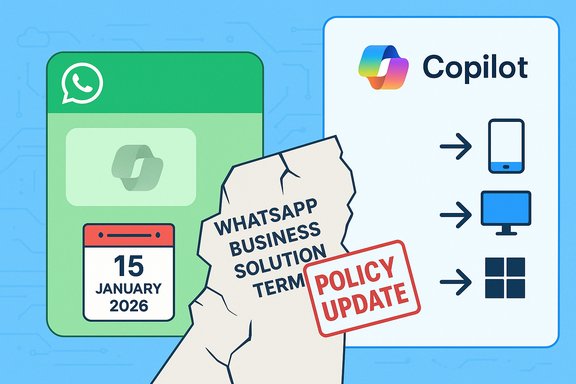
Illustration of AI providers, a no-bots ban, and cloud tech ahead of January 15, 2026.Background​

In mid‑October 2025 WhatsApp quietly added a new “AI Providers” clause to its Business Solution terms, setting an effective date of January 15, 2026 for enforcement. The clause broadly defines “AI Providers” to include creators of large language models (LLMs), generative AI platforms, and general‑purpose AI assistants, and prohibits those providers from using the WhatsApp Business Solution when the AI assistant is the primary functionality offered. The policy retains a carve‑out for conventional business automation — customer service bots that use AI incidentally to a broader workflow remain permitted — but explicitly blocks consumer‑facing assistants being distributed via the Business API.
OpenAI responded in October by telling users that ChatGPT will no longer be available on WhatsApp after January 15, 2026, and encouraged account linking or migration to the ChatGPT app to preserve conversation history. Microsoft published its own notice on November 24, 2025, announcing that Copilot on WhatsApp will be discontinued on January 15, 2026, and that users should export any chat threads they wish to retain because the WhatsApp integration ran as an unauthenticated session that cannot be migrated into Microsoft’s account‑based Copilot surfaces.
Those are the core facts: a policy change from Meta, a hard enforcement date (January 15, 2026), and major LLM vendors planning to remove or wind down their WhatsApp integrations accordingly.

What changed in WhatsApp’s Business API rules​

The new “AI Providers” clause — what it says in practice​

WhatsApp’s updated Business Solution terms add a broad definition of “AI Providers” and a prohibition that, in practical terms, prevents third‑party general‑purpose chatbots from using the Business API when the chatbot is the primary product being delivered. The company framed the policy around the intended purpose of the Business API: business‑to‑customer workflows, not consumer distribution of open‑ended assistants.
Key practical effects of the change:
  • General‑purpose chatbots using the Business API must stop being offered through WhatsApp once the rule takes effect on January 15, 2026.
  • Business automation remains allowed when AI is incidental or ancillary (for example, an airline’s booking assistant or an e‑commerce follow‑up bot).
  • The change affects both direct integrations and third‑party providers that route LLM outputs through WhatsApp’s Business Solution.

Why Meta says it made the change​

Meta has publicly explained the update in operational terms: the Business API was designed for enterprise messaging, and the emergence of consumer‑facing chatbots using the same infrastructure created unanticipated message volume, support burdens, and a mismatch with the product’s intended use case. In plain language, WhatsApp’s Business infrastructure was not architected as a consumer chatbot distribution layer, and the company chose to enforce that boundary.
This rationale is technically plausible: general‑purpose assistants can generate large, unpredictable volumes of messages and multimedia, pushing enterprise messaging systems beyond their designed load patterns and support models.

How Microsoft and OpenAI are responding​

Microsoft: Copilot’s migration plan​

Microsoft’s Copilot team posted a formal notice that Copilot on WhatsApp will be shut down on January 15, 2026. The company says Copilot will continue to be available on Microsoft’s own surfaces:
  • Copilot mobile app (iOS and Android)
  • Copilot on the web (copilot.microsoft.com)
  • Copilot built into Windows and other Microsoft products
Microsoft highlighted that the WhatsApp integration was unauthenticated — interactions on WhatsApp were not tied to a Copilot account — and therefore chat histories cannot be migrated automatically into Copilot accounts. Microsoft instructed users who wish to keep threads to export them using WhatsApp’s export tools before the January 15 deadline.
Microsoft also framed the shift as a move to authenticated, richer experiences: first‑party apps and web allow synced history, subscription tiers, multimodal features (voice, vision), and enterprise controls that an unauthenticated WhatsApp contact cannot provide.

OpenAI: ChatGPT’s migration and account linking​

OpenAI confirmed that ChatGPT will stop functioning on WhatsApp after January 15, 2026, and encouraged users to link their WhatsApp phone numbers to ChatGPT accounts before the deadline so prior conversations can appear in ChatGPT history. OpenAI’s guidance stressed that WhatsApp does not support chat exports and that users should link soon to preserve history.
OpenAI also highlighted that ChatGPT remains available through native apps and the web, reiterating the common vendor response: move users to authenticated, account‑backed experiences.

What this means for users — practical steps​

If you used Copilot, ChatGPT, Perplexity, or similar assistants through WhatsApp, the immediate priorities are (1) preserve anything you need from current chat threads, and (2) plan migration to vendor native apps or alternate channels.

Exporting WhatsApp chats — step‑by‑step (Android & iPhone)​

  • Open the chat thread (individual or group) you want to export.
  • Tap the menu (three dots on Android) or the contact/group header on iPhone.
  • Choose More → Export Chat (Android) or Export Chat from the contact profile (iPhone).
  • Choose whether to include media (photos/videos). Note: including media may limit how much message history can be exported.
  • Choose a destination (email, cloud storage, file app) to save the exported .txt and media bundle.
Notes and caveats:
  • Exports produce a human‑readable archive, usually a .txt plus media files; they are archival — you cannot import exported .txt histories back into Copilot or ChatGPT as live, account‑synced conversations.
  • WhatsApp’s export may limit the number of messages or the age of included media; for large or long histories, multiple exports or manual backup of media may be required.
  • If a vendor offers account linking (for example linking your WhatsApp number to ChatGPT), follow their official linking flow before January 15 to retain chat continuity where possible.

Timeline and urgency​

  • The enforcement date is January 15, 2026 — treat that as a hard cutoff.
  • Start exporting important threads now rather than waiting: exports can be time‑consuming and error‑prone for large histories, and users often discover missing media or truncated exports at the last minute.

What this means for businesses and developers​

For businesses using WhatsApp for customer support​

If your organization uses WhatsApp as a support channel and relies on AI for automated replies, the updated policy generally does not ban AI in business workflows so long as the AI is ancillary to the broader business function. Key actions for businesses:
  • Review your usage against WhatsApp’s new “AI Providers” language to confirm it qualifies as incidental or ancillary rather than consumer‑facing primary functionality.
  • If you use third‑party LLMs as primary assistants, plan migration off the Business API or redesign the bot to be a support tool tightly integrated with your CRM and human escalation flows.
  • Monitor message volume and rate patterns — high‑volume conversational assistants are more likely to be flagged under the new terms.

For AI vendors and developers​

The ban forces vendors to rethink distribution strategies that relied on WhatsApp as an easy front door to millions of users. Recommended steps:
  • Build authenticated experiences: Offer account linking and authenticated apps to preserve continuity and user trust.
  • Provide clear export/migration tools: Facilitate moving users from a WhatsApp session to native apps or web, including preserving context where compliant and feasible.
  • Diversify channels: Deploy assistants on native mobile apps, the web, desktop clients, and other messaging platforms that still permit LLM bots.
  • Design for enterprise integration: For vendors targeting business customers, developing certified integrations that are clearly ancillary to business workflows will be essential.

Technical and privacy considerations​

Unauthenticated integrations and data portability​

WhatsApp‑based assistants were often set up as number‑based or ephemeral contacts that did not require a vendor account sign‑in. That simplified onboarding for users but carried consequences:
  • Vendors could not reliably map a WhatsApp session to a persistent user identity, limiting personalization and continuity.
  • Because interactions were unauthenticated, vendors like Microsoft cannot automatically import WhatsApp threads into account‑backed histories on Copilot’s web/mobile surfaces.
  • From a privacy perspective, unauthenticated sessions mean the messaging platform (WhatsApp/Meta) retains direct control over the message stream, and vendors have limited ability to apply account‑level data controls.

Export risks and security​

Exporting chat histories and media is the pragmatic path to preserve threads, but it introduces risks:
  • Exported archives are typically unencrypted plain text and media files; users should store these artifacts securely if they contain sensitive information.
  • Using third‑party migration tools may expose data to additional parties; avoid untrusted utilities for sensitive chats.
  • Vendors providing account linking should document what history will be stored on their servers and how data controls and retention policies apply.

Bigger picture: platforms, gatekeeping, and competition​

Meta’s move to restrict third‑party general‑purpose chatbots on WhatsApp raises a set of strategic and regulatory questions that go beyond load management.
  • The policy leaves Meta’s own assistant(s) as the primary sanctioned, general‑purpose AI option on WhatsApp, which creates a practical advantage for Meta’s in‑house AI products on its own messaging surface.
  • That advantage is likely to be seen by competitors and some regulators as the sort of self‑preferencing that draws scrutiny in other contexts. Whether regulators will treat this change as an anti‑competitive practice depends on legal tests and jurisdictional frameworks.
  • Historically, major platform firms have faced complaints (and in some cases investigations) when changes to platform rules effectively favor owned services. The WhatsApp AI restriction sits squarely in that pattern and could attract attention from competition or consumer authorities if affected vendors or market participants raise formal complaints.
Caveat: motive attribution is inherently speculative. Meta’s public rationale cites operational mismatch and compliance with the Business API’s purpose; it is plausible that both operational and competitive factors played into the decision. That dual possibility should be flagged as an interpretive judgment rather than an established fact.

Alternatives and where users can go next​

If you relied on Copilot or ChatGPT inside WhatsApp, here are immediate alternatives:
  • Copilot users: switch to the Copilot mobile app or copilot.microsoft.com, or use Copilot features in Windows and Edge. These first‑party surfaces provide authenticated history, voice and vision features, and subscription tiers.
  • ChatGPT users: install the ChatGPT app on iOS, Android, or use the web; link your WhatsApp phone number to your ChatGPT account if you want prior conversations carried over into ChatGPT history.
  • Other messaging platforms: many AI providers maintain presences on other platforms (for example, Telegram or standalone SMS/phone interfaces) — but capabilities and policies vary by platform.
  • Native apps and web: vendors are emphasizing native apps and web as the durable distribution channels where account linking, subscriptions, and richer features live.

Risks and downside scenarios​

  • Loss of convenience: For many users, the great appeal of an in‑chat assistant was the frictionless UX inside WhatsApp. The migration imposes friction and could reduce casual usage.
  • Data fragmentation: Chats split across platforms and export files create fragmented histories and complicate continuity.
  • Potential for decreased innovation: If large platforms increasingly restrict third‑party distribution channels, smaller AI vendors may find user acquisition costlier and growth slower — unless alternative distribution strategies or open platforms step in.
  • Regulatory ripple effects: Should competition authorities view the change as self‑preferencing, it could prompt inquiries that reshape platform rules and vendor strategies.
Wherever the line is drawn between operational necessity and competitive advantage, platform policy shifts like this one change the calculus for product teams, privacy officers, and regulators alike.

Practical checklist for users and administrators​

  • If you’ve chatted with Copilot or ChatGPT on WhatsApp, export any important conversations now. Do not assume that archival exports include all media or unlimited history.
  • Link your phone number to the vendor’s native account where supported (OpenAI provides an account‑linking flow; Microsoft recommends switching to Copilot’s app).
  • Install the vendor’s native app and sign in to get authenticated history and multi‑device sync.
  • For businesses: audit your WhatsApp usage to ensure compliance with the new Business API terms — redesign chat experiences that rely on LLMs as primary functionality.
  • For developers: accelerate building authenticated onboarding flows and diversify distribution channels beyond the WhatsApp Business Solution.

Final analysis — winners, losers, and the likely aftermath​

The removal of third‑party LLM chatbots from WhatsApp will create clear near‑term winners and losers:
  • Winners: Platform owners that retain integrated AI assistants (Meta’s Meta AI on WhatsApp); vendors that already operate authenticated apps and web presences; enterprises that use AI in ancillary customer‑service roles and remain compliant.
  • Losers: Third‑party AI vendors who relied on WhatsApp as a zero‑friction distribution channel; casual users who lose the convenience of in‑chat assistants; opportunistic startups using Business API access to reach consumers.
Over the medium term, expect three parallel responses:
  • Vendor migration to native apps, web UIs, and other messaging platforms.
  • Product redesign emphasizing account linking and authenticated experiences to preserve continuity and unlock richer features.
  • Regulatory watchfulness, as the competitive dynamics implicit in platform rule changes attract scrutiny in jurisdictions sensitive to self‑preferencing and gatekeeper behavior.
The policy shift reinforces a broader lesson for AI product teams: reliance on a third‑party messaging surface as a primary distribution method is fragile. The durable strategy is to pair frictionless onboarding channels with a clear path to authenticated, account‑based experiences where user data, history, and premium monetization can be managed under the vendor’s own controls.

Conclusion​

WhatsApp’s policy rewrite and the ensuing withdrawals by ChatGPT and Microsoft’s Copilot mark a turning point in how conversational AIs will be distributed to consumers. The move forces a trade‑off between reach and control: WhatsApp offered massive reach with low friction, but vendors sacrificed authentication and portability. The new rules nudge the ecosystem toward authenticated, first‑party apps and web experiences — environments that support richer features and clearer data controls but require explicit user onboarding.
For users, the immediate task is simple and urgent: export anything you care about and migrate to a native app or web account before January 15, 2026. For vendors and developers, the message is equally clear: diversify channels, make account linking frictionless, and design product architectures that do not depend on a single platform’s policy goodwill.
The next few months will test whether the industry can preserve the convenience of conversational AI while moving those experiences to places where history, identity, and privacy can be managed on the user’s terms — and whether regulators will view platform policy choices as legitimate product governance or as a new form of market foreclosure.

Source: livemint.com After ChatGPT, Microsoft’s Copilot will also leave WhatsApp next month: here's why | Mint
 

WhatsApp chat on a phone with Copilot, surrounded by AI providers and a calendar.
Microsoft has confirmed that Copilot — its consumer-facing AI assistant — will be removed from WhatsApp on January 15, 2026, a direct consequence of an October policy revision to the WhatsApp Business Solution that disallows general-purpose LLM‑based chatbots from using the Business API as a primary distribution channel.

Background​

Since late 2024, several major AI vendors experimented with delivering conversational assistants inside WhatsApp by using the WhatsApp Business Solution (commonly called the Business API). The approach offered a low-friction, familiar surface that let consumers message an AI contact like any other number for quick answers, summaries, writing help, and lightweight multimodal interactions. Those in‑chat experiences proved popular: Microsoft says Copilot on WhatsApp served millions of people while it was available. WhatsApp’s Business API was originally designed for structured business-to-customer communications — shipping updates, appointment reminders, and support workflows — not open-ended, consumer-facing assistants. In October 2025 Meta added a new “AI providers” clause to the Business Solution terms that explicitly prohibits providers of large language models, generative AI platforms, and general-purpose AI assistants from using the Business API when such AI is the primary functionality being offered. The clause takes effect January 15, 2026.

What changed: the WhatsApp policy in plain language​

  • WhatsApp updated the Business Solution terms to define “AI Providers” broadly and banned those providers from accessing or using the Business API to deliver general-purpose conversational assistants when the assistant is the primary product being made available.
  • The effective enforcement date is January 15, 2026, after which the Business API will no longer be a permitted distribution channel for standalone chatbots like Copilot or ChatGPT.
  • The policy preserves a carve-out for business‑incidental AI — that is, narrow, enterprise automation where AI is ancillary to a broader customer service workflow (for example, an airline using AI to confirm bookings).
This is not framed as an outright ban on AI functionality inside WhatsApp as a concept; rather, it is a platform-level restriction on the Business API’s role as a distribution channel for consumer chat assistants.

Microsoft’s official position and the immediate user impact​

Microsoft’s Copilot team posted a clear advisory: Copilot on WhatsApp will remain available until January 15, 2026, and users should export any WhatsApp chat history they want to keep before that date because the WhatsApp integration was unauthenticated and therefore cannot be migrated into Copilot’s account-backed surfaces. Microsoft is directing users to the following alternatives:
  • Copilot mobile app for iOS and Android
  • Copilot on the web at copilot.microsoft.com
  • Copilot on Windows, including built-in integrations and Edge experiences
Microsoft also emphasises that its first‑party Copilot surfaces offer authenticated accounts, persistent history, and additional multimodal features such as Copilot Voice and Copilot Vision that the WhatsApp integration could not support. Key, load-bearing facts Microsoft confirmed:
  • Cutoff date: January 15, 2026. After that date the WhatsApp Copilot contact will no longer respond.
  • Chat history will not be transferred automatically because the WhatsApp integration did not link sessions to Microsoft accounts. Users must export chats manually.
  • Microsoft recommends migrating to Copilot’s native apps or web to preserve continuity and unlock richer features.

Broader ecosystem effects: OpenAI, Perplexity and beyond​

Microsoft is not alone. OpenAI and several startups that had built WhatsApp integrations also announced wind-downs or migrations after Meta’s policy shift. OpenAI has urged its WhatsApp users to move to first‑party ChatGPT apps and to link their phone numbers to preserve history where possible, because platform-imposed limits complicate exports or transfers after the deadline. The immediate practical effect is a reallocation of conversational AI distribution from messaging surfaces toward vendor-owned apps, web portals, and first‑party platform integrations. That trend forces three consequential changes for users and developers:
  • Consumers must install or use dedicated apps or web UIs instead of messaging an AI inside WhatsApp.
  • Vendors must build authenticated, account-based experiences if they want history, personalization, and richer modalities.
  • Messaging platforms can better prioritize moderation and resource allocation at the cost of narrowing third‑party discovery channels.
These changes are already prompting industry coverage and regulatory attention. Italian competition authorities have broadened scrutiny of Meta’s terms for potential anti‑competitive effects, reflecting concerns that in‑house AI integration plus a ban on rivals in a critical distribution channel may limit competition.

Technical analysis: why platforms cite infrastructure and moderation burdens​

WhatsApp’s official rationale emphasizes operational realities: open-ended LLM conversations generate unpredictable, high‑volume traffic patterns, extended session context requirements, and elevated moderation complexity that differ sharply from transactional business messages. Those differences produce three specific technical strains:
  • Message volume and throughput: LLM assistants can produce long, recursive interactions that multiply message counts and backend processing compared with typical business notifications.
  • Context and session management: Supporting long conversational histories at scale requires persistent contexts and authenticated sessions — features the Business API was not optimized to provide generically.
  • Safety and moderation: Free‑form assistant interactions raise different content‑moderation and safety demands (misinformation, toxic content, abuse vectors) that require extra tooling and human-review pipelines.
From a platform engineering perspective, re-scoping the Business API to enterprise‑anchored automation reduces these burdens and simplifies capacity planning. However, the operational argument does not fully explain the choice to bar third‑party general‑purpose assistants — it only justifies stricter limits and better enforcement. Observers point out that the same engineering rationale conveniently dovetails with business incentives.

Strategic analysis: monetization, control and the platform power question​

Meta’s policy reshapes distribution in ways that materially advantage first‑party AI:
  • By disallowing third‑party consumer assistants on the Business API, Meta constrains rival vendors’ ability to piggyback WhatsApp’s enormous reach without building their own apps or establishing account links.
  • Consolidating conversational AI inside platform-owned channels (Messenger, integrated WhatsApp surfaces) creates opportunities to monetize AI interactions more directly or to route associated commerce inside Meta’s ecosystem.
  • The broad wording and Meta’s discretion over what constitutes an “AI provider” give the company latitude to permit or prohibit services selectively, raising concerns about non‑transparent gatekeeping.
This combination of operational and commercial incentives has prompted regulatory attention in Europe and elsewhere, with competition watchdogs probing whether the policy change impedes fair competition in the emerging conversational AI market. The regulatory angle elevates the story from product design to public interest: portability, competition, and platform neutrality are now central issues.

User‑facing risks and trade-offs​

The shift from in‑chat assistants to first‑party apps offers tangible benefits — authentication, persistent history, richer features, and arguably better safety controls — but it also introduces real risks:
  • Loss of low‑friction access: Users who relied on WhatsApp to access Copilot without installing anything face additional friction (app installs, account creation).
  • Data portability and fragmentation: Unauthenticated WhatsApp sessions mean chat transcripts will not automatically migrate; users must act to export or link accounts before the deadline. Export formats may be limited (plain text or local files) and do not guarantee import into other services.
  • Reduced competition and choice: Smaller vendors and startups lose a free distribution channel, which could reduce innovation and consumer options unless alternative interoperable standards emerge.
  • Vendor lock‑in risk: Centralizing interactions around a few first‑party apps increases the incentive for larger vendors or platform owners to monetize premium features and to collect richer datasets linked to authenticated accounts.
Each of these trade-offs is a concrete decision point for users and policymakers alike.

Practical steps for users and IT administrators​

For individuals and organizations that used Copilot on WhatsApp, the transition is time‑sensitive and straightforward if acted on promptly.
  1. Export chat history before January 15, 2026:
    • Use WhatsApp’s built‑in Export Chat feature to save conversations as text or with media attachments.
    • Decide whether to include media; exports that include media are larger and may be harder to store or import elsewhere.
  2. Migrate to authenticated Copilot surfaces:
    • Install the Copilot mobile app (iOS/Android) or use copilot.microsoft.com on the web.
    • Sign in with a Microsoft account to enable persistent history, cross‑device sync, and account‑backed personalization.
  3. For ChatGPT users on WhatsApp:
    • OpenAI recommended linking your WhatsApp number to a ChatGPT account so that past conversations can appear in ChatGPT history; follow OpenAI’s guidance for linking before the enforced cutoff to preserve continuity.
  4. Consider alternatives for in‑chat assistant use:
    • Evaluate messaging platforms whose policies remain permissive (for example, Telegram has historically permitted bot integrations) or adopt vendor‑provided lightweight web clients and PWAs that offer lower friction but still support authentication. Note that options vary by vendor and may change over time.
  5. For enterprises:
    • If your organization used AI via WhatsApp for customer workflows that may now be restricted, review whether the usage is “incidental” (permitted) or “primary” (disallowed) under the new terms.
    • Plan migration strategies: move to the vendor’s authenticated API, build native apps, or switch to permitted business‑automation patterns.
Acting early reduces data loss risk and minimizes user disruption.

What regulators and policy watchers should focus on​

The policy shift raises several regulated‑policy questions that deserve scrutiny:
  • Is Meta’s restriction anti‑competitive? Blocking third‑party consumer assistants on a platform with billions of users may disadvantage rival vendors and entrench Meta AI’s distribution advantage. Competition agencies in several jurisdictions are already investigating potential market‑power concerns.
  • Does the policy undermine portability? Portability rights are central to digital competition arguments. The unauthenticated model that enabled easy access to AI via WhatsApp also limited portability; regulators should consider whether platform rules create unnecessary barriers to switching or data transfer.
  • Transparency and enforcement: The clause gives Meta wide discretion to determine what “counts” as an AI provider. Regulators may demand clearer enforcement processes and non‑discriminatory criteria to avoid opaque gatekeeping.
  • Safety versus access trade‑offs: Platforms must balance moderation and safety obligations against competition and innovation. Policymakers should weigh whether operational concerns justify wide bans or whether technical and contractual enforcement mechanisms could address safety without limiting distribution.
These are active policy debates that will shape where conversational AI can live and how users can interact with it.

Alternatives and likely vendor strategies​

Facing the loss of WhatsApp distribution, vendors will likely pursue several complementary strategies:
  • Push users to native apps and the web to regain control over authentication, features, and monetization.
  • Provide account linking tools to preserve history (as OpenAI has done), smoothing the transition for existing users.
  • Use other messaging platforms with permissive bot policies or invest in lightweight PWAs and browser experiences that mimic in‑chat convenience with better identity controls.
  • Advocate for interoperable standards or developer-friendly platform rules that restore multi‑vendor access to widely used messaging surfaces.
Which of these approaches succeeds will depend on product usability, user willingness to install apps, and potential regulatory constraints on how platforms manage third‑party access.

Strengths and weaknesses of the policy change — a balanced assessment​

Notable strengths
  • Operational clarity for WhatsApp: Narrowing the Business API use cases helps WhatsApp protect capacity and prioritize enterprise workflows for which the API was designed.
  • Forces authenticated, safer experiences: Pushing vendors toward authenticated apps can improve moderation, personalization, and safety controls.
  • Reduces ad-hoc moderation load: Removing mass consumer assistants from the Business API reduces unexpected moderation burdens on WhatsApp’s business infrastructure.
Potential weaknesses and risks
  • Concentrates distribution power: The policy risks entrenching large platform owners and decreasing opportunities for smaller vendors to reach users frictionlessly.
  • Erodes portability and choice: Users lose a convenient access point and may find their history fragmented unless they act proactively.
  • Opaque enforcement: Broad wording and platform discretion create uncertainty for developers about what will be permitted, potentially chilling innovation.
Where this policy sits between legitimate engineering constraints and strategic platform control is a central tension. The policy solves certain technical problems but also reshapes competitive dynamics in favor of platform and first‑party vendors.

What to watch next​

  • How Meta enforces the clause in practice: will the company allow narrowly scoped third‑party bots that are clearly business‑incidental, or will enforcement be broad and exclusionary?
  • Regulatory outcomes: competition investigations (for example, in Italy and possibly other jurisdictions) could lead to interim measures or clarifying obligations on platform neutrality.
  • Vendor responses: which companies successfully migrate users to native apps, and whether alternatives such as Telegram or PWAs regain traction.
  • Standards and interoperability efforts: whether industry bodies or regulators push for portability and non‑discrimination for conversational services.

Conclusion​

The removal of Microsoft Copilot from WhatsApp — effective January 15, 2026 — is a clear inflection point for how conversational AI will be distributed. Platforms cite operational and safety concerns to justify the move, and Microsoft (alongside OpenAI and others) has prepared migration paths to first‑party apps, the web, and native integrations. That transition offers the upside of authenticated, feature‑rich experiences but also poses real risks: loss of low‑friction access, weaker portability, and potential concentration of distribution power in the hands of platform owners.
For users, the immediate action is straightforward: export any WhatsApp Copilot chats you want to keep and sign in to vendor‑owned Copilot apps or web portals to preserve continuity. For policymakers, the challenge is to balance platforms’ operational needs with the public interest in competition, portability, and transparent enforcement. The way these tensions are resolved will shape the practical contours of consumer AI access for years to come.
Source: Zoom Bangla News Microsoft Ends Copilot on WhatsApp Following Policy Shift
 

Microsoft has confirmed that Copilot will stop working on WhatsApp on January 15, 2026, after WhatsApp’s owner updated the WhatsApp Business API to bar general‑purpose AI chatbots — a policy shift that forces Microsoft, OpenAI and other LLM providers to pull their assistants from one of the world's largest messaging surfaces.

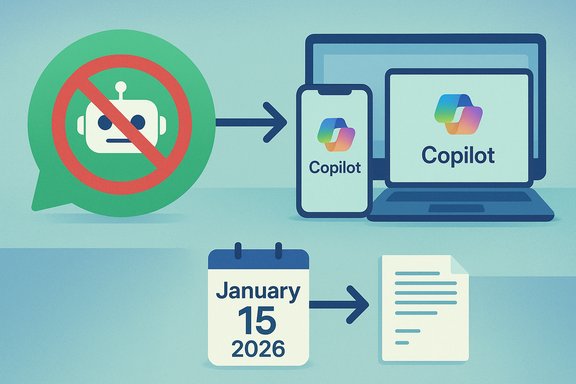
Illustration of exporting a WhatsApp chat on January 15, 2026, with phones and a laptop.Background​

WhatsApp’s Business Solution (commonly called the Business API) was designed to let verified businesses message customers at scale — shipping receipts, appointment confirmations, support responses and transactional updates. In October 2025, WhatsApp added a new section aimed at “AI providers,” broadly defining that group to include creators and operators of large language models, generative AI platforms and general‑purpose AI assistants. The updated terms say those providers may not use the Business Solution when the AI assistant itself is the primary functionality being delivered. The rule becomes enforceable on January 15, 2026. Microsoft’s Copilot team published a short, direct advisory that their WhatsApp contact will be discontinued on that date, and that users should migrate to Copilot’s native surfaces — the Copilot mobile apps, copilot.microsoft.com on the web, and Copilot on Windows — while exporting any WhatsApp chats they want to preserve. Microsoft framed the exit as a compliance step in response to the updated platform rules rather than a voluntary product retirement. The user‑facing result is immediate: general‑purpose third‑party assistants that had relied on WhatsApp’s Business API are being removed or required to find alternate distribution surfaces. OpenAI publicly acknowledged the same outcome for ChatGPT on WhatsApp and directed users to its native apps and website. Multiple independent outlets confirmed the chain of events and the January 15, 2026 cutoff.

What WhatsApp actually changed (plain terms)​

The new “AI providers” clause​

  • The Business Solution terms now include explicit prohibitions against developers or providers of large‑language models, generative AI platforms, and general‑purpose AI assistants using the Business Solution when those AI capabilities are the primary functionality being offered.
  • WhatsApp preserved a carve‑out for business‑incidental uses of AI — e.g., an airline using AI internally to help agents reply to booking queries, or a retailer automating order updates. Those remain permissible so long as AI is not the main consumer‑facing feature delivered through the Business API.

Effective date and scope​

  • The policy takes effect January 15, 2026. It applies specifically to the Business Solution / Business API, not to every message or every part of WhatsApp’s consumer app.
  • The clause’s broad wording gives WhatsApp and Meta discretion to interpret what “primary functionality” and “AI Provider” mean in practice, making enforcement somewhat discretionary unless clarified in partner guidance.

Microsoft’s announcement and the immediate user impact​

Microsoft’s Copilot team published a FAQ‑style post that lays out the migration plan in plain language:
  • Copilot on WhatsApp will remain available until January 15, 2026; after that date the WhatsApp contact will stop responding.
  • Conversations initiated with Copilot inside WhatsApp cannot be automatically migrated into Copilot’s authenticated, account‑backed history because the WhatsApp integration ran unauthenticated. Microsoft therefore recommends users export any WhatsApp chats they want to keep using WhatsApp’s built‑in export tools.
  • Microsoft points users to the Copilot mobile apps (iOS and Android), the Copilot website, and Copilot on Windows as the supported alternatives; those surfaces support authenticated accounts, history sync, and richer multimodal features (voice, vision) that the WhatsApp contact could not provide.
Those are the core, verifiable facts people need: a firm cutoff date, a required migration for continued access, and an explicit warning that chat histories on WhatsApp will not be carried forward automatically. Microsoft’s post frames the change as compliance with WhatsApp’s policy update and as a timely nudge toward first‑party surfaces where account continuity and richer features are available.

Why WhatsApp changed course — official rationale and likely motives​

WhatsApp’s public explanation emphasizes the API’s intended purpose: the Business Solution exists to help businesses message customers with structured, transactional flows and customer support. According to Meta and reporting based on the updated terms, an unexpected wave of consumer‑facing LLM assistants used the API as a distribution channel and created atypical message volumes, moderation burdens and support overhead that the Business API was not designed to handle. That operational argument is plausible: free‑form, high‑volume conversational traffic differs materially from templated business notifications. But the policy also has clear strategic side effects. By removing third‑party general‑purpose assistants from WhatsApp’s Business Solution, Meta effectively narrows distribution for rival assistants inside a massively popular messaging surface — and preserves space for Meta’s own in‑app assistant to serve general‑purpose queries. Industry observers and reporters have flagged this competitive dimension and pointed out that the clause’s discretionary language gives Meta broad leeway to determine what counts as a banned use. Those considerations are already attracting regulatory attention in some jurisdictions.

Who’s affected — vendors, startups and users​

  • Major consumer assistants delivered via WhatsApp’s Business API are directly affected: Microsoft Copilot, OpenAI’s ChatGPT (the 1‑800‑ChatGPT WhatsApp contact), Perplexity, and various startups that used WhatsApp as a low‑friction distribution channel. OpenAI and Microsoft both announced wind‑down guidance in response to the policy.
  • Smaller startups that relied on WhatsApp to reach users without building native apps are particularly exposed. Rebuilding user acquisition and engagement funnels for app or web distribution is non‑trivial and costly.
  • Businesses using AI incidental to customer workflows (support bots, booking assistants) are largely unaffected if AI is not the primary user experience — but any business whose flows resemble an open‑ended assistant should review whether they fall inside or outside the new policy scope.

Data portability, authentication and chat history: practical reality​

Two simple technical facts govern what users can keep and why migration is painful:
  • The WhatsApp Copilot integration was unauthenticated: the Copilot bot functioned like a contact inside WhatsApp rather than as an authenticated, account‑linked session that Microsoft could map back to a Copilot account. Because of that, Microsoft cannot import or re‑associate WhatsApp conversation history into Copilot’s account‑backed history on the web or mobile. Microsoft explicitly states this limitation.
  • WhatsApp’s export tools are the only supported method to preserve a record of conversations. Exported chats are archival artifacts — plaintext or zipped media — not account‑linked conversation history that can be restored inside a different assistant. Users who want a record must export before the January 15 deadline and manage the exported files themselves.
This combination of unauthenticated access and differing platform semantics produces a discontinuity: what worked as a frictionless, no‑login experience on WhatsApp cannot be ported seamlessly into the richer, account‑based systems vendors now want users to adopt. That gap is the single largest user‑facing harm created by the policy change.

Immediate steps for users (practical checklist)​

  • Export important chats now. Use WhatsApp’s Export Chat feature to save threads that include Copilot or other assistant interactions. Include media if needed and verify the exported archive. Microsoft and multiple vendors have urged users to do this before the cutoff.
  • Link accounts where supported. If a provider (for example, OpenAI’s ChatGPT) offers an account‑linking flow from the WhatsApp contact profile, follow the vendor guidance to preserve conversation continuity where possible. That option is provider‑specific and may allow history to appear inside the provider’s app once linked.
  • Install and sign in to vendor apps. Download the Copilot mobile app or ChatGPT app and sign in with your account to get authenticated, synced history and premium features. Vendors point to these native surfaces as their long‑term experience.
  • For business or automation flows: audit your integration now. If your service used a general‑purpose assistant via WhatsApp, rearchitect to either: (a) reduce AI to a clearly ancillary business use, or (b) shift to authenticated channels (apps, web) or alternative messaging platforms that permit such assistants.

Enterprise and developer implications​

  • Re‑design for authenticated, account‑linked flows. The pitfall of unauthenticated “contact‑based” assistants is now obvious: platform rules can change, leaving no migration path. Developers should design assistants that let users link accounts and persist conversations in vendor systems to enable portability and continuity.
  • Avoid single‑channel dependence. Building a product that relies on a single third‑party distribution surface — however popular — is a business risk. Consider multi‑surface strategies (web, native apps, alternative messengers) and clear account‑linking options from day one.
  • Rethink the business model. WhatsApp’s decision is explicitly about the Business API’s intended commercial remit. Vendors that monetize assistants by delivering high‑volume conversational traffic through a platform that expects transactional messaging will need to find new revenue mechanics or build deeper partnerships that align with platform pricing and support expectations.

Strategic and regulatory fallout — a closer look​

The policy pivot sits at the intersection of operational necessity and platform strategy. Meta’s official reason — that general‑purpose chatbots imposed unusual system load and required different support — is plausible and is consistent with the technical differences between customer‑service bots and open‑ended LLM assistants. But the rule’s net effect is also strategically favorable to Meta: it reduces third‑party distribution for rival assistants inside WhatsApp and clears room for Meta’s own Meta AI to serve general‑purpose needs inside the app. Observers have called attention to that competitive angle. Regulators are paying attention. European competition authorities and other watchdogs are already monitoring how large platforms’ platform rules, in‑app integration priorities, and data centralization strategies may affect competitive dynamics. The policy’s timing and discretionary language raise questions that could invite antitrust or market‑dominance probes, particularly where a dominant communication surface restricts third‑party distribution in ways that advantage the platform owner’s proprietary services. Recent reporting shows at least one European authority broadening inquiries into Meta’s AI integrations and platform rules — a development that underscores regulatory interest in these shifts.

Strengths and benefits of the change (what proponents would say)​

  • Operational stability: restricting high‑volume open‑ended assistants on an API designed for transactional business messages reduces unexpected load and simplifies platform support requirements.
  • Clarity of product intent: the Business API’s purpose — enabling businesses to communicate with customers — becomes less ambiguous when one type of unanticipated use case is curtailed.
  • Potentially improved safety and moderation posture: third‑party assistants raise content moderation complexities; consolidating general‑purpose assistants onto dedicated, authenticated surfaces may make moderation and abuse mitigation more tractable.
These are real, defensible benefits from an engineering and platform management perspective.

Risks and downsides (what critics and users will feel)​

  • Reduced consumer choice and convenience: millions of users who discovered assistants through WhatsApp now face friction — installing apps, creating accounts, and losing local chat continuity unless they export records. Microsoft itself described the WhatsApp integration as having helped “millions” of people connect with Copilot; the loss of that low‑friction surface is concrete and immediate.
  • Lock‑in and competition concerns: the policy advantageously positions Meta’s own assistant and raises concerns about dominant platforms steering traffic toward their own services via policy changes rather than open market competition.
  • Data portability and archival loss: unauthenticated sessions cannot be migrated into vendor accounts, and exported archives are archival only — they do not restore the interactive history inside a new assistant experience. Users who care about continuity face irreversible gaps if they fail to export before the deadline.

How different players are reacting (short profiles)​

  • Microsoft: Confirmed Copilot will stop working on WhatsApp on January 15, 2026, advised exports and migration to first‑party apps and web; emphasized richer capabilities on native surfaces (voice, vision, companion features).
  • OpenAI: Confirmed that ChatGPT’s WhatsApp contact will cease after the same effective date, urged users to link accounts where supported and to use ChatGPT’s native apps and website for continuity. OpenAI also highlighted how many users had adopted ChatGPT on WhatsApp during the experiment.
  • Startups and smaller vendors: Many must either wind down WhatsApp channels or pivot to alternative messengers (Telegram, Signal) or to building native apps and web experiences — a costly, time‑sensitive migration.

Practical recommendations for readers and businesses​

  • If you used Copilot or other assistants on WhatsApp: export chats now, back them up securely, and install and authenticate with the vendor’s native app to preserve as much continuity as the provider supports.
  • If you run an AI startup that used WhatsApp: treat this as a design lesson. Plan authenticated linkage, multi‑surface distribution and an owned user identity from the product’s earliest days. Reassess contractual dependencies on third‑party distribution channels and maintain alternative funnels for user acquisition and retention.
  • If you operate customer‑facing bots on WhatsApp for business: confirm whether your bot remains compliant with the updated Business API terms. If your AI is incidental to a broader business workflow, you should remain within the allowed carve‑out — but document and justify the incidental nature of AI in case of review.

What remains unclear (and should be watched)​

  • Enforcement mechanics: Meta has not published detailed operational guidance about how it will detect or block “primary” AI assistant traffic on the Business API. The discretionary language in the clause suggests flexible enforcement but leaves technical and contractual questions open. Until WhatsApp issues partner‑level guidance, interpretation and compliance will be ambiguous.
  • Transition support for users: whether vendors will be able to provide robust, automated linking flows that preserve history varies by provider. Some (OpenAI) offered link‑to‑account options; others used unauthenticated models with no migration path. Users should heed the explicit export warnings.
  • Regulatory outcomes: antitrust and competition authorities may view the policy through a competition lens, particularly where it disadvantages third‑party assistants in favor of an integrated, in‑house solution. Ongoing regulatory interest will be a decisive factor for how platform rules like this evolve.

Conclusion​

The removal of Microsoft Copilot from WhatsApp — and parallel exits by other LLM providers — is a high‑visibility example of how platform policy can reshape distribution for consumer AI overnight. For users, the rule change imposes a concrete migration task: export chat history where needed and adopt vendor apps or websites for continued access. For developers and companies, the event is a stark reminder that unauthenticated, single‑channel strategies carry systemic risk when platform rules change.
There are defensible operational reasons behind WhatsApp’s decision, but the policy also amplifies strategic and regulatory questions about who controls the AI interface inside dominant communication platforms. The January 15, 2026 cutoff is firm; stakeholders should act now to preserve data, rearchitect fragile flows, and push for clearer partner guidance from platform owners so that future transitions are predictable, auditable, and fair.
Source: Zoom Bangla News Microsoft Copilot to Exit WhatsApp as Meta Tightens Platform Rules
 

Microsoft’s Copilot will stop functioning on WhatsApp on January 15, 2026, as Microsoft confirmed in a Copilot team blog post saying the change is required by recent updates to WhatsApp’s platform policies that remove LLM-based, general-purpose chatbots from the WhatsApp Business Solution.

Policy update for WhatsApp Business Solution Terms with Copilot branding.Background​

WhatsApp’s Business API was opened to companies to let businesses use the messaging service for customer support, notifications and transactional workflows. In October 2025 Meta introduced a new clause targeting what it calls “AI Providers” — a definition broad enough to cover large language models, generative AI platforms and general-purpose assistants — and said those providers will be prohibited from using the WhatsApp Business Solution when the AI itself is the primary functionality being offered. That policy change is scheduled to take effect on January 15, 2026. Microsoft’s official Copilot post, published November 24, 2025, is explicit: Copilot on WhatsApp will remain available through January 15, 2026, but will be discontinued on that date. Microsoft directs users to switch to the Copilot mobile app, Copilot on Windows, or the Copilot web experience and instructs users who want to preserve WhatsApp conversations with Copilot to export chat history using WhatsApp’s built-in export tools before the cutoff. Meta’s policy change and Microsoft’s withdrawal from WhatsApp are part of a broader shift: several third‑party AI chatbots, including OpenAI’s ChatGPT and other LLM-based services, have either announced or are expected to end their WhatsApp integrations because the new Business Solution terms effectively bar distribution of general-purpose chat assistants through WhatsApp.

What exactly changed: the policy and the mechanics​

The policy language and practical effect​

Meta added a dedicated section to the WhatsApp Business Solution terms that focuses on “AI Providers.” The policy states, in effect, that “AI Providers are strictly prohibited from accessing or using the WhatsApp Business Solution when such technologies are the primary functionality being made available for use.” That short formulation captures the operational rule: if your WhatsApp presence is fundamentally a public-facing chatbot, the Business API will no longer be the right channel for it after January 15, 2026. Practically speaking, the policy change hits two things at once:
  • It blocks distribution channels for consumer-facing LLM assistants that had used WhatsApp as a familiar, low-friction way to reach users.
  • It preserves WhatsApp Business API for its original use case: enterprise-to-customer support, commerce and transactional messaging — where AI can be used as a tool inside a business flow rather than the primary product.

Microsoft’s reasoning and how it frames the move​

Microsoft’s public statement is straightforward and narrow: because WhatsApp’s platform policies have changed, Copilot will be discontinued on WhatsApp effective January 15, 2026. Microsoft positions this as a user‑experience transition, urging Copilot users to migrate to Microsoft’s other Copilot surfaces — mobile apps, web, and Windows — which it says offer the same core capabilities plus extras such as Copilot Voice, Vision and the new companion presence “Mico.” Microsoft also emphasizes that Copilot access on WhatsApp was unauthenticated, which means chat history cannot be ported to other Copilot platforms automatically. Users are advised to export content from WhatsApp if they need it.

Why this matters: immediate user impact​

For end users: migration, lost conveniences and chat history​

Millions of people tried AI assistants via WhatsApp because the app’s ubiquity made access trivial: no new account, no new app, just start messaging. The Microsoft announcement means those users will need to adopt a new workflow — install the Copilot mobile app, visit copilot.microsoft.com, or use Copilot on Windows — to keep using Copilot after January 15, 2026. Microsoft’s blog makes clear that Copilot on WhatsApp will stop working entirely on that date. Because Microsoft describes the WhatsApp access as unauthenticated, there is no automatic migration path for conversations. If users want to keep a record of their Copilot chats that occurred on WhatsApp, Microsoft explicitly recommends exporting chats using WhatsApp’s export tools before the service shuts down on WhatsApp. That means:
  • Users must proactively export any conversations they want to keep.
  • Exported files will be copies (text files, optionally with media) and are not importable into Copilot’s apps as live history.

How to export WhatsApp chats (practical steps)​

  • Open the conversation in WhatsApp.
  • On Android: tap the three-dot menu → More → Export chat → choose Without media or Include media and then select a save/share destination.
  • On iPhone: open chat → tap the contact/group name → Export Chat → choose Without Media or Attach Media (iOS limits apply) and then share/save to Mail, Files, etc.
Notes and caveats:
  • Exported chat text is typically saved as a .txt file; including media usually creates a .zip that bundles the transcript and media files.
  • iOS and Android have different media limits and behaviors; iOS typically limits attached media to a set number of recent items. Exported files lose WhatsApp’s end‑to‑end encryption protections once saved outside the app, so secure storage is essential.

The strategic picture: Meta, Microsoft and the platform war​

Meta’s stated rationale vs. competitive dynamics​

Meta frames the policy change as a product-alignment and infrastructure decision: WhatsApp Business API was designed to serve businesses; an influx of general-purpose chatbots was stretching capacity and creating a use case the API wasn’t built to support. That’s the public explanation offered to journalists. But the policy also has clear competitive consequences: by closing the Business API to third‑party LLMs, Meta limits how rival AI assistants can reach WhatsApp’s user base, effectively funneling conversational traffic toward Meta AI. Observers and industry coverage highlight the optics: the change benefits Meta’s own assistant by restricting distribution of competing AI services on a platform used by more than three billion people. This raises questions about platform gatekeeping and how messaging ecosystems may be reshaped by owners who also operate AI products.

Market and developer implications​

  • Startups and LLM providers that relied on WhatsApp as a low-friction distribution channel will now need to accelerate other channels: their own apps, web chat, integrations with other messengers (Telegram, SMS, in-app experiences), or white‑label business partnerships.
  • Enterprises that used LLMs internally or as part of customer workflows on WhatsApp remain largely unaffected so long as the AI is incidental to the business service; the policy explicitly aims to preserve customer-support bots and commerce workflows.

Technical and privacy considerations​

Unauthenticated access: what it means and the consequences​

Microsoft says the WhatsApp Copilot integration was unauthenticated, which implies users did not sign in to Copilot with a Microsoft account when using the WhatsApp contact; the WhatsApp contact responded to messages without a linked Copilot identity. That architecture allowed quick access but has tradeoffs:
  • No account linkage means no secure, server-side association between a user’s Copilot profile and their WhatsApp messages, so Microsoft cannot migrate that conversation history into Copilot’s authenticated surfaces.
  • Unauthenticated usage complicates personalization, multi-device syncing, and secure export/import flows — features that fully authenticated Copilot experiences can support.
From a security and privacy perspective, exported chat transcripts are plaintext outside WhatsApp’s end-to-end encryption. Users who follow Microsoft’s instruction to export should be aware that the exported file is a non‑encrypted artifact and must be stored securely; standard precautions apply (encrypted cloud storage, local backups behind full-disk encryption, secure deletion when no longer needed). Operational guidance on WhatsApp export behavior underscores that exported data may omit media that’s no longer on the device, and iOS/Android have different limits.

Data residency, telemetry and terms of service​

  • Microsoft’s Copilot surfaces (web, mobile, Windows) operate under Microsoft’s own privacy and telemetry frameworks, which differ from Meta’s data practices. Users migrating to Copilot apps should review the Copilot privacy terms and any subscription details for Copilot Pro features.
  • Meta has previously indicated that conversations with Meta AI may be used to show ads and personalization on its properties; moving a conversation out of WhatsApp and into Microsoft’s ecosystem changes the data controller relationship and therefore the privacy expectations. News coverage and policy analysis have highlighted this difference as a strategic factor behind the policy change.

For IT managers, developers and businesses​

If you offered a customer-facing LLM on WhatsApp​

  • Evaluate alternative distribution channels now. WhatsApp will not be available for general-purpose chatbot distribution for AI providers after January 15, 2026.
  • Consider migrating critical services to:
  • your own mobile or web apps,
  • conversational SDKs embedded inside enterprise apps,
  • other messaging platforms that allow third-party bots,
  • or building authenticated integrations that fall under the “ancillary AI” exception for business workflows (if your bot genuinely supports a business process rather than acting as a public assistant).

For IT teams supporting end users​

  • Communicate timelines clearly: Copilot on WhatsApp is scheduled to work until January 15, 2026; plan migration communications and support resources well before that date.
  • Provide step-by-step instructions for exporting chats and emphasize secure handling of exported files. Use device-specific guidance to avoid missing media or hitting iOS media limits.

Broader risks and policy questions​

Platform control and anticompetitive concerns​

The move spotlights a recurring tension in modern platforms: owners of dominant distribution channels can set rules that favor integrated services. By restricting third-party LLM distribution, Meta effectively consolidates a major conversational interface (WhatsApp) for itself, raising questions about competition policy, developer access, and long-term interoperability of AI assistants. Regulators and industry observers will likely scrutinize whether platform owners are using technical terms and API governance to advantage their own products. Reporting around the policy change has already framed it as a partial lock-in that benefits Meta AI.

User choice and fragmentation​

Users benefit from choice and seamless access. The WhatsApp policy and resulting departures create fragmentation: users who liked using Copilot inside WhatsApp must install another app or use a browser. That friction reduces immediate access and could slow adoption for some demographics who prefer in‑app AI rather than managing multiple services. Device-level barriers, corporate device policies, or app store restrictions could further complicate moves to standalone Copilot apps.

Operational load and infrastructure arguments​

Meta’s stated reason — that general-purpose chatbots increase message volume and operational burden on the Business API — is plausible on its face. Third-party LLM assistants can (and often do) generate high message volumes, media requests, and conversational churn that differ from predictable customer-support traffic. From an engineering perspective, segregating these workloads can simplify capacity planning. That rationale does not remove the policy’s competitive effects, but it provides a technical justification that may be deemed legitimate by policy-makers.

Practical checklist: what to do next if you used Copilot on WhatsApp​

  • Export any Copilot conversations from WhatsApp you want to keep before January 15, 2026. Use the in‑app Export Chat option (Android or iPhone) and choose whether to include media. Store the exported files securely.
  • Install the Copilot mobile app (iOS/Android), sign in with a Microsoft account, and review Copilot privacy settings and feature access. Microsoft says Copilot on mobile, web, and Windows offer the same core features and additional capabilities like Copilot Voice and Vision.
  • Update internal documentation and customer-facing pages that referenced Copilot on WhatsApp, and provide alternative contact methods for support and AI interactions.
  • For developers: review WhatsApp Business Solution terms and determine whether your bot qualifies as an ancillary AI for a business workflow or must migrate to another channel. Build authenticated experiences where possible to avoid the limitations of unauthenticated access.

Conclusion​

Microsoft’s decision to retire Copilot on WhatsApp by January 15, 2026, is a direct consequence of WhatsApp’s updated Business Solution terms that exclude general‑purpose LLM chatbots as a distribution channel. Microsoft is presenting the move as a technical and policy-driven transition, steering users toward Copilot’s own apps and the web experience and advising exports for anyone who wants to preserve WhatsApp conversations. The episode crystallizes several broader trends: platform owners asserting tighter control over what can run on their APIs; a rapid reconfiguration of how AI assistants reach end users; and growing pressure on startups and LLM providers to build independent distribution and authentication strategies. For everyday users, the most immediate impact is practical — export what matters, install the supported Copilot apps or use the web client, and be mindful of privacy when storing exported conversations. For the industry, it is another reminder that dominant platforms can change the rules quickly, and the distribution layer for AI assistants remains politically and economically contested.
Source: LatestLY Microsoft Copilot Leaving WhatsApp: Microsoft AI-Powered Assistant Will Soon End Support As Meta-Owned Platform Updates Policies for LLM Chatbots | 📲 LatestLY
 

Attachments

  • windowsforum-copilot-leaves-whatsapp-on-january-15-2026-migration-guide.webp
    windowsforum-copilot-leaves-whatsapp-on-january-15-2026-migration-guide.webp
    1.8 MB · Views: 0
No bots: Copilot arrives on phones, tablets, and laptops starting January 15, 2026.
WhatsApp will no longer host Microsoft’s Copilot or other general-purpose LLM chatbots after a platform policy update that takes effect on January 15, 2026, forcing millions of users and dozens of third‑party AI services to migrate to standalone apps, web portals, or alternative messaging channels.

Background / Overview​

WhatsApp’s owner, Meta, quietly revised the WhatsApp Business Solution (the Business API) terms in October 2025 to add an “AI providers” restriction that explicitly prohibits providers of large language models (LLMs), generative AI platforms, and general‑purpose AI assistants from using the Business API when those AI capabilities are the primary functionality being offered. The policy change has an effective enforcement date of January 15, 2026, and applies to existing integrations as well as new signups. Microsoft’s Copilot team has confirmed the practical consequence: Copilot on WhatsApp will be discontinued on January 15, 2026, and users should transition to Copilot’s native surfaces — the Copilot mobile apps (iOS and Android), Copilot on the web, and Copilot on Windows. Microsoft also warns that conversations held with Copilot on WhatsApp are unauthenticated and cannot be migrated automatically to Microsoft account‑backed Copilot histories; users who want to retain those threads must export them using WhatsApp’s export tools before the deadline. This change is not isolated to Microsoft. Other prominent AI assistants that used WhatsApp as a low‑friction distribution channel — including OpenAI’s ChatGPT and a number of startups — are either confirmed to cease WhatsApp support or are expected to follow, because the Business API path they used is the exact capability targeted by the new clause.

What exactly changed in WhatsApp’s Business Solution terms​

The policy in plain language​

The updated terms introduce a new section addressing “AI Providers” and include wording that, in essence, states:
  • Providers and developers of AI or machine learning technologies — including but not limited to large language models, generative AI platforms, and general‑purpose AI assistants — are prohibited from accessing or using the WhatsApp Business Solution to provide those technologies when they are the primary functionality being made available.
The policy preserves a key exception: AI used incidentally in customer‑facing business workflows (order confirmations, booking interactions, ticket triage, transactional notifications) remains permitted. The distinguishing line is whether the AI assistant is the business’s core offering (and therefore disallowed) or an ancillary tool within a broader enterprise flow (and therefore allowed).

Enforcement date and immediate effect​

Meta set a specific enforcement date — January 15, 2026 — giving a short migration window after the October 2025 publication. That enforcement means high-volume, consumer‑facing chat assistants that previously appeared as WhatsApp contacts via the Business API will stop accepting messages or otherwise be disabled on that date unless they reconfigure to a permitted model or shift to other channels.

Why Meta changed the rules — official explanation vs strategic incentives​

Meta’s published rationale frames the change as a corrective step: the Business API was built for enterprise‑to‑customer communication (support, updates, commerce), not as a distribution channel for consumer chatbots. Meta told reporters that the rapid adoption of general‑purpose assistants imposed operational strain, unpredictable message volumes, and support/moderation burdens that the API was not designed to handle. That explanation is credible on its face — large, open‑ended LLM traffic can generate very different moderation and infrastructure requirements compared with transactional messaging — but the policy also has clear strategic side effects. By restricting third‑party LLMs on WhatsApp, Meta narrows the field for in‑app assistants and makes it easier for its own Meta AI to be the dominant conversational agent inside WhatsApp, Instagram, and Messenger. Several analysts and reporters have read the move as a consolidation of a high‑value distribution channel under Meta’s control. That strategic interpretation is plausible but not explicitly stated in Meta’s language and should be treated as analysis rather than fact.

Immediate user impact — what consumers must do now​

The decision affects individual users and businesses differently. The most pressing user‑facing points are:
  • Copilot and other general‑purpose assistants will remain functional in WhatsApp only until January 15, 2026. After that, the chat contacts will stop responding.
  • Conversations with Copilot on WhatsApp are unauthenticated; Microsoft cannot transfer them into account‑backed Copilot histories on the web or apps. Users who want to keep records must export chat history from WhatsApp before the cutoff. Microsoft explicitly recommends this.
  • For continued access to Copilot, users should install the official Copilot mobile app, visit copilot.microsoft.com, or use Copilot integrated into Windows. Microsoft says these surfaces offer the same core capabilities plus additional multimodal features.
Practical migration checklist for users:
  1. Export chat threads with Copilot or any other AI assistant from WhatsApp (including media if needed).
  2. Install the vendor’s official app (Copilot app, ChatGPT app, or the provider’s web client) and create or link an account.
  3. Update any workflows or automations that relied on in‑chat assistants (for example, Zapier bridges or bot triggers) to use new endpoints or authenticated APIs.
  4. For business-critical usage, plan a test migration to validate feature parity and data portability.

Enterprise and developer implications​

For businesses using AI in customer support​

The policy preserves enterprise‑side AI when it is part of a transactional or support workflow. That means banks, airlines, retailers, and service providers can continue to use AI in WhatsApp for defined business cases — but they must ensure the AI is truly incidental or ancillary to a business process, per the terms. Firms that relied on open‑ended assistants for discovery or marketing via WhatsApp will need to reengineer.

For startups and AI vendors​

WhatsApp’s Business API had been a low‑cost distribution channel: vendors could expose an assistant without requiring users to download an app. Losing that channel raises user acquisition costs and forces vendors to accelerate investments in:
  • Native mobile/web apps with account systems and notifications.
  • OAuth and verified phone‑number linking so conversational history can be tied to user accounts.
  • Alternative messaging platforms that permit third‑party bots (for example, Telegram), albeit with much lower global reach than WhatsApp.
  • Monetization models that do not rely on platform distribution.
The immediate business response will likely involve rapid migration plans, customer communication, and temporary redirects to alternative channels. For smaller vendors without deep engineering resources, the change could be existential.

Technical details and limitations that drove the change​

Large‑scale LLM chats within a messaging ecosystem create unique technical problems:
  • Moderation overhead: Open‑ended LLM responses can produce policy‑sensitive content; moderation at WhatsApp scale requires different tooling and human review commitments than transactional bot flows.
  • Message volume: Conversational assistants generate more back‑and‑forth traffic per user, increasing throughput and cost for the Business API hosting layer.
  • Authentication and data portability: Many WhatsApp LLM integrations used unauthenticated contact numbers. That design makes it impossible for vendors to reliably persist user identity and sync chat history into account‑backed products without an explicit linking flow. Microsoft specifically flagged this as the reason it cannot import WhatsApp conversations into Copilot accounts.
These constraints explain why Meta opted for a policy fix rather than incremental technical measures: changing the terms gives the company quick, broad control over the use case while buying time to build or refine enforcement and moderation tooling.

Privacy and data‑portability concerns​

Users: export and verify​

Because many third‑party assistants on WhatsApp ran as unauthenticated contacts, there’s no automatic way for Microsoft or other vendors to reconstruct conversation history on new, account‑based platforms. Users should therefore:
  • Export WhatsApp chats including media before January 15, 2026, and verify the exported file includes the critical information they need.
  • Store exported files securely (encrypted local storage or highly trusted cloud storage), mindful that exported chat content may include personal data and should be treated with standard data‑protection safeguards.

Enterprises: compliance and contractual obligations​

Businesses using WhatsApp for customer interactions must audit retention policies and data flows. If a third‑party assistant processed personal data, contractual terms and data‑processing agreements need to be reviewed to ensure customers’ rights and regulatory requirements (e.g., GDPR) are preserved during migration. Vendors leaving WhatsApp should provide clear instructions on records, retention, and export procedures to their customers.

Competition, regulation, and antitrust questions​

The policy raises immediate questions about platform power and competition. When a dominant messaging platform closes a distribution channel to third‑party services — and retains the capability to offer a native alternative — regulators and competition observers are likely to scrutinize the move. Key points for consideration:
  • Does the policy constitute legitimate platform governance to preserve infrastructure and safety, or does it function as market foreclosure that disadvantages rivals?
  • Are there objective technical or safety thresholds Meta could have used to permit third‑party LLMs under stricter controls rather than enacting a blanket policy?
  • Will affected vendors raise concerns with competition authorities, arguing that WhatsApp’s reach (multiple billions of users) makes exclusion from the Business API an unreasonable barrier to market entry?
These are open questions; the policy change is defensible on operational grounds, but the strategic implications mean regulators and industry stakeholders will watch closely. Any formal regulatory interpretation will depend on jurisdictional law and a granular review of Meta’s internal decision‑making and enforcement practices.

The product perspective: what Copilot and similar assistants lose — and gain​

Lost convenience: frictionless in‑chat access​

WhatsApp offered a high convenience factor: users could message an AI in a familiar chat interface without new installs. That frictionless access drove rapid user adoption and experimentation.

Gained capabilities: richer, account‑backed experiences​

By migrating to first‑party apps and the web, vendors like Microsoft can provide:
  • Authenticated accounts and synced history across devices.
  • Multimodal features (voice, vision) with better integration and permissions control.
  • Subscription tiers and usage tracking for monetization.
  • Improved moderation pipelines under vendor control.
Microsoft’s post highlights that Copilot’s native apps and web surfaces offer features such as Copilot Voice, Copilot Vision, and a companion presence called Mico, which are more difficult to deliver in the constrained WhatsApp contact form. Those enhancements aim to offset the loss of WhatsApp by offering superior functionality elsewhere.

Practical migration guide for IT teams and power users​

  1. Inventory: List all workflows, automations, and integrations that rely on Copilot or other AI assistants inside WhatsApp.
  2. Prioritize: Identify high‑impact flows and users who require uninterrupted access (customer service lines, critical support).
  3. Communicate: Notify affected users and customers with clear timelines and step‑by‑step migration instructions.
  4. Export: Provide instructions and support for exporting WhatsApp chat history (including media) safely.
  5. Rebuild or reconfigure:
    • Option A: Rebuild features within the provider’s mobile/web app and link users via OAuth or phone‑number verification.
    • Option B: Reconfigure interactions so AI is ancillary inside WhatsApp (if that fits the permitted model).
  6. Test: Validate edge cases, authentication flows, and data retention behavior before the enforcement date.
  7. Monitor: Track user adoption of the new surfaces and respond to feedback rapidly.
Enterprises should also check contractual commitments to customers regarding continuity, data access, and regulatory obligations during this transition.

Broader implications for the future of conversational AI distribution​

This policy shift marks a broader inflection point in where and how LLMs reach users:
  • Platforms will increasingly define the permissible shape of AI experiences inside their walled gardens.
  • Vendors must diversify distribution strategies to avoid overdependence on a single platform’s API.
  • The economics of AI distribution will favor vendors that control both the model and the distribution channel (or who can build strong cross‑platform account systems).
  • User expectations will evolve: those who valued convenience will need to accept explicit onboarding steps to access AI assistants, while power users will benefit from richer, personalized, and account‑centric experiences.
In short, the era of “install‑nothing” AI via dominant messaging apps may be ending; the next chapter is accounted, authenticated, and feature‑rich AI delivered by vendor‑owned surfaces or alternative messaging platforms.

Notable strengths and potential risks of the policy​

Strengths​

  • Clarity of purpose: WhatsApp reestablishes the Business API’s intended role for enterprise workflows, reducing misuse of a channel designed for transactional messaging.
  • Operational relief: Limiting general‑purpose LLM traffic should reduce moderation load and unpredictable message volumes on the Business API.
  • Encourages better practices: Vendors are pushed to build authenticated experiences, improving data portability, user control, and monetization options.

Risks​

  • Consolidation and lock‑in: Meta’s policy effectively reserves high‑visibility in‑app assistant real estate for itself, which could harm competition and consumer choice.
  • Increased friction for users: The migration raises friction for users who preferred the simplicity of in‑chat assistants; this could reduce usage and experiment-driven discovery.
  • Startup fragility: Early‑stage AI vendors that relied on WhatsApp for distribution may face existential threats or be forced into costly pivots.
  • Regulatory scrutiny: The move may attract antitrust attention in jurisdictions concerned about platform gatekeeping.
Where a policy offers operational safeguards it can also create economic and competitive distortions; balancing those outcomes will be the central challenge for platforms, regulators, and the AI industry going forward.

Final takeaways​

WhatsApp’s policy update and Microsoft’s confirmation that Copilot will leave WhatsApp on January 15, 2026 represent a major reset in how conversational AI is distributed on dominant messaging platforms. The change preserves WhatsApp’s Business API for enterprise use cases, forces AI vendors to invest in authenticated, vendor‑controlled surfaces, and sharpens debates about platform control and competition. Practical guidance for affected users is clear: export any chat histories you want to keep, install the vendor’s native apps or use the web client, and plan for reconfigured workflows where necessary. For businesses and startups, the decisive lesson is to diversify distribution, prioritize authenticated identity and portability, and expect platforms to change rules quickly. The January 15, 2026 cutoff is the hard milestone; the next months are the migration window that all impacted parties must use wisely. In the broader sweep, the episode is a reminder that the architecture of online services — the APIs platforms choose to expose, the contracts they enforce, and the enforcement timelines they set — shape not just technical outcomes but markets, user expectations, and the competitive dynamics of an entire industry.

Source: newskarnataka.com https://newskarnataka.com/technolog...on-whatsapp-after-new-policy-update/26112025/
 

Back
Top