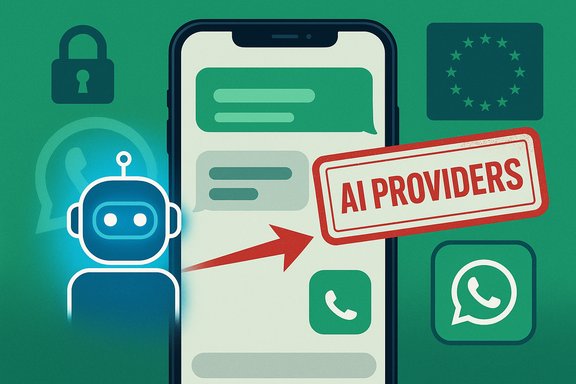
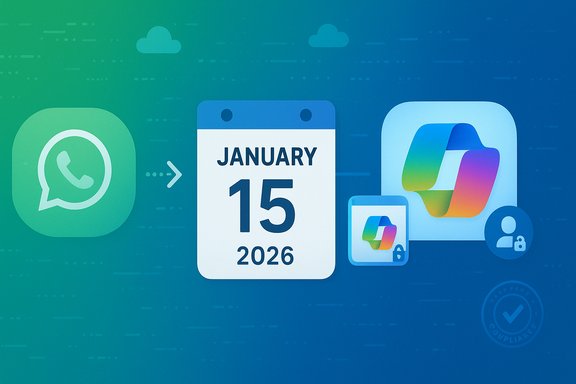
Microsoft’s Copilot will stop responding inside WhatsApp on January 15, 2026, after WhatsApp’s owner revised its Business API terms to explicitly bar third‑party, general‑purpose large‑language‑model (LLM) chatbots from operating as primary services through the platform.
WhatsApp’s Business Solution (commonly referred to as the WhatsApp Business API) was originally built to let verified businesses send transactional messages, manage customer support threads, and run commerce flows at scale. Over 2024–2025, that API also became a low‑friction distribution channel for consumer‑facing AI assistants: vendors could expose an AI contact that users message like any other phone number and immediately get responses from an LLM. That experiment accelerated adoption — and friction — prompting Meta to add a new “AI Providers” clause to the Business Solution terms in October 2025. The new clause prohibits providers of LLMs, generative AI platforms, and general‑purpose AI assistants from using the Business Solution “when such technologies are the primary (rather than incidental or ancillary) functionality being made available for use,” with enforcement set for January 15, 2026. Microsoft’s Copilot team confirmed the practical consequence: Copilot on WhatsApp will be discontinued on that date, and users are being directed to Microsoft’s first‑party Copilot surfaces — the Copilot mobile apps (iOS and Android), Copilot on the web, and Copilot integrated into Windows — for ongoing access. Microsoft has also warned users to export any WhatsApp chat history they want to keep because the WhatsApp integration was unauthenticated and those conversations cannot be migrated automatically into Copilot account histories.
Source: Windows Central Copilot users on WhatsApp, brace yourselves: Support ends mid‑January 2026
 Background
WhatsApp’s Business Solution (commonly referred to as the WhatsApp Business API) was originally built to let verified businesses send transactional messages, manage customer support threads, and run commerce flows at scale. Over 2024–2025, that API also became a low‑friction distribution channel for consumer‑facing AI assistants: vendors could expose an AI contact that users message like any other phone number and immediately get responses from an LLM. That experiment accelerated adoption — and friction — prompting Meta to add a new “AI Providers” clause to the Business Solution terms in October 2025. The new clause prohibits providers of LLMs, generative AI platforms, and general‑purpose AI assistants from using the Business Solution “when such technologies are the primary (rather than incidental or ancillary) functionality being made available for use,” with enforcement set for January 15, 2026. Microsoft’s Copilot team confirmed the practical consequence: Copilot on WhatsApp will be discontinued on that date, and users are being directed to Microsoft’s first‑party Copilot surfaces — the Copilot mobile apps (iOS and Android), Copilot on the web, and Copilot integrated into Windows — for ongoing access. Microsoft has also warned users to export any WhatsApp chat history they want to keep because the WhatsApp integration was unauthenticated and those conversations cannot be migrated automatically into Copilot account histories. What changed: the policy in plain English
The new “AI Providers” clause
WhatsApp’s updated Business Solution terms introduce a named prohibition on “AI Providers,” a broadly worded category that explicitly includes creators or operators of LLMs, generative AI platforms, and general‑purpose AI assistants. The policy is clear about scope: if those AI capabilities are the primary functionality offered through the Business API, the provider is not permitted to use the API for distribution. The clause grants Meta wide discretion to determine what constitutes “primary functionality,” which creates a practical enforcement lever and potential ambiguity for edge cases.Allowed vs. banned use cases
- Allowed: narrowly scoped, business‑centric automations (order confirmations, status updates, appointment reminders, or ticket triage) where AI is incidental to the company’s service.
- Banned: consumer‑facing, general‑purpose AI assistants that use WhatsApp as their main distribution surface (for example, open‑ended chatbots whose primary product is conversational AI delivered through a WhatsApp contact).
Microsoft’s response and the migration plan
Official guidance and timeline
Microsoft published a formal advisory telling users that Copilot on WhatsApp will remain available through January 15, 2026, and will stop working on that date. The company recommends that users move to its first‑party surfaces — the Copilot mobile app (iOS and Android), Copilot on the web (copilot.microsoft.com), and Copilot inside Windows — to retain continuity and access richer features such as Copilot Voice, Copilot Vision, and the companion presence called Mico. Microsoft also emphasized that because the WhatsApp integration used an unauthenticated contact model, chat transcripts on WhatsApp cannot be imported automatically into Copilot accounts; users should export chats if they want to preserve them.Practical migration steps Microsoft recommends
- Export any WhatsApp conversations with Copilot you want to keep (WhatsApp provides an Export Chat tool that can include media).
- Install and sign in to the Copilot mobile app (iOS/Android) or use Copilot on the web to get an authenticated, account‑backed experience.
- If you used Copilot for work flows inside WhatsApp, update any integrations or automations to reference authenticated Copilot APIs or alternative messaging channels.
Why Meta says it changed the rules — and why critics disagree
Meta’s public rationale
Meta frames the update as a defense of the Business API’s original purpose: predictable, enterprise‑to‑consumer workflows. The company argues that open‑ended LLM assistants generate unpredictable message patterns, create elevated load, and increase moderation burdens — conditions that do not fit the Business Solution’s intended use. In comments to the press, Meta representatives stressed the API is meant to serve businesses and that new rules help ensure the API serves tens of thousands of companies building those experiences.The counterarguments
Industry observers and competing AI vendors see a strategic dimension to the change. By restricting third‑party LLMs and reserving the messaging surface for Meta’s own AI offerings, critics argue Meta is tilting the playing field in favor of its in‑house generative AI stack. That friction has quickly escalated into regulatory scrutiny in Europe: competition authorities have opened investigations into whether Meta’s policy unfairly disadvantages rival AI providers. Several outlets report that the EU’s antitrust bodies are examining the policy change as a possible abuse of dominant market position.What Meta actually permitted
Importantly, the new language does not ban AI from WhatsApp entirely. It preserves the use of AI when it is incidental to a business workflow — for example, an airline using AI to auto‑triage support tickets or a retailer sending AI‑assisted shipping updates. The line between “incidental” and “primary” remains where most disputes will land. That ambiguity gives Meta discretion to interpret and enforce the rule on a case‑by‑case basis, creating uncertainty for developers building borderline services.Who is affected — and how severely
Consumers
For individual users who adopted Copilot by adding it as a WhatsApp contact, the impact is primarily convenience and continuity. Messaging Copilot like any other contact was simple and required no separate app install or sign‑in. After January 15, 2026, that convenience vanishes; users will need to install Copilot’s mobile app or use the web version to continue chatting. Users who want to keep a record of their WhatsApp Copilot chats must export them before the deadline because automatic migration is not supported.Small businesses and developers
Small businesses and startups that used WhatsApp as an easy distribution surface for AI‑driven customer experiences face real migration costs. The Business API’s low friction allowed many operators to reach users without developing native apps or authenticated account systems. Those services must now either:- Re-architect as authenticated, account‑backed experiences on web or native apps,
- Move to alternative messaging platforms with more permissive policies, or
- Narrow their AI functionality to be incidental to a larger business workflow to remain compliant with WhatsApp’s carve‑outs.
Large vendors and platforms
Major vendors — Microsoft, OpenAI, Perplexity, and others — have already signaled they will comply and migrate users off WhatsApp in the months leading up to the enforcement date. For platform owners and cloud providers, the bigger strategic implication is that distribution strategies have become brittle: platform policy can invert go‑to‑market assumptions rapidly, pushing vendors to invest more heavily in first‑party surfaces and authenticated identity models.Technical and product implications for Copilot and Windows
Why the WhatsApp integration was limited
Copilot’s WhatsApp deployment was, by design, a lightweight contact model: it allowed quick Q&A and short interactions but did not provide the full authenticated experience available in Microsoft’s own apps. That model limited feature parity — things like persistent memory tied to accounts, secure access to enterprise data, and advanced multimodal inputs were constrained or impossible in the WhatsApp surface. Microsoft argues the move off WhatsApp will enable a richer, more secure Copilot experience on Windows and other Microsoft‑controlled surfaces.The push to authenticated, account‑backed experiences
Industrywide, there is a clear migration to surfaces where vendors control identity, data retention, and richer modalities. Authenticated experiences enable:- Persistent, searchable conversation history associated with a user account,
- Tighter enterprise data protections and compliance controls,
- Rich multimodal features such as voice and vision that require enhanced permissioning,
- Better monetization and telemetry control for vendors.
Legal and competition risks — the EU response
Antitrust scrutiny
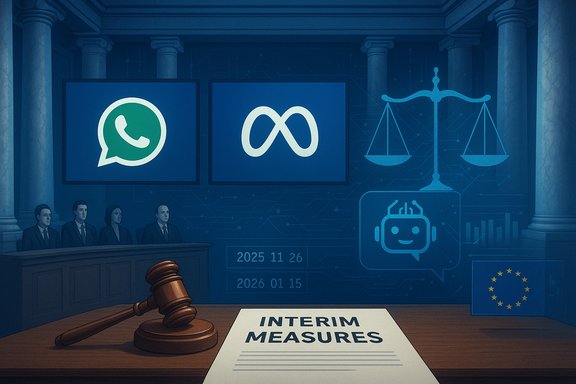
Regulators in Europe have moved quickly. The European Commission and several national regulators opened formal inquiries into whether Meta’s policy change constitutes an abuse of dominance by limiting rival AI providers’ access to WhatsApp’s vast user base. The probe examines if the new rules unfairly favor Meta’s in‑house AI by denying access to third‑party chatbots that previously used the Business API as a distribution channel. Early reporting indicates the investigation is active, and the legal risk to Meta is material given its market position.Enforcement and fines
If regulators conclude the policy sterically disadvantages competition, Meta could face interim measures or fines. Antitrust fines for large digital incumbents can be substantial, and enforcement could require Meta to adjust policy language or create carve‑outs that preserve neutral access for non‑Meta AI providers. For vendors, the ongoing inquiry underscores that platform policy shifts can produce regulatory consequences that extend beyond product and operational planning.What users and admins should do now — short checklist
- Export WhatsApp chat history you want to keep before January 15, 2026. WhatsApp’s export tool can create a plain‑text archive and optionally include media; exported files are archival and are not importable into Copilot’s account history.
- Install or update the Copilot mobile app on iOS or Android and sign in with your Microsoft account to get an authenticated experience and persistent history.
- Test Copilot on the web (copilot.microsoft.com) and on your Windows devices to confirm settings, features, and any subscription requirements.
- If you relied on Copilot inside WhatsApp for business workflows, inventory those automations and plan a migration: re‑implement as authenticated bots, place logic behind company‑controlled webhooks, or move to alternative messaging platforms.
- For organizations subject to records retention or compliance, store exported chat archives in your corporate records systems and update processes to avoid data loss.
Alternatives and workarounds
- Use Copilot’s native mobile and web apps for full feature access and authenticated history.
- For businesses needing in‑chat automation on WhatsApp, reframe features to be incidental AI (automated confirmations, structured responses) rather than primary, general‑purpose assistants to remain compliant with the policy.
- Explore other messaging platforms with different policies (for example, Telegram or proprietary in‑app experiences) but beware of fragmentation and user adoption trade‑offs.
Strengths and weaknesses of the policy change — critical analysis
Strengths (platforms and businesses)
- Predictability for enterprise customers: By refocusing the Business API on transactional, enterprise use cases, WhatsApp reduces the operational unpredictability introduced by open‑ended LLM traffic. This helps enterprises relying on stable throughput and moderation guarantees.
- Operational control for Meta: The policy lets Meta manage capacity, abuse mitigation, and moderation across WhatsApp’s infrastructure in a way that aligns with its commercial model. That control can reduce unexpected cost spikes tied to LLM workloads.
Weaknesses and risks (competition, users, vendors)
- Risk of reduced competition: Removing third‑party distribution channels can tilt the landscape toward native Meta AI offerings and limit competitive choices for users and businesses. That structural effect is precisely why regulators in Europe have opened probes.
- User friction and fragmentation: For many users, the WhatsApp contact model was convenient because it required no separate app or sign‑in. Forcing a migration to native apps increases friction and may slow adoption of AI features.
- Ambiguity in enforcement: The policy’s reliance on Meta’s discretion to define “primary functionality” invites uncertainty for developers. Borderline services will face arbitrary or inconsistent enforcement decisions unless Meta clarifies guardrails.
Unverifiable or disputed claims — cautionary notes
- Microsoft and other vendors have stated that Copilot’s WhatsApp deployment reached “millions” of users. While the companies report broad adoption, independent verification of exact user counts and usage patterns has not been published; treat quantitative adoption figures as vendor‑reported and therefore indicative but not independently verified.
Broader lessons for the AI distribution era
Platform policy is now a first‑class constraint in the architecture of conversational AI. The WhatsApp case shows that distribution strategies built on third‑party surfaces can be fragile: a single contract or terms change can remove an entire channel overnight. Companies seeking resilience should prioritize:- Account‑backed identity and portable conversation history,
- Multi‑surface availability (native apps, web, OS integrations),
- Clear legal and compliance strategies to anticipate platform policy shifts.
Final takeaways
- Copilot will stop functioning on WhatsApp on January 15, 2026; Microsoft has advised users to migrate to Copilot’s mobile apps, the web, or Windows and to export WhatsApp chat histories if they want to keep them.
- WhatsApp’s Business API update draws a firm line between business‑centric automations and general‑purpose AI assistants, privileging the former and disallowing the latter as primary uses.
- The decision has attracted regulatory attention in Europe, where competition authorities are probing whether Meta’s policy change raises antitrust concerns by favoring its own AI offerings.
- Users and businesses should act now: export chat histories they want to keep, install Copilot’s native apps or test the web experience, and plan any necessary migrations for business workflows that relied on WhatsApp as a distribution channel.
Source: Windows Central Copilot users on WhatsApp, brace yourselves: Support ends mid‑January 2026