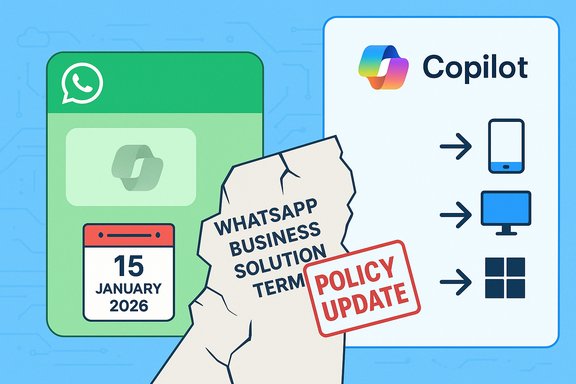
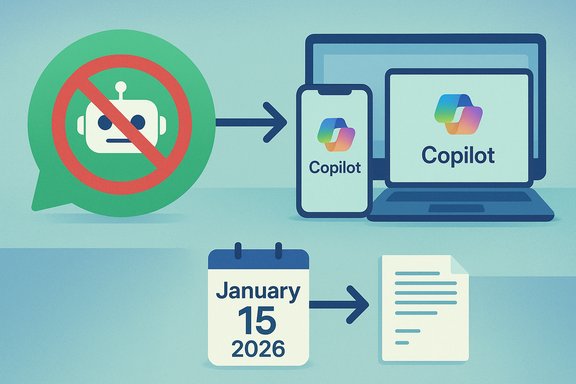
Microsoft has confirmed that its Copilot chatbot will stop responding inside WhatsApp on January 15, 2026, a direct consequence of WhatsApp’s revised Business API rules that bar general-purpose AI assistants — a change that forces users onto Microsoft’s own Copilot apps, the web, and Windows and raises urgent questions about data portability, platform control, and where conversational AI should live.
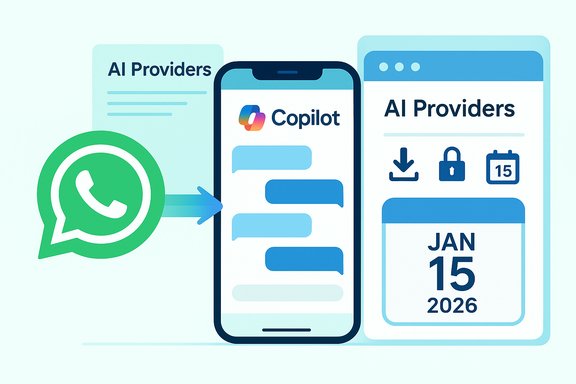
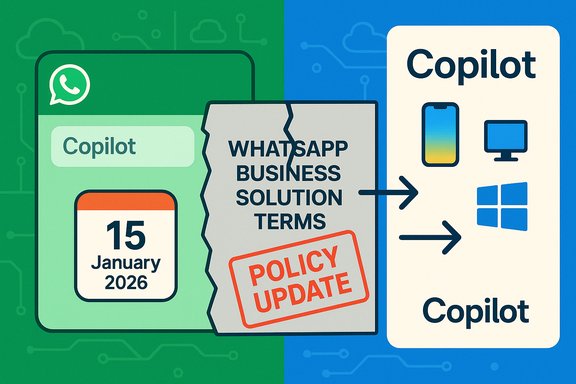
WhatsApp’s parent company, Meta, updated the WhatsApp Business Solution terms in October 2025 to add an explicit “AI Providers” clause that prohibits developers of large language models and general-purpose AI assistants from using the Business API when those assistants are the primary functionality being offered. The policy takes effect on January 15, 2026, and is aimed at reserving the Business API for enterprise-to-customer workflows rather than consumer-facing chat assistants. Microsoft’s Copilot on WhatsApp — a lightweight, unauthenticated contact-based integration that launched in late 2024 and reached millions of users — will be discontinued on that date. Microsoft’s official Copilot blog confirms the shutdown, advises users to export any WhatsApp Copilot conversations they wish to keep before the cut-off, and directs people to the Copilot mobile app, Copilot on the web, and the Copilot experience on Windows as the supported alternatives.
The episode crystallizes competing imperatives in today’s digital ecosystem: platform stability and enterprise focus on one hand, and openness, convenience, and broad reach for AI on the other. Consumers and businesses who relied on the simplicity of messaging-based assistants face a short migration window — and a longer debate about whether messaging platforms should be neutral conduits for AI or curated walled gardens run in the interest of platform owners.
Source: Moneycontrol https://www.moneycontrol.com/techno...eta-s-new-rules-kick-in-article-13695658.html
 Overview
WhatsApp’s parent company, Meta, updated the WhatsApp Business Solution terms in October 2025 to add an explicit “AI Providers” clause that prohibits developers of large language models and general-purpose AI assistants from using the Business API when those assistants are the primary functionality being offered. The policy takes effect on January 15, 2026, and is aimed at reserving the Business API for enterprise-to-customer workflows rather than consumer-facing chat assistants. Microsoft’s Copilot on WhatsApp — a lightweight, unauthenticated contact-based integration that launched in late 2024 and reached millions of users — will be discontinued on that date. Microsoft’s official Copilot blog confirms the shutdown, advises users to export any WhatsApp Copilot conversations they wish to keep before the cut-off, and directs people to the Copilot mobile app, Copilot on the web, and the Copilot experience on Windows as the supported alternatives. Background
How third-party assistants arrived on WhatsApp
Messaging platforms have long been attractive distribution channels for conversational AI because they lower the friction of onboarding: users already have a chat app, a phone number, and a familiar UX. That dynamic encouraged companies from startups to large cloud providers to expose assistants through WhatsApp’s Business API as a quick path to reach billions of users. But those early experiments treated the Business API as a de facto consumer channel rather than the enterprise messaging tool it was designed to be. WhatsApp’s Business Solution historically focused on transactional messages: appointment reminders, order updates, customer support flows and invitations. Over time, the volume and pattern of open-ended AI conversations proved atypical for those workflows — raising engineering, moderation, and monetization challenges that Meta says motivated the change. The updated terms explicitly allow AI to be incidental or ancillary to business automation but forbid AI providers from using the API as the primary distribution channel for general-purpose assistants.What Microsoft offered on WhatsApp
Microsoft positioned Copilot on WhatsApp as a convenient, conversational surface for quick prompts — drafting messages, summarizing content, producing images, or answering questions within a familiar chat thread. The WhatsApp integration intentionally avoided deep account ties: interactions were unauthenticated and did not provide direct access to Microsoft 365 data, persistent identity, or cross-device sync available on Microsoft’s owned surfaces. That simplicity was the feature and the liability: frictionless access at the cost of portability and continuity.What actually changes on January 15, 2026
- Copilot on WhatsApp will stop responding and the Copilot contact will cease to accept messages after January 15, 2026. Microsoft confirmed that date publicly on its Copilot blog.
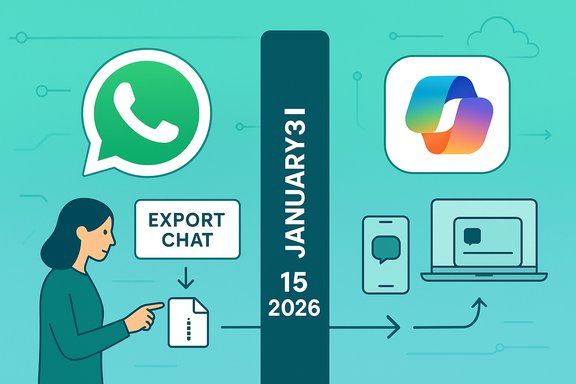
- Users must export WhatsApp chat history they wish to preserve because the WhatsApp integration was unauthenticated and Microsoft cannot migrate those threads into Copilot’s account-backed history. Microsoft explicitly instructs users to use WhatsApp’s export tools prior to the cutoff.
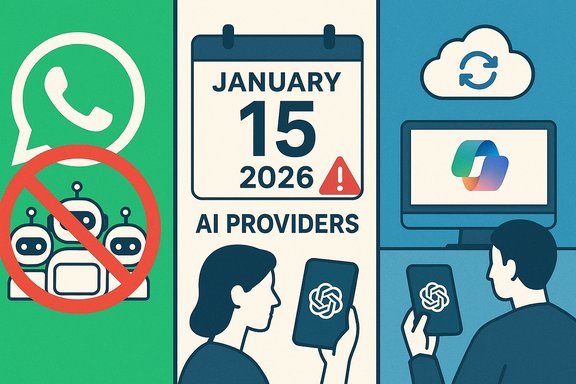
- Third-party LLM providers that ran consumer-facing assistants through the Business API — including OpenAI’s ChatGPT, Perplexity and several startups — are being forced to wind down those channels or migrate to alternate surfaces. News reporting and vendor statements indicate similar exit plans or migration guidance for other providers.
Immediate user-facing consequences
- If you used Copilot inside WhatsApp, you have an explicit deadline to extract any information you care about from that chat. Use WhatsApp’s Export Chat function and store exports securely.
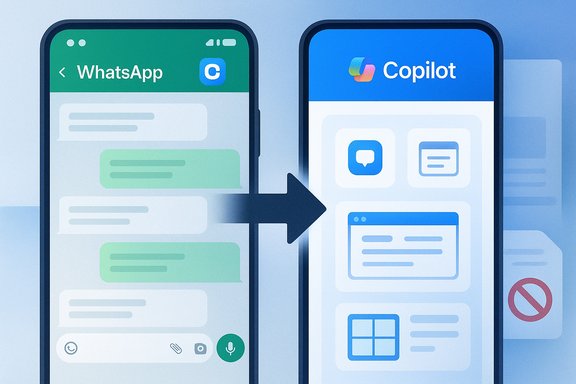
- Conversations will not be automatically ported into Microsoft’s Copilot app, the Copilot web experience, or Copilot on Windows. Exported WhatsApp archives are archival text (and media) — they are not convertible into account-linked chat history inside Copilot.
- Microsoft is steering users to first-party surfaces that provide authenticated accounts, synchronized history, richer multimodal features (voice, vision), and subscription options; those surfaces are intended to replace the convenience of chat-in-WhatsApp with features and controls Microsoft can govern.
Why Meta changed the rules — stated reasons and strategic implications
Meta’s official rationale
Meta frames the change as a realignment of the Business API with its original purpose: reliable, enterprise-grade communications and commerce workflows. Meta told reporters that third-party AI assistants created unusual message volumes and operational burdens that the Business API was not designed to carry. The policy aims to protect business customers and the stability of the API.Analysts’ and industry interpretations
Beyond operational concerns there are clear strategic incentives. Restricting general-purpose assistants from the Business API concentrates distribution of conversational AI inside players’ own apps and grants Meta greater control over who gets prime access to WhatsApp’s massive user base. That tightening also makes Meta’s own assistant offerings comparatively advantaged inside WhatsApp, Messenger, and Instagram. Multiple outlets and industry observers have highlighted this consolidation risk. The policy’s broad wording (“as determined by Meta in its sole discretion”) gives WhatsApp discretion to classify what counts as an “AI Provider,” creating uncertainty for developers.Risk analysis: privacy, portability, and platform power
Data portability and user risk
The most immediate and concrete risk is data loss. Unauthenticated chat-based integrations — prized for their ease of use — do not create account-linked histories that vendors can migrate. That means users who relied on Copilot inside WhatsApp must proactively export conversations before the January 15 deadline if they want an archive. Exports are plaintext or zipped media dumps and are not importable into Copilot’s account-backed history, so the move creates a discontinuity in continuity. Microsoft warned users to export chats; WhatsApp’s export tool also has caveats around encryption and file formats that users should understand. Exported archives are no longer protected by WhatsApp’s end-to-end encryption once you move them out of the app, so that process introduces tangible security risks if exported files are mishandled. Store exports in encrypted personal storage, limit copies, and delete temporary files after archiving.Platform gatekeeping and competitive effects
Meta’s decision demonstrates how platform owners can reshape downstream markets by selectively opening or closing API channels. Narrowing third‑party access to a dominant messaging surface amplifies the value of in‑house assistants and pressures competitors to build and maintain their own apps or find alternative distribution channels (Telegram, web, SMS, standalone mobile apps). That dynamic raises competition concerns: platform policies that fortify first‑party products can reduce consumer choice and increase switching costs for users who had become accustomed to the convenience of embedded assistants. Industry watchers will likely scrutinize the move for anticompetitive effects.Operational costs and moderation
Meta’s operational argument is not speculative. Open‑ended LLM interactions produce high message density, longer sessions, and unpredictable moderation flags compared with structured business templates. Those workloads can materially increase infrastructure and content‑moderation costs for messaging services that were engineered for short, transactional exchanges. The rule change can therefore be read as a pragmatic approach to reallocating finite platform resources. Still, the decision’s timing and breadth mean operational rationale and strategic advantage operate in tandem.What vendors and developers should do
For Microsoft and other AI providers
- Harden first-party surfaces: ensure Copilot mobile, web, and Windows experiences are robust, support authenticated migration flows, and give users reliable continuity options.
- Add clear export/import guidance: because exports are archival, vendors should offer tools to help users reconstitute important context in the new app wherever possible (for example, import prompts or bookmarks).
- Provide enterprise options: for business customers, support authenticated, auditable integrations that comply with regulatory and data residency needs.
For businesses that used WhatsApp for AI-assisted workflows
- Audit your usage: determine whether your bots were using the Business API as a general-purpose assistant or providing AI as incidental to a business workflow. The latter remains permissible under the new rules.
- Re-architect where required: move general-purpose capabilities to web or app destinations; keep customer-service automations within the Business API but ensure they are scoped and documented as business processes.
- Communicate with customers and partners: provide migration timelines and instructions, and design alternatives if WhatsApp was the primary channel.
Developer checklist (technical)
- Map every WhatsApp endpoint your solution calls and label whether it is “business-ancillary” or “general-purpose.”
- If general-purpose, plan for deprecation of that channel by January 15, 2026: switch to authenticated webhooks, web apps, or third-party messaging channels.
- Instrument telemetry to detect any migration friction and track user retention when moving channels.
- Update legal and privacy notices to reflect new storage, export, and retention procedures that users must follow.
How consumers should act now (practical steps)
- Export chats now: open the Copilot WhatsApp chat, tap the contact info, choose “Export chat,” and decide whether to include media. Save the exported file to encrypted cloud storage or local encrypted disk. Exports taken after January 15, 2026 will not capture Copilot interactions that are no longer available.
- Move to Copilot first‑party surfaces: install the Copilot mobile app on iOS or Android, sign in to copilot.microsoft.com via your Microsoft account, or enable Copilot on Windows to restore authenticated continuity, richer features, and (where applicable) synced conversation history.
- For ChatGPT users: follow OpenAI’s published guidance to link accounts or migrate to the ChatGPT app before the deadline (OpenAI has published migration instructions and has publicly stated it will discontinue WhatsApp support on the same date). Note that company-reported user numbers (for example, claims about tens of millions of WhatsApp users for a given assistant) are self-reported and should be treated as company statements unless independently verified.
Broader implications for the AI and messaging ecosystems
Consolidation of AI on first‑party surfaces
This episode accelerates an industry trend: major AI providers and platform owners increasingly prefer to host assistant experiences on first-party apps and websites where identity, telemetry, monetization, and moderation can be tightly controlled. That model delivers better continuity and richer features for authenticated users, but it also increases friction for casual users who valued the low-friction convenience of messaging-based access.Emergence of migration patterns
Expect a multi-pronged migration strategy across the industry: vendors will push native apps and web experiences, maintain presence on alternative messaging platforms with permissive policies (Telegram, GroupMe, Viber), and offer incremental import tools or prompt libraries to help users rebuild context. Startups that built businesses around WhatsApp distribution face meaningful operational and user-acquisition headwinds.Regulatory and policy scrutiny
The change invites regulatory attention on platform gatekeeping. Competition authorities in multiple jurisdictions have previously scrutinized how dominant platforms favor first‑party services; this policy shift could trigger similar inquiries or at least formal complaints by affected vendors. Separately, privacy watchdogs will be interested in how exported chat archives are handled and whether users are adequately warned about the loss of encryption and portability constraints.Strengths, weaknesses, and key takeaways
Strengths of the policy change (from Meta’s perspective)
- Reduces engineering and moderation burden from unstructured LLM traffic.
- Protects Business API’s original intent and monetizable enterprise flows.
- Gives Meta more control to integrate and scale its own assistant experiences in its ecosystem.
Weaknesses and risks
- Harsh cutover: short lead time and unauthenticated integrations cause fragmentation and possible data loss for users who don’t export chats.
- Competitive concerns: the change advantages Meta’s own AI products and restricts competitors from leveraging a massive messaging channel.
- User friction: casual users lose a convenient access point and may not adopt vendor apps, reducing overall AI reach and possibly increasing digital exclusion in regions where WhatsApp dominates.
Key takeaways for readers
- January 15, 2026 is a firm deadline: Copilot on WhatsApp will stop working after that date, and Microsoft recommends exporting chats before the cutoff.
- This is both an operational and strategic move that reshapes where conversational AI will live — leaning toward first‑party, authenticated surfaces instead of third‑party messaging channels.
- Users and businesses should act proactively: export any important Copilot conversations now, migrate critical workflows off WhatsApp if they depended on general-purpose assistants, and plan for the costs and complexity of building owned channels.
Practical “what to do” checklist (step‑by‑step)
- Open WhatsApp and locate the Copilot chat.
- Tap the contact name → Export chat → choose “Include media” if you need images or attachments.
- Save the exported file to an encrypted cloud folder or a local encrypted drive; avoid leaving exports in unprotected inboxes or shared folders.
- Install the Copilot mobile app (iOS/Android) or bookmark copilot.microsoft.com and sign in with your Microsoft account to start building an authenticated conversation history.
- If you rely on Copilot for business workflows, coordinate with IT: connect Copilot to corporate Microsoft 365 accounts, validate compliance controls, and update any customer‑facing flows previously tied to WhatsApp.
- For ChatGPT users on WhatsApp, follow OpenAI’s migration guidance — link your account where supported — before January 15, 2026. Treat any large user-number claims (e.g., tens of millions) as company statements unless confirmed by independent measurement.
Conclusion
Meta’s decision to restrict general-purpose AI on the WhatsApp Business API and Microsoft’s subsequent withdrawal of Copilot from WhatsApp are more than a product change — they mark a structural pivot in how conversational AI is distributed. The practical fallout is immediate: users must export chat history before January 15, 2026, and move to authenticated Copilot surfaces for continuity. Strategically, the move accelerates a migration away from third‑party messaging integrations to first‑party apps and web experiences that prioritize identity, moderation, and monetization control.The episode crystallizes competing imperatives in today’s digital ecosystem: platform stability and enterprise focus on one hand, and openness, convenience, and broad reach for AI on the other. Consumers and businesses who relied on the simplicity of messaging-based assistants face a short migration window — and a longer debate about whether messaging platforms should be neutral conduits for AI or curated walled gardens run in the interest of platform owners.
Source: Moneycontrol https://www.moneycontrol.com/techno...eta-s-new-rules-kick-in-article-13695658.html

 LatestLY