

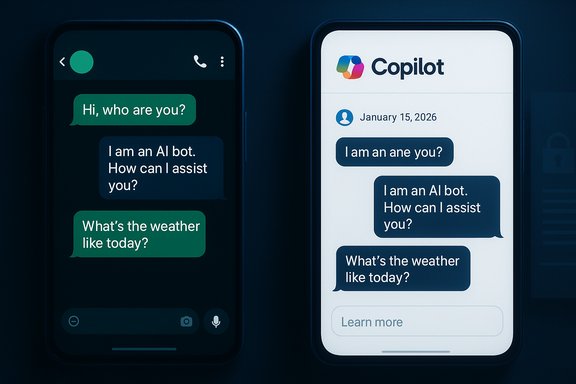
Microsoft confirmed this week that Copilot — its consumer-facing AI assistant — will no longer operate inside WhatsApp after January 15, 2026, a decision Microsoft says is the direct result of an update to WhatsApp’s Business Solution terms that bars general-purpose LLM chatbots from the platform.
Since late 2024, several major AI providers experimented with running lightweight, contact-based assistants inside WhatsApp’s Business Solution (the Business API). Those integrations let users message an AI contact just like a normal phone number, receiving answers, summaries and even generated media inside the WhatsApp chat surface. Microsoft’s Copilot was among the highest-profile entrants and — according to the company — reached millions of people during that period. In mid‑October 2025, Meta updated the WhatsApp Business Solution terms to introduce a specific prohibition on “AI Providers” — a broadly worded category that explicitly includes creators of large language models, generative-AI platforms and general‑purpose AI assistants when those capabilities are the primary functionality offered through the API. The new clause carries an enforcement date of January 15, 2026, and the effect is clear: third‑party, general‑purpose AI chatbots distributed via the Business API must stop operating on WhatsApp by that date. Microsoft’s Copilot team published a short advisory confirming the practical consequence: Copilot on WhatsApp will be discontinued on January 15, 2026, and users are being directed to Microsoft’s first‑party Copilot surfaces — the Copilot mobile app (iOS/Android), Copilot on the web (copilot.microsoft.com), and Copilot on Windows — for ongoing access. Microsoft also warned that the WhatsApp integration was unauthenticated, so chat histories in WhatsApp cannot be migrated automatically into Copilot accounts; users who want to retain conversations should export them before the cutoff.
Expect a bifurcation:
The January 15, 2026 cutoff is concrete; for users and businesses that relied on Copilot inside WhatsApp, the sensible immediate action is simple and urgent: export any conversations you need to keep, install and sign in to Copilot’s authenticated surfaces, and review any business automations that must be reengineered for compliance with WhatsApp’s Business Solution rules. The policy change will reverberate across product strategy, regulation and competition as the AI distribution landscape adjusts to platform governance and the economics of running open‑ended LLMs at scale.
Source: LatestLY Microsoft Copilot Leaving WhatsApp: Microsoft AI-Powered Assistant Will Soon End Support As Meta-Owned Platform Updates Policies for LLM Chatbots | LatestLY
 Background / Overview
Since late 2024, several major AI providers experimented with running lightweight, contact-based assistants inside WhatsApp’s Business Solution (the Business API). Those integrations let users message an AI contact just like a normal phone number, receiving answers, summaries and even generated media inside the WhatsApp chat surface. Microsoft’s Copilot was among the highest-profile entrants and — according to the company — reached millions of people during that period. In mid‑October 2025, Meta updated the WhatsApp Business Solution terms to introduce a specific prohibition on “AI Providers” — a broadly worded category that explicitly includes creators of large language models, generative-AI platforms and general‑purpose AI assistants when those capabilities are the primary functionality offered through the API. The new clause carries an enforcement date of January 15, 2026, and the effect is clear: third‑party, general‑purpose AI chatbots distributed via the Business API must stop operating on WhatsApp by that date. Microsoft’s Copilot team published a short advisory confirming the practical consequence: Copilot on WhatsApp will be discontinued on January 15, 2026, and users are being directed to Microsoft’s first‑party Copilot surfaces — the Copilot mobile app (iOS/Android), Copilot on the web (copilot.microsoft.com), and Copilot on Windows — for ongoing access. Microsoft also warned that the WhatsApp integration was unauthenticated, so chat histories in WhatsApp cannot be migrated automatically into Copilot accounts; users who want to retain conversations should export them before the cutoff. What changed in WhatsApp’s policy — plain language
The new “AI Providers” restriction
WhatsApp’s revised Business Solution terms add a named prohibition aimed at providers of AI technology. The relevant language — quoted in contemporaneous reporting — says providers of AI/ML technologies, including but not limited to large language models and generative platforms, are prohibited from using the Business Solution “when such technologies are the primary (rather than incidental or ancillary) functionality being made available for use.” The clause grants Meta broad discretion to determine what counts as “primary.”What the rule permits and what it bans
- Allowed: Business‑incidental AI used inside a larger, enterprise-focused workflow (e.g., automated order confirmations, support triage, appointment reminders).
- Disallowed: General‑purpose conversational assistants that use WhatsApp as their front-end distribution channel (e.g., public chatbots whose main product is an open‑ended AI experience).
Why Microsoft is pulling Copilot from WhatsApp
Microsoft’s public explanation ties the decision directly to WhatsApp’s policy update: because the Business Solution terms now disallow third‑party, general‑purpose LLM chatbots, Copilot must be removed from that delivery channel. Microsoft has framed the change as a move to ensure continuity on authenticated, account‑backed surfaces — where Copilot can offer persistent history, tighter privacy controls, and richer multimodal features (voice and vision). Independent reporting confirms Microsoft and other vendors (including OpenAI) are winding down WhatsApp integrations in response to Meta’s October policy update. Several outlets noted that the ban takes effect January 15, 2026, and that vendors will be pushed to native apps, web portals, and OS integrations.Immediate user impact: what to do now
For users who relied on Copilot inside WhatsApp, the practical steps are short and urgent:- Export any WhatsApp chats with Copilot you want to keep — do this before January 15, 2026. Microsoft explicitly notes the WhatsApp integration was unauthenticated, so Copilot cannot import or transfer those histories into its account‑backed surfaces.
- Install and sign in to the Copilot mobile app (iOS/Android), use copilot.microsoft.com on the web, or enable Copilot on Windows for continued, authenticated access.
- For recurring or enterprise workflows that used an unauthenticated WhatsApp bot, rearchitect those flows into supported, authenticated channels or narrow them to business‑incidental automations that comply with the Business Solution terms.
How to export WhatsApp chat history (general guidance)
Export mechanics vary by platform and WhatsApp version, but the common process is:- On iPhone: Open the chat → tap the contact or group name → tap “Export Chat” → choose Include Media or Without Media → choose destination (Email, Files, cloud storage). The export creates a .zip (iOS) containing a .txt transcript and included media.
- On Android: Open the chat → tap the three‑dot menu → More → Export Chat → choose whether to include media → pick a sharing destination (email, Google Drive, or local storage). Android exports are typically a .txt file or a .zip if media is included.
- Exported files are not protected by WhatsApp’s end‑to‑end encryption once exported. Treat exported transcripts as sensitive files and store them securely.
- Exports are copies — they don’t delete the original messages inside WhatsApp.
- Exported chat formats cannot be reliably re‑imported into WhatsApp as native history; they are intended for archival and external review.
The technical and product reasons WhatsApp gave — and the industry reading
Meta’s public rationale focuses on platform fit and operational costs: WhatsApp’s Business Solution was built for enterprise‑to‑customer messaging (structured notifications, support flows) and not for high‑volume, open‑ended LLM traffic. Meta told reporters the emergent use of the Business API by general‑purpose chatbots produced unexpected message volumes, moderation overhead and different support needs than the API was designed to handle. Industry observers add a second, pragmatic layer: when vendors expose a public LLM inside a messaging app via the Business API, the platform loses a degree of control over moderation, monetization and identity. Locking down the Business Solution constrains third‑party distribution while keeping more conversational traffic inside Meta’s ecosystem — which can favor Meta’s own Meta AI product and preserve the commercial orientation of the Business API. That inference is analytically plausible but should be treated as industry interpretation rather than an explicit company admission.Business and developer implications
- Enterprises that built customer workflows relying on an unauthenticated, third‑party LLM inside WhatsApp must rework those automations to either:
- Use a business‑incidental AI model hosted behind the enterprise’s own flows (explicitly allowed), or
- Migrate customers to an authenticated Copilot (or other vendor) surface outside WhatsApp.
- Startups and smaller vendors that used WhatsApp as a low‑friction distribution channel now face higher go‑to‑market costs: building native apps, handling authentication, and acquiring users without the reach of a pre‑installed chat surface.
- The policy creates an incentive to design identity‑first products. Vendors that already offer authenticated experiences and account portability will win the migration; those that depend on frictionless contact numbers and unauthenticated session models will face churn.
Competition, platform control, and the regulatory angle
Meta’s policy change has already prompted regulatory scrutiny. Italy’s competition authority (AGCM) expanded an antitrust probe into Meta over the new Business Solution terms and the integration of AI features into WhatsApp, citing concerns the changes could limit competition by closing a high‑reach distribution channel to rivals. That probe illustrates the exact tension regulators are watching: platform owners gating distribution can affect competition in adjacent markets (AI assistants) even while defending technical or product rationales. Observers caution that the practical outcome — fewer third‑party assistants inside WhatsApp and more traffic for Meta AI — creates a competitive effect even if Meta frames the move as product alignment. That claim is analytic and plausible, but it is not a direct admission by Meta; it should be understood as a strategic interpretation under regulatory and industry examination.Technical anatomy: why unauthenticated bots matter
The WhatsApp Copilot deployments operated as unauthenticated contact models: users could message a phone number and receive responses without linking that conversation to a Microsoft account. That model delivers ease of use but creates three practical limitations:- No guaranteed server‑side mapping to a user identity, so no automatic way to port chat history to account‑backed services.
- Weaker access controls and enterprise governance (difficult to apply corporate policies or secure corporate data).
- Greater moderation and abuse management complexity for the platform, since a high volume of anonymous LLM sessions can be unpredictable and costly to police.
Strengths and opportunities for users and vendors
- Richer, authenticated experiences: Moving to Copilot apps and web provides account-backed history, cross‑device sync, stronger privacy controls and features (Copilot Voice, Copilot Vision) that were not possible inside WhatsApp’s constrained chat model.
- Better enterprise governance: For businesses, moving to authenticated channels reduces data leakage risk tied to unauthenticated contacts and enables compliance workflows to be applied consistently.
- Predictability for platforms: WhatsApp can preserve the Business API’s design intent (enterprise messaging), reduce moderation overhead and better monetize business‑oriented features.
Risks, tradeoffs and things to watch
- Loss of convenience and reach: WhatsApp provided a zero‑install, instantly discoverable surface; moving to dedicated apps or web reduces the casual discovery that drove high initial usage. This is a user‑experience regression for people who preferred the in‑chat convenience.
- Data portability friction: The unauthenticated export mechanism is blunt: exported transcripts are plain files and cannot be imported seamlessly into Copilot’s account history. Users who relied on WhatsApp for continuity will face lost context unless they proactively export and manually curate history.
- Market concentration risk: Restricting third‑party distribution channels risks concentrating conversational AI activity onto a smaller set of vendor‑controlled surfaces. Regulators may scrutinize this effect; ongoing probes (for example, in Italy) make it likely this issue will be contested.
- Privacy exposure from exports: Exported chat files are not covered by WhatsApp’s end‑to‑end in‑app encryption once saved externally; users must take care to store exported transcripts securely.
- Uncertainty about borderline cases: The new policy leaves interpretive discretion to Meta about what counts as “primary” functionality. That ambiguity creates compliance risk for vendors attempting to design borderline business‑incidental AI experiences on WhatsApp.
Practical migration checklist (for users and businesses)
- Export important chats now. Use WhatsApp’s Export Chat on each chat you care about and store the resulting files in a secure place. Remember: exported files can include or exclude media and are not encrypted by WhatsApp once saved externally.
- Install and sign in to Copilot on the web, iOS, Android or Windows. Enable history and sync if you want persistent context across devices.
- For enterprises: audit any customer flows that relied on unauthenticated third‑party bots and plan to migrate to either:
- an authenticated vendor surface with integrated identity, or
- a narrow, business‑incidental bot that complies with WhatsApp’s Business Solution terms.
- Monitor regulatory developments and platform enforcement clarifications, especially if your product sits near the line between incidental and primary functionality.
Broader significance: what this episode signals about conversational AI distribution
This event crystallizes a shifting distribution model for conversational AI. Early experiments favored “platform piggybacking”: vendors used existing messaging surfaces to deliver AI without building full apps. The policy shift favors a different architecture: authenticated, vendor‑controlled surfaces where identity, governance and subscription models can be enforced.Expect a bifurcation:
- First‑party, authenticated apps and web experiences with richer features and persistent memory.
- Narrow, business‑incidental bots embedded in enterprise workflows that adhere to platform rules.
Final assessment: strengths, limits, and open questions
Microsoft’s response is sensible from a product and security standpoint: migrate users to authenticated Copilot surfaces that support richer modalities and better governance; give users an explicit export path for portability. Those are defensible choices for both Microsoft and many enterprise customers. At the same time, the policy raises legitimate concerns about portability, discovery and competition. The effective removal of third‑party assistants from a global messaging channel reduces low‑friction choice for consumers and creates regulatory friction for platforms and vendors. Early regulatory action — such as the Italian competition agency’s broadened probe — indicates regulators view those competitive effects as material. Unverifiable or interpretive claims are present in public commentary — for example, assertions that Meta’s change is purely a competitive play to favor Meta AI. That reading is plausible based on the practical effects, but it is interpretive rather than a stated admission from Meta; it should be treated as analysis rather than fact. Similarly, exact traffic or operational metrics cited by platforms to justify the change (message volumes, moderation costs) are not publicly disclosed with quantitative detail; those operational claims are therefore company assertions that are difficult to independently verify.The January 15, 2026 cutoff is concrete; for users and businesses that relied on Copilot inside WhatsApp, the sensible immediate action is simple and urgent: export any conversations you need to keep, install and sign in to Copilot’s authenticated surfaces, and review any business automations that must be reengineered for compliance with WhatsApp’s Business Solution rules. The policy change will reverberate across product strategy, regulation and competition as the AI distribution landscape adjusts to platform governance and the economics of running open‑ended LLMs at scale.
Source: LatestLY Microsoft Copilot Leaving WhatsApp: Microsoft AI-Powered Assistant Will Soon End Support As Meta-Owned Platform Updates Policies for LLM Chatbots |
LatestLY