

WhatsApp’s long-awaited wrist presence, OpenAI’s new agentic security researcher and Microsoft’s latest Copilot personality together mark a notable week in AI and mobile messaging — a trio of releases that push convenience, automation and agentic thinking forward while reopening familiar questions about safety, control and trust.
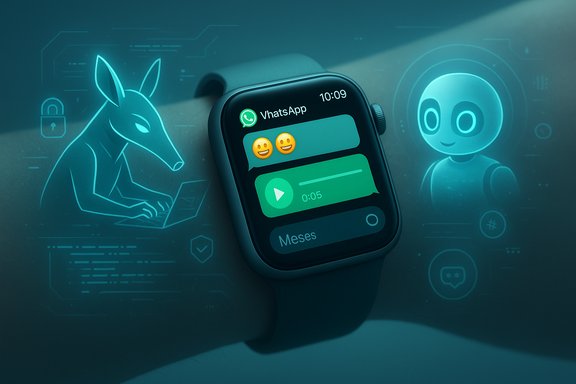
Apple Watch users can now run a native WhatsApp companion app that goes beyond notification mirroring to let people read, reply and send voice notes directly from their wrist — a capability long requested by the platform’s installed base. OpenAI introduced Aardvark, an agentic security researcher built to scan repositories, reason about exploitability and propose fixes autonomously, positioning an LLM-driven agent as a continuous defender inside development workflows. OpenAI’s announcement highlights early benchmark figures and private-beta availability. Microsoft’s Copilot expansion landed a new expressive avatar called Mico, broader collaboration features (Copilot Groups), memory/personalization controls and browser-level “actions” that let the assistant see tabs and act across web workflows. The update reframes Copilot as an increasingly social, agentic companion and also invokes the old Clippy comparison — intentionally or not. This package of releases highlights three converging trends: AI moving into device-level convenience (WhatsApp on Apple Watch), AI agents performing specialist work at scale (OpenAI’s Aardvark), and mainstream assistants becoming more social, persistent and action-capable (Microsoft Copilot + Mico). Each development individually matters to consumers and IT teams; together they illustrate the new reality of agents and conversational AI being woven into everyday endpoints and development lifecycles.
The watch app also reduces dependency on the phone for quick triage — you no longer need to pull out an iPhone to decide whether a conversation requires immediate attention. That matters both for user experience and for device battery/lifecycle trade-offs in everyday use.
Watch these signals in the near term:
Conclusion
The pace of productization is unmistakable: messaging on the wrist is now a full experience, and autonomous agents are entering both development pipelines and consumer-facing assistants. These are practical, useful advances — but they also demand a proportional increase in governance, testing and transparency. Users should enjoy the convenience, but organizations must plan for the new workflows, audit trails and security tools that the agentic future requires.
Source: CNET WhatsApp on Apple Watch, OpenAI Unveils Agentic Security Tool, Microsoft Copilot Releases New AI Pal | Tech Today - Video
 Background / Overview
Apple Watch users can now run a native WhatsApp companion app that goes beyond notification mirroring to let people read, reply and send voice notes directly from their wrist — a capability long requested by the platform’s installed base. OpenAI introduced Aardvark, an agentic security researcher built to scan repositories, reason about exploitability and propose fixes autonomously, positioning an LLM-driven agent as a continuous defender inside development workflows. OpenAI’s announcement highlights early benchmark figures and private-beta availability. Microsoft’s Copilot expansion landed a new expressive avatar called Mico, broader collaboration features (Copilot Groups), memory/personalization controls and browser-level “actions” that let the assistant see tabs and act across web workflows. The update reframes Copilot as an increasingly social, agentic companion and also invokes the old Clippy comparison — intentionally or not. This package of releases highlights three converging trends: AI moving into device-level convenience (WhatsApp on Apple Watch), AI agents performing specialist work at scale (OpenAI’s Aardvark), and mainstream assistants becoming more social, persistent and action-capable (Microsoft Copilot + Mico). Each development individually matters to consumers and IT teams; together they illustrate the new reality of agents and conversational AI being woven into everyday endpoints and development lifecycles.WhatsApp on Apple Watch: what changed, and why it matters
What’s new in the watchOS companion
WhatsApp’s native Apple Watch app replaces the years-long limitation of notification-only behavior with a fuller set of on-wrist features. The initial public rollout allows users to:- Read full WhatsApp messages (not just truncated notifications).
- Reply inline — including emoji reactions.
- Record and send voice notes directly from the Apple Watch.
- Receive WhatsApp call notifications when calling features are supported in-region.
- See clearer media (images/stickers) and a longer slice of chat history on-screen.
Why this is important for users
For people who rely on wearables to reduce “phone reach” friction — runners, commuters, office workers in meetings — being able to complete common WhatsApp actions on the wrist is a genuine convenience win. Voice notes are especially meaningful on the watch, because they sidestep tiny-screen typing friction and map naturally to quick conversational replies.The watch app also reduces dependency on the phone for quick triage — you no longer need to pull out an iPhone to decide whether a conversation requires immediate attention. That matters both for user experience and for device battery/lifecycle trade-offs in everyday use.
Practical limits and privacy considerations
- It’s a companion app not a fully standalone WhatsApp client: the watch requires the paired iPhone to be updated and nearby for most capabilities in the initial rollout. Some media and call behaviors may still rely on phone-side support.
- WhatsApp reiterates that end-to-end encryption remains in effect across devices; users should still verify device-linking prompts and watch for unexpected pairing requests. Encryption claims come from WhatsApp’s product statements and have the usual caveats about endpoint security (the encrypted channel protects in-flight data but not an unlocked device).
- Some advanced features (creating new chats, full message search, or full independence from the phone) are not part of the initial launch and may arrive later.
OpenAI’s Aardvark: an agentic security researcher
What Aardvark claims to do
OpenAI describes Aardvark as an autonomous agent tailored for security research: it continuously analyzes code repositories to find bugs and vulnerabilities, assesses exploitability, writes and runs tests, and proposes fixes or patches. OpenAI positions Aardvark as a defender that replicates the exploratory workflows of human security researchers at scale. The company says the tool is now in private beta for selected partners. Public coverage highlights early benchmark numbers OpenAI shared: Aardvark reportedly found 92% of known and synthetically introduced vulnerabilities in curated “golden” repos used during testing. OpenAI also says Aardvark has contributed to internal and partner security efforts and that it has produced CVEs in responsibly disclosed findings for some open-source projects.Why an agentic security researcher matters
- Scale: Security teams are chronically resource limited. A continuous agent that monitors commits, raises prioritized alerts and suggests fixes could reduce time-to-detection.
- Contextual reasoning: Unlike simple scanners, Aardvark aims to use LLM reasoning plus dynamic testing to reason about exploitability in context (e.g., misconfigured logic paths, chained conditions across files).
- Integration: OpenAI’s write-up emphasizes pipelines and developer workflows — the point is not only to flag bugs but to produce actionable test cases and suggested patches that developers can adopt or refine.
Validity, limits and safety cautions
- Vendor-provided benchmarks require independent validation. The 92% figure comes from OpenAI’s internal tests on curated repositories — that improves signal but is not the same as broad-field performance on messy, real-world codebases. Caution is warranted until independent audits and cross-project evaluations are published.
- Autonomy and correctness: An agent that both suggests and applies patches could speed remediation — but it also risks introducing incorrect changes if aggressiveness is not gated. The ideal usage pattern is “human-in-the-loop” verification for all substantive fixes.
- Disclosure and responsible use: OpenAI says it will responsibly disclose vulnerabilities and offer pro-bono scanning for select OSS projects; operationalizing such programs at scale requires robust coordination with maintainers and clear remediation workflows.
How enterprises should treat Aardvark today
- Pilot, don’t enable fleet-wide. Treat Aardvark as a complementary tool within an existing security operations pipeline.
- Keep a human reviewer in the loop for all proposed code changes and patches.
- Cross-check Aardvark findings with static/dynamic-analysis tooling and existing SAST/DAST outputs.
- Treat early benchmark claims as vendor-provided — require proof points on your own codebase before relying on automated triage.
Microsoft Copilot’s personality push: Mico and agentic features
What Microsoft shipped
Microsoft’s Copilot Fall release stitches several major UX and capability changes into a single package:- Mico — an optional animated avatar that appears in voice interactions, reacts with expressions and colors, and can be customized; it includes playful callbacks (a hidden Clippy easter egg).
- Copilot Groups — real-time shared Copilot sessions that can include up to 32 people and let the assistant moderate, summarize and contribute to group workflows.
- Memory & Personalization — opt-in long-term memory that enables Copilot to recall context across sessions with controls for deletion and management.
- Browser/Edge actions — tab reasoning, cross-tab comparisons and “actions” that can automate multi-step web tasks (booking, form filling) when permitted by the user.
The product thesis: companion, not just a tool
Microsoft frames the update around a human-centered companion thesis: Copilot should feel social, conversational and persistent — a digital partner that can remember preferences and operate with permission across apps. Mico is literally the visual embodiment of that thesis, intended to make voice interactions feel more natural and less transactional.Strengths and practical value
- Accessibility: Voice + persona + memory can make Copilot a powerful accessibility aid for users who prefer spoken interaction or require assistive workflows.
- Collaboration: Groups extend Copilot from a 1:1 assistant to a shared collaborator, useful for brainstorming, planning and workshops where a neutral summarizer or facilitator is helpful.
- Workflow integration: Edge tab reasoning and actions are meaningful for users who research and transact on the web; automating repetitive web workflows saves time.
Risks, governance and security trade-offs
Bringing agentic features into mainstream workflows raises well-known risks, many of which have already been flagged by security and industry analysts:- Expanded attack surface: Agents that can read tabs, access local files or act on behalf of users widen the blast radius for misconfiguration or malicious prompts. Enterprises must update DLP rules, SIEM ingestion and admin policies to account for agent-driven flows.
- Brittleness and hallucination: Agents that simulate UI actions or interpret OCR are brittle: they can misclick, misinterpret UI elements or hallucinate step success. The “live step log” and human review checkpoints Microsoft provides are necessary but not sufficient.
- Privacy and retention: Memory features are useful, but defaults and admin behavior determine real risk. Enterprises need clear retention and opt-in defaults and must test eDiscovery and retention scenarios before wide rollout.
Practical recommendations for IT leaders
- Start with a controlled Insider/limited pilot; do not flip Copilot-wide enablement for sensitive tenants.
- Integrate agent events into existing logging, DLP and SIEM pipelines to detect anomalous behaviors.
- Require admin approval for connectors to external accounts (Gmail, Google Drive, third-party SaaS) and test connector scopes carefully.
- Set human verification gates for any agentic transaction (purchases, privilege changes, code pushes).
Cross-cutting analysis: what these three moves reveal about the AI landscape
1) Agents are moving from labs into live systems
Between Aardvark’s private beta and Copilot’s agentic Actions, we’re seeing LLM-driven agents transition from research demos to production-adjacent tooling. That shift accelerates efficiency — but it also requires rethinking governance, audit trails and operator skills.- For defenders: agentic security tools can scale detection, but they must be validated against real-world codebases and integrated with human review.
- For end users: agents that act reduce friction, but users need better, simpler controls and clearer indicators when an agent is taking a consequential action.
2) UX personalization is now a battleground
Mico’s arrival illustrates a larger product strategy: make AI feel personal and social so users keep returning. That creates both product stickiness and privacy friction. Memory controls, obvious indicators and easy wipe options are essential to avoid surprises and regulatory scrutiny.3) Device endpoints are not neutral — the watch matters
WhatsApp on Apple Watch is emblematic of a microtrend: companies want presence on the simplest possible surface. The UX trade-off of wrist convenience vs. phone-level functionality will continue to shape where major apps invest development effort next.4) Independent verification remains a keystone
Vendor-provided performance claims — whether a 92% recall rate for Aardvark or bold reliability promises for agentic features — need independent audits. Security and IT leaders should insist on benchmarks, third-party testing and proof-of-concept runs before broad adoption. OpenAI’s blog and early press coverage provide a starting place, but independent security audits and reproducible results will matter more for trust.Actionable guidance: what readers and IT teams should do next
For consumers and Apple Watch users
- Update your iPhone, Apple Watch and WhatsApp app to the latest versions to receive the companion app.
- Confirm device linking prompts and review WhatsApp’s multi-device settings to ensure only trusted devices are paired.
- Use voice message features on the watch for short conversational replies, but reserve sensitive actions for your phone until the watch experience matures.
For developers and security practitioners evaluating Aardvark
- Request a private-beta slot or a trial run on a non-critical repo.
- Compare Aardvark outputs with existing static/dynamic tools and human triage to measure false positives/negatives.
- Require manifest audit logs for any code-change suggestions and gate automated patches behind CI approvals.
For IT leaders deploying Copilot features
- Start with limited pilots and defined use cases (e.g., meeting summarization, helpdesk triage).
- Integrate Copilot agent events into endpoint detection and incident response playbooks.
- Establish connector catalogs and strict admin controls for external account access; test eDiscovery, retention and deletion flows.
Strengths, risks and the regulatory angle
Notable strengths
- Usability gains are tangible: the Apple Watch app reduces friction, Copilot Groups and Mico make AI more accessible and social, and Aardvark offers potential scale for security teams.
- The market is maturing: vendors now ship agentic tooling with admin controls and staged rollouts rather than raw experiments.
- Productivity wins are concrete when agents are applied to repetitive, well-scoped tasks (e.g., triage, code scanning, short-form replies).
Principal risks
- New attack surfaces: agentic automation and agent-to-account connectors concentrate sensitive access and make DLP, credential management and runtime enforcement more urgent.
- Hallucination and erroneous actions: agents misreading UI, making incorrect patches, or acting on the wrong data introduce operational risk.
- Privacy friction: long-term memory and group-aware agents may retain contextual details that users and regulators find unacceptable unless defaults are conservative and controls are simple.
Regulatory and policy considerations
- Regulators will ask for clear audit trails, opt-in defaults for persistent capture, and demonstrable mechanisms for deletion and redress.
- Security tooling vendors and enterprise CISOs should insist on runtime protections (blocking credential exfiltration, preventing unauthorized tool use) for agent platforms. Third-party vendors are already building runtime enforcement layers for AgentKit and related products.
Final verdict and what to watch next
This week’s trio — the WhatsApp Apple Watch app, OpenAI’s Aardvark and Microsoft’s Mico-led Copilot update — is a microcosm of AI’s current phase: practical, productized, and simultaneously agentic. Convenience and automation are accelerating adoption, but the operational complexity of agentic systems is real and immediate.Watch these signals in the near term:
- Independent audits and benchmarks for Aardvark and other security agents.
- Enterprise telemetry on Copilot Actions and group features — early incident patterns will shape admin defaults.
- Expansion of WhatsApp watch features into more standalone capabilities and the security model for device linking.
- Third-party runtime-security tooling adoption for AgentKit and OpenAI connectors to close gaps exposed by early adopters.
Conclusion
The pace of productization is unmistakable: messaging on the wrist is now a full experience, and autonomous agents are entering both development pipelines and consumer-facing assistants. These are practical, useful advances — but they also demand a proportional increase in governance, testing and transparency. Users should enjoy the convenience, but organizations must plan for the new workflows, audit trails and security tools that the agentic future requires.
Source: CNET WhatsApp on Apple Watch, OpenAI Unveils Agentic Security Tool, Microsoft Copilot Releases New AI Pal | Tech Today - Video
