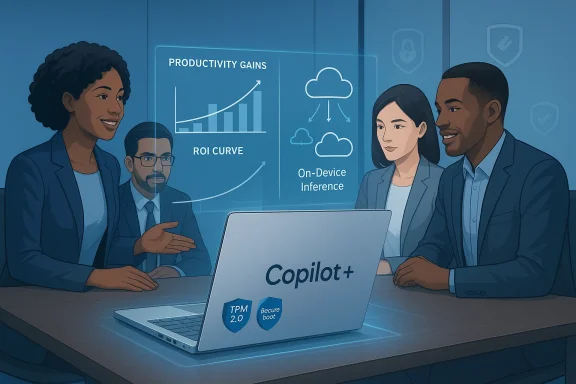
For organizations wrestling with where to place scarce IT dollars in the new fiscal year, a striking message is emerging: modernizing endpoint hardware to support on-device AI — the class of machines Microsoft brands as Copilot+ PCs or AI PCs — can materially change the economics of AI adoption. A Forrester New Technology Total Economic Impact™ (NTTEI) study commissioned by Microsoft modeled a composite 2,000‑employee organization and projected very large three‑year returns when aging devices were replaced with Microsoft AI PCs, attributing value to measurable gains in end‑user productivity, IT operational efficiency, and reduced security risk.
This feature examines what those findings mean for your 2026 IT planning: what the numbers actually represent, where the value is most likely to come from, what the study’s limitations are, and how to convert headline ROI claims into a defensible procurement and deployment plan that survives CFO scrutiny.
The business conversation about AI has shifted from “what if” to “how fast and where.” Platform providers and OEMs have responded by co‑designing silicon, operating system features, management tools, and cloud services to accelerate assistant‑driven workflows. Modern “AI PCs” add discrete NPUs (Neural Processing Units), expanded memory and storage, and enterprise manageability features — which vendors argue enable faster, more private, and lower‑latency AI features on device. These capabilities are positioned as a complement to cloud inference, not a replacement: lightweight or latency‑sensitive computation runs locally, while heavier reasoning and data‑heavy tasks remain in the cloud.
For IT leaders this matters for two practical reasons. First, device readiness becomes a gating factor for rolling out workplace copilots and agentic workflows at scale. Second, the total cost of ownership (TCO) calculation shifts: higher upfront device costs may be justified by downstream labor savings, lower support costs, and reduced incident impacts — if those benefits can be measured and reproduced in your environment. Vendor‑commissioned TEI/TEI‑style studies have entered procurement conversations as one input for that tradeoff — but they must be read as modeled scenarios, not guarantees.
Important caveat: the study uses a modeled “composite” with conservative and aggressive scenarios. That means your mileage will vary: results depend on which roles get new devices, how intensively Copilot features are used, and how disciplined your rollout, governance, and training programs are. Forrester’s modeled figures should be treated as planning inputs, not firm guarantees.
That said, do not treat the Forrester headline ROI as a plug‑and‑play guarantee. If your environment includes many legacy apps, weak identity controls, or limited analytics to prove minutes saved, prioritize foundation work first: inventory, labeling, identity hygiene, and a small, well‑instrumented pilot. Without those, a fleet refresh can be expensive and slow to produce measurable benefits.
The Forrester NTTEI study offers a pragmatic signal for 2026 device budgeting: upgrading endpoints to AI‑capable PCs can open measurable productivity, support, and security benefits — but those benefits are realized only when technology, measurement, process, and governance are aligned. Treat the study as a well‑constructed planning input: use it to design a pilot that produces auditable, manager‑verified savings before committing to fleet‑wide refresh. Do that, and the modeled ROI can become tangible business value rather than vendor‑friendly aspiration.
Source: Microsoft How AI PCs Deliver ROI for FY26 IT Budgets | Microsoft Business
This feature examines what those findings mean for your 2026 IT planning: what the numbers actually represent, where the value is most likely to come from, what the study’s limitations are, and how to convert headline ROI claims into a defensible procurement and deployment plan that survives CFO scrutiny.
 Background / Overview
The business conversation about AI has shifted from “what if” to “how fast and where.” Platform providers and OEMs have responded by co‑designing silicon, operating system features, management tools, and cloud services to accelerate assistant‑driven workflows. Modern “AI PCs” add discrete NPUs (Neural Processing Units), expanded memory and storage, and enterprise manageability features — which vendors argue enable faster, more private, and lower‑latency AI features on device. These capabilities are positioned as a complement to cloud inference, not a replacement: lightweight or latency‑sensitive computation runs locally, while heavier reasoning and data‑heavy tasks remain in the cloud.For IT leaders this matters for two practical reasons. First, device readiness becomes a gating factor for rolling out workplace copilots and agentic workflows at scale. Second, the total cost of ownership (TCO) calculation shifts: higher upfront device costs may be justified by downstream labor savings, lower support costs, and reduced incident impacts — if those benefits can be measured and reproduced in your environment. Vendor‑commissioned TEI/TEI‑style studies have entered procurement conversations as one input for that tradeoff — but they must be read as modeled scenarios, not guarantees.
What Forrester’s NTTEI study actually says (and what it doesn’t)
The headline numbers — translated
The study commissioned by Microsoft aggregated interviews with customers who replaced older PCs with Microsoft AI PCs and constructed a single composite organization (2,000 employees; ~US$1 billion revenue). In that modeled scenario, Forrester reported multi‑year ROI and NPV ranges driven by three value streams: productivity gains for knowledge workers, reduced IT support and deployment costs, and quantifiable reductions in security incident exposure. Vendor materials and analyst summaries present this as strong directional evidence that a planned refresh can pay back — sometimes quickly.Important caveat: the study uses a modeled “composite” with conservative and aggressive scenarios. That means your mileage will vary: results depend on which roles get new devices, how intensively Copilot features are used, and how disciplined your rollout, governance, and training programs are. Forrester’s modeled figures should be treated as planning inputs, not firm guarantees.
Where the modeled value comes from
Forrester (and the customers it interviewed) attributed value to three principal categories:- End‑user productivity: measured time savings from tasks like drafting documents, generating slide decks, summarizing meetings, and spreadsheet analysis — especially for knowledge workers who use Microsoft 365 heavily. These gains compound when copilots automate repetitive handoffs or accelerate decision cycles.
- IT efficiency: faster device provisioning, fewer helpdesk tickets, and lower mean‑time‑to‑repair when modern manageability features (e.g., Intel vPro, Autopilot, remote recovery tools) are used effectively. Remote repair and out‑of‑band management reduce site visits and operational overhead.
- Security risk reduction: hardware‑anchored security (TPM 2.0, Secure Boot, Pluton), richer telemetry, and on‑device inference options that keep sensitive content local can reduce breach likelihood and limit incident costs. The study models fewer high‑cost incidents when modern security primitives are in place.
Critical analysis: strengths, assumptions, and blind spots
No single vendor‑commissioned analysis should be the sole basis for a multi‑million‑dollar procurement. That said, the NTTEI approach is useful because it translates anecdotal pilot wins into an auditable model. Below I unpack the study’s genuine strengths and where IT leaders must push back.Strengths — real reasons to pay attention
- End‑to‑end alignment reduces integration friction. When client, cloud, and management are designed together, time‑to‑value shortens — you don’t waste months integrating disparate components. This is particularly true for organizations already invested in Microsoft 365 + Azure tooling.
- Device features are materially different from 2020‑era laptops. Hardware trust anchors (TPM 2.0, Secure Boot, Pluton), NPUs for local inference, and vPro‑class remote management are not incremental; they change the security and manageability baseline for fleets. Those architectural differences can substantively reduce incident scope and operational friction.
- A disciplined pilot methodology makes the ROI model reproducible. The study and community guidance emphasize measuring minutes saved, instrumenting telemetry (Viva/Teams/endpoint logs), and requiring manager verification — practices that produce defensible CFO‑ready numbers when followed.
Assumptions and risks — what to challenge in boardroom conversations
- Sample framing and selection bias. Vendor‑commissioned studies often draw from early adopters who self‑select because they had good governance, modern tooling, or strong change‑management programs. Extrapolating those results to a broad, heterogeneous population can overestimate benefit. Treat headline ROI numbers as directional until your pilot reproduces them.
- Hidden consumption and operational costs. On the cloud side, agent orchestration, model serving, and retrieval‑augmented generation pipelines introduce metered consumption costs (Azure Foundry / Azure OpenAI) that can grow rapidly if workflows aren’t optimized. The study models these costs, but procurement must insist on consumption controls and observability.
- Device fragmentation and application compatibility. Not every enterprise app behaves the same on newer platforms. Device refreshes can reveal legacy dependencies and compatibility issues that slow rollouts; a mixed‑fleet strategy may be necessary until critical applications are validated.
- Human factors and governance. The technology can create promise, but the outcome depends on training, role redesign, and guardrails. Independent research shows many generative‑AI pilots fail to produce financial returns without these organizational investments. Forrester’s model assumes disciplined rollout and measurement.
Practical roadmap: converting modeled ROI into a defensible plan
If the Forrester NTTEI study has persuaded or intrigued your leadership, use the following pragmatic playbook to reduce risk and create finance‑grade ROI evidence.Phase 0 — Pre‑approval: create the CFO ask (Month 0)
- Build a one‑page investment thesis that lists targeted KPIs: minutes saved per role, helpdesk ticket reduction, time‑to‑onboard improvements, and expected incident cost reduction.
- Commit to a measurable pilot that uses telemetry and manager verification (Viva/Teams/Copilot admin logs + time‑and‑motion samples) rather than anecdote. Require CFO sign‑off on the pilot’s success criteria.
Phase 1 — Discovery & pilot (Months 1–3)
- Inventory devices and prioritize roles with the highest AI‑value density (senior analysts, legal, finance, field service leads). Use a sample cohort of 50–200 users with high Microsoft 365 usage to get statistically meaningful results.
- Pilot two workflows: one knowledge work (e.g., meeting recaps, document drafting) and one operational (e.g., field inspection assistant). Instrument everything: action‑level Copilot telemetry, outcome verification, and manager surveys.
Phase 2 — Measure, govern, and iterate (Months 3–9)
- Produce 30/60/90 dashboards: readiness metrics (label coverage, device compliance), early productivity deltas (minutes saved verified by managers), and governance indicators (reduced risky writebacks, DLP triggers). A defensible ROI requires combining telemetry with human‑verified sampling.
- Implement guardrails up front: model‑version pinning, data‑source whitelists, human‑in‑the‑loop escalation policies for high‑risk decisions, and consumption caps on Foundry/OpenAI calls.
Phase 3 — Scale and optimize (Months 9–36)
- Expand device refresh to targeted business units based on pilot outcomes. Maintain a mixed‑fleet strategy for lower‑value roles to control CAPEX. Provide role‑specific training and a shared prompt/playbook library.
- Institutionalize cost observability: model routing logs, chargeback for AI consumption, and SLA‑driven governance for agents. Use A/B testing and challenger models to avoid drift and measure incremental value.
The numbers: realistic TCO and sensitivity checks
Your procurement team will want to run sensitivity analyses. The community guidance suggests a three‑scenario approach: conservative / base / aggressive. Key levers to model:- Device cost per seat: real street prices for enterprise AI‑capable laptops commonly range across configurations, but many business‑ready SKUs sit in the $2,000–$3,000 band; treat $2,500 as a planning anchor but plug your negotiated discounts into the model.
- Adoption rate and daily minutes saved: conservative models should assume modest adoption and manager‑verified minutes saved (e.g., 10–20 minutes/day for knowledge workers), while aggressive scenarios use larger per‑user impact estimates derived from early adopters. Require sample sizes and manager sign‑off to validate.
- Cloud consumption: model Azure Foundry / Azure OpenAI costs for agent orchestration and heavy inference. Set explicit ceilings in the pilot and include operational headroom for growth.
- IT OPEX offsets: quantify reduced helpdesk tickets, lower MTR (mean time to repair), and lower imaging/reimaging costs from modern remote management — these are tangible and often realized sooner than user productivity gains.
Security, privacy, and governance implications
The Forrester model credits part of the NPV to security incident reduction — but verify that claim in your environment.- Hardware trust anchors matter. Modern business PCs with TPM 2.0, Secure Boot, and vendor support for Pluton create a stronger root of trust that raises the cost for attackers and reduces some classes of compromise. Those features also enable better attestation for device health.
- On‑device inference reduces data exfiltration risk in some workflows. For highly sensitive content (legal, HR, health records), keeping inference local avoids sending content to cloud models; but this does not absolve you from enforcing access controls, DLP, and audit logging. Local inference must be paired with robust identity and labeling hygiene.
- Agentic workflows increase the attack surface. When copilots act across systems (sending emails, triggering processes), they can create high‑impact failure modes (prompt injection, runaway automation). Build explicit human approvals and restrict agent privileges for high‑risk operations.
- Enforce least privilege for agent accounts and restrict writeback actions.
- Require human approval gates for finance, legal, and HR actions.
- Pin model versions and restrict model classes available to different roles.
- Surface cost and usage dashboards for all model consumption.
Procurement and deployment tactical recommendations
- Negotiate both device and cloud terms together. Device refresh without locked‑in cloud governance leaves you exposed to variable consumption costs. Insist on transparent metering and access to logs.
- Prefer role‑based Copilot licensing. Not every seat needs the same Copilot tier. Prioritize knowledge worker cohorts where minutes‑saved translate into measurable financial value.
- Use trade‑ins and staged refreshes. A phased rollout reduces compatibility risk and allows you to optimize the procurement price curve. Reserve premium Copilot+ devices for roles that require local inference or high‑security features (legal, finance, R&D).
- Require vendor playbooks and operational runbooks. Ask OEMs and integrators for migration playbooks, compatibility lists for critical apps, and SOWs that include governance and training services.
Case studies and where ROI tends to be real
Across vendor materials and practitioner reports, the highest confidence gains appear in:- Sales and customer success: faster proposal generation, better CRM‑grounded summaries, and automated follow‑ups that shorten sales cycles.
- Finance and legal: document drafting, contract redlining, and spreadsheet synthesis where time‑to‑decision has high dollar value.
- Field service and manufacturing: onsite assistants that provide low‑latency instructions and reduce rework when offline or low‑connectivity is a factor.
Buyer’s checklist: the defensive procurement questions to insist upon
- Do you get raw telemetry exports and the right to audit model consumption?
- Can we set and enforce hard consumption caps for agent workloads?
- What guarantees or runbooks exist for legacy app compatibility on new Copilot+ SKUs?
- How are model training and derivative IP handled in contractual language?
- What remediation/rollback playbooks do you provide for misbehaving agents or compromised accounts?
Verdict: when to refresh, and when to wait
For organizations that already rely heavily on Microsoft 365, have mature device management practices, and can commit to disciplined pilots with CFO‑grade telemetry and governance, the Forrester NTTEI projections add a persuasive, auditable argument to refresh planning. The value streams — time saved for knowledge workers, lower operational support costs, and fewer high‑impact incidents — are real and measurable when the rollout is executed with rigor.That said, do not treat the Forrester headline ROI as a plug‑and‑play guarantee. If your environment includes many legacy apps, weak identity controls, or limited analytics to prove minutes saved, prioritize foundation work first: inventory, labeling, identity hygiene, and a small, well‑instrumented pilot. Without those, a fleet refresh can be expensive and slow to produce measurable benefits.
Immediate action plan for CIOs and IT planners (concrete, next‑step checklist)
- Approve a time‑boxed pilot (50–200 users) focused on two workflows: one knowledge work, one operational. Require CFO‑approved KPIs and manager verification.
- Inventory device readiness and classify the fleet by role and critical application dependencies. Reserve premium Copilot+ devices for high‑value cohorts.
- Implement governance guardrails before scale: model pinning, least‑privilege agent accounts, DLP, and human approval gates for high‑risk flows.
- Negotiate procurement and cloud terms together, insisting on consumption transparency and audit rights.
- Publish a 90‑day dashboard to the CFO that shows telemetry, validated minutes saved, governance metrics, and a conservative NPV/payback calculation. Use that as the basis to scale or pause.
The Forrester NTTEI study offers a pragmatic signal for 2026 device budgeting: upgrading endpoints to AI‑capable PCs can open measurable productivity, support, and security benefits — but those benefits are realized only when technology, measurement, process, and governance are aligned. Treat the study as a well‑constructed planning input: use it to design a pilot that produces auditable, manager‑verified savings before committing to fleet‑wide refresh. Do that, and the modeled ROI can become tangible business value rather than vendor‑friendly aspiration.
Source: Microsoft How AI PCs Deliver ROI for FY26 IT Budgets | Microsoft Business