

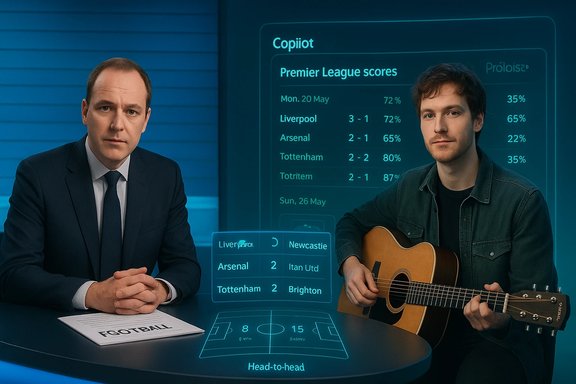
The Premier League’s light‑hearted predictions column has quietly become a frontline test of what modern sports journalism looks like when human experience meets algorithmic recall — and, for now, the machines are winning. In early January 2026 the BBC’s weekly predictions feature saw veteran pundit Chris Sutton fall behind an artificial intelligence powered by Microsoft’s Copilot, as Sutton’s guest for the week — singer‑songwriter and Newcastle fan Andrew Cushin — lent a human, culturally rooted counterpoint to the machine’s numerate output. The episode matters because it is more than a tidy internet story: it shows editorial teams experimenting with AI output as a published voice, the Premier League doubling down on Copilot in its product roadmap, and the practical questions that follow when opaque models enter routine, public forecasting.
Background
What the BBC has been doing and why editors care
The BBC’s predictions strand runs every matchweek through the Premier League season: a resident pundit submits exact scorelines for all fixtures, a guest contributor offers alternate picks, and the public can submit their own forecasts. This year the editorial team added a third published voice — an AI summoned via a simple prompt to Microsoft Copilot Chat — and the results are presented side‑by‑side for readers to judge. The scoring is straightforward and intentionally rewards precision: 10 points for a correct result (win/draw/loss) and 40 points for an exact scoreline, meaning exact calls are disproportionately valuable across the season’s 380 fixtures.This small experiment sits inside a much bigger shift. The Premier League announced a five‑year strategic partnership with Microsoft to embed Copilot‑style experiences into its official digital platforms — a push that includes a Copilot‑powered “Premier League Companion” intended to surface decades of stats, articles and videos to fans on demand. That institutional move helps explain why Copilot has migrated from novelty to regular editorial fixture: the league and its partners are building the technical plumbing that makes Copilot outputs practical at scale.
Who was involved in this episode
- Chris Sutton: former Premier League striker and the BBC’s resident pundit making weekly predictions. His comment that “it’s been a bad start to the new year for me, with AI top of the table” neatly captures the tone — bemused, self‑effacing, and headline‑friendly.
- Andrew Cushin: Newcastle‑born singer‑songwriter whose second album, Love Is For Everyone, entered the UK Top 40 in 2025 and who played a sold‑out hometown gig at Newcastle’s City Hall in October 2025. His presence reframes the feature: predictions are not just numbers, they are part of a cultural conversation about clubs, players and local identity.
- Microsoft Copilot Chat: the conversational assistant that the BBC prompted to “predict this weekend’s Premier League scores.” The outputs were published unedited alongside the human picks, raising editorial questions about provenance, reproducibility and responsible presentation.
Why this small weekly feature is a useful testbed
On the surface, a pundit versus guest versus AI column is entertainment. Under the surface, it compresses three different knowledge systems into one page:- Tacit expertise and narrative judgment — embodied by Sutton, who leans on tactical reading, dressing‑room signals, and managerial nuance.
- Fan‑driven instincts and cultural storytelling — embodied by Cushin and other celebrity guests, whose picks carry local resonance and personality.
- Pattern recognition at scale — the AI’s comparative strength: fast recall of seasons of data, consistent application of heuristics, and the ability to output an entire matchday’s scores in seconds.
The mechanics: how the AI was used — and why that matters
The BBC disclosed that the Copilot output was produced by prompting Microsoft Copilot Chat with a simple instruction — essentially a one‑line request — and publishing the returned scorelines unedited. That tidy setup has pros and cons.Strengths:
- Speed and scale: the model produces a full slate of predictions instantly, which is highly practical for matchweek publishing cycles.
- Consistency: the AI applies the same decision heuristic across matches, avoiding emotional swings or fandom bias that can affect humans.
- Data recall: when connected to rich archives, Copilot can surface obscure head‑to‑head records or historical context in ways a writer would take longer to fetch. This capability is part of the underlying Premier League–Microsoft product plan.
- Data freshness: a single Copilot prompt issued at one moment may not capture late injuries, last‑minute team news, or other matchday changes unless the model is explicitly provided with those live feeds. That makes single‑sample Copilot outputs brittle near kick‑off.
- Opaque provenance: conversational models rarely produce a reproducible log of exact data sources, model version or timestamps unless the editorial team records them. Without that traceability, it is hard to audit or rerun outputs for verification.
- Single deterministic outputs mask uncertainty: Copilot returned single scorelines rather than probability distributions. Presenting a single number can imply false precision to readers, especially those tempted to use predictions for betting or fantasy choices.
What actually happened: Sutton, Cushin, and the Copilot week
The published column for week 20 displayed Sutton’s picks, Cushin’s alternatives, and Copilot’s scores. The machine’s performance in the preceding week (week 19) — where Copilot combined multiple correct results with a pair of exact matches to post a superior weekly haul — is what drew attention. That win is not proof of systematic domination; rather, it demonstrates how a single well‑timed exact score can swing the leaderboard because of the 40‑point reward for accuracy.Sutton’s candid line about losing at cards to his daughter and quipping that she may have had “help from somewhere” — a reference that invited the AI comparison — humanised the piece and emphasised the entertainment value at stake. Cushin contributed local perspective and readable copy: his Newcastle loyalties and stage experience rewired predictions into narrative hooks rather than cold statistics alone.
The architecture behind the headlines: Premier League and Microsoft
The Premier League’s five‑year partnership with Microsoft is material to this story. The deal names Microsoft as the official cloud and AI partner for the league’s digital platforms and explicitly mentions a Copilot‑powered Premier League Companion that draws on “30 seasons of stats, 300,000 articles and 9,000 videos.” This is not speculative: it is a corporate strategic move to put Copilot at the interface of fans’ digital experiences, which in turn normalises Copilot outputs being used editorially by partners. That institutional backing changes the dynamics:- It encourages media outlets to experiment with Copilot as a content tool because the league’s data will be more systematically available.
- It strengthens product teams’ ability to supply the model with fresher, richer matchday information — if, and only if, pipelines are built to surface real‑time team sheets, injuries or official bulletins to the assistant.
- It raises governance questions: platform integrations must make it possible to record model versions, data timestamps and the precise prompts used to ensure reproducibility and accountability.
Editorial best practices and guardrails (practical guidance for newsrooms)
For newsrooms and publishers experimenting with LLMs in public forecasting, the BBC experiment suggests concrete steps to preserve credibility and protect readers:- Disclose model and prompt: publish the exact prompt and the model environment (Copilot product name, timestamp and model version when available). This promotes reproducibility and reader trust.
- Record and publish performance metrics: weekly leaderboards should be supplemented with win rates, exact‑score hit rates and trendlines so audiences can see whether AIs are consistently superior or merely lucky.
- Prefer probabilistic outputs: ask the AI for probability distributions (e.g., home win 54%, draw 22%, away win 24%) rather than single deterministic scorelines. Probability inputs are easier to calibrate and compare with betting markets.
- Audit prompts and outputs: maintain internal logs of prompts, model responses and any editorial edits. If a model is used to inform betting‑sensitive content, add explicit disclaimers about limitations and the probabilistic nature of forecasts.
- Combine model outputs with statistical back‑ends: integrate Copilot’s narrative strengths with a reproducible statistical pipeline (xG models, Elo ratings or market odds). This hybrid approach preserves explainability and auditability.
The wider implications: journalism, fandom, and the market
AI will not simply eliminate punditry; instead, it reshapes the skillset and the spectacle around it.- For broadcasters, the editorial value shifts toward interpretation: telling readers why an AI picked a line, interrogating anomalies, and adding human context that models cannot intuitively capture (locker room mood, recent tactical tweaks, personality‑driven selection decisions).
- For fans, published AI forecasts offer a new form of engagement: compare your picks with both a pundit and a data‑driven baseline. That can be playful and informative, but it also has potential harms if readers treat the machine’s scorelines as betting tips without understanding uncertainties.
- For product teams and developers, the experiment underscores a clear product requirement: build sports‑specific APIs that expose not only scores but evidence — team sheets, injury lists, and time‑stamped data — and that return explainable probabilities rather than single outputs.
A practical primer for Windows‑based hobbyists and community sites
Readers who want to reproduce or explore this kind of experiment on a Windows machine should adopt a reproducible, auditable workflow:- Use Microsoft 365 Copilot or Copilot Chat as the conversational front end. Note the product name and timestamp each session.
- Frame structured prompts asking for probabilities, justifications and cited headlines rather than single scorelines. Repeat the prompt multiple times to measure variance.
- Save transcripts locally and record model metadata (product, apparent version, timestamp) in a simple CSV or notebook.
- Cross‑check key facts (injuries, suspensions, AFCON call‑ups) against official club communications or league bulletins just before kick‑off.
- Optionally, combine Copilot narratives with a statistical engine (xG or odds‑derived probabilities) to create an ensemble forecast that’s replicable and auditable.
What’s verifiable — and what deserves caution
Verified claims:- The BBC published a week‑by‑week predictions feature that included Chris Sutton, a guest (Andrew Cushin for week 20) and an AI output generated by prompting Microsoft Copilot Chat; the publication and the Copilot prompt disclosure were explicit.
- The Premier League and Microsoft announced a five‑year strategic partnership that includes a Copilot‑powered Premier League Companion drawing on decades of league content and migration of core infrastructure to Azure. This is confirmed in Microsoft and Premier League press material and by news agencies.
- Andrew Cushin released an album in 2025 (Love Is For Everyone) which entered the UK Top 40 and toured extensively, including a reported sold‑out show in Newcastle in October 2025. These facts are corroborated by multiple event and press listings.
- The BBC’s Copilot output is a snapshot of a conversational assistant’s reply at a single time; it is not a transparent, reproducible model run with documented data feeds. Unless the editorial team provides the model version and the precise data pulls behind the output, it is impossible to assert that the AI had access to live team sheets or other late updates. Readers and reporters should treat that single published Copilot run as non‑reproducible unless such metadata is published.
- A single week’s leaderboard win by an AI does not demonstrate season‑long superiority. The scoring regime (40 points for exact matches) makes individual weeks highly sensitive to variance; long‑term evaluation requires running the comparison across many matchweeks with consistent, recorded methodology.
Conclusion: augmentation, accountability, and the future of the pundit column
The Sutton‑v‑Cushin‑v‑Copilot episode is instructive because it turns an entertainment feature into an ethical, technical and editorial experiment in miniature. The early result — Copilot topping the weekly leaderboard — is not a prophecy of punditry’s obsolescence. It is, instead, an argument for a disciplined editorial posture:- Embrace AI as a rapid, data‑rich assistant that can scale routine tasks and surface obscure context.
- Preserve human judgment for narrative framing, uncertainty communication and last‑mile verification.
- Demand reproducibility from product partners: publish prompts, model versions and timestamps; prefer probabilistic outputs; and track model performance over time.
Appendix: quick reference for editors and developers
- Key editorial checks to run before publishing AI predictions:
- Record the exact prompt, product name, model version (if visible) and timestamp.
- Ask the model for probabilities and justifications citing recent headlines.
- Cross‑check team sheets and injury lists within an hour of publication.
- Publish a short methodological note explaining what the AI was given and what it wasn’t.
- Suggested reader‑facing disclosures:
- “AI output generated by Microsoft Copilot Chat using a single editorial prompt; probabilities not provided; outputs published unedited.”
Source: BBC Premier League predictions: Chris Sutton v singer-songwriter Andrew Cushin - and AI
