

Enterprises quietly hiring an “AI productivity director” are not chasing moonshots — they’re hiring an operator to turn costly generative‑AI licenses into measurable time savings, safer workflows, and repeatable business outcomes. view
Generative AI has moved from curiosity to boardroom priority. Analyst modeling puts the upside in the trillions: McKinsey estimates generative AI could add between $2.6 trillion and $4.4 trillion in annual economic value across dozens of real‑world use cases. That headline number frames the scale of the prize, but capture depends on disciplined adoption, not just procurement.
Vendors and early adopters report striking micro‑level gains when tools are integrated with real workflows. Microsoft’s internal Copilot studies found participants were about 29% faster on structured tasks (searching, summarizing, drafting) and many power users saved more than ten hours per month. GitHub’s experiments with Copilot report developers finishing coding tasks far more quickly — one controlled trial found a roughly 55% reduction in time to complete a specific programming task. These studies are powerful signals, but they also underscore an operational truth: those gains rarely appear by accident. They arrive where someone coordinates licenses, integration, guardrails, training, and measurement. ([microsoft.com](What Can Copilot’s Earliest Users Teach Us About AI at Work? operational owner — the AI productivity director — is the practical halfway house between IT and data teams: the person who makes enterprise copilots and agents disappear into work in ways that are safe, auditable, and countable.
Key attributes:
Key guardrails:
Source: findarticles.com Businesses Shift To AI Productivity Directors
Generative AI has moved from curiosity to boardroom priority. Analyst modeling puts the upside in the trillions: McKinsey estimates generative AI could add between $2.6 trillion and $4.4 trillion in annual economic value across dozens of real‑world use cases. That headline number frames the scale of the prize, but capture depends on disciplined adoption, not just procurement.
Vendors and early adopters report striking micro‑level gains when tools are integrated with real workflows. Microsoft’s internal Copilot studies found participants were about 29% faster on structured tasks (searching, summarizing, drafting) and many power users saved more than ten hours per month. GitHub’s experiments with Copilot report developers finishing coding tasks far more quickly — one controlled trial found a roughly 55% reduction in time to complete a specific programming task. These studies are powerful signals, but they also underscore an operational truth: those gains rarely appear by accident. They arrive where someone coordinates licenses, integration, guardrails, training, and measurement. ([microsoft.com](What Can Copilot’s Earliest Users Teach Us About AI at Work? operational owner — the AI productivity director — is the practical halfway house between IT and data teams: the person who makes enterprise copilots and agents disappear into work in ways that are safe, auditable, and countable.
 Why a CAIO (alone) isn’t the adoption answer
Governance vs. adoption: complementary but different problems
A Chief AI Officer (CAIO) or centralized AI research team serves critical roles: vendor strategy, model selection, long‑horizon R&D and enterprise governance. But governance doesn’t automatically create adoption. Practical barriers — identity integration, DLP across connectors, role‑specific prompt patterns, prompt libraries, and change management — are organizational and operational problems, not purely technical or research ones.- Governance and policy answer “what should we do” and “what must we avoid.”
- Adoption answers “how do actual people make this part of daily work” and “where does the value show up on the ledger?”
Why the market is signaling this role now
Three trends converge to make this role timely:- Massive investment and rising infrastructure spend as firms prepare for scaled AI deployments — IDC and other analysts call a broad industry pivot toward AI‑first spending and expect sustained growth in AI infrastructure and platform investment.
- Repeated micro‑evidence of productivity gains for targeted tasks when tools are properly integrated osoft Copilot, GitHub Copilot, and academic field studies).
- The operational challenge of shadow AI, license underuse, and teams building brittle, ungoverned automations — risks that require an accountable operator to reduce exposure while increasing throughput.
What an AI Productivity D
The job is highly pragmatic and cross‑disciplinary. Think of the role as "head of AI enablement" with a remit to convert vendor seats into measurable outcomes, safely.Headline responsibilities
- Drive usage and activation: ens are used by prioritized roles and workflows; seed role‑based prompt libraries and playbooks; run hands‑on cohort onboarding and office hours.
- Make AI safe by design: publish an and model matrix, configure DLP and least‑privilege connectors, define escalation rules to private RAG (retrieval‑augmented generation) pipelines for regulated queries.
- Redebolting AI onto legacy processes; rework steps to exploit summarization, drafting, code scaffolding, and scheduled agent runs where automation is reliable.
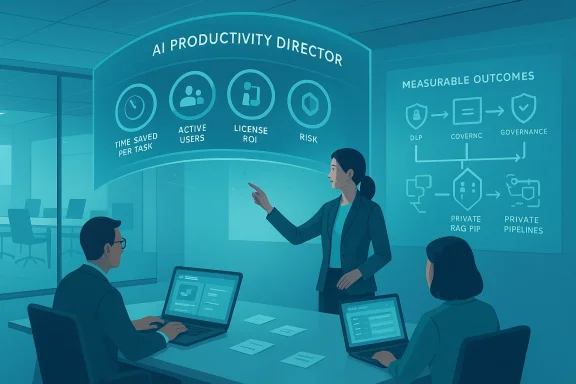
- Measure and report: instrument pilots with objective KPIs (active use, time saved per task, quality signals), tie outcomes to license ROI, and produce executive dashboards.
A typical week, in practice
- Audit license utilization and identify underused seats. workshops and publish two or three effective prompts/playbooks.
- Work with IT to deploy SSO, tenant policies, and DLP connectors for a pilot agent.
- Measure pilot metrics — time saved, error rates, customer satisfaction — and update leadership.
- Host office hours and collect feedback for iteration.
Evidence: what the public data actually shows
The AI productivity director is an operational answer to a simple measurement problem: can the productivity gains vendors and labs report be delivered at scale in messy enterprise settings?Independent and vendor research — the strongest load‑bearing claims
- McKinsey modeling: generative AI could produce between $2.6T and $4.4T in annual value across 63 use cases — a top‑level economic framing that underscores the potential but does not guarantee capture.
- Microsoft Copilot pilots: Microsoft’s internal and customer studies report ~29% faster completion of structured tasks and large perceived quality and time‑saving improvements among Copilot early users. Those results come from structured task sets in instrumented studies and are directional evidence for what disciplined rollout can achieve.
- GitHub Copilot controlled experiment: GitHub’s research team reported developers in a controlled experiment completed a specified coding task ~55% faster when using Copilot. The experiment is a credible, directly measurable result in a clearly defined developer task.
- Field experiments and academic work: multiple academic and industry trials (contact‑center pilots, consultancy experiments, and workplace randomized trials) repeatedly show meaningful gains (common magnitudes in published work: mid‑teens to low‑double‑digit percent improvements across different roles, with larger uplifts for lower‑skilled or novice workers). These findings point to variance: gains are real but context dependent.
How to interpret these numbers
- They are task‑ and context‑specific. A 55% speedup in a defined coding exercise does not automatically translate to 55% across all software engineering workflows.
- Controlled experiments simplify measurement and reduce noise; real production environments add regulatory, data‑quality, and cultural friction that tend to reduce effect sizes.
- The consistent lesson: measured pilots with instruments, baselines, and control groups are essential. The AI productivity director’s job is to design and run those pilots so leadership can make evidence‑based scaling decisions.
Case studies and cautionary examples
Howden — an illustrative insurance story
Reporting that popularized the term describes Howden creating an AI productivity director role to bridge build‑vs‑buy decisions and scale copilots across underwriters and brokers. The director helped prioritize Microsoft Copilot for summarization tasks, Anthropic Claude for deeper analysis, and ChatGPT Enterprise for flexible reasoning — trimming broker hours on long policies and fread‑hoc gen‑AI help requests. The Howden account is illustrative of the potential, but the public detail set is not a full audited study and should be treated as directional evidence until corroborated internally.Public‑sector pilots and the limits of generalization
Well‑documented public pilots (for example, government and regulated trials) reveal a practical truth: outcomes are highly sensitive to governance, data readiness, and measurement design. A careful trial can show substantial time savings; a non‑instrumented rollout can produce compliance risk and minimal ROI. The Dsimilar experiments demonstrate both the promise and the importance of statistically controlled design.Hiring the role: what to look for
This is a hybrid change‑leadership hire — not a PhD researcher, nor a pure project manager.Key attributes:
- Domain credibility: proven success shipping automation or productivity programs at scale.
- Technical fluency: prompt engineering, RAG architectures, and practical model‑selection experience.
- Security and governance savvy: experience with DLP, vendor risk assessments, and data classification.
- Change management skills: cohort onboarding, stakeholder management, training design, and a track record of measurable adoption.
- Evidence of shipped automation at scale (case studies and metrics).
- Hands‑on familiarity with enterprise copilots (Microsoft 365 Copilot, ChatGPT Enterprise, Anthropic, or private model stacks).
- Track record of running instrumented pilots and scaling them cross‑unit.
- Credibility with IT, data, security and business leadership.
KPIs and how to measure success
A short, practical KPIs while keeping measurement attainable:- Weekly active users per tool (segmented by role).
- % of prioritized workflows instrumented with AI assist.
- Average time saved per task (using logs + sample time‑motion verification).
- License ROI: (time saved × loaded hourly rate × users) − license + operating cost.
- Reduction in shadow AI incidents and remediation backlog.
- Quality signals: error/rollback rate, customer satisfaction, rework frequency.
A practical 90‑day starter playbook for CIOs
- Inventory and prioritize (Days 1–14)
- Map existing licenses, key workflows, and data classification.
- Pick 3 high‑frequency, low‑risk processes as first pilots (meeting summaries, internal drafts, code scaffolding).
- Appoint and fund (Days 7–21)
- Make a staffed appointment and give a 6–12 month budget for a small cross‑functional team (IT, security, data, operations).
- Pilot design and instrument (Days 15–45)
- Run narrow, instrumented pilots with defined KPIs.
- Publish role‑based playbooks and curated prompt libraries.
- Lock down DLP for connectors and enforce SSO and least privilege.
- Measure, iterate, scale (Days 46–90)
- Evaluate results against KPIs. Scale winners across a single business unit, retire failures.
- Use templates and telemetry to accelerate rollout. Establish weekly office hours and an escalation path to data engineering for private RAG pipelines.
Governance, safety, and risk mitigation
The director’s job is not to block innovation; i safe and repeatable.Key guardrails:
- Approved tool catalog and model matrix: define what to use for low‑sensitivity drafting vs. what requires private model + RAG.
- DLP and connector controls at the tenant level: enforce at the integration layer, not just by policy memo.
- Escalation rules: when a query touches regulated or high‑sensitivity data, route to secure pipelines only.
- Audit trails and explainability: capture prompts, model profor post‑hoc review.
- Enforcement levers: procurement gates that require an adoption plan and risk assessment before a vendor is approved.
Risks and realistirocess eliminates model risk or cultural friction. Expect and plan for these risks:
- Hype vs. durable impact: pilot effect sizes often shrink in production. Treat vendor claims as directional until your instrumented pilots prove otherwise.
- Hallucination and model error: require human signoff and RAG for knowledge‑sensitive decisions. Never expose customers or regulators to unverified model outputs.
- Shadow AI and data leakage: unmanaged adoption of consumer tools is a first‑order regulatory and IP risk — the highest priority age paths.
- Measurement complexity: authentic measurement sometimes requires time‑motion studies or synthetic controls; sloppy metrics create false confidence.
- Talent and culture: the director’s influence depends on visible sponsorship and the authority to enforce standards across procurement and IT.
The economics: license ROI and scaling math (practical framing)
A simple way to think about ROI for a Copilot‑style seat:- Estimate time saved per user per week (from pilot).
- Multiply by loaded hourly rate to get weekly value per seat.
- Annualize and subtractost to derive net ROI per seat.
Where the role adds the most value (sweet spots)
- Document‑heavy professions (insurance, legal, compliance) where summarization + RAG produce outsized time savings.
- Repetitive support workflows ( agent augmentation has shown durable gains in field experiments.
- Sales and proposal generation, where templates and CRM integration compress time‑to‑first‑draft.
Critical takeaways and final analysis
- The AI productivity director is an operational answer to a measurement and adoption problem: organizations are buying seats and infrastructure, but value leaks unless someone is accountablrchases into repeatable business outcomes.
- Public evidence (McKinsey, vendor trials, and independent academic and field studies) consistently shows potential for large productivity gains — but effect sizes are highly contextual and sensitive to governance, measurement, and workflow redesign.
- The role must be both pragmatic and empowered: hire a cross‑domain operator, fund a small team for a 90‑day adoption sprint, instrument pilots, and insist on outcome metrics before scaling.
Source: findarticles.com Businesses Shift To AI Productivity Directors
