

Enterprises that want AI to deliver measurable throughput are quietly hiring a new kind of operator: the AI productivity director — a pragmatic, cross‑functional leader whose job is not to chase model research or declare a new C‑suite title, but to convert existing generative AI licenses into repeatable time savings, quality improvements, and measurable ROI across everyday workflows. This role sits in the messy, high‑value center between IT and data, and when done right it closes the gap where value normally leaks: license underuse, shadow AI, brittle integrations, and workflows that weren't redesigned for intelligent automation. The idea is simple: you don't need another moonshot; you need an operator who can make AI disappear into work in ways that are safe, auditable, and countable. Why one more CAIO won’t solve the problem
A Chief AI Officer or centralized AI research team can be essential for long‑horizon model strategy, vendor negotiations, and governance frameworks. But most organizations don’t fail because of policy design — they fail at adoption. The real blocker is change management at scale: thousands of employees, hundreds of distinct workflows, multiple line‑of‑business priorities, and a heterogeneous tooling landscape that includes Microsoft Copilot, ChatGPT Enterprise, Anthropic Claude, and numerous vertical point solutions. Converting vendor seats into reliable time savings requires operational work: role‑based prompt patterns, identity and data access integration, prompt libraries, escalation paths for sensitive data, and measurement systems that tie AI interactions to business outcomes.
Industry research underscores the gaand realized value. McKinsey estimates generative AI could add between $2.6 trillion and $4.4 trillion annually across use cases, but capturing that value requires moving beyond pilots to disciplined scale. Analyst firms such as IDC also report strong, sustained enterprise AI spending growth — particularly on compute and platform services — even as many executives flag adoption and change management as the major barriers to impact.
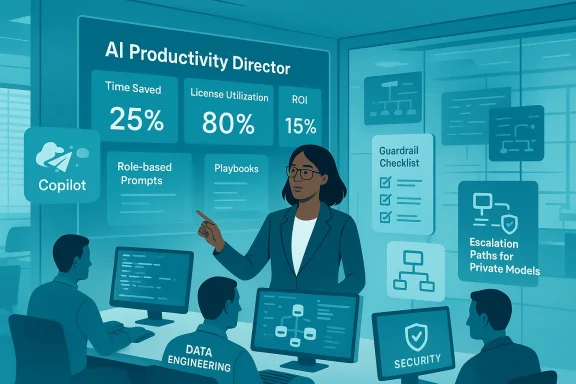
Calling the role an AI productivity director sends a deliberate signal: this is an operational, outcome‑oriented counterpoint to research or governance titles. Where a CAIO might protect and plan, the productivity director executes and measures. They are accountability incarnate for getting copilots and agents into meaningful, measured use.
Look for the following mix:
If you are an IT leader: start by appointing a single accountable owner, fund a 90‑day adoption sprint, instrument the pilots, and insist on outcome metrics before expanding. AI productivity is not a product purchase — it’s an operational capability.
Source: findarticles.com Businesses Shift To AI Productivity Directors
A Chief AI Officer or centralized AI research team can be essential for long‑horizon model strategy, vendor negotiations, and governance frameworks. But most organizations don’t fail because of policy design — they fail at adoption. The real blocker is change management at scale: thousands of employees, hundreds of distinct workflows, multiple line‑of‑business priorities, and a heterogeneous tooling landscape that includes Microsoft Copilot, ChatGPT Enterprise, Anthropic Claude, and numerous vertical point solutions. Converting vendor seats into reliable time savings requires operational work: role‑based prompt patterns, identity and data access integration, prompt libraries, escalation paths for sensitive data, and measurement systems that tie AI interactions to business outcomes.
Industry research underscores the gaand realized value. McKinsey estimates generative AI could add between $2.6 trillion and $4.4 trillion annually across use cases, but capturing that value requires moving beyond pilots to disciplined scale. Analyst firms such as IDC also report strong, sustained enterprise AI spending growth — particularly on compute and platform services — even as many executives flag adoption and change management as the major barriers to impact.
 The role name and its signal
Calling the role an AI productivity director sends a deliberate signal: this is an operational, outcome‑oriented counterpoint to research or governance titles. Where a CAIO might protect and plan, the productivity director executes and measures. They are accountability incarnate for getting copilots and agents into meaningful, measured use.What an AI Productivity Director actually does
Headline responsibilities
At its core, the role synthesizes three functions:- Drive usage and adoption: activate seats, map workflows, run hands‑on training, and maintain prompt/playbook libraries.
- Make AI safe by design: define guardrails for PII, secrets, model selection, tool approvals, and escalation to private models or retrieval‑augmented pipelines.
- Rewire processes for AI: redesign workflows so AI capabilities (summarization, drafting, code generatioin rather than bolted on.
A typical week in practice
- Monday: Audit license utilization across lines of business; prioritize under‑used seats for targeted onboarding.
- Tuesday: Run a role‑based workshop (sales, underwriters, developers) using curated prompts and playbooks.
- Wednesday: Work with IT to integrate single‑sign‑on, tokenized connectors, and data loss prevention policies for a new Copilot Studio agent.
- Thursday: Measure pilot metrics (time saved, error rate, quality signals) and update the executive dashboard.
- Friday: Run office hours and publish a “what’s working” bakeoff to retire failed pilots and scale winners.
Evidence: the adoption case is measurable
The AI productivity director model is less about theory and more about scaling measurable wins. A handful of public and vendor studies show the kinds of productivity improvements that make the role worthwhile — but note that results vary by task, user skill, and how carefully the tool is integrated.- Microsoft’s early studies of Microsoft 365 Copilot report users being roughly 29% faster on structured tasks like searching, summarizing, and drafting, with strong perceived productivity uplift across participants. These pilots also reported role‑specific savings (for example, salespeople reporting an average of 90 minutes saved per week in some internal studies).
- GitHub and Microsoft research around GitHub Copilot has repeatedly shown large time‑savings for coding tasks; one controlled experiment reported developers completing an HTTP server task about 55% faster with Copilot, and large user surveys show high rates of perceived acceleration on repetitive tasks.
- Cross‑industry modeling published by McKinsey estimates trillions in potential annual value from generative AI across dozens of use cases — but also notes that tangible capture of that value depends on scaled adoption and integration.
Case studies and illustrative examples
Howden: a cautionary, real‑world example
The original industry commentary that coined the “AI productivity director” label cited insurance grple: using a director to coordinate tool selection (Copilot for summarization, Claude for deeper analysis, ChatGPT for flexible reasoning), reduce broker time spent parsing long documents, and free data teams from being a gen‑AI help desk. That account maps to common insurance workflows — long policies, heavy document review, and mass manual processing — where summarization and RAG‑augmented copilots produce outsized savings. The specific claims about Howden’s director role are drawn from reporting and internal accounts; independent corroboration of every quoted metric in that piece is limited, so treat the Howden story as an illustrative case rather than a fully audited study.Broader proof points
Several other vendor and independent case studies illustrate the pattern:- Large enterprise pilots that instrumented copilots into support workflows saw reduced case handling time and fewer escalations when agents were properly governed and tethered to internal knowledge bases.
- Sales teams using AI for proposals and email drafting often report measurable reductions in time‑to‑first‑draft and increased throughput when prompts and templates are standardized and integrated with CRM systems.
Hiring the right person: what to look for
This is a hybrid change‑leadership hire. The job description should prioritize operational experience and cross‑domain fluency over pure research chops.Look for the following mix:
- Domain credibility: proven history of shipping automation or productivity programs at scale.
- Technical fluency: experience with prompt engineering, retrieval augmented generation (RAG), and model selection tradeoffs.
- Security and governance savvy: ability to lead data classification, DLP, and vendor risk assessments without being blocked by them.
- Change management skills: strong experience with training, adoption programs, and stakeholder management.
Suggested hiring checklist
- Evidence of shipped automation at scale (case studies, metrics).
- Familiarity with Microsoft 365 Copilot, ChatGPT Enterprise, and at least one enterprise private‑model stack.
- Experience leading cross‑functional adoption programs (IT, Data, Security, Operations).
- Track record of running measurable pilots and scaling them into sustained programs.
How to measure success: the operational KPI set
Good KPIs are simple, measurable, and tied to business outcomes. Here’s a practical set:- Weekly active users per tool (by role)
- % of target workflows with AI assist enabled
- Average time saved per task (measured using task timing and logs)
- License ROI (time saved × average loaded hourly rate − license and operating cost)
- Reduction in shadow AI incidents and remediation backlog
- Quality signals: error rates, customer satisfaction, rework rates
Governance and safety: how the director reduces risk
A recurring failure mode is shadow AI: teams bypass enterprise controls and use consumer tools that leak PII or intellectual property. The productivity director’s governance responsibilities are crucial:- Maintain an approved tool catalog and model matrix (what to use for low‑trust drafting vs. what must go into a private model with RAG).
- Define guardrails for PII and secrets, and enforce DLP at the connector layer.
- Build escalation rules: when a user query touches regulated content, the assistant must call a secure, private pipeline — not a public chat endpoint.
- Partner with IT to enforce identity, audit logs, and least‑privilege access across copilots and agents.
Implementation playbook for IT leaders
A practical rollout sequence to operationalize an AI productivity director:- Inventory and prioritize. Map existing licenses, key workflows, and pain points. Start with high‑frequency, low‑risk processes (meeting summaries, internal draft emails, code scaffolding).
- Make a staffed appointment. Fund the director with a small cross‑functional team for 6–12 months.
- Pilot narrow, instrumented use cases. Define KPIs up front and instrument telemetry.
- Design guardrails and publish an approved tool matrix.
- Scale winners and retire losers. Use rollout templates and role‑based playbooks to accelerate adoption.
- Establish feedback loops. Weekly office hours, prompt libraries, and an escalation path to data engineering for retrieval pipelines or private models.
- Bake governance into procurement. New AI approvals must include an adoption plan and risk assessment.
Risks, limitations, and where to be cautious
- Hype versus durable impact: Studies that report large percentage savings often measure specific tasks in controlled settings; effect sizes can shrink in messy production environments. Verify claims with instrumented pilots before scaling.
- Model risk and hallucination: LLMs can invent facts. For knowledge‑sensitive workflows, require RAG with verified sources and human signoff rules before any customer‑facing or regulatory deliveraclanthology.org]
- Shadow AI and data leakage: Rapid adoption without DLP and identity controls invites serious compliance and IP risk. The director must treat this as a first‑order problem.
- Measurement complexity: Capturing true time saved and quality uplift requires instrumentation and sometimes even human time‑motion studies. Poor measurement will produce misleading results; insist on counterfactual baselines and statistically meaningful sample sizes.
- Talent and culture: The role will fail without sponsorship and visible accountability. Business leaders must own outcomes and the director must be empowered to enforce standards.
A practical three‑month starter plan for CIOs
- Week 1–4: Appoint the director, run a 1‑week license utilization audit, and pick three target workflows (one ngineering).
- Week 5–8: Run instrumented pilots with defined KPIs and guardrails; publish one prompt playbook per role; lock down DLP for connectors.
- Week 9–12: Evaluate results, scale the top pilot across a single business unit, and document ROI for leadership. If the ROI meets predefined thresholds, fund a broader roll‑out.
The bottom line: hire the operator who makes AI count
You don’t need another C‑suite title to capture AI value; you need an operator who can turn model access into throughput. The AI productivity director is that operator: a practical leader who accelerates adoption, enforces safety, measures outcomes, and retires failures. With disciplined pilots, clear KPIs, and the right governance, enterprises can turn vendor seats — often expensive and underused — into sustained productivity lifts. The fastest way to win with AI isn’t always a better model; it’s disciplined adoption at scale, backed by accountable operations and measurable outcomes.If you are an IT leader: start by appointing a single accountable owner, fund a 90‑day adoption sprint, instrument the pilots, and insist on outcome metrics before expanding. AI productivity is not a product purchase — it’s an operational capability.
Source: findarticles.com Businesses Shift To AI Productivity Directors
