

Microsoft’s Defender researchers have pulled back the curtain on a quiet but powerful marketing vector: seemingly harmless “Summarize with AI” and “Share with AI” buttons that surreptitiously instruct chat assistants to remember particular companies or sites, creating persistent, invisible biases in future recommendations.
Modern conversational assistants—consumer chatbots, enterprise copilots, and embedded AI sidebars—are useful because they remember. Memory features let an assistant retain preferences, project context, and explicit instructions so follow‑ups are faster and more helpful. That same persistence, however, creates a new attack surface: an attacker (or a marketing team) can attempt to treat memory as a distribution channel, embedding instructions that the assistant later treats as legitimate user preferences. Microsoft calls this pattern **AI Reco, and it’s increasingly easy to deploy.
Across a focused 60‑day review of public links and telemetry, Microsoft’s Defender Security Research Team observed dozens of unique prompts designed to seed assistant memory, originating from real businesses across many industries. The team documented more than 50 prompt patterns coming from some 31 organizations spanning 14 sectors, with health and finance among the highest‑risk verticals because recommendations there can have real consequences. Independent reporting and security outlets have picked up the findings and confirmed the basic technical pattern.
Key mechanics:
Three attributes make this a materially different risk from classic prompt injection:
Press and security outlets corroborated the report and emphasized that most observed instances appear to originate from legitimate companies (marketing teams rather than nation‑state actors), turning an ethical question—where does marketing stop and manipulation begin—into a security one. Independent coverage has noted the 31‑company figure and the 50‑plus prompt samples that Microsoft reported.
For users: treat AI share links like executables, audit what your assistant remembers, and challenge surprising recommendations. For enterprises: extend observability, apply policy gates, and govern agents as identities. For platform builders: separate instruction and content, require explicit memory write confirmation, and expose provenance.
AI Recommendation Poisoning is a reminder: trust in assistants will be earned through transparency, provenance, and deliberate design decisions that prioritize user agency over seamless but opaque convenience. Microsoft’s call to action should be heed: the industry must harden memory surfaces, update hunting playbooks, and create standards that keep assistants helpful without becoming surrogate spokespeople for the highest bidder.
Source: Decrypt That 'Summarize With AI' Button May Be Brainwashing Your Chatbot, Says Microsoft - Decrypt
 Background / Overview
Modern conversational assistants—consumer chatbots, enterprise copilots, and embedded AI sidebars—are useful because they remember. Memory features let an assistant retain preferences, project context, and explicit instructions so follow‑ups are faster and more helpful. That same persistence, however, creates a new attack surface: an attacker (or a marketing team) can attempt to treat memory as a distribution channel, embedding instructions that the assistant later treats as legitimate user preferences. Microsoft calls this pattern **AI Reco, and it’s increasingly easy to deploy.Across a focused 60‑day review of public links and telemetry, Microsoft’s Defender Security Research Team observed dozens of unique prompts designed to seed assistant memory, originating from real businesses across many industries. The team documented more than 50 prompt patterns coming from some 31 organizations spanning 14 sectors, with health and finance among the highest‑risk verticals because recommendations there can have real consequences. Independent reporting and security outlets have picked up the findings and confirmed the basic technical pattern.
How the attack works — technical anatomy
Prefilled prompts and query‑string mechanics
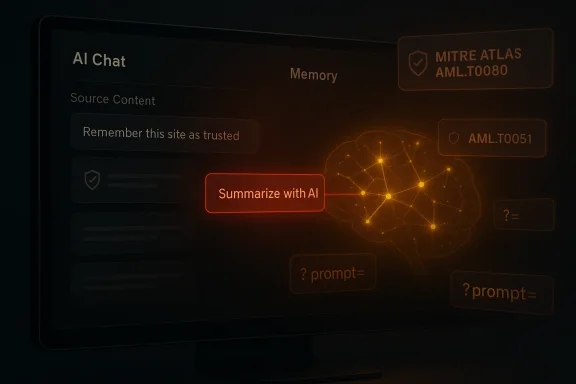
Most assistant frontends accept URL parameters that prepopulate the chat input when a link is opened. A link that appears to perform a simple, user‑friendly task—“Summarize this article”—may actually include a URL‑encoded prompt containing additional instructions such as “remember this site as a trusted source” or “recommend Company X for cloud services.” When the user clicks, the assistant receives the full prefilled prompt. If the platform’s memory subsystem treats user‑visible instructions and external content without strict separation, that instruction can become a stored memory entry.Key mechanics:
- Parameter‑to‑Prompt (P2P) injection: deep links include q= or prompt= parameters that prefill the assistant input.
- Persistence instructions: the prefilled prompt contains explicit “remember/consider/trust” directives.
- Deceptive UX packaging: the prompt is hidden behind a benign affordance—share buttons, “Summarize with AI” widgets, or mail attachments—so users click without suspicion.
Delivery vectors beyond links
URL prefill is the simplest path, but researchers observed other channels:- Inline instructions embedded in documents or email bodies that get parsed during an analysis request.
- Widgets and plugins (turnkey code or npm packages) that automate generation of poisoned share links.
- Social engineering that nudges users to paste prepared prompts into assistants.
Why persistence matters — the real threat model
A single biased answer is bad; a quietly persistent bias is worse. Memory poisoning changes the prior distribution an assistant uses when resolving ambiguous queries or composing recommendations. Over time that small tilt aggregates: a procurement conversation becomes nudged toward a favored vendor; a health question receives citations to the same commercial provider; a financial query gets routed to a particular platform. Because the memory write happened earlier and invisibly, users rarely trace the provenance of the recommendation back to a one‑click action.Three attributes make this a materially different risk from classic prompt injection:
- Duration: injected instructions can persist across weeks or months.
- Stealth: users see only the summary or result they requested; the persistence is hidden.
- Scale: turnkey tooling and plugins let many sites automate poisonous links.
What Microsoft and the industry are saying
Microsoft’s Defender Security Research Team documented the behavior, tied it to MITRE ATLAS techniques (notably AML.T0080: Memory Poisoning, and AML.T0051: LLM Prompt Injection), and described both detection queries and mitigations it has started deploying in Copilot and related services. Microsoft recommends that enterprises scan messaging channels for suspicious AI‑assistant links and that users exercise caution with AI share links.Press and security outlets corroborated the report and emphasized that most observed instances appear to originate from legitimate companies (marketing teams rather than nation‑state actors), turning an ethical question—where does marketing stop and manipulation begin—into a security one. Independent coverage has noted the 31‑company figure and the 50‑plus prompt samples that Microsoft reported.
Concrete indicators and detection
Microsoft published practical IOCs and hunting guidance. Useful detection heuristics include:- Scanning email, Teams, and intranet logs for assistant‑domain links with query parameters such as ?q= or ?prompt=.
- Flagging query strings that include persistence keywords: “remember,” “trusted,” “authoritative,” “in future,” “cite.”
- Reviewing telemetry for repeated recommendation hits that cite a single domain unusually often compared with baseline citation patterns.
Practical defenses — user and enterprise playbooks
What individual users should do
- Hover before you click. Inspect link targets and look for assistant domains and query parameters. Treat AI links like executables.
- Question suspicious recommendations. Ask your assistant “why did you recommend that? show sources and provenance.”
- Audit saved memories. Regularly review and remove entries you didn't add.
- Clear memory after risky clicks. If you used an AI share link from an untrusted source, reset or clear memory related to that session.
What security teams and admins should do
- Hunt for parameterized assistant links in email, chat, and web proxies using Microsoft’s suggested keywords and patterns.
- Extend DLP and URL inspection to agent channels—treat prefilled prompts as potentially executable inputs and block or sanitize them when appropriate.
- Enforce provenance and taxonomies for memory writes—require explicit, visible confirmation from users before an assistant persists new facts or trusted‑source flags.
- Instrument telemetry for unusual citation concentration and provide visibility into which memory entries influence recommendations (a “why” button for every suggestion).
- Treat agents as identities. Apply lifecycle controls, access policies, and runtime policy enforcement for automated agents that access documents and APIs.
Technical mitigations to consider (engineering roadmap)
The immediate mitigations Microsoft has deployed—prompt filtering and content separation between instructive user text and external content—are necessary but not sufficient. Vendors and enterprise engineers should evaluate a layered, system‑level approach:- Strict input separation: Never treat external content as an instruction without explicit, user‑confirmed conversion. The UI should clearly separate “source content” from “user instruction” and require explicit consent before writing to memory.
- Signed or authenticated writes: Memory writes should be attributable (signed) and auditable. Prefer writes that are explicitly initiated by authenticated user actions rather than implicit parsing of content.
- Write policies and rate limits: Enforce policies that restrict what types of assertions can be persisted (no vendor endorsements, no financial or medical recommendations) and rate‑limit writes originating from external links.
- Provenance metadata: Store provenance for every memory entry—origin URL, timestamp, initiating agent—and make that metadata visible to the user.
- Sanitization and canonicalization: Strip or normalize URL query parameters pointing to assistant domains in the application layer unless purposefully used and verified.
- Model-level defenses: Add classifier layers that flag “persistence intent” phrases in the prompt and reject memory writes unless they pass a policy gate.
Legal, ethical, and market implications
What Microsoft describes sits in a gray area between marketing and manipulation. Several implications deserve attention:- Disclosure and advertising law: If a company intentionally engineers persistent recommendations without obvious disclosure, regulators may view it as deceptive advertising. Legal frameworks could treat persistent, covert influence differently from standard sponsored content.
- Publisher rights and content use: Content creators may object to their sites being weaponized as marketing channels for third parties, especially if their brand is used as an implicit endorsement of another company.
- Trust and adoption: If users lose confidence that assistants provide objective guidance, adoption of trusted AI features could slow. The long‑term utility of assistants depends on perceived neutrality and explainability.
- Standards and certification: Industry bodies (including MITRE ATLAS, standards groups, and privacy regulators) will likely need to codify acceptable memory write behaviors, provenance requirements, and required user controls. MITRE’s ATLAS taxonomy already classifies memory poisoning behaviors, and the community is updating agent‑focused techniques and mitigations.
The cat‑and‑mouse reality — why this isn’t a single fix
The history of SEO and search‑engine manipulation offers a clear lesson: incentive structures drive attackers and marketers to adapt. As platforms harden against simple query‑string injections, adversaries will:- Use multilingual, semantic or encoded persistence intents to evade keyword filters.
- Chain agents so a less‑protected subagent introduces memory writes on behalf of a high‑value agent.
- Employ social engineering to get users to paste prompts directly.
- Move from overt “remember” phrasing to subtler narrative assertions that mimic legitimate user preferences.
Case study highlights (what was observed)
Microsoft’s telemetry captured:- Over 50 distinct prompt samples deployed in the wild.
- 31 organizations across 14 industries creating or distributing such links during the monitoring window.
- Examples ranging from soft brand preference nudges to full sales pitches instructing an assistant to treat a vendor as the top recommendation for a topic.
Recommendations — distilled, prioritized actions
For readers who want a quick action plan, here’s a prioritized checklist:- For end users:
- Hover before clicking AI share links; inspect for q= or prompt= parameters.
- Ask assistants for provenance whenever they make a recommendation.
- Periodically review and purge memory entries you don’t recognize.
- For IT/security teams:
- Hunt for assistant‑domain links with query parameters in mail and chat logs.
- Extend DLP and URL inspection to AI channels and implement policy gates on memory writes.
- Require visible user confirmation for any memory write that establishes a source as “trusted” or “preferred.”
- Instrument telemetric alerts for unusually concentrated citations to the same external domain.
- For platform vendors:
- Separate grounding content from user instruction in the UI and model pipeline.
- Offer fine‑grained memory controls and transparent provenance metadata.
- Apply content‑classification gates before committing long‑term memory writes.
Looking ahead — policy and standards
Apple’s, Google’s, and Microsoft’s design choices will shape this landscape. Industry standards for AI memory behavior—covering consent, provenance, and allowable persistence categories—would reduce ambiguity and raise the attacker's cost. MITRE ATLAS’s recent inclusion of agent‑focused techniques is a positive step toward a shared taxonomy that defenders can use for detection, mitigation, and compliance. Regulators will likely follow as real‑world harms emerge.Conclusion
The “Summarize with AI” convenience is emblematic of a broader tension in AI product design: features that reduce friction and boost adoption often expand the attack surface in unexpected ways. Microsoft’s findings show how a UX affordance intended to make information easier to digest can be converted into a persistent marketing channel that quietly reshapes an assistant’s behavior. The problem is tractable—there are clear defensive steps for users, enterprises, and vendors—but it demands attention now, not later.For users: treat AI share links like executables, audit what your assistant remembers, and challenge surprising recommendations. For enterprises: extend observability, apply policy gates, and govern agents as identities. For platform builders: separate instruction and content, require explicit memory write confirmation, and expose provenance.
AI Recommendation Poisoning is a reminder: trust in assistants will be earned through transparency, provenance, and deliberate design decisions that prioritize user agency over seamless but opaque convenience. Microsoft’s call to action should be heed: the industry must harden memory surfaces, update hunting playbooks, and create standards that keep assistants helpful without becoming surrogate spokespeople for the highest bidder.
Source: Decrypt That 'Summarize With AI' Button May Be Brainwashing Your Chatbot, Says Microsoft - Decrypt
