

Ookla’s June 10, 2026 report says the AI reliability risk surface shifted sharply between January 1, 2025 and April 16, 2026, as US Downdetector data showed 3.72 million user-reported problems across ChatGPT, Claude, Gemini, Copilot, AWS, and Azure. The headline is not simply that AI apps went down more often. It is that AI has moved from a browser tab into the operating rhythm of work, and outages now land less like app glitches and more like business-process failures.
For years, the enterprise treated generative AI as a useful sidecar: a place to rewrite a memo, summarize a transcript, or ask for a regex that should probably be checked twice. That framing is already obsolete. ChatGPT, Claude, Gemini, and Microsoft Copilot are now where employees draft customer responses, interrogate documents, test code, plan campaigns, and automate pieces of support and analysis.
The reliability burden changes the moment a tool stops being optional. If a chatbot fails while someone is experimenting, the cost is annoyance. If an AI agent stalls halfway through a code task, loses access to a file, or hits an authentication loop during a customer-support workflow, the cost becomes operational delay.
That is the real meaning of Ookla’s finding. The report is not just a scoreboard of which AI brand had the noisiest outage day. It is evidence that the AI stack is being pulled into the same category as identity, cloud storage, collaboration, and network connectivity: invisible when it works, painfully obvious when it does not.
This is uncomfortable territory for AI vendors, because the industry has spent most of its energy selling capability rather than dependability. Demos show models reasoning across files, calling tools, generating code, and acting as agents. Downdetector data shows what happens when those capabilities become normal enough that users notice immediately when they break.
That escalation matters because it is normalized against each service’s own median. In other words, this is not merely a popularity contest where the biggest service naturally attracts the most complaints. Ookla is looking for abnormal spikes relative to each platform’s usual level of user-reported trouble.
The result is a picture of a market scaling faster than its reliability habits. AI vendors are adding features, models, connectors, paid tiers, developer tooling, memory systems, enterprise controls, and agentic workflows in rapid succession. Every new layer is useful, but every layer also creates another place for a failure to surface.
The old chatbot failure mode was simple: the site was slow or the answer failed to generate. The new failure modes are messier. A model may be available while file upload is broken. A coding agent may start a task but fail to finish it. A connector may authenticate successfully in the morning and fail after a token refresh. An enterprise workflow may depend on a model endpoint, a search index, a storage provider, a permissions boundary, and a cloud region all working at once.
That is why “AI outage” is becoming too small a phrase. The risk is not only model downtime. It is the fragility of a composite service that increasingly behaves like a miniature cloud platform.
But the more interesting part of the report is that ChatGPT’s baseline trend appears to have improved. Ookla says its median daily report volume was lower in April 2026 than in April 2025, even as usage of tools such as Codex scaled rapidly in recent months. That suggests a platform moving from explosive novelty into a more mature reliability phase, though not one immune from major incidents.
This distinction matters for IT leaders. A platform can have the largest outage days and still be improving relative to its own usage pattern. Conversely, a smaller platform can appear quiet until adoption reaches the point where previously hidden reliability limits become obvious.
OpenAI’s challenge is that expectations have changed faster than the product category’s cultural tolerance for failure. A flaky AI toy is forgiven. A flaky coding assistant that developers now rely on during daily work is not. The more ChatGPT and related OpenAI tools become part of development, analysis, and support pipelines, the less users will care whether the failure came from the model, the web interface, the API, an authentication provider, or a file-processing subsystem.
For Windows users and administrators, the key lesson is not to rank ChatGPT against Copilot or Claude by one spectacular outage. It is to ask whether the organization has identified which AI-dependent workflows are now critical enough to deserve monitoring, fallback, and support ownership.
That does not automatically mean Claude was the least reliable AI tool in some universal sense. Downdetector is a user-reporting signal, not a complete telemetry feed from inside the vendor’s infrastructure. But it does indicate that Claude crossed a threshold where problems became visible, repeatable, and disruptive enough for users to report in bursts.
This is the awkward middle stage of enterprise adoption. A service can be too important to ignore but not yet boring enough to trust without question. That is where many AI platforms now live.
Claude’s rise also shows how misleading early quiet periods can be. A low outage-report baseline may reflect excellent reliability, but it may also reflect lower usage, fewer enterprise integrations, or a user base that has not yet built daily routines around the service. Once the tool becomes part of actual work, the complaints arrive with the workload.
The industry should resist the temptation to treat this as a single-vendor story. Every AI platform that succeeds will face the same problem: the reward for adoption is a larger blast radius. Scale turns edge cases into incidents.
Copilot is not a standalone destination in the way a consumer chatbot often is. It is increasingly woven into Microsoft 365, Windows, Edge, Teams, GitHub, Dynamics, Power Platform, Azure, and enterprise identity. That makes Copilot powerful, but it also makes the boundaries of a “Copilot outage” harder to draw.
If a user cannot invoke Copilot in Word, is that a Copilot issue, a Microsoft 365 issue, an identity issue, a licensing issue, a regional service issue, or a network edge issue? In practice, the employee does not care. The button does not work.
This is where Microsoft faces a distinctive risk. Its advantage is distribution: Copilot can appear where work already happens. Its liability is the same distribution. The more AI is embedded into existing Microsoft workflows, the more outages in adjacent Microsoft services can feel like AI reliability failures to end users.
For WindowsForum readers, this is not theoretical. Many organizations are already experimenting with Copilot in Microsoft 365 while also relying on Entra ID, SharePoint, OneDrive, Exchange Online, Teams, Defender, Intune, and Azure. If AI features become part of the standard workflow, then Copilot availability belongs in the same operational conversation as tenant health, conditional access, service advisories, endpoint policy, and network routing.
The October 20, 2025 AWS DynamoDB event is the kind of failure that should keep architects humble. AWS said the disruption involved DNS resolution issues for regional DynamoDB service endpoints in US-EAST-1, a region whose importance to the modern internet is almost comically large. The visible impact spread far beyond a single database product because so many services depend on the same regional control planes and platform assumptions.
Nine days later, Microsoft Azure suffered a major Azure Front Door incident beginning on October 29, 2025, affecting customers and Microsoft services that relied on Azure Front Door and Azure CDN. Connection timeouts and DNS resolution issues were the public symptoms, but the deeper lesson was about dependency concentration. When the front door breaks, it does not matter how healthy the room behind it is.
These were not “AI outages” in the narrow marketing sense. They were cloud infrastructure shocks. But that distinction is increasingly academic when AI workflows depend on cloud-hosted models, vector databases, storage systems, identity providers, content delivery networks, and API gateways.
The AI risk surface has shifted because the AI product is no longer just the model. It is the model plus the orchestration layer, plus the retrieval system, plus the connector framework, plus the cloud region, plus the identity stack, plus the endpoint where the employee is trying to get work done.
A chat response either succeeds or fails in front of the user. An agent can fail halfway through. It can complete the wrong subset of steps. It can lose access to a tool, hit a rate limit, mis-handle an expired credential, or stall without a useful recovery path.
That shifts the operational model from uptime to task integrity. Traditional availability monitoring asks whether a service is reachable. Agentic AI forces a different question: did the work finish correctly, with the right permissions, using the right data, and with a recoverable audit trail?
This is especially important in code and customer-support scenarios. A stalled code-generation task may leave a developer with partial changes and unclear provenance. A failed support assistant may interrupt a customer interaction that now depends on AI summarization or retrieval. A broken connector may silently degrade answer quality by cutting off access to current internal documents.
The danger is not that AI will occasionally be unavailable. Every system fails. The danger is that organizations will treat AI as a magical productivity layer while failing to design it like a production dependency.
That does not make the signal useless. Smoke alarms do not identify the electrical fault, but they tell you when something is burning. For AI platforms, user-reported disruption data may be one of the few public ways to compare visible reliability pain across services that otherwise publish limited and differently formatted status information.
The “ten times median” threshold helps reduce some noise because it looks for unusual surges rather than raw complaint volume alone. Still, it cannot tell us whether an incident was caused by model serving, networking, authentication, storage, rate limiting, a bad deployment, or a third-party dependency. It tells us that users saw enough trouble to report it at abnormal levels.
For IT departments, that distinction should shape the response. Downdetector should not be treated as a definitive incident source, but it should be treated as an early-warning complement to vendor status pages, synthetic monitoring, help-desk tickets, API health checks, and internal telemetry.
The lesson is not to panic every time a public outage graph twitches. The lesson is to stop pretending that vendor status pages are the whole truth. Users often experience the failure before the official dashboard catches up.
The first step is inventory. IT teams need to know which AI services employees are using, which ones are licensed, which ones are connected to company data, and which workflows would slow down or stop if those services were unavailable for a few hours. Shadow AI is not just a data-governance problem; it is also a continuity problem.
The second step is classification. Not every AI use deserves production-grade controls. Casual writing help is different from customer-support triage, software delivery, finance analysis, legal review, or incident response. The problem is that many organizations have not drawn those lines, so they cannot tell which failures matter until the failure happens.
The third step is fallback. If Copilot is unavailable inside Microsoft 365, can users complete the task manually? If a coding agent stalls, is there a clean way to recover the workspace? If a support assistant cannot retrieve documents, does the agent know where to go instead? If an AI vendor’s API is degraded, does the application fail closed, fail open, or fail incomprehensibly?
This is not an argument against AI adoption. It is an argument for treating successful AI adoption as a reliability engineering problem. The more useful the tool becomes, the more boring its operations must be.
A user may report that Copilot “doesn’t work,” but the cause could be a conditional access policy, a browser profile issue, a token problem, a tenant-side outage, a licensing mismatch, or a service degradation. The support burden will land on the same help desks already handling Windows updates, Microsoft 365 issues, Intune policy drift, and identity headaches.
This is where observability becomes practical rather than fashionable. IT teams need to correlate AI complaints with service health, sign-in logs, device state, network path, browser version, and tenant configuration. Without that, the support experience becomes guesswork wrapped in vendor branding.
There is also a governance angle. If official AI tools are unreliable or poorly supported, users will route around them. They will paste work into personal accounts, switch to unsanctioned models, or invent fragile workarounds. Reliability is therefore part of security. A sanctioned tool that fails too often creates demand for an unsanctioned alternative.
Microsoft has an opportunity here because it controls so much of the enterprise desktop and productivity stack. But that opportunity cuts both ways. If Copilot becomes a normal part of Windows and Microsoft 365 work, Microsoft inherits not only AI expectations but also the enterprise expectation that critical tools are manageable, monitorable, and supportable.
The AI industry has spent the last three years proving that generative systems can be useful; the next phase will be judged by whether they can be dependable when they are embedded in the unglamorous machinery of work. Ookla’s report is an early warning that the reliability conversation has moved from “is the chatbot up?” to “what business process just stopped?” That is a harder question, and by the time every company has an answer, AI will no longer feel like a new category of software at all.
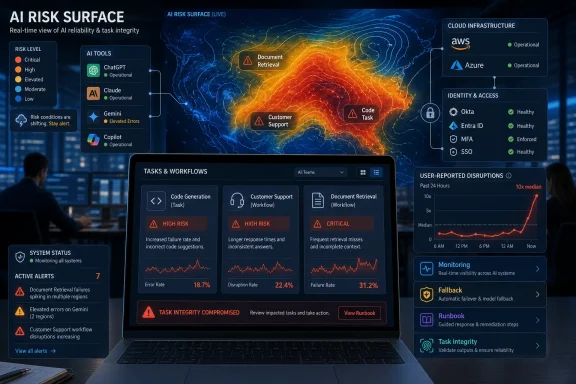 AI Has Become Infrastructure Before It Has Learned to Behave Like Infrastructure
For years, the enterprise treated generative AI as a useful sidecar: a place to rewrite a memo, summarize a transcript, or ask for a regex that should probably be checked twice. That framing is already obsolete. ChatGPT, Claude, Gemini, and Microsoft Copilot are now where employees draft customer responses, interrogate documents, test code, plan campaigns, and automate pieces of support and analysis.The reliability burden changes the moment a tool stops being optional. If a chatbot fails while someone is experimenting, the cost is annoyance. If an AI agent stalls halfway through a code task, loses access to a file, or hits an authentication loop during a customer-support workflow, the cost becomes operational delay.
That is the real meaning of Ookla’s finding. The report is not just a scoreboard of which AI brand had the noisiest outage day. It is evidence that the AI stack is being pulled into the same category as identity, cloud storage, collaboration, and network connectivity: invisible when it works, painfully obvious when it does not.
This is uncomfortable territory for AI vendors, because the industry has spent most of its energy selling capability rather than dependability. Demos show models reasoning across files, calling tools, generating code, and acting as agents. Downdetector data shows what happens when those capabilities become normal enough that users notice immediately when they break.
The Outage Curve Is Catching Up With the Adoption Curve
The most striking number in the report is the jump in high-signal AI app disruption days. Ookla defines those as days when a service recorded more than ten times its own median daily report volume during the measured period. Across ChatGPT, Claude, Gemini, and Copilot, those days rose from six in the first quarter of 2025 to 16 in the fourth quarter of 2025, then to 51 in the first quarter of 2026.That escalation matters because it is normalized against each service’s own median. In other words, this is not merely a popularity contest where the biggest service naturally attracts the most complaints. Ookla is looking for abnormal spikes relative to each platform’s usual level of user-reported trouble.
The result is a picture of a market scaling faster than its reliability habits. AI vendors are adding features, models, connectors, paid tiers, developer tooling, memory systems, enterprise controls, and agentic workflows in rapid succession. Every new layer is useful, but every layer also creates another place for a failure to surface.
The old chatbot failure mode was simple: the site was slow or the answer failed to generate. The new failure modes are messier. A model may be available while file upload is broken. A coding agent may start a task but fail to finish it. A connector may authenticate successfully in the morning and fail after a token refresh. An enterprise workflow may depend on a model endpoint, a search index, a storage provider, a permissions boundary, and a cloud region all working at once.
That is why “AI outage” is becoming too small a phrase. The risk is not only model downtime. It is the fragility of a composite service that increasingly behaves like a miniature cloud platform.
ChatGPT Looks Both Huge and More Mature
ChatGPT produced the biggest individual AI-app disruption signals in Ookla’s dataset, including roughly 68,000 reports on December 2, 2025. That is not surprising. OpenAI’s product has become the default consumer and workplace reference point for generative AI, and large user populations produce large visible spikes when something goes wrong.But the more interesting part of the report is that ChatGPT’s baseline trend appears to have improved. Ookla says its median daily report volume was lower in April 2026 than in April 2025, even as usage of tools such as Codex scaled rapidly in recent months. That suggests a platform moving from explosive novelty into a more mature reliability phase, though not one immune from major incidents.
This distinction matters for IT leaders. A platform can have the largest outage days and still be improving relative to its own usage pattern. Conversely, a smaller platform can appear quiet until adoption reaches the point where previously hidden reliability limits become obvious.
OpenAI’s challenge is that expectations have changed faster than the product category’s cultural tolerance for failure. A flaky AI toy is forgiven. A flaky coding assistant that developers now rely on during daily work is not. The more ChatGPT and related OpenAI tools become part of development, analysis, and support pipelines, the less users will care whether the failure came from the model, the web interface, the API, an authentication provider, or a file-processing subsystem.
For Windows users and administrators, the key lesson is not to rank ChatGPT against Copilot or Claude by one spectacular outage. It is to ask whether the organization has identified which AI-dependent workflows are now critical enough to deserve monitoring, fallback, and support ownership.
Claude Shows the Violence of Scaling From Quiet to Critical
Claude is the report’s clearest example of scale-up volatility. According to Ookla, Claude had near-zero Downdetector report volumes in early 2025, then developed a sustained reporting baseline from mid-July as adoption increased. By the first quarter of 2026, it accounted for 39 of the 51 high-signal AI app disruption days in the dataset.That does not automatically mean Claude was the least reliable AI tool in some universal sense. Downdetector is a user-reporting signal, not a complete telemetry feed from inside the vendor’s infrastructure. But it does indicate that Claude crossed a threshold where problems became visible, repeatable, and disruptive enough for users to report in bursts.
This is the awkward middle stage of enterprise adoption. A service can be too important to ignore but not yet boring enough to trust without question. That is where many AI platforms now live.
Claude’s rise also shows how misleading early quiet periods can be. A low outage-report baseline may reflect excellent reliability, but it may also reflect lower usage, fewer enterprise integrations, or a user base that has not yet built daily routines around the service. Once the tool becomes part of actual work, the complaints arrive with the workload.
The industry should resist the temptation to treat this as a single-vendor story. Every AI platform that succeeds will face the same problem: the reward for adoption is a larger blast radius. Scale turns edge cases into incidents.
Copilot’s Reliability Story Is Also Microsoft’s Cloud Story
Microsoft Copilot appears in Ookla’s AI-app set with three high-signal disruption days in the first quarter of 2026. That number is smaller than Claude’s and Gemini’s in the report, but Microsoft’s AI reliability story cannot be read only through Copilot-branded incidents.Copilot is not a standalone destination in the way a consumer chatbot often is. It is increasingly woven into Microsoft 365, Windows, Edge, Teams, GitHub, Dynamics, Power Platform, Azure, and enterprise identity. That makes Copilot powerful, but it also makes the boundaries of a “Copilot outage” harder to draw.
If a user cannot invoke Copilot in Word, is that a Copilot issue, a Microsoft 365 issue, an identity issue, a licensing issue, a regional service issue, or a network edge issue? In practice, the employee does not care. The button does not work.
This is where Microsoft faces a distinctive risk. Its advantage is distribution: Copilot can appear where work already happens. Its liability is the same distribution. The more AI is embedded into existing Microsoft workflows, the more outages in adjacent Microsoft services can feel like AI reliability failures to end users.
For WindowsForum readers, this is not theoretical. Many organizations are already experimenting with Copilot in Microsoft 365 while also relying on Entra ID, SharePoint, OneDrive, Exchange Online, Teams, Defender, Intune, and Azure. If AI features become part of the standard workflow, then Copilot availability belongs in the same operational conversation as tenant health, conditional access, service advisories, endpoint policy, and network routing.
The Cloud Layer Is Now Part of the AI Layer
Ookla’s inclusion of AWS and Microsoft Azure is the most important editorial choice in the report. It recognizes that AI reliability does not stop at the chatbot window. AI platforms sit on hyperscale cloud infrastructure, and cloud incidents can become AI incidents even when the model vendor is not the root cause.The October 20, 2025 AWS DynamoDB event is the kind of failure that should keep architects humble. AWS said the disruption involved DNS resolution issues for regional DynamoDB service endpoints in US-EAST-1, a region whose importance to the modern internet is almost comically large. The visible impact spread far beyond a single database product because so many services depend on the same regional control planes and platform assumptions.
Nine days later, Microsoft Azure suffered a major Azure Front Door incident beginning on October 29, 2025, affecting customers and Microsoft services that relied on Azure Front Door and Azure CDN. Connection timeouts and DNS resolution issues were the public symptoms, but the deeper lesson was about dependency concentration. When the front door breaks, it does not matter how healthy the room behind it is.
These were not “AI outages” in the narrow marketing sense. They were cloud infrastructure shocks. But that distinction is increasingly academic when AI workflows depend on cloud-hosted models, vector databases, storage systems, identity providers, content delivery networks, and API gateways.
The AI risk surface has shifted because the AI product is no longer just the model. It is the model plus the orchestration layer, plus the retrieval system, plus the connector framework, plus the cloud region, plus the identity stack, plus the endpoint where the employee is trying to get work done.
Agentic AI Makes Small Failures More Expensive
The industry’s favorite word right now is agentic, which roughly means AI systems that do not merely answer but act. They plan steps, call tools, inspect files, execute code, update tickets, send messages, and continue tasks over time. That is exactly where reliability becomes harder and more consequential.A chat response either succeeds or fails in front of the user. An agent can fail halfway through. It can complete the wrong subset of steps. It can lose access to a tool, hit a rate limit, mis-handle an expired credential, or stall without a useful recovery path.
That shifts the operational model from uptime to task integrity. Traditional availability monitoring asks whether a service is reachable. Agentic AI forces a different question: did the work finish correctly, with the right permissions, using the right data, and with a recoverable audit trail?
This is especially important in code and customer-support scenarios. A stalled code-generation task may leave a developer with partial changes and unclear provenance. A failed support assistant may interrupt a customer interaction that now depends on AI summarization or retrieval. A broken connector may silently degrade answer quality by cutting off access to current internal documents.
The danger is not that AI will occasionally be unavailable. Every system fails. The danger is that organizations will treat AI as a magical productivity layer while failing to design it like a production dependency.
Downdetector Is a Smoke Alarm, Not a Root-Cause Report
Downdetector data is valuable because it captures what users experience in the wild. It is also imperfect. Reports can be influenced by service popularity, media attention, regional concentration, user demographics, and the degree to which people know where to complain when something breaks.That does not make the signal useless. Smoke alarms do not identify the electrical fault, but they tell you when something is burning. For AI platforms, user-reported disruption data may be one of the few public ways to compare visible reliability pain across services that otherwise publish limited and differently formatted status information.
The “ten times median” threshold helps reduce some noise because it looks for unusual surges rather than raw complaint volume alone. Still, it cannot tell us whether an incident was caused by model serving, networking, authentication, storage, rate limiting, a bad deployment, or a third-party dependency. It tells us that users saw enough trouble to report it at abnormal levels.
For IT departments, that distinction should shape the response. Downdetector should not be treated as a definitive incident source, but it should be treated as an early-warning complement to vendor status pages, synthetic monitoring, help-desk tickets, API health checks, and internal telemetry.
The lesson is not to panic every time a public outage graph twitches. The lesson is to stop pretending that vendor status pages are the whole truth. Users often experience the failure before the official dashboard catches up.
Enterprise IT Needs an AI Runbook Before the First Big AI Outage
Most organizations already have rough playbooks for email outages, identity problems, VPN failures, endpoint incidents, and cloud-region disruptions. Far fewer have an AI outage runbook. That gap will become obvious the first time a department discovers that a process quietly became dependent on an AI tool nobody formally owns.The first step is inventory. IT teams need to know which AI services employees are using, which ones are licensed, which ones are connected to company data, and which workflows would slow down or stop if those services were unavailable for a few hours. Shadow AI is not just a data-governance problem; it is also a continuity problem.
The second step is classification. Not every AI use deserves production-grade controls. Casual writing help is different from customer-support triage, software delivery, finance analysis, legal review, or incident response. The problem is that many organizations have not drawn those lines, so they cannot tell which failures matter until the failure happens.
The third step is fallback. If Copilot is unavailable inside Microsoft 365, can users complete the task manually? If a coding agent stalls, is there a clean way to recover the workspace? If a support assistant cannot retrieve documents, does the agent know where to go instead? If an AI vendor’s API is degraded, does the application fail closed, fail open, or fail incomprehensibly?
This is not an argument against AI adoption. It is an argument for treating successful AI adoption as a reliability engineering problem. The more useful the tool becomes, the more boring its operations must be.
Windows Shops Will Feel This Through Identity, Endpoints, and Policy
For Windows-heavy organizations, the AI reliability story will be filtered through Microsoft’s ecosystem whether or not Microsoft is the only AI vendor in use. Employees will access AI tools through Edge, desktop apps, Teams, Office, browser sessions, single sign-on, device compliance policies, and endpoint security controls. That means AI failure may show up as an endpoint support ticket long before anyone calls it an AI incident.A user may report that Copilot “doesn’t work,” but the cause could be a conditional access policy, a browser profile issue, a token problem, a tenant-side outage, a licensing mismatch, or a service degradation. The support burden will land on the same help desks already handling Windows updates, Microsoft 365 issues, Intune policy drift, and identity headaches.
This is where observability becomes practical rather than fashionable. IT teams need to correlate AI complaints with service health, sign-in logs, device state, network path, browser version, and tenant configuration. Without that, the support experience becomes guesswork wrapped in vendor branding.
There is also a governance angle. If official AI tools are unreliable or poorly supported, users will route around them. They will paste work into personal accounts, switch to unsanctioned models, or invent fragile workarounds. Reliability is therefore part of security. A sanctioned tool that fails too often creates demand for an unsanctioned alternative.
Microsoft has an opportunity here because it controls so much of the enterprise desktop and productivity stack. But that opportunity cuts both ways. If Copilot becomes a normal part of Windows and Microsoft 365 work, Microsoft inherits not only AI expectations but also the enterprise expectation that critical tools are manageable, monitorable, and supportable.
The New AI Outage Playbook Starts With Boring Questions
The practical response to Ookla’s report is not to abandon AI platforms or chase a mythical provider that never fails. The practical response is to ask dull, concrete operational questions before the next disruption makes them urgent. AI reliability planning should look less like futurism and more like business continuity.- Organizations should identify which AI workflows have become operational dependencies rather than optional productivity enhancements.
- Administrators should monitor vendor status, user reports, help-desk trends, and synthetic transactions because no single signal will describe the whole failure.
- Enterprise AI deployments should have fallback paths for writing, coding, support, document retrieval, and customer-facing workflows.
- Security teams should treat unreliable sanctioned AI tools as a shadow-AI risk because frustrated users will look for alternatives.
- Procurement teams should ask AI vendors about incident transparency, service-level commitments, connector reliability, and data-access failure modes before expanding licenses.
- Windows and Microsoft 365 administrators should prepare for AI incidents to appear first as identity, endpoint, browser, or tenant-support tickets.
The AI industry has spent the last three years proving that generative systems can be useful; the next phase will be judged by whether they can be dependable when they are embedded in the unglamorous machinery of work. Ookla’s report is an early warning that the reliability conversation has moved from “is the chatbot up?” to “what business process just stopped?” That is a harder question, and by the time every company has an answer, AI will no longer feel like a new category of software at all.
References
- Primary source: Advanced Television
Published: 2026-06-10T09:50:11.655324
Loading…
www.advanced-television.com