

AI speakers and educators are becoming a surprise growth segment in the broader enterprise services market as businesses race to close a widening gap between AI excitement and AI execution. That is the central message behind a recent National Law Review pickup of remarks from Glen Maguire, an independent AI consultant in Auckland, who argues that many leaders do not need more tools so much as clearer judgment about how to deploy them. In practical terms, the demand is no longer just for software licenses or pilots; it is for translation, training, and credible guidance that can turn AI awareness into business value.
The rise of AI education services is not happening in a vacuum. Over the last two years, generative AI has shifted from novelty to boardroom priority, and many organizations have learned the hard way that buying access to a tool is not the same as building capability around it. Microsoft’s current training materials for business leaders explicitly frame generative AI as something that must be aligned to goals, governed responsibly, and implemented with practical strategies rather than experimentation alone.
That distinction matters because AI adoption is increasingly a change-management problem, not a software-installation problem. Microsoft’s own Copilot readiness guidance now emphasizes organizational readiness, role clarity, and behavior change, which is a notable shift from earlier, more tool-centric messaging. In other words, the market is maturing toward how people work rather than simply what they use.
The article’s core claim — that businesses across New Zealand and Australia are seeking AI speakers and educators to bridge internal knowledge gaps — fits a much broader pattern visible across official training ecosystems and the consulting market. Microsoft Learn now offers role-specific learning paths for business leaders, business users, and school leaders, while regional training providers market hands-on AI courses and executive briefings as practical ways to move from curiosity to adoption.
There is also a labor-market angle here. As AI becomes embedded in workflows, organizations need people who can explain not just prompts and outputs, but governance, risk, workflow redesign, and measurement. A growing body of research also suggests that successful AI use in knowledge work depends on context-sensitive implementation, role-specific training, and social learning — not one-off onboarding videos or generic demos.
This is why the surge in demand for AI speakers is noteworthy. It suggests that enterprises are moving beyond a “buy first, ask questions later” mindset and toward a more disciplined approach to transformation. That is good news for organizations serious about productivity, but it is also a warning sign: many teams are still underprepared for the speed at which AI is being normalized.
That shift explains why AI speakers, executive briefings, and hands-on workshops are in demand. Leaders are not asking for abstract theory; they want a framework for deciding where AI fits, what it can safely automate, and how to align teams that may have very different levels of comfort. The National Law Review article’s emphasis on clarity over hype echoes that practical turn, and it tracks with Microsoft’s own guidance that adoption succeeds when organizations focus on role clarity and behavior change.
The business case is also becoming more urgent because internal AI literacy now affects competitiveness. If one company can use AI to shorten response times, reduce repetitive work, and speed up decision-making while its rival is still debating policy, the advantage compounds quickly. In that sense, AI education is less about curiosity and more about preventing a capability gap from hardening into a strategic disadvantage.
That is not necessarily a weakness. In the early phase of any major technology shift, external educators often play an essential role in helping companies avoid expensive mistakes. They can accelerate learning, surface hidden assumptions, and challenge the idea that a tool purchase equals transformation. The strongest consultants, in other words, are not merely trainers; they are translators between technical possibility and commercial reality. That distinction is increasingly important.
Maguire’s framing also reflects a larger pattern in enterprise AI consulting. The buyers are not just IT departments anymore. Leaders in operations, HR, legal, finance, sales, and customer service all need enough AI literacy to make decisions that are consistent, safe, and economically sensible. Microsoft’s business-leader training paths mirror that broad audience, reinforcing the idea that AI is now a cross-functional management issue.
At the same time, consultants are most effective when they help organizations build durable internal capacity. The goal should be to reduce dependency on outside speakers over time, not create a permanent reliance on them. That is why the best engagements tend to end with role-based playbooks, internal champions, and repeatable learning structures.
There is also a strong fit between these markets and the kind of business-focused AI education now in demand. Mid-sized enterprises often lack large internal AI teams, so they lean on consultants who can provide practical guidance without requiring a full transformation office. That creates fertile ground for workshops, speaking engagements, and focused briefings that are tightly linked to business outcomes.
The regional angle matters because it shows that AI adoption is not only a Silicon Valley story. Across many economies, the bottleneck is not access to models, but access to people who can explain how to use them well. That makes educators an important part of the AI supply chain, especially in markets where in-house expertise is still catching up.
This is where educators earn their keep. A good AI workshop should not simply define machine learning, generative AI, or prompts; it should map those concepts onto time-consuming tasks, decision bottlenecks, and measurable outcomes. If the session does not help participants imagine Monday morning use cases, it is probably too abstract to change behavior.
There is also a strong case for small-group or leadership-focused sessions. Large, generic training events can build awareness, but they often fail to answer the specific questions that determine adoption: What should we automate first? Where do humans stay in the loop? How do we measure value? Those questions are increasingly central to the way organizations think about AI maturity.
This pressure is visible in the way training is being designed. Microsoft now offers material specifically for business leaders, while other organizations market executive AI briefings that focus on strategy, resourcing, and ROI. The message is clear: leadership needs a level of AI literacy that supports decision-making without pretending every manager must become a model expert.
The danger, however, is performative adoption. Some companies will feel compelled to announce AI initiatives before they have the internal skills to support them, which can lead to fragmented rollouts and disappointing returns. Better education reduces that risk by helping leaders distinguish between genuine readiness and mere momentum.
This shift favors educators who can move between strategy and execution. The best sessions now translate broad AI themes into operational decisions: document drafting, internal search, meeting summarization, customer response workflows, and knowledge retrieval. Those are the kinds of tasks where AI can create immediate gains, provided the organization has the right safeguards in place.
There is also a growing recognition that adoption is not purely top-down. Research on workplace AI use shows that employees often learn through trial and error, peer discussion, and informal experimentation, even when formal training is available. That suggests enterprises need both structured education and social reinforcement if they want new behavior to stick.
That fragmentation is actually a sign of maturity. Early AI education was often product-agnostic and conceptual. Now the best training is role-based, workflow-oriented, and connected to the realities of enterprise governance. In many organizations, that means the training economy itself is becoming more specialized, with educators serving as translators between broad platform capability and concrete employee behavior.
There is, however, a tension here. As more vendors and consultants rush into the space, quality will vary widely. Some sessions will offer genuine capability-building; others will rely on generic inspiration, shallow demos, or sales-driven messaging. Buyers will need to be more discerning about whether a speaker can actually change practice or merely explain the headlines.
That matters because adoption is sticky when people can feel the benefit quickly. If a workshop helps a manager cut report prep time or helps a team improve search and summarization, it creates internal advocates who will keep the momentum going. In a crowded market, that hands-on proof will separate high-value educators from the merely enthusiastic.
More importantly, the trend opens up a genuine opportunity for businesses that treat education as an investment rather than an overhead cost. The best AI training can unlock productivity gains, improve leadership confidence, and reduce the probability of costly early mistakes. It can also help align teams that may otherwise be pulling in different directions. That alignment is often underestimated.
There is also the danger of overpromising. AI vendors and consultants can sometimes make adoption sound cleaner, faster, and more universal than it really is. In reality, model quality, data readiness, governance maturity, and workforce behavior all influence outcomes, and those variables can slow deployment or reduce returns. The gap between demo and deployment is still very real.
Another concern is training fatigue. Employees may tune out if every new tool arrives with another mandatory session that feels generic or disconnected from their actual work. Research suggests that people often learn AI through social and experiential methods, so organizations that ignore peer learning and hands-on practice may get weaker results than expected.
We should also expect more specialization. Executive AI briefings, school-leader workshops, industry-specific sessions, and role-based adoption programs are already emerging as distinct product categories. As organizations move from experimentation to scale, they will want training that matches their sector, their governance needs, and their internal maturity level.
Source: The National Law Review AI Speakers and Educators in Demand as Businesses Struggle to Keep Up
 Background
The rise of AI education services is not happening in a vacuum. Over the last two years, generative AI has shifted from novelty to boardroom priority, and many organizations have learned the hard way that buying access to a tool is not the same as building capability around it. Microsoft’s current training materials for business leaders explicitly frame generative AI as something that must be aligned to goals, governed responsibly, and implemented with practical strategies rather than experimentation alone.That distinction matters because AI adoption is increasingly a change-management problem, not a software-installation problem. Microsoft’s own Copilot readiness guidance now emphasizes organizational readiness, role clarity, and behavior change, which is a notable shift from earlier, more tool-centric messaging. In other words, the market is maturing toward how people work rather than simply what they use.
The article’s core claim — that businesses across New Zealand and Australia are seeking AI speakers and educators to bridge internal knowledge gaps — fits a much broader pattern visible across official training ecosystems and the consulting market. Microsoft Learn now offers role-specific learning paths for business leaders, business users, and school leaders, while regional training providers market hands-on AI courses and executive briefings as practical ways to move from curiosity to adoption.
There is also a labor-market angle here. As AI becomes embedded in workflows, organizations need people who can explain not just prompts and outputs, but governance, risk, workflow redesign, and measurement. A growing body of research also suggests that successful AI use in knowledge work depends on context-sensitive implementation, role-specific training, and social learning — not one-off onboarding videos or generic demos.
This is why the surge in demand for AI speakers is noteworthy. It suggests that enterprises are moving beyond a “buy first, ask questions later” mindset and toward a more disciplined approach to transformation. That is good news for organizations serious about productivity, but it is also a warning sign: many teams are still underprepared for the speed at which AI is being normalized.
Why AI Education Is Suddenly a Business Priority
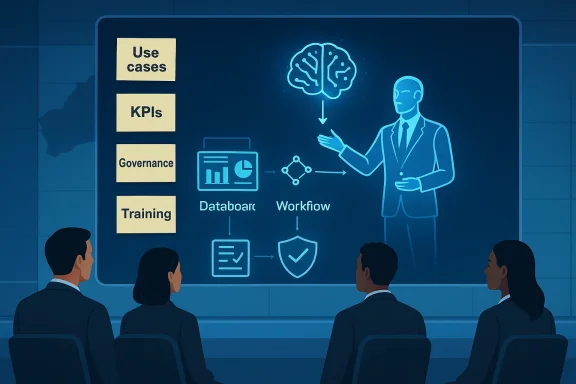
AI education has become a business priority because the gap between tool availability and actual capability is widening. Employees can now access chatbots, copilots, and agentic tools with minimal friction, but that ease of access hides a deeper challenge: knowing when the technology is useful, when it is risky, and when it is simply the wrong answer. Microsoft’s learning paths now explicitly teach leaders how to prioritize AI use cases, track KPIs, and put governance in place — evidence that the market has moved from experimentation to operationalization.That shift explains why AI speakers, executive briefings, and hands-on workshops are in demand. Leaders are not asking for abstract theory; they want a framework for deciding where AI fits, what it can safely automate, and how to align teams that may have very different levels of comfort. The National Law Review article’s emphasis on clarity over hype echoes that practical turn, and it tracks with Microsoft’s own guidance that adoption succeeds when organizations focus on role clarity and behavior change.
The business case is also becoming more urgent because internal AI literacy now affects competitiveness. If one company can use AI to shorten response times, reduce repetitive work, and speed up decision-making while its rival is still debating policy, the advantage compounds quickly. In that sense, AI education is less about curiosity and more about preventing a capability gap from hardening into a strategic disadvantage.
What leaders are actually buying
Organizations are often purchasing a mixture of translation, trust-building, and implementation support. A good speaker can explain the difference between consumer-grade prompting and enterprise-grade deployment, while a good educator can help teams connect AI use cases to specific workflows. The most valuable sessions are increasingly the ones that reduce uncertainty and create a shared vocabulary.- Executive alignment on AI priorities
- Practical use cases for specific departments
- Governance and safe-use guidance
- Change management for teams
- Productivity improvements tied to measurable outcomes
The Glen Maguire Story as a Market Signal
Glen Maguire’s comments matter less as a one-off quote and more as a market signal. Independent consultants who speak directly to executives are increasingly standing in for internal AI capability that has not yet been built. When an organization hires someone to explain AI in business terms, it is often admitting that internal teams do not yet share a common understanding of the technology’s scope or limits.That is not necessarily a weakness. In the early phase of any major technology shift, external educators often play an essential role in helping companies avoid expensive mistakes. They can accelerate learning, surface hidden assumptions, and challenge the idea that a tool purchase equals transformation. The strongest consultants, in other words, are not merely trainers; they are translators between technical possibility and commercial reality. That distinction is increasingly important.
Maguire’s framing also reflects a larger pattern in enterprise AI consulting. The buyers are not just IT departments anymore. Leaders in operations, HR, legal, finance, sales, and customer service all need enough AI literacy to make decisions that are consistent, safe, and economically sensible. Microsoft’s business-leader training paths mirror that broad audience, reinforcing the idea that AI is now a cross-functional management issue.
Why external voices carry weight
External educators can often say things internal teams cannot. They can challenge executives to define the real problem, not just buy the latest feature, and they can frame the risks of overreliance, poor prompting, or weak governance without worrying about internal politics. That outsider status can make the message more credible, especially when staff are skeptical or fatigued by vendor hype.At the same time, consultants are most effective when they help organizations build durable internal capacity. The goal should be to reduce dependency on outside speakers over time, not create a permanent reliance on them. That is why the best engagements tend to end with role-based playbooks, internal champions, and repeatable learning structures.
Why New Zealand and Australia Are Good Bellwethers
New Zealand and Australia are useful barometers for this trend because both markets are highly exposed to global software platforms, but they also tend to adopt new workplace practices with a strong emphasis on pragmatism. Regional providers are already marketing AI training across executive, operational, and public-sector audiences, which suggests real demand rather than speculative interest.There is also a strong fit between these markets and the kind of business-focused AI education now in demand. Mid-sized enterprises often lack large internal AI teams, so they lean on consultants who can provide practical guidance without requiring a full transformation office. That creates fertile ground for workshops, speaking engagements, and focused briefings that are tightly linked to business outcomes.
The regional angle matters because it shows that AI adoption is not only a Silicon Valley story. Across many economies, the bottleneck is not access to models, but access to people who can explain how to use them well. That makes educators an important part of the AI supply chain, especially in markets where in-house expertise is still catching up.
Practical market signals
Several indicators point to a durable market for AI education in the region:- Organizations are asking for role-specific, not generic, training.
- Executive teams want help deciding where to start.
- Businesses are trying to reduce repetitive work quickly.
- Adoption is spreading faster than internal policy frameworks.
- Staff need confidence, not just access, to use AI safely.
From Awareness to Application
The article’s most useful framing is its move from awareness to application. Many organizations have now heard enough about AI to know it matters, but they have not yet built the routines, guardrails, and use cases that convert interest into daily impact. Microsoft’s current training path for business leaders explicitly focuses on aligning AI with goals, automating tasks, and adopting secure, responsible solutions, which is a strong sign that the vendor ecosystem sees application as the real battleground.This is where educators earn their keep. A good AI workshop should not simply define machine learning, generative AI, or prompts; it should map those concepts onto time-consuming tasks, decision bottlenecks, and measurable outcomes. If the session does not help participants imagine Monday morning use cases, it is probably too abstract to change behavior.
There is also a strong case for small-group or leadership-focused sessions. Large, generic training events can build awareness, but they often fail to answer the specific questions that determine adoption: What should we automate first? Where do humans stay in the loop? How do we measure value? Those questions are increasingly central to the way organizations think about AI maturity.
Application beats admiration
Admiration for AI is easy. Application is harder. Organizations that move quickly tend to focus on a narrow set of high-value tasks, build confidence through repetition, and create practical norms around review, escalation, and documentation. That is why practical business-focused education is more valuable than hype-driven evangelism.- Identify one or two priority use cases first
- Define what “good output” looks like
- Establish review rules for sensitive work
- Measure time saved or quality improved
- Expand only after the pilot proves value
Leadership Pressure and Executive Credibility
AI has become a test of executive credibility. Boards, investors, employees, and customers increasingly expect leaders to have a sensible point of view on the technology, even if they are not technical experts. That means the modern executive must be fluent enough to ask the right questions, set the right boundaries, and articulate a strategy that feels grounded rather than fashionable.This pressure is visible in the way training is being designed. Microsoft now offers material specifically for business leaders, while other organizations market executive AI briefings that focus on strategy, resourcing, and ROI. The message is clear: leadership needs a level of AI literacy that supports decision-making without pretending every manager must become a model expert.
The danger, however, is performative adoption. Some companies will feel compelled to announce AI initiatives before they have the internal skills to support them, which can lead to fragmented rollouts and disappointing returns. Better education reduces that risk by helping leaders distinguish between genuine readiness and mere momentum.
What executives need to know
A useful executive AI briefing should cover:- Business impact by function
- Governance and compliance expectations
- Cost drivers and scaling risks
- Workforce readiness and training needs
- Metrics that show whether adoption is working
The Enterprise Use-Case Shift
One of the clearest signs of market maturity is the move toward tailored use cases. Organizations are no longer satisfied with generic claims that AI can “save time” or “boost productivity.” They want concrete examples tied to finance, legal, customer service, HR, sales, and knowledge management. Microsoft’s learning content now explicitly encourages leaders to prioritize use cases by value, feasibility, and time to value, which is exactly the kind of discipline that enterprise buyers are looking for.This shift favors educators who can move between strategy and execution. The best sessions now translate broad AI themes into operational decisions: document drafting, internal search, meeting summarization, customer response workflows, and knowledge retrieval. Those are the kinds of tasks where AI can create immediate gains, provided the organization has the right safeguards in place.
There is also a growing recognition that adoption is not purely top-down. Research on workplace AI use shows that employees often learn through trial and error, peer discussion, and informal experimentation, even when formal training is available. That suggests enterprises need both structured education and social reinforcement if they want new behavior to stick.
Why use cases matter more than features
Feature lists are easy to forget. Use cases are sticky because they connect directly to the job people are trying to do. When teams see how AI can remove friction from a familiar workflow, the technology stops feeling abstract and starts feeling useful. That is the moment adoption begins to accelerate.- Faster document first drafts
- Better internal knowledge retrieval
- Reduced repetitive admin work
- Quicker summarization of meetings and reports
- More consistent support for routine decisions
The Role of Copilot, ChatGPT, and the New Training Economy
The current wave of demand for AI educators is closely tied to the spread of tools like ChatGPT and Microsoft Copilot. These products have made AI tangible for millions of workers, but they have also created confusion about what is safe, approved, and effective in a workplace context. Microsoft’s official training now ranges from “work smarter with AI” for business users to leader-focused guidance on adoption, indicating that the education market is fragmenting by audience and job role.That fragmentation is actually a sign of maturity. Early AI education was often product-agnostic and conceptual. Now the best training is role-based, workflow-oriented, and connected to the realities of enterprise governance. In many organizations, that means the training economy itself is becoming more specialized, with educators serving as translators between broad platform capability and concrete employee behavior.
There is, however, a tension here. As more vendors and consultants rush into the space, quality will vary widely. Some sessions will offer genuine capability-building; others will rely on generic inspiration, shallow demos, or sales-driven messaging. Buyers will need to be more discerning about whether a speaker can actually change practice or merely explain the headlines.
What good training looks like
Good AI training should do more than introduce terms. It should help participants practice prompting, evaluate outputs, understand risk, and apply the tool to a real task from their own work. Microsoft’s prompt-a-thon and business-user courses reflect this practical orientation, showing that the strongest training programs are built around doing, not just listening.That matters because adoption is sticky when people can feel the benefit quickly. If a workshop helps a manager cut report prep time or helps a team improve search and summarization, it creates internal advocates who will keep the momentum going. In a crowded market, that hands-on proof will separate high-value educators from the merely enthusiastic.
Strengths and Opportunities
The rise in demand for AI speakers and educators has several obvious strengths. It creates a practical bridge between technical capability and business adoption, and it gives organizations a faster route to AI fluency than building everything internally from scratch. It also helps normalize responsible usage by making governance and risk part of the conversation from the beginning.More importantly, the trend opens up a genuine opportunity for businesses that treat education as an investment rather than an overhead cost. The best AI training can unlock productivity gains, improve leadership confidence, and reduce the probability of costly early mistakes. It can also help align teams that may otherwise be pulling in different directions. That alignment is often underestimated.
- Faster AI adoption with less confusion
- Better alignment between leadership and staff
- Improved productivity in repetitive workflows
- Stronger governance and safer use
- More credible executive decision-making
- Better use of existing tools like Copilot and ChatGPT
- Lower risk of wasted pilots and scattered experimentation
Risks and Concerns
The biggest risk is that businesses may confuse education with transformation. A polished keynote can raise awareness, but it cannot substitute for clear policies, workflow redesign, and ongoing practice. If organizations stop at inspiration, they may end up with better vocabulary but not better execution.There is also the danger of overpromising. AI vendors and consultants can sometimes make adoption sound cleaner, faster, and more universal than it really is. In reality, model quality, data readiness, governance maturity, and workforce behavior all influence outcomes, and those variables can slow deployment or reduce returns. The gap between demo and deployment is still very real.
Another concern is training fatigue. Employees may tune out if every new tool arrives with another mandatory session that feels generic or disconnected from their actual work. Research suggests that people often learn AI through social and experiential methods, so organizations that ignore peer learning and hands-on practice may get weaker results than expected.
- Generic training that fails to change behavior
- Hype that outpaces governance
- Poorly chosen use cases with low ROI
- Shadow AI use outside approved channels
- Executive pressure without internal readiness
- Training fatigue and employee skepticism
- Dependency on external speakers without internal capability-building
Looking Ahead
The next phase of this market will likely favor educators who can prove business outcomes, not just deliver polished presentations. Companies will want evidence that workshops change behavior, reduce cycle times, or improve the quality of decisions. That means the most successful AI speakers will increasingly function as part educator, part strategist, and part change consultant.We should also expect more specialization. Executive AI briefings, school-leader workshops, industry-specific sessions, and role-based adoption programs are already emerging as distinct product categories. As organizations move from experimentation to scale, they will want training that matches their sector, their governance needs, and their internal maturity level.
What to watch
- Growth in executive-focused AI briefings
- More role-specific training for departments and functions
- Greater demand for governance-first education
- Stronger integration of AI training with workflow redesign
- Rising expectations for measurable ROI from workshops
Source: The National Law Review AI Speakers and Educators in Demand as Businesses Struggle to Keep Up
