

Microsoft’s message from Davos this year is blunt but optimistic: AI and sustainability are not competing priorities but two sides of the same transformation coin—if leaders design AI programs with operational rigor, cloud-native efficiency, and governance baked in from the start.
The World Economic Forum in Davos has long been a barometer for executive sentiment on global risks and opportunities. At the 2026 meeting, the conversation moved beyond speculative AI hype toward pragmatic questions about how AI changes operational footprint, supply chains, and the energy and water needs of tomorrow’s infrastructure. On January 28, 2026, Microsoft published a Strategic Guide titled Aligning AI Transformation with Sustainability Goals that formalizes this shift and lays out five practical practices executives can apply immediately to pursue a “dual return”: better business outcomes paired with lower environmental impact.
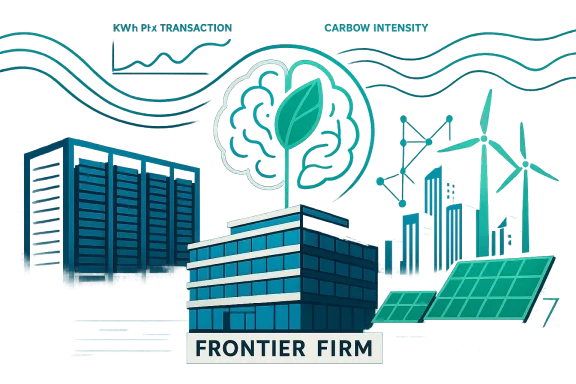
Microsoft’s thesis rests on the idea of the “Frontier firm”: organizations that embed intelligence across strategy, operating model, and culture to boost productivity, accelerate innovation, and reduce waste. That framing matters because it reframes sustainability from a compliance burden into a design principle for transformation. The guide’s five practices—modern cloud strategy, cloud-provider sustainability assessment, responsible data management, cloud workload optimisation, and fitting the model to the mission—are straightforward but require disciplined execution and measurement to deliver on Microsoft’s promise.
This article examines each practice, weighs the evidence supporting the claims, flags where numbers are company‑reported rather than independently verified, and offers practical implementation guidance for IT and sustainability leaders who must balance ambition with operational reality.
Three mechanisms explain how AI transformation can reduce environmental impact:
Why it matters
Why it matters
Why it matters
Why it matters
Why it matters
Interpretation and verification
For leaders, the practical takeaway is straightforward but demanding: treat sustainability as a design constraint for AI transformation, not a trailing compliance exercise. Measure what you do, choose the right technologies for the task, and hold partners accountable for the downstream impacts you will inherit. Done correctly, AI can be a lever to bend both business performance and environmental impact in the right direction.
Source: Microsoft 5 practices to aligning AI transformation and sustainability | The Microsoft Cloud Blog
 Background
The World Economic Forum in Davos has long been a barometer for executive sentiment on global risks and opportunities. At the 2026 meeting, the conversation moved beyond speculative AI hype toward pragmatic questions about how AI changes operational footprint, supply chains, and the energy and water needs of tomorrow’s infrastructure. On January 28, 2026, Microsoft published a Strategic Guide titled Aligning AI Transformation with Sustainability Goals that formalizes this shift and lays out five practical practices executives can apply immediately to pursue a “dual return”: better business outcomes paired with lower environmental impact.Microsoft’s thesis rests on the idea of the “Frontier firm”: organizations that embed intelligence across strategy, operating model, and culture to boost productivity, accelerate innovation, and reduce waste. That framing matters because it reframes sustainability from a compliance burden into a design principle for transformation. The guide’s five practices—modern cloud strategy, cloud-provider sustainability assessment, responsible data management, cloud workload optimisation, and fitting the model to the mission—are straightforward but require disciplined execution and measurement to deliver on Microsoft’s promise.
This article examines each practice, weighs the evidence supporting the claims, flags where numbers are company‑reported rather than independently verified, and offers practical implementation guidance for IT and sustainability leaders who must balance ambition with operational reality.
Why the link between AI transformation and sustainability matters
AI does not exist in a vacuum: it is a systems-level capability that changes how organizations sense, decide, and act. When AI moves from pilot to production, it touches compute platforms, data pipelines, business processes, real‑world supply chains, and the choices leaders make about procurement, facilities, and partners. That systemic reach is why AI can both increase and decrease environmental impact depending on how it’s designed and governed.Three mechanisms explain how AI transformation can reduce environmental impact:
- Efficiency gains in operations (fewer repeat processes, better scheduling, and predictive maintenance).
- Demand reduction from better decision-making (less overproduction, smarter logistics).
- Infrastructure consolidation and higher utilization (moving workloads to efficient hyperscale clouds and right‑sizing compute).
The five Microsoft practices: what they mean, why they matter, and how to act
1. Adopt a modern cloud strategy
Microsoft’s recommendation: move workloads into efficient hyperscale cloud environments where possible, because these platforms often deliver the most efficient compute-per-workload and can improve performance while lowering energy use.Why it matters
- Hyperscale cloud providers operate at scale and invest in advanced cooling, power distribution, and hardware refresh cycles that typically yield better energy efficiency than legacy enterprise datacenters.
- Cloud platforms enable dynamic provisioning, autoscaling, and workload orchestration—capabilities that reduce idle capacity and waste.
- International energy analyses and multiple academic and industry studies confirm that shifting from many small, inefficient on‑premises facilities to a smaller number of hyperscale facilities has historically improved average energy intensity. However, these same reports warn that total consumption is increasing because AI workloads are expanding demand far faster than efficiency gains can offset.
- Practical implication: cloud migration is an efficiency lever, not a free pass. Organizations must still measure end‑to‑end lifecycle emissions (including embodied carbon in hardware and grid intensity where the cloud region operates).
- Inventory workloads by sensitivity, latency needs, data residency, and compute profile.
- Migrate stateless and non-latency-sensitive services first; refactor critical analytic workloads for autoscaling.
- Negotiate sustainability commitments and transparency (renewable procurement, PUE, water use) as part of cloud contracts.
- Measure before and after migration with consistent metrics (kWh per completed job, carbon intensity per transaction).
2. Assess your cloud provider’s sustainability and trust goals
Microsoft’s recommendation: treat your cloud provider’s sustainability profile as part of your own footprint.Why it matters
- Your environmental disclosures increasingly incorporate Scope 3 emissions—emissions from your suppliers and partners. Datacenter energy mixes, renewable contracts, and transparency practices affect your corporate metrics.
- Community impacts—water use, local grid stress, and tax/tariff decisions—can create reputational, regulatory, and operational risks if not assessed early.
- Recent industry moves show hyperscalers making public commitments on renewable energy, water stewardship, and local community investments; Microsoft’s own Community‑First AI Infrastructure initiative (announced earlier in 2026) commits to paying fair utility rates, replenishing water, and investing in local communities where datacenters operate.
- But community backlash and canceled projects in several regions demonstrate the political and social sensitivity of large datacenter builds; companies should not assume provider commitments remove the need for residency-level due diligence.
- Add provider sustainability KPIs into vendor evaluation and procurement scorecards.
- Request site-level metrics on power mix, water use intensity, and local community programs.
- Build multi-stakeholder community engagement into location selection and expansion plans.
3. Manage data responsibly for efficient and accurate AI
Microsoft’s recommendation: efficient, governed data pipelines reduce unnecessary compute and storage while improving model quality.Why it matters
- Data sprawl drives storage costs and compute overhead. Poor data hygiene leads to repeated processing of irrelevant or low-quality inputs, amplifying energy consumption and reducing model accuracy.
- Better metadata, lifecycle policies, and data‑retention rules let teams run lighter, faster experiments and production workstreams.
- Engineering studies and cloud migration experiences show that data lifecycle management can significantly reduce storage footprints and I/O operations—both of which matter for energy and cost.
- This practice requires organisational change: data cataloging, governance, and stewardship are human-led efforts as much as technical ones.
- Implement a data classification and retention policy that ties retention to business value.
- Use tiered storage and lifecycle rules to keep frequently used training sets on faster—but more energy-expensive—storage only as long as needed.
- Build provenance and automated validation to prevent wasteful reprocessing.
4. Optimize cloud workloads
Microsoft’s recommendation: right‑size compute, avoid idle resources, and streamline data movement to lower energy use while improving cost and performance.Why it matters
- Production AI workloads, if poorly configured, can run inefficiently for hours or days. Right‑sizing instances, using accelerated burst modes, and optimizing batch windows all reduce energy per result.
- Network and data movement account for a significant share of cloud energy; minimizing unnecessary transfers reduces both latency and footprint.
- Benchmarks and engineering best practices show meaningful gains from workload optimization, and many cloud providers offer tools to estimate energy and carbon per operation. However, measuring real-world carbon requires mapping compute usage to regional grid carbon intensity.
- Optimization must be continuous: model retraining, new data sources, and changing usage patterns require ongoing review.
- Implement cost-and-carbon-aware CI/CD pipelines that include sizing checks and automated shutdown for ephemeral environments.
- Move heavy batch processes to lower-carbon time windows or cloud regions where renewable procurement is demonstrably higher.
- Use profiling tools to find waste (e.g., idle GPUs, oversized VMs, or redundant data copies).
5. Fit the model to the mission
Microsoft’s recommendation: choose the right model for the job. Bigger is not always better—selecting smaller, specialized models for routine tasks reduces compute and cost while preserving effectiveness.Why it matters
- Large models carry disproportionate compute and energy costs. For many business tasks, fine‑tuned smaller models or retrieval-augmented approaches are sufficient and far more efficient.
- Model selection integrated with governance and performance targets keeps transformation practical and sustainable.
- Industry research and practitioner case studies show that model compression, distillation, and retrieval-augmentation can cut inference costs dramatically with minimal hit to performance for targeted tasks.
- The tradeoff: smaller models may require more engineering investment to achieve the same end-to-end reliability and safety properties as larger, pre-trained models.
- Define the business objective and performance requirement clearly (accuracy, latency, throughput).
- Benchmark models across size/performance/cost axes, and evaluate lifecycle cost (training + inference + retraining).
- Prefer specialized, fine‑tuned models or hybrid architectures for high-volume, low-risk tasks.
- Track real-world energy and cost per inference as a KPI.
What the research and field evidence show — the good and the cautionary
Microsoft’s guide includes a sidebar experiment: five professionals summarized a 3,000‑word technical report into 200 words (median 41 minutes; an estimated 13.7 watthours of laptop energy), while Microsoft Copilot produced an equivalent summary in under a minute using an estimated 0.29 watthours of datacenter energy—framing the outcome as roughly 55× faster and 47× more energy efficient.Interpretation and verification
- The experiment is a useful illustrative datapoint showing how automation can compress human time and server energy for routine knowledge tasks.
- Important caveats: the methodology (how laptop energy was estimated, the datacenter measurement boundaries, and any amortized baseline energy costs) are disclosed by Microsoft in summary form but not independently audited in the public announcement. These kinds of controlled comparisons can be sensitive to assumptions (device power states, network transfer energy, and datacenter sharing of resources). Treat the numbers as directional rather than a universal law.
- Independent energy studies and international agencies demonstrate two truths at once: first, modern clouds are on average more energy–efficient per unit compute than fragmented enterprise infrastructure; second, the aggregate energy consumed by datacenters is rising rapidly due to AI demand, and that growth may outpace efficiency gains without careful planning and grid coordination.
- This implies leaders must combine efficiency with demand management. Measuring energy per useful output (kWh per completed business transaction, or gramsCO2e per model inference) is more informative than raw server-hour metrics.
- ABB’s Genix platform: customer stories and case materials show the platform enabling measurable efficiency gains—Microsoft’s published customer story cites examples such as up to 25% improvements in data-center efficiency and ~15–18% energy optimization in industrial processes. These are valuable signal cases, but like many vendor-stated benefits they are best validated through customer-level audits and peer-reviewed evaluations when possible.
- Giatec and concrete: Giatec reports using AI and IoT to optimize concrete mixes, reducing cement use and claiming cumulative reductions of 2.5 million tons of CO2 and per-pour savings up to $10,000. These numbers are powerful, but they are company-reported aggregated outcomes; independent third‑party validation would strengthen confidence.
- Space Intelligence and forest mapping: Microsoft customer narratives report a 75% reduction in time to map large areas (3 billion hectares over 50+ countries in one year) after moving to cloud-based Planetary Computer and Foundry. The speed and scale improvements are credible given cloud scalability and abundant public satellite datasets, but again, these are company-captured case studies rather than peer-reviewed evaluations.
Risks and governance: where transformation can go wrong
AI-enabled sustainability wins are real—but so are the risks. Leaders must guard against several common failure modes:- Scope blind spots: counting only direct emissions while ignoring Scope 3 impacts from suppliers or cloud providers.
- Measurement mismatches: comparing apples-to-oranges (e.g., measuring a single-run inference in a dedicated datacenter vs. shared, amortized cloud infrastructure).
- Local externalities: building AI-heavy datacenters in regions without sufficient grid or water infrastructure can shift burdens to communities—even if total emissions fall.
- Greenwashing risk: overstating sustainability benefits in marketing without audited metrics invites reputational and regulatory consequences.
- Operational complexity: deploying models without lifecycle management can lead to model sprawl, data debt, and hidden energy drains.
- Adopt clear measurement standards: kWh per business result, carbon intensity tied to region/time, and consistent lifecycle boundaries.
- Treat sustainability metrics as first-class production KPIs alongside latency and error rates.
- Insist on third-party audits for large supplier claims used in corporate reporting.
- Include community impact assessments in datacenter and region selection processes.
Implementation roadmap: five pragmatic steps to get started this quarter
- Establish an AI + sustainability steering group that includes IT, sustainability, procurement, and legal.
- Run three rapid experiments:
- Move one non-critical workload to a hyperscale cloud region and compare kWh and cost per transaction.
- Apply model selection to a high-volume internal task and quantify energy and latency before/after.
- Implement data lifecycle rules to retire redundant training datasets and measure storage reduction.
- Instrument and track energy and carbon per business output across pilot workloads.
- Build procurement clauses that require site-level sustainability metrics and community engagement commitments from cloud and datacenter partners.
- Publish a single, transparent metric in the next sustainability report that ties AI activity to energy and emissions (and state assumptions clearly).
Conclusion
Microsoft’s Strategic Guide reframes a crucial conversation: AI is not inherently at odds with sustainability. When transformation is intentional—guided by a modern cloud strategy, rigorous data stewardship, workload optimisation, and mission‑appropriate model choice—AI can accelerate value while shrinking resource intensity. The most persuasive evidence comes from real-world customer outcomes that combine domain expertise with cloud scale; however, many headline numbers remain company‑reported case studies and merit independent validation.For leaders, the practical takeaway is straightforward but demanding: treat sustainability as a design constraint for AI transformation, not a trailing compliance exercise. Measure what you do, choose the right technologies for the task, and hold partners accountable for the downstream impacts you will inherit. Done correctly, AI can be a lever to bend both business performance and environmental impact in the right direction.
Source: Microsoft 5 practices to aligning AI transformation and sustainability | The Microsoft Cloud Blog
