

Microsoft’s India-stage remarks this week distilled a familiar but urgent thesis: artificial intelligence will reconfigure work, not simply “steal” it — but the cost of standing still will be a fast slide into irrelevance for individuals and organisations alike. Satya Nadella and Puneet Chandok used the company’s India AI Tour to press a two-part argument: (1) AI is primarily an augmentation and task‑unbundling force that reshapes jobs, and (2) the strategic battleground is data and the human systems that learn to use it. These claims were illustrated with a concrete public‑sector example — MahaCrimeOS in Maharashtra — and a host of partner and customer names aimed at showing traction in industry.
Microsoft’s India AI Tour stop in Mumbai on December 12, 2025 combined executive stagecraft with policy‑facing announcements and partner showcases. Puneet Chandok, President for Microsoft India & South Asia, framed the narrative around careers and continuous learning: AI will “dissect” and “unbundle” jobs rather than wholesale replace people, and refusing to learn will be the real career risk. Satya Nadella layered a strategic argument on top of that: data, used contextually at the “experience layer,” is the most strategic corporate asset in the AI era. The event also highlighted real deployments — including a state-level cybercrime investigation platform in Maharashtra that Microsoft says has materially sped up case handling. Multiple independent outlets reported the remarks and local project details. This feature parses the statements, verifies the core technical and numerical claims against public reporting, and offers an evidence‑based critique of the messaging and its real implications for workers, IT leaders, and policy teams. It cross‑references mainstream Indian press coverage and independent analysis to separate rhetorical framing from operational fact.
In short: the core idea — AI will redefine tasks; resistance to learning will be costly — is a useful heuristic for career management and procurement strategy. But the onus is now on vendors, governments and enterprise customers to make the claims verifiable, to publish outcomes, and to design safety nets that allow societies to harvest AI’s productivity upside without leaving large groups behind. The next months should focus less on slogans and more on measurable, audited evidence of impact.
Source: Rediff MoneyWiz AI Won''t Steal Jobs: Microsoft''s Chandok
 Background / Overview
Microsoft’s India AI Tour stop in Mumbai on December 12, 2025 combined executive stagecraft with policy‑facing announcements and partner showcases. Puneet Chandok, President for Microsoft India & South Asia, framed the narrative around careers and continuous learning: AI will “dissect” and “unbundle” jobs rather than wholesale replace people, and refusing to learn will be the real career risk. Satya Nadella layered a strategic argument on top of that: data, used contextually at the “experience layer,” is the most strategic corporate asset in the AI era. The event also highlighted real deployments — including a state-level cybercrime investigation platform in Maharashtra that Microsoft says has materially sped up case handling. Multiple independent outlets reported the remarks and local project details. This feature parses the statements, verifies the core technical and numerical claims against public reporting, and offers an evidence‑based critique of the messaging and its real implications for workers, IT leaders, and policy teams. It cross‑references mainstream Indian press coverage and independent analysis to separate rhetorical framing from operational fact.What Chandok actually said — unpacking the message
The central claims
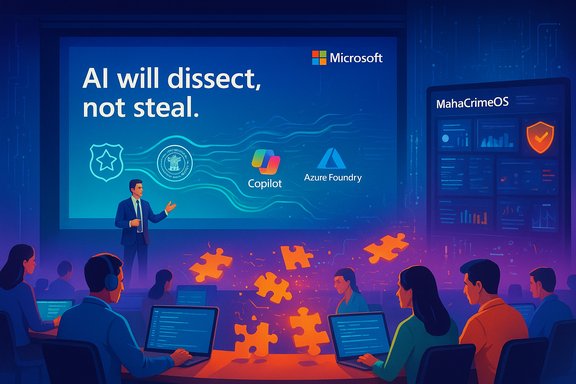
- “Will AI steal jobs? I don’t think AI will steal jobs. It will dissect jobs. It will unbundle jobs.” — Puneet Chandok.
- “The real pink slip in this new AI era is not automation… the real pink slip is refusal to learn.” — Puneet Chandok.
What that framing intends to achieve
Chandok’s message serves three corporate goals simultaneously:- Reassure workers and governments worried about mass displacement.
- Shift the debate from binary “jobs lost/gained” headlines to continuous learning and skills policy.
- Position Microsoft as both vendor and educator — a company that will provide tooling and skilling pathways.
Nadella’s strategic framing: data, commodity models, and use cases
Data as the strategic asset
Satya Nadella’s public comments at the same event emphasized that in the “experience layer” of products and services, data is one of the most strategic assets — but it must be used contextually with AI. This is an important distinction: raw model performance is not the only lever; how a company collects, curates, and applies its data to deliver user experiences is where competitive advantage can persist. Multiple outlets captured Nadella describing that tension and highlighting data’s centrality.“Are models becoming a commodity?”
Nadella also queried whether base AI models risk becoming commoditized — a judgement that underpins Microsoft’s dual strategy: invest at scale (cloud + models + product integration) while keeping the differentiation in product‑specific data and enterprise workflows. That logic is visible across Microsoft’s recent product work: Copilot integrations, Copilot Studio, and Azure AI Foundry — moves that emphasize orchestration, governance and data plumbing as much as raw LLM performance. Internal community commentary and product analyses have repeatedly observed this platform‑plus‑data position.MahaCrimeOS: the case study Microsoft used onstage
The claim
Nadella pointed to a Maharashtra government project (MahaCrimeOS) that uses Microsoft tools in Nagpur, asserting that the system “reduced the turnaround time on cybercrime investigations by 80 percent.” That specific figure was reported in press coverage of the event.What independent reporting confirms
- Local and national press describe MahaCrimeOS as an AI‑enabled investigative platform initially piloted in Nagpur that combines cloud infrastructure, retrieval and multilingual extraction, and workflow automation to help police process complaints and digital evidence faster. Reporting indicates the platform was built with state partners and Microsoft technologies (Azure, Foundry), and that the government announced plans to scale it statewide to more than 1,000 police stations.
- Multiple outlets reference improvements in processing speed and case handling efficiency, but independent verification of the exact 80% number is limited in public reporting to the Microsoft stage remarks and wire/press copy quoting Nadella. Where precise percentages appear, they stem from the company or government claims relayed by reporters. Given that, the 80% figure should be treated as a company‑reported outcome that requires independent audit for rigorous confirmation. Readers should view the specific percentage with cautious interest until an independent evaluation or data release is published.
Why the MahaCrimeOS example matters (and why to read it carefully)
- Real operational wins sell the idea that AI can move the needle on civic services and public safety. A successful state deployment creates a reusable proof point for selling to other governments and enterprises.
- Yet, civic AI deployments raise immediate governance questions: data sovereignty, chain of custody for digital evidence, audit trails for automated recommendations, and privacy safeguards when integrating banking, telecom and public records. The headlines around scale (replicating to 1,100 stations) amplify both the potential benefits and the need for scrupulous oversight. Press coverage notes the Maharashtra rollout plan but is thin on published audit data, error rates, or redaction controls. That gap is material and must be closed if public trust is to be sustained.
Corroboration and verification: what’s confirmed, what’s not
- Confirmed: Chandok’s and Nadella’s quotes and stage presence at the India AI Tour were widely reported in national media; their high‑level framing (AI unbundles tasks; data is strategic) is established.
- Confirmed: MahaCrimeOS exists, was piloted in Nagpur, uses Microsoft Azure/Foundry technologies, and the Maharashtra state government announced an intent to scale the platform across the state. Multiple outlets report these facts.
- Partially confirmed / flagged: the precise numerical claim of “80% reduction in turnaround time” was made from the stage and echoed by newswire and press reports, but independent, auditable evidence (public metrics, audit reports, or academic evaluation) is not yet publicly available. That numeric claim should therefore be treated as a company‑reported or government reported outcome pending independent verification. Caution advised.
Strategic strengths in Microsoft’s messaging and approach
- Focus on continuous learning reduces panic and reframes the debate: by telling employees “learn or be left behind,” Microsoft aligns its product narrative with skilling commitments that it can operationalize through certifications, training partnerships and partner networks. This is a pragmatic message for enterprises seeking to smooth digital transformation.
- Linking a high‑profile public‑sector deployment (MahaCrimeOS) to broader product claims is persuasive: it converts abstract productivity promises into a concrete civic use case that buyers and governments can point to as a template. Public‑sector wins also build trust for enterprise customers in regulated industries.
- Emphasizing data + product rather than raw model size is defensible and commercially savvy. If base models become more widely available, the real differentiation will be in curated data, connectors, workflow integrations, and governance — exactly the layers Microsoft is promoting through Copilot, Copilot Studio and Azure tooling.
Key risks and blind spots Microsoft (and customers) must address
- Governance and auditability: Agentic systems and investigative aids require reproducible logs, human‑in‑the‑loop controls, and legal defensibility for any automated outputs used in official processes. Without robust audit trails, the risk to prosecutions, civil liberties and public trust is material.
- Over‑reliance on vendor narratives: Large platform providers naturally promote success stories. Independent evaluations and third‑party audits are essential to prevent selection bias (showcasing only the cleanest outcomes). The 80% figure for MahaCrimeOS is compelling but needs independent confirmation.
- Data residency and interoperability: Deployments that span public and private data sources (banks, telcos, public records) must implement strict data contracts, anonymization, and clear provenance. Enterprise customers should demand contractual guarantees about locality, retention and access.
- Societal distribution of benefits: If AI productivity gains are not paired with public skilling programs and safety nets, productivity improvements can increase inequality. Microsoft’s skilling pronouncements are part of the solution, but government and industry collaboration will be required.
- Vendor lock‑in and commercial opacity: Large, integrated stacks can accelerate adoption but create switching costs. Organizations should negotiate for portability, clear SLAs, and transparency about seat activation and billing metrics. Internal Windows forum analysis and enterprise advisory commentary highlight this as a recurring commercial concern in large-scale Copilot rollouts.
Practical recommendations for IT leaders, HR and policy teams
- Treat pilot claims as hypotheses to be tested. Insist on KPIs that are auditable and reproducible: time saved per case, error rates, human override frequency, and incidence of false positives/negatives.
- Require end‑to‑end provenance: for decision‑support tools used in investigations, retain immutable logs that link evidence, model inputs, outputs, and human decisions.
- Contractually bind activation to outcomes: when licensing Copilot or large seat deployments, get measurable activation metrics and governance SLAs rather than headline seat counts alone.
- Build skilling paths tied to roles, not features: design micro‑credential stacks that marry domain knowledge (e.g., cyber investigations) with AI literacy and human‑in‑the‑loop training.
- Commission independent audits for public deployments: invite neutral academic or third‑party auditors to validate claims like turnaround‑time improvements and publish redacted findings.
- Plan for privacy-by-design and least privilege: codify data minimization, anonymization ingress/egress points and strict role‑based access for agentic systems.
What to watch next: six near‑term signals
- Publication of independent metrics or audits for MahaCrimeOS (or similar public‑sector pilots).
- Activation and usage dashboards from enterprise Copilot rollouts that move beyond license counts to show real productivity gains.
- Contractual language from major partners (TCS, Infosys, Wipro, Cognizant) about portability, governance and auditability.
- Evidence of formal skilling outcomes — certifications, redeployments, and job placement metrics — following Microsoft partner training initiatives.
- Regulatory responses from Indian and other jurisdictions on agentic automation used in policing and public services.
- Any independently produced studies showing long‑term labor market impacts in sectors with rapid AI adoption.
Final analysis — measured optimism with accountability
Microsoft’s message at the India AI Tour is coherent and persuasive: AI will reshape jobs by unbundling tasks, and the companies and individuals that win will be those that invest in data, governance, and continuous learning. The MahaCrimeOS example offers a tangible narrative of impact — and it may well be a real operational improvement — but the sharp numeric claim (an 80% reduction in investigative turnaround) requires independent auditing to be fully credible beyond company‑reported results. The good news for Windows‑era IT professionals and enterprise leaders is that the immediate work is practical, not esoteric: instrument outcomes, insist on auditability, and design human‑in‑the‑loop processes that preserve accountability. The harder societal questions — reskilling at scale, equitable distribution of productivity gains, and legal frameworks for automated decision support — demand coordinated action from vendors, employers, and governments. Microsoft’s rhetoric is aligned with this direction, but rhetoric must be backed with transparent metrics and governance if trust is to follow.In short: the core idea — AI will redefine tasks; resistance to learning will be costly — is a useful heuristic for career management and procurement strategy. But the onus is now on vendors, governments and enterprise customers to make the claims verifiable, to publish outcomes, and to design safety nets that allow societies to harvest AI’s productivity upside without leaving large groups behind. The next months should focus less on slogans and more on measurable, audited evidence of impact.
Source: Rediff MoneyWiz AI Won''t Steal Jobs: Microsoft''s Chandok
