

Dan Ives’ latest Wedbush note reframes the AI winners debate for 2026 by putting monetization vectors—cloud platform seats, device subscriptions, robotaxi services, vertical AI software and cybersecurity—at the center of his investment thesis, and naming Microsoft, Apple, Tesla, Palantir and CrowdStrike as his five highest-conviction AI picks for the year ahead.
Dan Ives’ call is notable because it deliberately sidelines the obvious semiconductor darling of the AI era—Nvidia—in favor of companies that, in his view, are positioned to convert AI activity into recurring revenue and durable cash flow. That repositioning matters: the market’s second phase of AI growth is beginning to reward platform owners and application providers rather than only the raw compute suppliers that dominated headlines in 2023–2025.
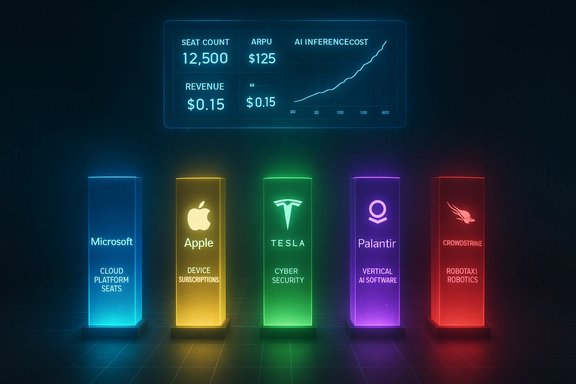
Across multiple summaries of Wedbush’s note, Ives highlights five distinct monetization pathways:
The practical takeaway is straightforward: the AI story is entering a phase where who charges for outcomes matters as much as what accelerates the compute—monitor seat counts, per‑user ARPU, inference economics, production milestones and cybersecurity bookings to separate the companies that will convert AI promise into durable revenue from those that remain promising but unproven.
Source: CoinCentral Dan Ives Picks Microsoft, Apple, Tesla, Palantir as Top AI Picks for 2026 - CoinCentral
 Background / Overview
Dan Ives’ call is notable because it deliberately sidelines the obvious semiconductor darling of the AI era—Nvidia—in favor of companies that, in his view, are positioned to convert AI activity into recurring revenue and durable cash flow. That repositioning matters: the market’s second phase of AI growth is beginning to reward platform owners and application providers rather than only the raw compute suppliers that dominated headlines in 2023–2025.Across multiple summaries of Wedbush’s note, Ives highlights five distinct monetization pathways:
- Microsoft (MSFT) — platform and cloud monetization via Copilot and Azure inference.
- Apple (AAPL) — device-embedded AI and subscription services on a massive installed base.
- Tesla (TSLA) — autonomy and robotics (robotaxi / Cybercab) creating new service revenues.
- Palantir (PLTR) — verticalized, decision-intelligence software that sells enterprise AI outcomes.
- CrowdStrike (CRWD) — AI-native cybersecurity as a recurring subscription business.
Microsoft: the enterprise AI flywheel
What Wedbush is asserting
Wedbush calls 2026 a “true inflection year” for Microsoft’s AI monetization, arguing that a combination of identity, productivity suites and hyperscale cloud infrastructure gives Microsoft a unique seat-based revenue opportunity via Copilot and Azure inference. The analyst recently assigned Microsoft a lifted price target consistent with this view.Verifiable anchors
Microsoft itself and multiple market write-ups state the company’s AI business has reached a meaningful annualized revenue run rate. That figure—widely reported in 2025 coverage—has been used as a concrete modeling anchor by sell-side analysts. Several independent outlets cited Microsoft’s AI revenue run-rate approaching the low‑ to mid‑double-digit billions, which analysts use to justify higher forward revenue expectations for Azure and Copilot monetization.Strengths
- Distribution control: Microsoft already owns identity (Azure AD/Entra), Windows endpoints and Microsoft 365 seats, enabling powerful cross-sell mechanics for paid Copilot SKUs.
- Existing monetization: Copilot commercial offerings are priced and available, converting AI features into seat-based recurring revenue.
- Balance-sheet backing: Microsoft’s ability to fund large-scale datacenter capex reduces execution risk relative to smaller cloud vendors.
Risks and caveats
- CapEx timing and margin pressure: Large AI datacenter investments depress near-term margins until utilization improves.
- Field-check uncertainty: Many bullish penetration rates come from channel checks rather than audited company disclosures; investors should prefer company-reported seat counts and Azure inference metrics as the highest-signal data.
Apple: cautious execution, large optionality
The claim
Wedbush includes Apple on the list despite industry criticism that Apple was late to formalize an AI consumer strategy. Ives argues that Apple’s enormous device base—2.4 billion iOS devices and roughly 1.5 billion iPhones—gives it an immediate monetization runway for paid AI features, and he quantifies potential upside to the share price as material.What’s verifiable
Analyst notes and press coverage confirm two key, verifiable facts: Apple’s massive installed base is real, and the company has been building AI talent and product investments even if public product rollouts were measured. Wedbush’s $75–$100 per-share “value-add” estimate and their $350 price target are clearly analyst scenarios rather than company guarantees. Business coverage repeated those price-target moves.Strengths
- Direct monetization levers: Apple can bundle paid AI features into existing subscription products, OS-level services, or premium device tiers.
- Hardware + services lock-in: Apple historically extracts high ARPU from its ecosystem when features deliver clear utility and privacy assurances.
Risks and caveats
- Execution and timing: Apple’s historically cautious approach to cloud-dependent features and privacy-first design may slow revenue realization.
- Dependence on UX and privacy trade-offs: True consumer monetization will require balancing on-device processing with cloud services in ways that match Apple’s privacy posture—this is non-trivial and timeline-sensitive.
Tesla: the most binary call—robotaxis or repriced automaker
Wedbush’s bullish path
Ives describes 2026 as potentially a “monster year” for Tesla if robotaxi and robotics initiatives scale. He highlights the upcoming Cybercab production as a tangible milestone and sets an ambitious $600 price target for TSLA while projecting a base case $2 trillion market cap and a bull case up to $3 trillion.The Cybercab timeline
Elon Musk publicly stated that Cybercab production would begin in April (Q2) 2026; major tech press covered that target. Independent outlets reported production is slated to start in April, and Tesla-related beat reporting corroborated the timing. Those production statements came directly from Tesla’s public remarks and shareholder meeting briefings.Strengths
- First‑mover fleet data: Tesla’s deployed fleet yields massive driving data, an asset for training autonomous driving models.
- Optionality: If robotaxis and Optimus robotics succeed, Tesla’s revenue mix could shift from unit sales to recurring ride revenue and robotics services—very high optionality for valuation.
Risks and caveats
- Binary regulatory and safety pathway: Robotaxi economics require regulatory approval, demonstrable safety at scale, and viable insurance/operational models. Any high-profile incident or regulatory pushback could compress expected upside sharply.
- Execution vs. hype gap: History shows Tesla often sets aggressive timelines; production proclamations should be treated as company guidance subject to delays. Independent reporting confirms April production targets but also documents internal debate around design choices and fallback plans, indicating execution risk.
Palantir: vertical AI, stretched multiples
What Ives says
Wedbush positions Palantir as a verticalized AI decision‑intelligence play and projects an outsized upside (some notes describe a path to $1 trillion market cap). The stock’s dramatic YTD performance in 2025 is repeatedly cited by analysts as evidence of strong demand for its enterprise AI platform.What’s verifiable
Public earnings and contract disclosures show meaningful revenue acceleration and growing commercial traction. Palantir’s share performance in 2025 materially outpaced broad indices—independent market reporting confirms large year‑to‑date gains. However, the $1 trillion valuation projection is an analyst bull case that requires sustained, exceptional revenue and margin expansion to materialize.Strengths
- Sticky government contracts and vertical specialization: Palantir’s enterprise and federal ties create long sales cycles but often result in durable bookings and high retention.
- Product fit for explainable, operations‑level AI: Organizations that require integrated, auditable AI workflows are natural customers for Palantir’s style of decision intelligence.
Risks and caveats
- High valuation sensitivity: Palantir’s multiples have been elevated; any slip in commercial conversion or margin expansion could trigger sharp multiple compression.
- Concentration and political risk: Government procurement changes or political headwinds can materially affect visibility. Treat $1T scenarios as conditional, not baseline.
CrowdStrike: cybersecurity’s AI beneficiary
Thesis
Wedbush includes CrowdStrike as the cybersecurity leader best positioned to monetize AI-driven security needs. As adversaries weaponize generative models and automation, defenders who embed AI across telemetry and response can secure higher ARPU and retention. Wedbush raised targets on cybersecurity names and flagged CRWD as a core pick.What’s verifiable
CrowdStrike’s 2025 product releases and market commentary confirm significant integration of AI into its Falcon platform and adjacent modules. Market coverage indicates CRWD posted strong gains in 2025 and continues to expand bookings—supporting Wedbush’s thesis that security is a multi‑derivative beneficiary of enterprise AI adoption.Strengths
- Platform economics: Security platforms typically benefit from modular add-ons and expansion revenue—AI modules fit that monetization model well.
- Large enterprise footprints: Existing deployments enable upsell of AI-native detection and response features.
Risks and caveats
- Valuation compression risk: Cybersecurity stocks often trade at premium multiples; any growth slowdown or competitive displacement by cloud hyperscalers could compress multiples rapidly.
- Operational complexity: AI detection at scale is technically difficult and brittle; false positives, integration costs, or adversarial model misuse could slow adoption or create customer dissatisfaction.
Cross‑checks and verification: what’s confirmed and what’s speculative
- Dan Ives’ five-name list and the principal price targets and YTD returns are widely reported across mainstream outlets; Business Insider, CoinCentral, Benzinga and TipRanks all summarize the same Wedbush note and its headlines. These independent copies validate the set of names Ives chose and the publicized price targets.
- Microsoft’s public disclosures and multiple analyst write-ups confirm that management and corporate commentary used a multi‑billion annualized AI revenue run‑rate figure in 2025, which sell‑side analysts have used as a modeling anchor. Independent analyst notes also report large capex commitments to AI infrastructure—both points are verifiable.
- Tesla’s Cybercab production timetable (April 2026) is explicitly stated by Tesla leadership and covered by multiple press outlets; those production commitments are company-provided guidance and thus verifiable as guidance, though historically ambitious.
- Multi‑trillion or trillion-dollar company scenarios (Palantir to $1T, Tesla to $2–$3T, Apple $75–$100/share uplift) are sell‑side scenarios—useful as stretch cases but inherently conditional on multiple execution, adoption and regulatory variables. Treat them as analyst scenarios, not guarantees.
Actionable KPI checklist for validating Ives’ thesis in 2026
For investors and IT decision-makers who want to operationalize this thesis, track the following high‑signal, company-level metrics that will separate rhetoric from reality:- Microsoft
- Reported Copilot commercial seat counts and disclosed Copilot ARPU.
- Azure AI inference-hour growth and Azure gross-margin trend.
- Apple
- Product announcements that explicitly monetize AI (paid Siri/Copilot-like SKUs).
- Services revenue mix and any ARPU uplift tied to device-level AI subscriptions.
- Tesla
- Regulatory approvals and city‑level pilot metrics for robotaxi deployments.
- Cybercab production/acceptance rates and early fleet utilization metrics.
- Palantir
- Large commercial AIP contract announcements and disclosed recurring revenue from commercial customers.
- Federal procurement updates and sovereign/cloud certifications.
- CrowdStrike
- New bookings attributable to AI-native modules and expansion revenue per customer.
- Churn and net retention metrics as AI modules roll out.
- GPU pricing and availability, cloud capex cadence and model‑efficiency breakthroughs that could alter compute economics.
Critical analysis: strengths, blindspots and near-term risks
Notable strengths of Ives’ framework
- Practical focus on monetization: By privileging recurring revenue capture over pure technical leadership, the call offers testable hypotheses (seat counts, ARPU, bookings) that investors and CIOs can monitor.
- Diversified exposure to AI vectors: The five companies span cloud, devices, autonomy, vertical software, and security—reducing single-point dependency on any one AI stack.
Where the thesis overreaches
- Overly optimistic terminal valuations in headlines: Trillion‑dollar market cap scenarios read well in headlines but require numerous favorable execution and regulatory outcomes that are far from guaranteed.
- Implicit downplay of infrastructure risk: By excluding Nvidia from the top five in many headlines, the note can be read as minimizing how constrained or dominant accelerator supply and pricing could re‑center returns on chip providers. Nvidia and other infrastructure players remain central to compute economics.
- Reliance on field checks: Some of the most bullish penetration rates cited in sell‑side notes are channel checks rather than company-audited metrics—directional, not definitive. Investors should condition exposure on company‑reported KPIs.
Regulatory and macro risks to monitor
- Autonomy regulation and safety incidents could dramatically change Tesla’s service economics.
- Data privacy and model governance could slow Apple’s consumer monetization if regulatory regimes tighten.
- Export controls and GPU supply dynamics could constrain hyperscaler and enterprise deployment timing, affecting Azure and inference margins.
What this means for portfolios and IT buyers
For investors
- Treat Ives’ top-five list as a framework, not a shopping list. A balanced approach:
- Core positions in durable platform leaders (e.g., Microsoft) who already show monetization.
- Smaller satellite allocations to higher‑optionality names (Tesla, Palantir) sized to conviction.
- Defensive exposure to cybersecurity (CrowdStrike) to capture structural demand growth.
- Insist on observable, repeatable milestones (quarterly seat counts, ARPU, disclosed AIP deals) before increasing exposure into the highest-multiple names.
For enterprise IT leaders and procurement
- Negotiate AI‑ready contracts now: Reserve inference capacity, clarify egress/pricing terms and demand SLAs that cover model throughput and availability.
- Instrument KPIs: Build dashboards for inference-hour costs, latency, per-user AI adoption and security telemetry tied to AI modules.
- Plan governance and security: Treat AI rollouts as operational changes—codify incident response, model governance and data residency controls before broad deployment.
Conclusion
Dan Ives’ top-five AI picks for 2026 present a compelling reframing of the next phase of AI value capture: it’s about turning compute into paid, repeatable customer outcomes rather than merely owning the accelerators that make models run. That stance is rooted in verifiable company signals—Azure monetization, Copilot pricing, Palantir’s commercial traction, Tesla’s production plans and CrowdStrike’s AI integrations—and is widely reflected in market coverage. At the same time, headline price-targets and trillion‑dollar scenarios are analyst‑driven stretch cases that depend on flawless execution, favorable regulation and sustained customer economics. Investors and IT leaders should therefore treat Ives’ list as a strategic lens for where AI value may concentrate in 2026, and validate the thesis against the concrete KPIs outlined here before committing meaningful capital or operational dependence.The practical takeaway is straightforward: the AI story is entering a phase where who charges for outcomes matters as much as what accelerates the compute—monitor seat counts, per‑user ARPU, inference economics, production milestones and cybersecurity bookings to separate the companies that will convert AI promise into durable revenue from those that remain promising but unproven.
Source: CoinCentral Dan Ives Picks Microsoft, Apple, Tesla, Palantir as Top AI Picks for 2026 - CoinCentral
