

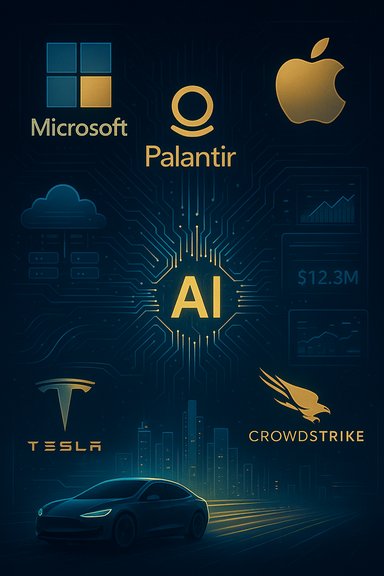
Wedbush’s latest note positions Microsoft, Palantir, Apple, Tesla, and CrowdStrike as the five large-cap names—alongside Nvidia—that investors should watch as the AI era moves from pilot projects to enterprise-scale deployments in 2026, a view summarized in the brief you provided and echoed across market coverage.
Background
The AI investment landscape in 2024–2026 has been dominated by a handful of infrastructure and platform winners: Nvidia for accelerators and software stack dominance; hyperscalers (Microsoft Azure, Amazon Web Services, Google Cloud) for distribution and model hosting; and a second wave of application- and security-focused companies positioned to monetize AI across enterprises. Wedbush’s Dan Ives frames 2026 as an inflection year in which enterprise rollouts and monetization—not just R&D or demos—begin to show through in financials and market valuations. That thesis is rooted in field checks Wedbush reports and recent company disclosures about AI revenue run rates, capex plans, and product commercialization timetables.This article dissects Wedbush’s five picks, verifies the core claims against public disclosures and independent reporting, and offers a practical assessment of the strengths, execution risks, and valuation sensitivities investors and IT leaders should track heading into 2026.
Overview of Wedbush’s five picks and the narrative
- Microsoft (MSFT): Azure + Copilot = enterprise AI flywheel — Wedbush argues fiscal 2026 is the true inflection point for Azure monetization and Copilot seat conversion.
- Palantir (PLTR): Data and decision-intelligence AI — Wedbush sees Palantir’s AIP and government/commercial traction as a path to a potential $1 trillion market cap over the next 2–3 years.
- Apple (AAPL): Device and services monetization of AI — Wedbush estimates AI could add roughly $75–$100 per share in value as Apple leverages its 2.4 billion iOS device base and new AI leadership hires.
- Tesla (TSLA): AI-driven valuation via robotaxis and robotics — Wedbush projects a path to $2T market cap in a base/bull scenario and up to $3T in a best-case AI/robotaxi roll-out.
- CrowdStrike (CRWD): Cybersecurity as a second/third-order AI beneficiary — Wedbush argues AI-driven threat evolution and demand for AI-native defenses make CrowdStrike a core cybersecurity pick.
Microsoft: Azure monetization and the Copilot flywheel
What Wedbush is claiming
Wedbush (Dan Ives) has repeatedly argued the market underestimates Azure’s near-term AI monetization and expects fiscal year 2026 to be the inflection when enterprise CIOs begin large-scale deployments tied to Copilot and Azure inference workloads. The firm has maintained an Outperform stance while raising price targets (noting moves across 2025 and 2026).Fact-check and public evidence
Microsoft itself disclosed that its AI business surpassed an annualized revenue run rate of $13 billion, a concrete anchoring metric that confirms material monetization is already occurring. This figure is in Microsoft’s public earnings commentary and reported by multiple outlets following the company’s Q2 FY2025 results. Wedbush’s field-checks claim broader seat conversion (they cite a 70% eventual penetration of Microsoft’s installed base in some of their notes). Field checks are typical sell-side inputs but are not the same as audited company metrics; investors should prefer company-reported seat counts, Copilot ARPU disclosures, or Azure inference-hour growth for ongoing verification.Strengths
- Distribution advantage: Microsoft controls the OS, identity, productivity suites, and a massive enterprise sales motion—making Copilot packaging and cross-sell unusually potent.
- Concrete monetization: The $13B run rate is real revenue—no longer just pilot signaling.
- Balance sheet and capex scale: Microsoft’s willingness to fund AI-optimized datacenter capex reduces execution risk relative to smaller cloud vendors.
Risks and caveats
- Capital intensity and margin timing: Large capex is a near-term headwind until utilization and higher-margin services kick in; Wedbush and others caution investors to watch utilization, recognized revenue from multiyear bookings, and Azure gross margins.
- Field-check uncertainty: Estimates like “70% penetration” are directional; they should be treated as analyst assumptions until corroborated by company metrics.
Palantir: the “decision-intelligence” play and the $1T projection
What Wedbush is claiming
Wedbush has positioned Palantir as a core leader of AI products for government and enterprise, asserting the company could grow into a $1 trillion market capitalization in the medium term as commercial AIP adoption accelerates.Fact-check and public evidence
Multiple market reports document Wedbush’s bullish language and raised price targets on Palantir; the analyst’s $1T projection is repeatedly cited across outlets as a two- to three-year horizon forecast. Those coverage items reference both Palantir’s AIP product and recent contract wins with government entities and commercial partners.Strengths
- Government relationships and sticky contracts: Palantir’s long-standing government work provides recurring, high‑value contracts and a large addressable base for applied AI work.
- Enterprise AIP growth: Palantir’s platform approach—integrating operational data into decision workflows—plays to use-cases where regulators and companies need explainability and integration, not just raw LLM outputs.
Risks and caveats
- Valuation leverage: Projecting a $1T valuation requires dramatic revenue and margin expansion. Current multiples already price significant growth, so any execution slippage or public-sector procurement shifts would be punished.
- Concentration & political risk: Heavy reliance on government contracts introduces programmatic and political tail risk; changes in procurement policy or budget priorities can swing revenue visibility.
Apple: device-scale AI monetization and the $75–$100-per-share claim
What Wedbush is claiming
Wedbush estimates Apple’s pending AI monetization could add $75 to $100 per share over the next few years, citing Apple’s 2.4 billion iOS devices and hiring moves (e.g., senior AI leadership) as foundational elements. The note also predicted Tim Cook would likely remain CEO through at least the end of 2027 to shepherd the AI transition.Fact-check and public evidence
Wedbush’s commentary and subsequent price-target updates (multiple outlets report the $75–$100 per-share potential and the $320→$350 target moves) are consistent across the trade press. The claim rests on a combination of user base scale, rumored partnerships (including reported cooperation with Google’s Gemini), and internal hires that suggest Apple is moving from a conservative AI posture to a monetization phase.Strengths
- Unique distribution: Apple’s device control provides direct monetization levers: app-level subscriptions, device-tier services, and on-device inference for premium features.
- Hardware + services lock-in: The installed base and upgrade cycle for iPhone create a natural runway for paid AI features and services.
Risks and caveats
- Execution complexity: Apple historically prioritizes privacy, on-device processing, and user experience over aggressive cloud monetization—navigating that balance while monetizing AI at scale is non-trivial.
- Monetization timing: The $75–$100 figure is an analyst’ estimate of potential upside; it depends on product timing (e.g., Siri 2.0, paid Copilot-like services), pricing, and user adoption rates.
Tesla: the robotaxi and robotics valuation thesis
What Wedbush is claiming
Wedbush’s bullish pathway for Tesla is an AI-driven revaluation: if robotaxis (Cybercab) and Optimus robotics scale, Tesla could reach $2 trillion market cap in a base scenario and $3 trillion in an aggressive bull case by the end of 2026. The firm expects the “march to an AI-driven valuation” to begin unlocking over a 6–9 month window as autonomous penetration increases.Fact-check and public evidence
Multiple financial outlets report Wedbush raising Tesla targets and discussing multi-trillion-dollar scenarios tied to autonomy and robotics. The broad market narrative has shifted: Tesla’s stock increasingly reflects forward-looking optionality for robotaxis and AI-enabled services rather than strictly vehicle unit economics.Strengths
- Optionality premium: Tesla’s vertical integration—vehicle hardware, fleet data, FSD software stack—creates optionality that can justify a high forward multiple if robotaxi economics prove out.
- First-mover data advantages: Large fleets and long-term driving data provide model training scale that new entrants may struggle to replicate.
Risks and caveats
- Regulatory and safety hurdles: Large-scale robotaxi deployments depend on regulatory approvals and demonstrable safety metrics; any high-profile incident or delay could reset valuations dramatically.
- Monetization uncertainty: The shift from vehicle-sales valuation to service-and-robotics valuation is binary—either mass deployment works and multiples expand or it stalls and expectations compress.
CrowdStrike: cybersecurity as an AI beneficiary
What Wedbush is claiming
Wedbush views cybersecurity as a secondary—but durable—beneficiary of the AI wave. As AI scales, threat surfaces change and enterprises need AI-native defenses. CrowdStrike’s expanding product set (Falcon, Charlotte AI, LogScale, identity and data protection modules) positions it to capture accelerated deal momentum into 2026. Wedbush has included CrowdStrike on its IVES AI 30 list and elevated its targets accordingly.Fact-check and public evidence
Press coverage of Wedbush’s notes confirms the firm’s inclusion of CrowdStrike in its AI lists and higher price targets. Independent reports detail CrowdStrike’s product expansion into AI-driven modules, and Wedbush’s field-checks report spreading adoption across cloud, identity, and data protection lines.Strengths
- Cross-sell into large enterprise footprints: CrowdStrike’s platform model benefits from additional modules and recurring SaaS economics.
- AI-native defense positioning: As adversaries adopt generative and automated tools, defenders who embed AI in telemetry and response can command premium pricing.
Risks and caveats
- Valuation compression risk: Cyber names frequently trade at rich revenue multiples; any slowdown in growth or competition (from Palo Alto, Microsoft, or novel startups) can pressure multiples.
- Operational complexity: Building reliable, explainable AI detection that scales across cloud and endpoints is technically hard and may produce false positives/costly integration work for customers.
Cross-cutting strengths and macro risks in Wedbush’s thesis
What makes the thesis credible
- Several claims are anchored to public company disclosures: Microsoft’s $13B AI run rate; Apple’s large device base and public hires; Palantir’s commercial momentum; Tesla’s public robotaxi pilots and stated production timelines. These anchor points move the conversation beyond pure speculation.
- Wedbush’s theme recognizes different exposure types—infrastructure, platform, device monetization, robotics, and security—offering diversified routes to capturing AI value rather than betting on a single modality.
Key macro and industry risks to watch
- Capex cycles and supply constraints: GPU supply, export controls, and datacenter build timelines materially influence revenue recognition and margins across hyperscalers and AI customers.
- Regulatory and reputational shocks: Autonomous vehicle incidents, AI-related privacy or misuse scandals, or sudden procurement policy changes (especially in government spending) can alter revenue trajectories.
- Competition and commoditization: Advances in efficient model architectures or low-cost alternatives could reduce compute intensity and compress margins for hardware and cloud providers.
How to watch the story in 2026 — practical tracking checklist
- Microsoft: quarterly disclosures of Copilot seat counts, Azure AI inference-hour growth, and Azure gross margin trends.
- Palantir: large commercial deal announcements, US federal contract updates, and AIP revenue cadence.
- Apple: product/feature launches that tie directly to monetized AI (Siri 2.0, paid AI features), plus services revenue trends.
- Tesla: robotaxi deployment cities, regulatory approvals, and Optimus commercialization updates.
- CrowdStrike: bookings and net-new logo trends tied to AI-enabled modules, plus churn/expansion metrics.
Verification and caveats: which claims are solid and which are speculative
- Publicly verifiable claims: Microsoft’s $13B AI run rate and Apple’s hiring/partnership moves are firm-level disclosures or reported directly by the companies and multiple outlets.
- Analyst projections and field-check estimates: Price targets, multi-year market-cap forecasts (Palantir $1T, Tesla $2T–$3T, Apple $75–$100/share uplift) are analyst scenarios grounded in an optimistic execution path. They are useful for sizing upside but should be treated as conditional projections rather than guaranteed outcomes.
- Flagged/Unverifiable items: Exact penetration metrics derived from sell-side channel checks (e.g., the 70% Microsoft-install-base figure) are not company-audited numbers and should be regarded as directional. Wedbush’s field checks inform conviction but require corroborating, repeatable company metrics for conviction to transition to proof.
Investment and IT reading: what this means for portfolios and Windows-centric IT leaders
- For investors: diversify exposure across AI vectors. The logical approach is a core allocation to durable platforms (Microsoft, select cloud/infra exposure) with satellite bets on pure-play platform enablers (Palantir), device-service arbitrage (Apple), and asymmetric optionality (Tesla, CrowdStrike) depending on risk tolerance.
- For IT leaders and Windows-focused enterprises: plan for AI as an operational change—not just a feature. That means renegotiating cloud SLAs and egress terms, validating region/SKU parity for inference workloads, piloting cost-optimized model runtimes (quantization, distillation), and beefing up AI-aware security controls. Wedbush’s notes echo that large-scale enterprise deployments are shifting from experimentation to procurement decisions.
Conclusion
Wedbush’s 2026 thesis—elevating Microsoft, Palantir, Apple, Tesla, and CrowdStrike as primary beneficiaries of the next wave of AI monetization—is a coherent, multi-vector investment framework grounded in observable changes: material AI revenue run rates, major product and talent moves at large incumbents, and a surge in enterprise deployment signals. Public company disclosures (Microsoft’s $13B run rate, Apple’s AI hires and partnership signaling) and consistent media reporting corroborate many of Wedbush’s anchor points. That said, several of Wedbush’s most bullish outcomes—Palantir at $1 trillion, Tesla at $2–$3 trillion, Apple harvesting $75–$100 of AI-created per-share value—remain contingent on flawless execution, favorable regulatory environments, and successful customer monetization. These are plausible but high‑variance scenarios; they merit attention, not certainty. Investors and IT decision-makers should track the concrete telemetry items listed above as the true arbiters of whether 2026 becomes the breakout monetization year Wedbush forecasts.(Important: the provided brief summarized Wedbush’s calls and analyst field checks; where Wedbush relied on channel checks or model-driven assumptions, treat those estimates as directional and verify them against subsequent company disclosures and quarter-to-quarter metrics.
Source: NAI500 Beyond Nvidia, Wedbush Highlights Five Key Companies in the AI Field by 2026
