

Microsoft’s AI push is entering a new phase: Wedbush analyst Dan Ives now calls fiscal 2026 a potential “big AI‑driven growth year” for Microsoft and has maintained an Outperform rating with a $625 price target, arguing that the market is underestimating Azure‑led monetization and Copilot adoption that could materially lift revenue and re‑rate the stock.
Microsoft’s strategic pivot from a software‑centric vendor to an AI‑first, cloud‑centric platform has been the dominant theme of its corporate story for the past two years. That pivot combines four obvious levers: a hyperscale cloud (Azure), enterprise productization of AI (the Copilot family), privileged model and partner access, and a global enterprise sales machine capable of turning pilots into long‑term contracts. Analysts such as Dan Ives argue those levers, working together, create a “flywheel” that can shift Microsoft’s revenue mix and margins over a multi‑year timeframe. Two concrete numbers anchor the bullish narrative and are repeatedly cited in investor discussions: Microsoft has publicly priced key Copilot offerings (providing a clear seat‑based monetization anchor), and management has disclosed a material AI-related revenue run rate that provides a meaningful base from which to project longer‑term scaling. At the same time, Microsoft disclosed very large capital spending to build AI‑capable data centers — a cost now visible on the P&L and balance sheet until utilization catches up.
Independent and public corroboration exists for strong Copilot and Azure traction (public pricing, reported AI run rates, Azure growth), but only Microsoft could provide precise penetration or seat numbers on a verifiable basis. Until such disclosures are regularly reported, the 70% claim should be considered an optimistic scenario‑level input.
For Windows users and IT decision‑makers, Microsoft’s AI program will continue to matter concretely: expect more embedded AI features, hybrid deployment patterns, and governance‑first rollouts. For investors, Wedbush’s thesis is thoughtful and actionable, but it is a scenario that requires monitoring of a handful of verifiable, company‑level metrics to move from plausible optimism into conviction.
Source: Sahm This Microsoft Analyst Expects 2026 To Be A 'Big AI Driven Growth Year' That Will Surprise Investors
 Background / Overview
Microsoft’s strategic pivot from a software‑centric vendor to an AI‑first, cloud‑centric platform has been the dominant theme of its corporate story for the past two years. That pivot combines four obvious levers: a hyperscale cloud (Azure), enterprise productization of AI (the Copilot family), privileged model and partner access, and a global enterprise sales machine capable of turning pilots into long‑term contracts. Analysts such as Dan Ives argue those levers, working together, create a “flywheel” that can shift Microsoft’s revenue mix and margins over a multi‑year timeframe. Two concrete numbers anchor the bullish narrative and are repeatedly cited in investor discussions: Microsoft has publicly priced key Copilot offerings (providing a clear seat‑based monetization anchor), and management has disclosed a material AI-related revenue run rate that provides a meaningful base from which to project longer‑term scaling. At the same time, Microsoft disclosed very large capital spending to build AI‑capable data centers — a cost now visible on the P&L and balance sheet until utilization catches up. What Wedbush Is Claiming — The Thesis in Plain Terms
The headline claims
- Wedbush (Dan Ives) kept an Outperform rating and a $625 price target, citing partner and field checks that point to accelerating enterprise Copilot and Azure adoption and a possible incremental revenue uplift into fiscal 2026.
- The note argues the market is under‑pricing Microsoft’s AI upside and that the company sits “in the sweet spot of enterprise strategic AI deployments.”
- Wedbush projects that Azure + Copilot momentum could add roughly $20–$25 billion to Microsoft’s top line by FY2026 under its base case, and it cites field checks estimating that over 70% of Microsoft’s installed base could ultimately be on this AI functionality within three years. That 70% figure is presented as a directional, channel‑check estimate rather than a corporate disclosure.
Why that matters
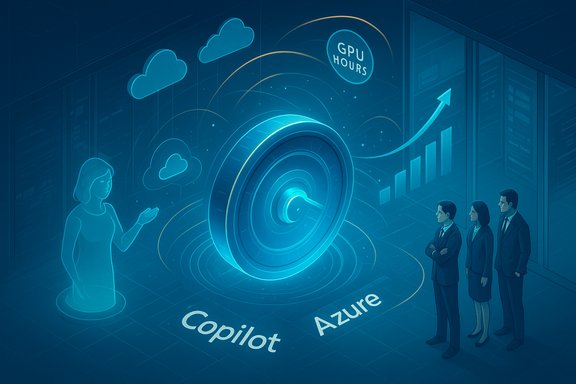
If even a modest fraction of Microsoft’s existing commercial seats adopt paid Copilot licenses and enterprise inference workloads shift onto Azure at scale, the combination creates two revenue engines at once: seat‑based recurring revenue and metered Azure consumption (GPU‑hours, storage, networking). That dual pathway to monetization is the central engine behind the $625 price‑target thesis.Verifying the Building Blocks — What Is Publicly Checkable
Analysts’ models lean on measurable inputs. Here’s how the most important claims stack up to public evidence and independent reporting.1) Copilot pricing and seat economics
Microsoft publicly announced enterprise pricing for Microsoft 365 Copilot at $30 per user per month for qualifying commercial plans when broadly available; the company also offers other Copilot SKUs and Copilot Pro individual subscriptions. That $30 figure is an explicit, public price anchor analysts use when modeling per‑seat ARPU expansion. Why this matters: converting a percentage of Microsoft’s hundreds of millions of commercial seats to a $30/month Copilot subscription scales quickly into multi‑billion recurring revenue flows if enterprise attachment and renewal rates are strong.2) AI revenue run rate
Microsoft management has described its AI business as having passed a multi‑billion annualized run rate — widely reported around the $13 billion mark in investor commentary following recent quarters. Several independent analysts and financial outlets repeated that run‑rate figure as part of Microsoft’s public earnings narrative. That establishes that AI monetization is already material, not merely experimental. Caution: “annualized run rate” is a momentum metric (current monthly or quarter revenue extrapolated to 12 months) rather than an audited trailing‑12‑month GAAP figure; it’s useful for trend analysis but sensitive to short‑term inflections. Treat it as a momentum indicator, not a guaranteed forward revenue number.3) Capital intensity and the $80 billion figure
Microsoft publicly signalled outsized infrastructure investment for AI‑capable data centers; multiple major outlets reported planned capital spending in the ~$80 billion range for fiscal 2025 as the company raced to add GPU‑dense capacity. That level of CapEx explains the near‑term margin and free‑cash‑flow pressure analysts are scrutinizing. Why this matters: heavy, front‑loaded CapEx creates a cash‑flow and margin drag until the new capacity is live and utilization improves; the timing of that utilization ramp is central to whether FY2026 becomes a true inflection year.4) Azure growth and AI contribution
Azure remains Microsoft’s primary growth engine. Public filings and commentary show Azure growth in the 30% range in recent quarters, with management pointing to AI workloads as a material contributor (management cited multiple percentage points of Azure growth attributable to AI services), which is the concrete channel for monetizing Copilot and enterprise agent workloads on Azure. Cross‑check: independent reporting from major news outlets and Microsoft investor materials consistently reflect strong Azure growth and a growing AI revenue wedge inside Azure’s results — that combination is the core revenue path for the Wedbush thesis.Strengths of the Wedbush Case — Why It Resonates
- Integrated distribution and trust: Microsoft controls OS, identity (Azure AD), productivity (Microsoft 365), collaboration (Teams), and the hyperscale cloud — an unusually broad stack to embed Copilot experiences and seat‑based monetization. That distribution reduces friction for enterprise adoption relative to point vendors.
- Clear monetization hooks: Public Copilot pricing and metered Azure inference economics provide levers that are easier to model than abstract “AI potential.” Seat pricing plus per‑inference consumption creates dual revenue vectors.
- Preferential model partnerships: Microsoft’s commercial relationship with leading model builders — notably OpenAI — provides privileged access and co‑engineering pathways that support differentiated enterprise productization. That advantage is repeatedly cited by sell‑side analysts as a moat around enterprise LLM deployments.
- Scale economics: Over time, higher utilization of owned data‑center assets and software/hardware optimizations should lower the marginal cost per inference and improve margins compared with early, highly‑subscribed phases. That dynamic underpins the argument that CapEx eventually becomes accretive.
Risks, Execution Pitfalls and What Could Go Wrong
CapEx timing and utilization risk
The core execution risk is timing: Microsoft’s data center build is enormous and capital‑intensive. If enterprise demand for paid Copilot seats and metered inference lags the pace required to fill capacity, margin recovery will be delayed and free cash flow will remain depressed. Public reporting around the ~$80B capex plan underscores that tradeoff.Competitive pressure on inference economics
AWS, Google Cloud, and specialized inference providers are all competing for the same enterprise workloads; downward pricing pressure on inference services — or a shift toward multi‑cloud/best‑price procurement — could compress the margin profile of Azure‑hosted inference. Analysts warn that inference economics are a fragile lever.Monetization friction and adoption variability
Converting pilots into enterprise‑wide paid deployments requires governance, integration, user training, and demonstrable ROI. Conversion rates vary widely by vertical and account size; failure to translate early wins into broad attachment rates would reduce the modeled revenue uplift. The “70% of installed base” field‑check is directional and should be read as an optimistic channel metric rather than a company audit.Regulatory and geopolitical constraints
Data residency, privacy regulations, and government procurement rules can slow or restrict adoption in regulated industries and geographies. Microsoft’s hybrid and sovereign cloud offerings mitigate some risk, but regulatory friction remains a material constraint.What Investors Should Watch — A Quarterly Checklist
- Copilot traction: paid Copilot seat counts (or attach rates), ARPU per Copilot seat, renewal rates and large‑account deployments. These will be the cleanest read on seat monetization.
- Azure AI consumption: sequential growth in inference GPU‑hours, Azure OpenAI commercial bookings, and any commentary on inference economics.
- CapEx cadence vs. utilization: percentage of new capacity online and utilization trends; commentary on depreciation and the CapEx mix.
- Large multiyear bookings: disclosure of multi‑year Azure/OpenAI or Copilot deals that lock in future revenue and validate pricing power.
- Margin trends and free cash flow: whether gross margin and operating margin begin to inflect upward as AI monetization grows.
Scenario Modeling — A Simple Framework
- Conservative (slow conversion): Copilot penetrates at single‑digit percentage of eligible seats; Azure AI consumption grows but does not offset CapEx pressure. Result: steady revenue growth, modest margin contraction persists, multiple stable or compresses.
- Base (Wedbush‑aligned): Copilot achieves meaningful mid‑teens penetration across commercial seats, Azure inference consumption accelerates, utilization improves, and margin recovery begins in FY2026. Result: top‑line acceleration, EPS rebound, and multiple expansion toward the $600+ band.
- Bear (execution/competition/regulation): Copilot monetization stalls, inference economics deteriorate under pricing pressure, and regulatory interventions or large vendor wins reduce Azure’s addressable inference share. Result: extended margin pressure, downward revaluation.
What the 70% “Installed Base” Claim Really Means
Wedbush’s field checks estimate that “over 70% of Microsoft’s installed base will ultimately be on this AI functionality” within three years — a headline‑grabbing claim that is best read as a channel‑check projection rather than a verified, audited company metric. Field checks and partner conversations are useful but noisy: they can reflect pockets of accelerated adoption rather than uniform global penetration. Investors should therefore treat the 70% figure as a directional input that illustrates scale potential, not a hard forecasting datum.Independent and public corroboration exists for strong Copilot and Azure traction (public pricing, reported AI run rates, Azure growth), but only Microsoft could provide precise penetration or seat numbers on a verifiable basis. Until such disclosures are regularly reported, the 70% claim should be considered an optimistic scenario‑level input.
Implications for IT Leaders and Windows Users
- For CIOs and procurement teams, Copilot adoption is increasingly a governance and architecture project rather than a mere pilot: data classification, identity/permission controls, and audit trails must be built before widescale rollouts. Hybrid deployments — on‑prem or sovereign clouds for sensitive inference workloads, public Azure for less sensitive tasks — will be common.
- For Windows users, the payoff is pragmatic: incremental productivity gains will show up in Office apps, Teams meeting summaries, smarter search, and agentic workflows. Those experience gains will increase stickiness but also raise questions about licensing mix and support.
- For partners and ISVs, Microsoft’s push creates both opportunity (new managed services, Copilot customizations, industry copilots) and competition (Microsoft is bundling more capabilities into core products). Differentiation will increasingly depend on vertical IP, integration, and compliance capabilities.
Balanced Assessment — Strengths vs. Hype
There is a defensible bull case: Microsoft has the distribution, enterprise trust, product breadth, and balance‑sheet strength to be a dominant enterprise AI platform. The company already reports a material AI run rate and has explicit Copilot pricing to model monetization. Those are hard, verifiable anchors supporting a positive long‑term view. At the same time, timing is everything. The market’s current premium for AI upside assumes a particular cadence of seat conversion and capacity utilization. High CapEx, competitive pressure on inference economics, and varied enterprise conversion rates mean the upside is substantial but conditional. Field checks, like the 70% adoption estimate, should be treated as directional and noisy inputs until Microsoft publishes more granular, auditable metrics.Practical Takeaways — For Investors
- Watch the quarterly signals: Copilot seat growth, ARPU per seat, Azure inference‑hour growth, CapEx utilization commentary, and large booked deals. These will be the tangible evidence that transforms an analyst thesis into company performance.
- Consider timeframe: Microsoft’s AI program is multi‑year; investors who demand immediate free‑cash‑flow accretion face a timing mismatch with a heavily front‑loaded CapEx program. Balance patience with active monitoring of conversion metrics.
- Stress test valuation: the $625 target is explicitly scenario‑dependent; map how many paid Copilot seats and how much incremental Azure AI consumption would be needed to justify that target under different margin assumptions.
Conclusion
Wedbush’s $625 call is a high‑conviction, quantifiable bet that Microsoft’s heavy infrastructure investment and suite of enterprise AI products — Copilot, Azure inference and model hosting, and privileged partner access — will transition from heavy, near‑term capital outlays into durable, high‑margin revenue streams by fiscal 2026. Publicly verifiable anchors exist: Copilot pricing is explicit, Microsoft has communicated a multi‑billion AI run rate, and the company has signalled very large CapEx commitments to scale AI‑optimized data centers. That said, the path to a full re‑rating is not guaranteed. The two biggest questions are timing (when will capacity utilization and margin leverage arrive? and conversion (how rapidly will pilots and pockets of adoption convert into enterprise‑wide, paid seats?. Field checks are encouraging, but they are inherently noisy; investors should demand quarter‑to‑quarter evidence — Copilot seat counts/ARPU, Azure inference‑hour growth, and major contract disclosures — before leaning fully into the bull case.For Windows users and IT decision‑makers, Microsoft’s AI program will continue to matter concretely: expect more embedded AI features, hybrid deployment patterns, and governance‑first rollouts. For investors, Wedbush’s thesis is thoughtful and actionable, but it is a scenario that requires monitoring of a handful of verifiable, company‑level metrics to move from plausible optimism into conviction.
Source: Sahm This Microsoft Analyst Expects 2026 To Be A 'Big AI Driven Growth Year' That Will Surprise Investors
