

Microsoft’s generational bet on enterprise AI—packaged most visibly as Copilot, Azure inference, and the new wave of autonomous agents—is not a sideshow to its legacy businesses; it is the company’s calculated attempt to create a new, high‑margin annuity model on top of decades of installed distribution. The Seeking Alpha piece the community shared lays out that “blue ocean” opportunity and the execution chain Microsoft must deliver to realize it: convert seats, capture inference consumption, manage capital intensity, and control security and governance risk. rview
Microsoft reported revenue of $69.6 billion for the quarter ended December 31, 2024, with management saying its AI business had surpassed an annual run rate of roughly $13 billion—figures the company published as headline results for the quarter. At the same time, Azure and other cloud services growth in that period was reported around the low‑to‑mid 30s percent, a pace where AI workloads are material contributors.
This combination—very large recurring user bases across Windows and Microsoft 365, plus hyperscale cloud capacity—creates a rare opportunity: Microsoft can embed AI into existing paid products (Copilot seats) while also monetizing the raw compute those seats consume (Azure inference). The Seeking Alpha author formalizes that story into a scenario framework: a bull case conversion and high utilization offset the front‑loaded capex; a base case of slower monetization and extended margin compression; and a bear case where capacity and supplier dynamics materially reduce returns.
Autonomous agents and “computer use” features enable agents to take actions across applications and web UIs—functionality that can drive real productivity gains, but also raises operational, reliability, and security expectations that enterprises will require before scaling. The product is moving from novelty to platform; the revenue path depends on convincing procurement, compliance, and security teams that agentic automation produces measurable ROI.
EchoLeak is an industry‑level signal: agentic features can amplify productivity but also introduce novel attack surfaces that traditional perimeter defenses don’t catch. For CIOs and security teams, the implications are immediate:
Why this matters: OpenAI’s ability to diversify compute providers reduces single‑provider exposure for its training and research workloads, but the Azure ecosystem retains preferential integration points (Copilot channel distribution). Practically, Microsoft must compete not just on capacity but on product integration, price, and the operational guarantees enterprise customers demand.
The public record supports the raw pieces of the thesis: headline quarterly revenue and an announced AI run rate near $13 billion, Azure growth in the low 30% range, and very large capex commitments—facts that are verifiable in Microsoft’s statements and mainstream coverage.
For Windows administrators, CIOs, and investors, the practical posture is the same: be measuredly optimistic. Build governance into pilots, watch the KPIs that meaningfully connect product adoption to monetization, demand contractual clarity on consumption and security, and track the scoreboard quarter by quarter. Microsoft’s generational bet may yet pay off handsomely—but it will be decided by execution, not by slogans.
Source: Seeking Alpha Microsoft's Blue Ocean Opportunity: Enterprise 'OpenClaw' (NASDAQ:MSFT)
Microsoft reported revenue of $69.6 billion for the quarter ended December 31, 2024, with management saying its AI business had surpassed an annual run rate of roughly $13 billion—figures the company published as headline results for the quarter. At the same time, Azure and other cloud services growth in that period was reported around the low‑to‑mid 30s percent, a pace where AI workloads are material contributors.
This combination—very large recurring user bases across Windows and Microsoft 365, plus hyperscale cloud capacity—creates a rare opportunity: Microsoft can embed AI into existing paid products (Copilot seats) while also monetizing the raw compute those seats consume (Azure inference). The Seeking Alpha author formalizes that story into a scenario framework: a bull case conversion and high utilization offset the front‑loaded capex; a base case of slower monetization and extended margin compression; and a bear case where capacity and supplier dynamics materially reduce returns.
 Why investors and IT leaders call this a “blue ocean”
Distribution + Annuity economics
Microsoft’s installed base remains the company’s most durable asset. Hundreds of millions of paid Office/Windows seats, enterprise Entra identities, and corporate contracts create a ready market to upsell AI features without building distribution from scratch. Turning those seats into paid Copilot licenses converts latent product value into recurring ARPU—an annuity—rather than one‑off deal revenue. This is the core of the bullish case.Multipronged monetization
Microsoft can extract value through several, potentially complementary levers:- Per‑seat Copilot licensing (Microsoft 365 add‑ons).
- Azure inference consumption (metered inference hours and platform services).
- Verticalized, industry‑specific copilots and premium data connectors.
- Developer tooling (Copilot Studio, GitHub Copilot) that expands the platform footprint.
Scale and balance‑sheet optionality
Microsoft’s balance sheet allows it to front‑load capital spending to avoid capacity constraints. Management has guided very large capex commitments to expand GPU and datacenter capacity—figures reported in public filings and media coverage indicate those investments run into the tens of billions (and management referenced multibillion‑dollar annual commitments). That ability to spend to win is a strategic advantage in a capital‑intensive race.The execution chain that decides the payoff
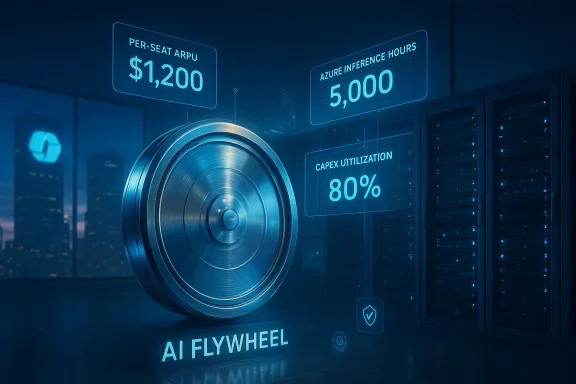
Turning distribution into durable cashflow is not g Alpha piece zeroes in on four operational levers that will determine whether Microsoft’s premium valuation is justified: seat conversion, inference economics (margin per inference), capex utilization (how quickly new capacity is monetized), and the timing of custom silicon.1) Seat conversion: beyond vanity metrics
Trials and demos are easy; paid, sustained adoption is hard. The key metrics are:- Copilot billed seats and conversion rates from trial to paid.
- Per‑seat ARPU and churn.
- Retention and expansion within large.
2) Inference economics and unit costs
Large‑scale inference is a volume game. The question is whether per‑unit economics—GPU hours, telemetry overhead, model size and caching strategies, network and storage egress—support attractive gross margins after the cost of compute is counted. Microsoft has said AI contributed materially to growth (adding double‑digit percentage points to Azure growth), but the company has also disclosed the heavy capital and power investments needed to host state‑of‑the‑art inference workloads. External analysts and Microsoft’s own statements confirm this dynamic.3) CapEx cadence vs. utilization
Buying or leasing GPUs and building datacenters is the easy part compared with filling them with paying workloads at predictable margins. The time lag—how many quarters it takes between capacity coming online and being used efficiently—drives whether capex is an investment or a persistent drag on margins. Microsoft’s guidance and analyst commentary emphasize this timing risk. ([cnbc.com](Microsoft shares slip on weak quarterly revenue guidance4) Custom silicon and supplier dynamics
Custom accelerators can materially improve per‑inference economics, but they carry development, fab, and integration risk. Meanwhile, GPU supplier pricing and availability are volatile; spot pricing swings and supplier allocation policies affect unit economics. Microsoft’s roadmap for any custom silicon or tighter supply agreements is an execution risk that investors must monitor.Product and platform developments: Copilot Studio, agents, and real‑world demand
Microsoft has aggressively productized the agent concept. Copilot Studio now supports autonomous agents, deep reasoning, and a Model Context Protocol (MCP) to integrate knowledge servers and tools—capabilities that materially expand enterprise use cases and, by extension, paid consumption. Microsoft announced general availability of autonomous agents and frequent Copilot Studio feature updates through 2025. Those product moves convert technical capability into deployable customer outcomes.Autonomous agents and “computer use” features enable agents to take actions across applications and web UIs—functionality that can drive real productivity gains, but also raises operational, reliability, and security expectations that enterprises will require before scaling. The product is moving from novelty to platform; the revenue path depends on convincing procurement, compliance, and security teams that agentic automation produces measurable ROI.
Security, governance, and the EchoLeak wake‑up call
No technology more powerful than LLMs is also more sensitive to context and guardrails. The EchoLeak research—responsibly disclosed by Aim Labs and confirmed with a Microsoft CVE (CVE‑2025‑32711)—demonstrated a zero‑click exfiltration vector where attacker‑supplied instructions inside untrusted content could cause Copilot to leak privileged data. Microsoft patched the issue server‑side and said no customers were affected, but the incident highlighted several structural risks: how retrieval‑augmented generation (RAG) systems treat untrusted inputs, the complexity of scope and context boundaries in LLMs, and the need for runtime guardrails.EchoLeak is an industry‑level signal: agentic features can amplify productivity but also introduce novel attack surfaces that traditional perimeter defenses don’t catch. For CIOs and security teams, the implications are immediate:
- Treat Copilot and agents as platforms: enforce DLP, telemetry, and red‑team testing for agent behavior.
- Negotiate contractual protections: capacity pricing ceilings, audit transparency, and security SLAs.
- Prefer hybrid architectures for regulated or latency‑sensitive workloads to reduce exposure.
The OpenAI relationship, Stargate, and infrastructure dynamics
The Microsoft–OpenAI relationship is a critical strategic input to the thesis. In early 2025 OpenAI announced the Stargate Project—an effort with partners including Oracle and SoftBank to build massive new AI compute capacity—and disclosed it would no longer be strictly exclusive to Azure for all new capacity. Microsoft clarified the arrangement: core elements of the partnership remain—IP access, revenue sharing, and API availability on Azure—but OpenAI now can build additional capacity and Microsoft retains a right of first refusal for new compute commitments. That tweak matters materially for Azure’s planning and for investor perceptions of Microsoft’s exclusivity advantage.Why this matters: OpenAI’s ability to diversify compute providers reduces single‑provider exposure for its training and research workloads, but the Azure ecosystem retains preferential integration points (Copilot channel distribution). Practically, Microsoft must compete not just on capacity but on product integration, price, and the operational guarantees enterprise customers demand.
KPIs to watch — the scoreboard that matters
To separate marketing from monetization, investors and IT leaders should track a focused set of operational KPIs that reveal whether Microsoft’s investments are converting into- Copilot billed seats (paid, not trial) and month‑over‑month churn.- Per‑seat ARPU and uplift in enterprise license ASP.
- Azure AI inference hours,nd inference gross margins.
-lized utilization on newly commissioned capacity. - RPO composition (how much backlog is AI‑tied; concentration risk).
- Security incidents, patch cadence, and third‑party verification of mitigations (EchoLeak taught this lesson).
Practical guidance for IT leaders and Windows adminopilot as a platform integration project, not a checkbox feature. Build governance, DLP, and incident response into pilots from day one.
- Run measurable pilots tied to clear ROI metrics: time saved, error reduction, support cost delta, and productivity gains. Don’t pilot for novelty.
- Negotiate commercial terms that limit consumption surprise: capacity pricing bands, predictable inference rates, and contractual transparency on model‑training use of tenant data.
- Keep regulated or latency‑sensitive workloads on hybrid/on‑prem whe AI Foundry and private link patterns to limit exposure.
- Require independent security verification for agentic features and insist on telemetry that surfaces unexpected data access patterns. EchoLeak showed that vendor claims alone are insufficient.
Investment implications — managing the asymmetric payoff
The Seeking Alpha analysis makes a practical, risk‑aware point: Microsoft is plausibly one of the best ways to own enterprile, but the valuation premium is a bet on successful execution across multiple, interdependent fronts.- Bull case: Rapid seat conversion, favorable inference economics, and high utilization turn AI into a multibillion‑dollar recurring revenue stream that justifies the capex and supports margin expansion. Evidence supporting this scenario includes early reported AI run‑rate figures and strong Azure consumption trends.
- Base case: Monetization is real but slower—capex is absorbed over more quarters, margins are pressured during the scaling phase, and valuations reprice to reflect a longer payoff window.
- Bear case: Supplier pricing, delayed custom silicon, security setbacks, or slower seat coonged margin drag—investors should expect volatility and an extended grading period.
Strengths, risks, and the verdict
Notable strengths
- Unrivaled distribution: Office/Windows/Teams/M365 footprints provide an immediate pathway to monetize AI features.
- Hyperscale cloud platform: Azure’s velocity and enterprise trust underpin consumption monetization.
- Product momentum: Copilot Studio and autonomous agents are moving from preview to enterprise feature sets that can drive measurable workflosoft.com](https://www.microsoft.com/en-us/mic...t-studio/whats-new-in-copilot-studio-m=openai))
- Financial capacity: Microsoft’s willingness to front‑load capex and absorb near‑term margin pressure is a competitive advantage in an arms race for compute.
Material risks
- Execution timing: Capex without utilization is a margin sink; the timing between capacity build and paid consumption is the single largest operational risk.
- Inference economics: If per‑unit costs remain high relative to what customers will tolerate, consumption revenue will be lower‑margin than anticipated.
- Security and governance: Agentic features bring novel attack vectors; EchoLeak shows real world blind spots that can slow enterprise adoption unless mitigated and independently verified.
- Partner dynamics: Changes in the OpenAI relationship and multi‑vendor initiatives like Stargate introduce external risk to the exclusive‑compute narrative—even as Microsoft retains strong integration and ROFR.
What to watch next (concrete triggers)
- Microsoft quarterly releases: look for explicit Copilot seat and ARPU disclosures, Azure AI consumption commentary, and capex cadence.
- Third‑party telemetry and independent security audits of agent behaviors—how quickly vendors remediate and publish mitigations after disclosures like EchoLeak.
- Supplier pricing trends for GPUs and accelerator availability; any sign of long‑term contract pricing improvements or worsening spot market dynamics will affect inference economics.
- Progress on custom silicon timelines or announced efficiency wins—these materially change unit economics.
Conclusion
Microsoft’s strategy to convert its massive software distribution into a durable, AI‑driven revenue flywheel is both credible and execution‑sensitive. The Seeking Alpha thesis neatly frames the opportunity and the dependencies: Microsoft has the assets—the distribution, the platform, and the balance sheet—to capture enterprise AI monetization at scale, but the payoff requires self‑discipline, favorable unit economics, timely capacity utilization, and robust security controls.The public record supports the raw pieces of the thesis: headline quarterly revenue and an announced AI run rate near $13 billion, Azure growth in the low 30% range, and very large capex commitments—facts that are verifiable in Microsoft’s statements and mainstream coverage.
For Windows administrators, CIOs, and investors, the practical posture is the same: be measuredly optimistic. Build governance into pilots, watch the KPIs that meaningfully connect product adoption to monetization, demand contractual clarity on consumption and security, and track the scoreboard quarter by quarter. Microsoft’s generational bet may yet pay off handsomely—but it will be decided by execution, not by slogans.
Source: Seeking Alpha Microsoft's Blue Ocean Opportunity: Enterprise 'OpenClaw' (NASDAQ:MSFT)
