

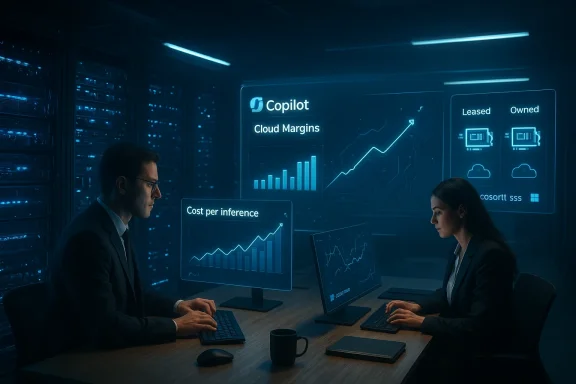
Microsoft’s Q2 preview has moved from routine quarter-to-quarter analysis into what feels like the industry’s greatest pressure test since 2021 — not because the company is suddenly vulnerable, but because the scale, timing and economics of its AI bets are now both measurable and market-moving. The headline numbers are impressive: double-digit revenue growth, an AI business that company management says has crossed an annualized revenue run rate in the low double-digit billions, and capex that has jumped to levels rarely seen outside of telecom or energy. But the real story for Windows users, IT leaders and investors is less about those topline figures and more about the operating algebra underneath them — GPU utilization, seat conversion for Copilot, cloud gross margins, the mix of leased versus owned accelerators, and the timing of custom silicon coming online. Those variables will determine whether the quarter is a bump in the road or a multi-quarter inflection.
Microsoft’s recent quarter presented a clean, verifiable set of facts: solid overall revenue growth, robust Azure expansion, and a materially higher level of capital spending directed at AI-capable data centers. Management’s public comments framed the company’s strategy as intentional: accept near-term margin and cash intensity to avoid capacity constraints and to embed AI across Microsoft 365, Windows and Azure — thereby converting compute into higher-quality, seat-based monetization.
This preview examines those facts, synthesizes independent corroboration, and translates the implications into a practical scoreboard: which metrics to track, what outcomes would validate the thesis, and which developments would justify caution.
Practical investing posture: measured optimism. Treat Microsoft as a high-quality core holding if you accept the premium and track the operational scoreboard closely. For IT leaders and Windows users, plan for progressive AI feature rollout, but build governance, cost controls, and hybrid patterns into adoption plans. Watch the KPIs that matter — Copilot seat economics, Azure inference consumption, cloud gross margins, capex composition, and GPU utilization — because those are the metrics that will convert narrative into evidence, and determine whether the company’s bold, front‑loaded strategy is vindicated or prolonged into a multi‑quarter grading period.
Conclusion: Microsoft is arguably one of the most defensible ways to own enterprise AI exposure at scale, but that claim rests on a chain of operational deliverables. The next several quarters — each an empirical test — will tell whether this is a prudent prepayment for market leadership or a longer slog before the unit economics turn decisively positive.
Source: Seeking Alpha Microsoft Q2 Preview: The Greatest Pressure Test Since 2021 (NASDAQ:MSFT)
 Overview
Microsoft’s recent quarter presented a clean, verifiable set of facts: solid overall revenue growth, robust Azure expansion, and a materially higher level of capital spending directed at AI-capable data centers. Management’s public comments framed the company’s strategy as intentional: accept near-term margin and cash intensity to avoid capacity constraints and to embed AI across Microsoft 365, Windows and Azure — thereby converting compute into higher-quality, seat-based monetization.This preview examines those facts, synthesizes independent corroboration, and translates the implications into a practical scoreboard: which metrics to track, what outcomes would validate the thesis, and which developments would justify caution.
Background: Why Q2 Feels Different
The shift from software to AI infrastructure
For much of Microsoft’s modern history, growth came from software distribution, enterprise agreements, and gradual cloud adoption. Now, the company is front-loading the infrastructure layer — building GPU-dense capacity, leasing what it needs short-term, and pursuing internal accelerators longer-term. That capital-first posture makes near-term results noisier and more dependent on timing than prior growth cycles.The three operating levers that matter
At the simplest level, Microsoft’s AI trade can be modeled with three levers:- Monetization: turning AI features (Copilot, GitHub Copilot, Azure AI inference) into recurring, seat-based revenue and higher ARPU.
- Capacity economics: capex and leasing decisions that set the unit cost of inference and training.
- Utilization: the percentage of deployed GPUs actually producing paying inference cycles (or internal value).
Q2 Quick Facts: What Management Said (and why it matters)
- Total revenue grew in the low double digits to roughly the high $60‑billion range for the quarter.
- Azure and other cloud services expanded around the low-30% year‑over‑year mark.
- Management reported an AI annualized revenue run‑rate in the order of magnitude of low double-digit billions.
- Quarterly capital expenditures jumped to the high tens of billions on an annualized basis, with one quarter’s spending reaching rare, record-setting levels.
- Microsoft Cloud revenue exceeded $40 billion for the quarter, driven materially by AI workloads.
What This Quarter is Testing: The Four Hypotheses
Microsoft’s strategic narrative can be restated as four testable hypotheses. Q2 — and the next several quarters — will either validate or weaken each.- Copilot and seat monetization scale quickly enough to offset infrastructure drag.
- Outcome to validate: measured growth in paid Copilot seats, rising ARPU within Microsoft 365 commercial, and clear references to larger multi‑year seat deals or expansions.
- Risk signal: strong adoption but low conversion from trial/pilot to paid seat, or ARPU growth that fails to match the added infrastructure costs.
- Azure AI inference becomes a durable, high‑margin consumption engine.
- Outcome to validate: rising Azure inference consumption that is increasingly billed on a consumption basis with gross margins improving as utilization rises and owned capacity increases.
- Risk signal: inference growth is real but still heavily tied to leased, premium-priced GPU capacity that suppresses cloud gross margins.
- Custom accelerators and software optimizations materially reduce cost-per-inference within a multi‑quarter horizon.
- Outcome to validate: announcements of internal accelerators with concrete performance-per-dollar improvements, or measurable step‑down in third‑party GPU spend as owned capacity replaces leases.
- Risk signal: custom silicon timeline slips or gains are incremental and insufficient to offset the near‑term capital drag.
- Commercial bookings and RPO give forward visibility that justifies front‑loading capex.
- Outcome to validate: a rising Remaining Performance Obligation (RPO) or record commercial bookings tied explicitly to AI and Azure commitments.
- Risk signal: bookings growth that’s more promotional/short-term versus long-term binding contracts.
Deep Dive: Financials, Margins and CapEx
Revenue and Azure growth — real but nuanced
Microsoft’s quarter delivered the sort of headline revenue beat investors expect from a market leader. But the nuance lies in the composition: a meaningful slice of Azure’s growth was AI-driven, while some non‑AI cloud growth showed friction. That split is important because AI-driven consumption can justify accelerated infrastructure, whereas non‑AI softness suggests go-to-market or macroweakness.Cloud gross margins — the canary in the coal mine
Cloud gross margins are the most sensitive near‑term variable. When you scale GPU-dense capacity, COGS rises: accelerated depreciation, specialized hardware leasing, higher power and cooling, and software stack investment to manage inference workloads. If Microsoft can show cloud gross margins stabilizing or improving as owned capacity replaces leases, that’s validation. If margins remain depressed, it suggests the unit economics are still unfavorable.CapEx cadence — strategic investment or margin pressure?
One quarter of record capex is manageable; a multi‑quarter run of elevated capex is different. The composition of capex (data center equipment and finance leases vs. non-infrastructure spend) matters. Investors want to see capex buy durable economic returns: owned accelerators that lower per‑inference costs, improved utilization, and the ability to capture more of the gross margin pool as productized AI features scale.Product and Ecosystem Implications for Windows Users and IT Leaders
For Windows users
Expect continued trickle-down of AI features into Windows and Office: smarter search, contextual summaries, and deeper OS-to-cloud integrations. Those features change workflows more than they change the hardware people buy, but they increase stickiness around Microsoft 365 and Windows ecosystems.For IT leaders
Copilot adoption is not a checkbox. Treat it as a procurement and governance program:- Model licenses as an ongoing operational expense, not a one-time feature.
- Include data residency, compliance, and inference economics in procurement decisions.
- Prioritize hybrid deployment for sensitive workloads and push less-sensitive, high-volume inference to public cloud.
- Cost-efficient inference patterns (batching, model distillation).
- Telemetry and observability for performance and cost.
- Hybrid architectures that enable data locality and cost control.
Practical Scoreboard: Metrics to Watch Next Quarter
If you want to move beyond narrative and track whether Microsoft’s strategy is working, follow this concise, prioritized checklist.- Copilot Paid Seats and ARPU — Are trials converting to paid seats? Is average revenue per paying seat rising? This is the most direct proof of seat monetization.
- Azure AI Inference Consumption — Month-over-month or quarter-over-quarter consumption growth; look for normalized growth excluding one-off contract effects.
- Cloud Gross Margin Percentage — Sequential movement here will tell the story of utilization and cost management.
- CapEx Composition — What portion of capex is data center hardware and finance leases? Is the cadence increasing or stabilizing?
- Remaining Performance Obligation (RPO) and Commercial Bookings — Higher, longer‑dated RPO tied to AI indicates forward revenue visibility.
- GPU Leasing vs. Owned Capacity Ratio — Any guidance or disclosure about the share of leased GPU capacity over time is crucial.
- Custom Silicon Milestones — Productization of Microsoft accelerators and any measured cost/perf improvements.
- Large AI Contract Wins — Enterprise contracts above $100M or multi-year Azure commitments tied to OpenAI or other large customers.
Scenarios: Bull, Base, Bear
Bull case (execution validates the strategy)
- Copilot adoption accelerates and ARPU rises.
- Azure AI inference becomes a durable consumption business.
- Owned accelerators materially lower the cost of inference within 2–4 quarters.
- Cloud gross margins recover, and RPO/bookings provide visible payback.
Base case (partial execution)
- AI revenue grows materially but custom silicon is slower than hoped.
- Cloud margins recover incrementally as owned capacity displaces leases over several quarters.
- Valuation drifts but long-term return remains attractive for patient investors.
Bear case (execution shortfalls)
- Seat conversion disappoints; utilization remains suboptimal.
- Third-party suppliers retain pricing power; GPU leasing remains expensive.
- Regulatory or competitive pressures limit bundling or ARPU expansion.
Strengths: Why the Seeking Alpha-like Thesis is Credible
- Distribution & Annuitization: Microsoft owns hundreds of millions of Office seats and enterprise agreements, a distribution advantage few companies can match.
- Balance-Sheet Optionality: The company can absorb capex cycles and lease capacity to manage timing risk.
- Product Integration: Embedding Copilot across Microsoft 365, Windows and developer tools creates sticky monetization paths that are higher value than raw compute consumption.
- Commercial Scale: Large bookings and enterprise relationships provide visibility and the ability to lock in multi-year commitments.
Risks and Where the Thesis Could Break
- Timing risk is the dominant variable. The thesis is time-sensitive: a one-quarter slip versus a multi‑quarter delay in custom silicon or utilization improvements materially changes outcomes.
- Supplier concentration and pricing. If third-party GPU suppliers maintain pricing power, Microsoft’s leased-capacity costs remain high and margins suffer.
- Competition from low-cost models. Advances by alternative providers that materially lower the cost of inference could compress pricing and erode the edge Microsoft hopes to monetize via seat-based models.
- Regulatory and antitrust constraints. Bundling Copilot into Microsoft 365 or Windows at scale could invite regulatory scrutiny that affects packaging and pricing strategies.
- Stranded capacity. Overbuilding ahead of demand risks underutilized data-center assets and impairment charges.
Tactical Takeaways: For Investors, IT Pros and Windows Fans
- For long-term investors: Microsoft still fits a core allocation if you size positions for a premium and accept multi‑quarter execution risk. Expect the payoff to be multi‑quarter to multi‑year.
- For value-focused investors: Watch cloud gross margins, Copilot seat economics, and capex trends closely; these will be the first signals markets use to re-price risk.
- For IT leaders: Start Copilot pilots with a governance plan and a cost model that includes inference economics and data residency considerations.
- For Windows enthusiasts and developers: Prioritize integration scenarios that preserve user privacy while leveraging cloud inference for productivity — hybrid patterns will dominate for the foreseeable future.
How to Read the Next Earnings Call (A Short Playbook)
- Listen for concrete Copilot seat counts and explicit ARPU commentary.
- Ask about the mix of Azure growth: how much is AI vs. non-AI?
- Probe capex composition and the timeline for owned accelerators.
- Demand disclosure on leased vs. owned GPU capacity and utilization guidance.
- Look for large, multi-year Azure commitments and RPO growth tied to AI.
Final Assessment
Microsoft’s Q2 preview is less about a single quarter and more about a structural trade: front-load capital to secure platform leadership in enterprise AI, then monetize via seat economics and cloud consumption. The raw factual pillars are clear and verifiable — robust revenue growth, a sizable AI run rate, accelerated capex — but the payoff is execution-sensitive. The company’s unique assets — distribution, balance sheet, annuities — give it a credible path to win. The greatest pressure test since 2021 is therefore not a death knell; it’s an operating crucible.Practical investing posture: measured optimism. Treat Microsoft as a high-quality core holding if you accept the premium and track the operational scoreboard closely. For IT leaders and Windows users, plan for progressive AI feature rollout, but build governance, cost controls, and hybrid patterns into adoption plans. Watch the KPIs that matter — Copilot seat economics, Azure inference consumption, cloud gross margins, capex composition, and GPU utilization — because those are the metrics that will convert narrative into evidence, and determine whether the company’s bold, front‑loaded strategy is vindicated or prolonged into a multi‑quarter grading period.
Conclusion: Microsoft is arguably one of the most defensible ways to own enterprise AI exposure at scale, but that claim rests on a chain of operational deliverables. The next several quarters — each an empirical test — will tell whether this is a prudent prepayment for market leadership or a longer slog before the unit economics turn decisively positive.
Source: Seeking Alpha Microsoft Q2 Preview: The Greatest Pressure Test Since 2021 (NASDAQ:MSFT)
