

Microsoft’s pivot from a software‑first company into a cloud‑and‑AI platform heavyweight is no longer theory — it’s measurable in revenue mix, unit economics, and capital intensity — and the Seeking Alpha thesis that Microsoft’s Azure and AI businesses provide stability backed by structural moats deserves careful attention and scrutiny. ttps://windowsforum.com/threads/microsofts-ai-first-strategy-fuels-growth-azure-and-copilot-lead.387239/latest)
Microsoft’s recent quarters have made the AI transition unambiguous. The company reported quarterly revenue near $69.6 billion, with Azure and other cloud services growing roughly 31% year‑over‑year and Microsoft Cloud revenue exceeding $40 billion in the quarter under review. Management has pointed explicitly to AI workloads as a material driver of Azure’s growth and disclosed an **AI annualized revenue run‑rate in the neighborhood of $1dline facts are the core inputs for any contemporary investment thesis about Microsoft.
At the same time, Microsoft’s capital plans have shifted. The company is investing aggressively in AI‑ready infrastructure — GPU‑dense racks, specialized networking, and co‑design work with partners — producing multi‑billion‑dollar quarterly capex spikes and forward capital guidancagnitude larger than in the pre‑AI era. Industry reporting and corporate commentary point to capex guidance and spending in the range that implies a concerted AI infrastructure push.
This article synthesizes the Seeking Alpha bullish argument, verifies the load‑bearing claims against independent sources, and offers critical journalistic analysis of what the numbers mean for investors, corporate customers, and the broader AI ecosystem.
However, the thesis is not risk‑free.d a lower short‑term margin profile for infrastructure scale, and returns on that infrastructure depend on utilization, pricing, and successful seat adoption. Capex commitments are large, and the hyperscale AI arms race means Microsoft must execute operationally and commercially — this is an execution story as much as it is a structural one. Independent industry reporting corroborates both the revenue traction and the capex escalation, underscoring the reality of both upside and downside.
For investors and enterprise customers, the prudent approach is scenario planning: if Microsoft successfully converts AI run‑rate into recurring, seat‑based revenue while normalizing infrastructure economics, the company’s long‑term returns on invested capital could be exceptional. If utilization or pricing dynamics disappoint, the company faces a longer period of margin compression and valuation sensitivity.
Conservative readers should model multiple outcomes, focus on capex cadence and Copilot adoption metrics, and treat management run‑rate figures as directional inputs rather than definitive GAAP line items. Optimists will see the same inputs as evidence that Microsoft is doing precisely what platform owners must do: accept near‑term investment pain to secure long‑term, high‑quality revenue rents. The resulting posture will define not only Microsoft’s next decade, but the shape of enterprise AI adoption itself.
Source: Seeking Alpha Microsoft: Cloud And AI-Driven Stability (NASDAQ:MSFT)
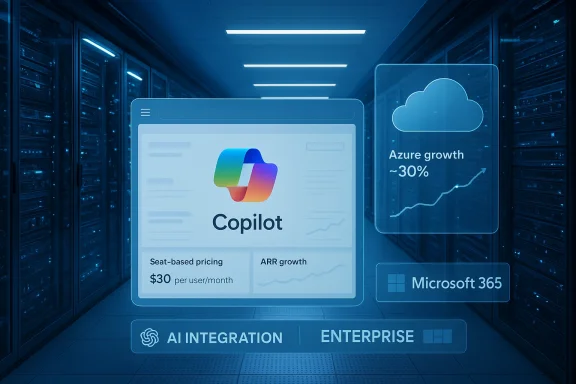 Background / Overview
Microsoft’s recent quarters have made the AI transition unambiguous. The company reported quarterly revenue near $69.6 billion, with Azure and other cloud services growing roughly 31% year‑over‑year and Microsoft Cloud revenue exceeding $40 billion in the quarter under review. Management has pointed explicitly to AI workloads as a material driver of Azure’s growth and disclosed an **AI annualized revenue run‑rate in the neighborhood of $1dline facts are the core inputs for any contemporary investment thesis about Microsoft.At the same time, Microsoft’s capital plans have shifted. The company is investing aggressively in AI‑ready infrastructure — GPU‑dense racks, specialized networking, and co‑design work with partners — producing multi‑billion‑dollar quarterly capex spikes and forward capital guidancagnitude larger than in the pre‑AI era. Industry reporting and corporate commentary point to capex guidance and spending in the range that implies a concerted AI infrastructure push.
This article synthesizes the Seeking Alpha bullish argument, verifies the load‑bearing claims against independent sources, and offers critical journalistic analysis of what the numbers mean for investors, corporate customers, and the broader AI ecosystem.
What Seeking Alpha argued — a concise summary
The Seeking Alpha piece frames Microsoft as a platform owner that is deliberately accepting margin compression in the near term to avoid capacity constraints and solidify a much larger, higher‑quality revenue base over time. The bullish comribution and entrenchment**: Microsoft already controls hundreds of millions of productivity seats (Office/Microsoft 365, Windows) and deep enterprise relationships; embedding AI there creates powerful seat‑based monetization with sticky recurring revenue.- AI molity: Rather than pure compute resale, Microsoft aims to turn compute into differentiated, productized features (Copilot seat economics, Microsoft 365 AI add‑ons, GitHub Copilot), which command higher margins and stronger retention.
- **Balance sheet ft can tolerate near‑term capital intensity because of its cash flow, recurring revenue base, and strategic partnerships (notably its relationship with OpenAI), giving it the optionality to scale ahead of demand.
The numbers: independent verification and context
Any high‑quality analysis must validate the key figures. Below I cross‑check Seeking Alpha’s load‑bearing facts against independent reporting and Microsoft’s public narrative.Revenue and cloud growth
- Seeking Alpha cited quarterly revenue in the high $60 billion range and **Azure growth around lic quarterly reporting and contemporaneous press coverage corroborate this figure; Azure and other cloud services growth was reported in the low‑to‑mid 30% area for the quarter in question.
AI annualized revenue run‑rate
- The $13 billion annualized AI run‑rate figure appears in company commentary and was widely repeated across financial outlets. This figure aggregates monetizationAI consumption, and related enterprise AI contracts. It is management‑provided and confirmed in earnings commentary reported by multiple outlets. Note: company‑provided run‑rate figures are useful but are backward‑looking snapshots of current sales pace, not guaranteed future annual revenue.
Capital expenditures and infrastructure spending
- The Seeking Alpha piece flagged a material uptick in capex, with quarters showing capex in the tens of billions. Independent industry analyses and reporting place Microsoft among the hyperscalers dramatically in infrastructure, and some industry tallies attribute an $80B+ annual capex posture for Microsoft in aggressive build scenarios for fiscal years centered on AI investments. Those numbers are reported in investor materials and corroborated by industry trackers. However, exact future capex projections vary by source and are sensitive to timing, exchange rates, and finance‑lease accounting.
Margin pressure
- Microsoft disclosed that cloud gross margins compressed as it scaled AI infrastructure, falling into the low‑70s (percentage) in periods where capacity was being brought online. This is consistent with public commentary: AI workloads carry higher infrastructure weight per dollar of revenue (accelerator utilization, model hosting, fine‑tuning) and thus depress cloud gross margins until utilization and software monetization improve.
Why the bullish case is credible — structuralpha’s core structural arguments are persuasive when examined closely. The strengths are concrete and measurable.
1) Platform distribution is a real moat
Microsoft’s enterprise presence — Microsoft 365, Teams, Windows for Business, and long enterprise agreements — is an extraordinary distribution asset. Embedding AI into productivity workflows converts AI from a commodity service into a workflow‑integrated feature, which changes pricing power and churn dynamics. This *seat econtral: companies pay per seat for productivity enhancements, not per GPU hour. That changes the monetization profile fundamentally.2) Productized AI (Copilot and Microsoft 365 add‑ons) drives higher ARPU
Copilot and other AI features are designed as add‑ons to existing subscriptions, enabling Microsoft to monetize AI through familiar channels (seat upgrades, bundles, enterprise agreements). If enterprises accept seat‑based pricing fcrosoft can capture higher margin revenue than raw infrastructure resale. This transforms capital‑intensive compute into durable, subscription revenue.3) Balance sheet and contractual optionality
Microsoft’s scale — large recurring revenue, significant free cash flow, and enterprise annuities — gives it the optionality to invest ahead of demand. The company can build capacity in anticipation of enterprise adoption and then capture the economic upside when monetization catches up. This flexibility differentiates it from smaller cloud providers and many enterprise software vendors.Risks, counterarguments, and the execution sensitivity
The bullish thesis rests on execution and market acceptance. The following risks are material and warrant being front and center in any investment or sA. Capital intensity may extend the margin drag longer than expected
Microsoft’s capex increases are real and large, and the duration of that spending matters. If GPU pricing, supply chains, or utilization dynamics do not normalize in the expected window, Microsoft could endure multi‑quarter margin compression that pressures operating income and returns on incremental capital. Industry reports show substantial capex commitments, and the arms race for AI capacity may force continued spending even as the revenlays catch‑up.B. Utilization and pricing dynamics
AI workloads are currently expensive to host. If utilization (the percentage of time accelerators are running paying workloads) stays low, or hyperscaler competition drives aggressive pricing, the compute economics could remain unattractive. Even with seat moers balk at seat pricing or seek open alternatives, Microsoft may face slower monetization than projected. Real enterprise purchasing cycles and legal/regulatory frictions can also slow adoption.C. Competition and supplier concentration
Microsoft’s strategy depends otners (notably NVIDIA chips, but also potential custom silicon paths). Supply concentration in high‑end accelerators (e.g., NVIDIA) introduces geopolitical, pricing, and capacity risks. Moreover, other cloud providers and independent AI startups are pursuing differentiated go‑to‑market strategies and custom silicon that could change competitive dynamics.D. Measurement and transparency limits
Several load‑bearing figures (AI run‑rate, Azure AI‑specigement‑provided and not always broken out in GAAP line items. Analysts and investors must therefore triangulate using multiple disclosures and third‑party estimates. That increases uncertainty and makes modeling the timeline of payback more ae.How to think about the tradeoff: capex now, subscription economics later
The central strategic tradeoff is straightforward: Microsoft is accelerating physical infrastructure and software integration to capture AI demand and accepting near‑term margin pressures to secure longer‑term recurring revenue that is higher quality than raw compute sales. Investors should parse that tradeoff along a few axes.- Short horizon (0–12 months): expect elevated capex, pressure on cloud gross margins, and continued investor sensitivity to growth rates. Earnings may look uneven as infrastructure costs move faster than monetization.
- Medium horizon (12–36 months): if Copilot seat adoption and enterprise Azure AI consumption scale as management expects, ARPU and operating leverage should improve materially. Seat‑based monetization can reduce churn and lift margins.
- Long horizon (3+ years): the winners will be those who combine distribution, productized agent workflows, and cost‑efficient infrastructure — if Microsoft achieves all three, it captures disproot, the capex could be sunk cost with weaker returns.
Implications for enterprise IT decision makers
Microsoft’s strategy affects customers and procurement in tangible ways.- Procurement planning: Enterprises should anticipate bundled AI offerings from Microsoft and re‑evaluate SaaS renewals to capture AI add‑ons that may change total cost of ownership.
- Dependency vs. optionality: Embracing Microsoft AI features increat may deliver meaningful productivity gains; organizations must weigh vendor concentration against measured productivity uplift.
- Hybrid and on‑prem considerations: Microsoft’s investments include both cloud and hybrid solutions (e.g., Azure Arc, on‑prem inferencing options). Customers looking for staged adoption can leverage hybrid offerings to optimize cost and performance.
Valuation and investor checklist
For investors, the model for Microsoft in the AI era requires explicit lines for the following items:- CapEx trajectory and timing — how long will elevated capital spending persist, and what is the expected payback window? Compare company guidance to independent capex trackers.
- AI revenue run‑rate growth and conversion — assess how quickly AI run‑rate translates into booked ARR and subscription revenue. Management’s $13B run‑rate is a useful baseline but requires modeling conversion rates to durable revenue.
- Cloud gross margin normalization — model scenarios for accelerator pricing, utilization improvements, and software monetization to estimate margin recovery.
- Competitive responses — incorporate potential price pressure from hyperscaler competition or faster‑than‑expected custom silicon adoption by competitors.
- Regulatory and geopolitical risk — account for restrictions on data flows, export controls on high‑end chips, and antitrust scrutiny that could raise costs or contions.
Technical implications: architecture, supply chain, and software engineering
Microsoft’s investments are not just about more data centers — they touch the stack end‑to‑end.- Hardware stack: GPU accelerators and specialiinate the capex conversation. Microsoft’s partnerships with chip vendors and potential moves toward custom silicon will be decisive for unit economics.
- Platform engineering: Operationalizing LLMs at scale requires orchestration layers, model management, observability, and cost controls that are different from trad. Microsoft’s investment in these layers increases stickiness if executed well.
- Security and compliance: As customers deploy generative AI across regulated workflows, requirements around data governance, private model hosting, and auditing become central. Microsoft’s enterprise footprint gives it an advantage if it can deliver compliant offerings at scale.
Practical signals to watch next quarter by quarter
To track whether the Seeking Alpha thesis is unfolding as promised, watch these signals:- Azure growth rate and explicit commentary on *AI‑contributedrcentage points attributable to AI).
- Movement in cloud gross margin percentage and management’s discussion of utilization and pricing.
- Copilot seat counts, Microsoft 365 AI adoption metrics, or other concrete customer uptake numbers.
- Quarterly capex and guidance revisions, particularly any changes to the announced multi‑year infrastructure posture.
- Partner and supplier trends — e.g., commitments from NVIDIA or announcements of custom silicon.
Final analysis — weighing optimism against execution risk
Seeking Alpha’s bullish take on Microsoft is rooted in real structural advantages: deep enterprise distribution, a large installed base of seats, and the ability to package AI as a productivity feature rather than a commodity compute sale. Those are powerful economic levers. The $13 billion AI run‑rate and ~31% Azure growth are tangible signs that monetization has begun, not merely future promise.However, the thesis is not risk‑free.d a lower short‑term margin profile for infrastructure scale, and returns on that infrastructure depend on utilization, pricing, and successful seat adoption. Capex commitments are large, and the hyperscale AI arms race means Microsoft must execute operationally and commercially — this is an execution story as much as it is a structural one. Independent industry reporting corroborates both the revenue traction and the capex escalation, underscoring the reality of both upside and downside.
For investors and enterprise customers, the prudent approach is scenario planning: if Microsoft successfully converts AI run‑rate into recurring, seat‑based revenue while normalizing infrastructure economics, the company’s long‑term returns on invested capital could be exceptional. If utilization or pricing dynamics disappoint, the company faces a longer period of margin compression and valuation sensitivity.
Conclusion
Microsoft’s cloud‑and‑AI pivot is tangible in numbers and strategy: Azure growth in the low‑30s, a reported AI annualized run‑rate around $13 billion, and elevated capex tied to AI infrastructure are all verifiable, load‑bearing facts. These facts undergird the Seeking Alpha bullish case — a credible, structural narrative — but they do not eliminate execution risk. Investors should value Microsoft not only as a defensive annuity of productivity software, but as an active infrastructure builder placing a large strategic bet on enterprise AI. That bet is defensible, measurable, and potentially transformative — provided Microsoft converts infrastructure into software‑priced, seat‑based revenue at scale and controls the timing and magnitude of the capital intensity required to get there.Conservative readers should model multiple outcomes, focus on capex cadence and Copilot adoption metrics, and treat management run‑rate figures as directional inputs rather than definitive GAAP line items. Optimists will see the same inputs as evidence that Microsoft is doing precisely what platform owners must do: accept near‑term investment pain to secure long‑term, high‑quality revenue rents. The resulting posture will define not only Microsoft’s next decade, but the shape of enterprise AI adoption itself.
Source: Seeking Alpha Microsoft: Cloud And AI-Driven Stability (NASDAQ:MSFT)
