

Microsoft’s rise from “your parents’ software company” to the hottest — and most expensive — name in tech feels both inevitable and confounding: inevitable because the company now sells AI-driven productivity at enterprise scale, confounding because you’re paying a premium price to own a business that’s simultaneously a utility, a research lab, and a capital‑intensive infrastructure operator.
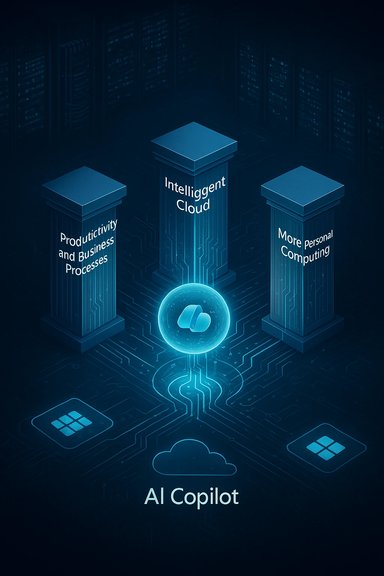
Microsoft today is not just Windows, not just Office, and not just Xbox. Its corporate structure centers on three pillars: Productivity and Business Processes (Office/Microsoft 365, Dynamics, LinkedIn), Intelligent Cloud (Azure, server products, GitHub), and More Personal Computing (Windows, Surface, Xbox, search/ads). That architecture is critical because each pillar differs in margin profile, capital intensity, and growth potential — and Microsoft’s AI pivot ties them together into a single investment narrative.
What changed over the last three years is not that Microsoft learned to market — it’s that it learned to monetize AI inside products it already controls. That shift is what separates the “AI hype” headlines from the real story: companies are paying Microsoft for AI in ways they didn’t pay before, and Microsoft is re‑pricing long‑standing annuities (Office, Teams) around that incremental value. The Ad‑Hoc News overview — part of the conversation feeding social media hype — captured that dynamic: Copilot demos, Game Pass wins, and Azure integration are visible reasons investors are willing to pay up.
Azure’s growth in the AI era has two parts: (1) AI‑driven growth (model hosting, inference, Copilot usage) which shows very high year‑over‑year percentages, and (2) non‑AI Azure growth, which remains important but grows more slowly. Management commentary and third‑party analyses indicate that AI services are adding significant percentage points to Azure’s headline growth.
But this is not a no‑risk “must‑own at any price.” The stock’s premium valuation means investors are buying conviction as much as fundamentals. The two biggest wildcards are (1) whether Microsoft can deploy its massive infrastructure investment efficiently and (2) whether AI monetization keeps accelerating without major competitive or regulatory shocks. For long‑term investors comfortable with these conditionalities, Microsoft is closer to a “cop” for a core allocation; for short‑term speculators chasing outsized returns, it’s probably too fully priced.
This view stitches together the headline conversation that sparked the recent social media frenzy with the hard financial and operational facts — including Microsoft’s own Copilot pricing moves and the company’s public capex and revenue run‑rate disclosures — so you can decide whether you’re buying into an operating transformation or a hype wave.
If tracking Microsoft’s progress, prioritize the five KPIs above, watch quarterly earnings for AI‑specific disclosures, and size positions to reflect both the durable strengths and the non‑trivial execution risks that define this chapter of the company’s story.
Source: AD HOC NEWS The Truth About Microsoft Corporation: Is This Tech Giant Still Worth Your Money?
 Background / Overview
Microsoft today is not just Windows, not just Office, and not just Xbox. Its corporate structure centers on three pillars: Productivity and Business Processes (Office/Microsoft 365, Dynamics, LinkedIn), Intelligent Cloud (Azure, server products, GitHub), and More Personal Computing (Windows, Surface, Xbox, search/ads). That architecture is critical because each pillar differs in margin profile, capital intensity, and growth potential — and Microsoft’s AI pivot ties them together into a single investment narrative.What changed over the last three years is not that Microsoft learned to market — it’s that it learned to monetize AI inside products it already controls. That shift is what separates the “AI hype” headlines from the real story: companies are paying Microsoft for AI in ways they didn’t pay before, and Microsoft is re‑pricing long‑standing annuities (Office, Teams) around that incremental value. The Ad‑Hoc News overview — part of the conversation feeding social media hype — captured that dynamic: Copilot demos, Game Pass wins, and Azure integration are visible reasons investors are willing to pay up.
Where the Numbers Stand Today
Market price and valuation: premium, not bargain
By early January 2026 Microsoft trades in the mid‑to‑high‑$400s per share, placing it firmly in mega‑cap territory where growth expectations are baked into price multiples. Market data summaries around this period show a trailing P/E in the low‑to‑mid 30s and a market capitalization in the multiple‑trillion‑dollar range — in short: investors are paying for highly probable revenue compounding, not a deep value discount. This matters because the premium valuation compresses margin for error. Missed execution on Azure capacity, weaker than expected Copilot uptake, or regulatory interventions can compress multiples quickly. At the same time, the market’s willingness to pay this premium reflects a credible path to material AI revenue, not just marketing spin.AI revenue: not theoretical anymore
Microsoft management and multiple earnings‑season analyses reported an AI business approaching or surpassing a $13 billion annualized revenue run rate, with year‑over‑year growth rates in the triple digits for AI services. That is not a throwaway metric; it’s a concrete scale of monetization from Azure AI, Microsoft 365 Copilot, GitHub Copilot, and other AI products. Put another way: Microsoft has transformed AI from an R&D concept into a growing revenue stream that meaningfully moves the top line. But the pace, sustainability, and margins of that revenue are still being defined.Capital spending: enormous and deliberate
To support AI workloads Microsoft signaled a dramatic ramp in capital spending — widely reported plans for roughly $80 billion of AI‑enabled data center investment for fiscal 2025. This is an extraordinary scale of infrastructure spending intended to carry compute, storage, and networking for model training and inference at hyperscale. Reuters and CNBC reported Microsoft’s plan to make a multi‑tens‑of‑billions infrastructure push to keep pace with demand. The implication is straightforward: Microsoft’s AI revenue curve is funded by a large, near‑term cash outlay. That reduces near‑term free cash flow and raises execution risk — but it also creates a durable infrastructure moat if Microsoft can deploy the CapEx efficiently and match it with high‑value enterprise contracts.The AI Engine: Copilot, Azure, and the OpenAI Partnership
Copilot: where product meets pricing
Microsoft has embedded Copilot across Microsoft 365 apps and into Teams, Windows, and enterprise workflows. For commercial customers, Microsoft 365 Copilot has an explicit per‑seat price (~$30/user/month for Microsoft 365 Copilot in commercial tiers) alongside bundled Copilot Chat options; for consumers, Copilot has been folded into Personal and Family plans, triggering modest price increases for those subscriptions. Microsoft’s own pages and blog confirm the $30 commercial price and the Personal/Family inclusion and price rise. This is a crucial point: Copilot is not free. Microsoft is both selling the AI feature directly and using it as a lever to re‑price existing subscriptions. The company also uses an AI credits model to throttle or monetize heavy usage, effectively creating a two‑part pricing system for AI features.Azure and OpenAI: platform + model economics
Azure provides the compute platform for Microsoft’s own services and for third‑party AI workloads. Through a strategic commercial relationship (and equity exposure) in OpenAI, Microsoft routes significant workloads through Azure, increasing cloud bookings and differentiating its cloud stack for LLM workloads. That combination — cloud infrastructure + differentiated model access — is a hard‑to‑replicate advantage, assuming Microsoft maintains model access and performance leadership.Azure’s growth in the AI era has two parts: (1) AI‑driven growth (model hosting, inference, Copilot usage) which shows very high year‑over‑year percentages, and (2) non‑AI Azure growth, which remains important but grows more slowly. Management commentary and third‑party analyses indicate that AI services are adding significant percentage points to Azure’s headline growth.
Reality Check: Infrastructure, Capacity, and Costs
Data center capacity is a real constraint
Executives have publicly acknowledged that demand for AI compute outstrips short‑term supply. Management warned that certain AI‑grade capacity constraints have shifted timing and that some customers must wait for available compute. That’s a real constraint with real consequences: if Microsoft cannot bring capacity online quickly, customers may move to alternate clouds or to specialized providers. Multiple outlets reported Microsoft highlighting capacity limits as a reason for the aggressive CapEx plan.CapEx: the double‑edged sword
The $80 billion (or similar) capex commitment funds future revenue but also risks returns if market adoption softens, GPU procurement becomes constrained, or competitors provide cheaper models and hosting. This is not just “spend to grow” — it’s a long‑duration asset commitment that requires steady demand to justify.- Upside: If AI monetization scales as forecast, early capacity locks in hyperscale economics, differentiated pricing, and sticky contracts.
- Downside: Underutilized servers are a sunk cost; procuring GPUs (NVIDIA H100/H200 class) exposes Microsoft to supply chain and pricing volatility; and energy/sustainability constraints complicate site selection and cost structures.
Monetization Strategy and the Consumer Backlash
Pricing moves and the opt‑out path
Microsoft’s consumer price increases (adding Copilot to Personal/Family plans and raising rates modestly) and its enterprise Copilot seat pricing show a deliberate strategy: charge for AI, but give customers a path to opt out. The opt‑out offering reduces churn risk in the short term but also creates a segmented revenue approach where heavy enterprise users subsidize consumer adoption. The Microsoft blog announcing Copilot in Personal/Family and the attendant $3/month increase (U.S. made this clear. Third‑party reporting and forum commentary flagged that price increases in some markets have provoked backlash and that Microsoft must manage customer expectations about AI value vs. cost.Copilot uptake: promising but uneven
Enterprise adoption metrics show traction — a meaningful share of enterprise customers are piloting or rolling out Copilot features — but adoption curves vary by sector, by country, and by internal change‑management appetite. Enterprise software adoption is rarely instantaneous; Copilot requires workflow changes, security reviews, and measurable ROI to migrate broad seat counts. Analysts and forums noted adoption is growing but not uniformly explosive.Competition: Who Can Stop Microsoft, and Where Is Pressure Coming From?
- AWS (Amazon) — dominant in raw cloud market share and highly focused on infrastructure economics. AWS competes on price, breadth of services, and enterprise relationships.
- Google Cloud — strong in AI research and in differentiated model offerings (Vertex AI) plus deep data and analytics integrations.
- OpenAI/Anthropic/XAI — model providers who can influence where customers run inference (on Microsoft Azure or other clouds) depending on commercial deals.
- Apple — dominant in hardware/consumer mindshare but not a cloud/AI infrastructure player at Microsoft’s scale.
- Meta — monetizes large AI in advertising and is a competitor in the AI revenue race in certain domains.
Risks: Real and Material
1. Valuation risk
Buying Microsoft at a mid‑30s P/E requires conviction that AI monetization will materially accelerate earnings growth. If growth disappoints, multiples can compress rapidly.2. Execution risk on CapEx
Large data center programs have long lead times. Delays, cost overruns, or supply chain issues for accelerators could push out ROI timelines and pressure margins.3. Monetization and pricing pushback
Consumer price increases and enterprise seat fees could prompt churn or slower adoption, particularly in price‑sensitive regions. Microsoft’s opt‑out approach mitigates but doesn’t eliminate this risk.4. Regulatory and privacy risk
Heavy AI integration with customer data invites regulatory scrutiny around privacy, antitrust (bundling Copilot with Office/Teams), and security. Enterprises demand strong controls; regulatory regimes could require architectural or contractual changes.5. Competitive disruption
A low‑cost model or interoperable stack from other major clouds, or breakthroughs in open‑source model efficiency, could erode Microsoft’s pricing power.6. Reputation and product risk
Bugs, hallucinations, or high‑profile misuse of Copilot features could slow enterprise rollouts and invite legal exposure. Security incidents or product failures have outsized impacts given Microsoft’s enterprise footprint.The Investment Conclusion: Cop, Hold, or Drop?
This is not a clickbait verdict — it is a calibrated framework.- For long‑term, diversified investors seeking a high‑quality tech core: Hold/Buy (core allocation). Microsoft’s durable annuities, accelerating AI revenue, and massive cash flows make it a plausible “core” for portfolios built for growth plus income (dividend + buybacks). The company’s scale and integration across enterprise workflows create a strong moat.
- For short‑term traders or those chasing hypergrowth volatility: Drop/Skip. Microsoft is not a high‑beta, small‑cap AI lottery ticket. The near‑term upside is more contingent on multiples expanding or AI monetization accelerating beyond what’s already priced in.
- For risk‑sensitive value investors: Consider trimming or hold only with strict position sizing. The stock’s premium valuation deserves either conviction or a smaller allocation.
Practical KPIs to Watch (How to Monitor the Thesis)
- Copilot monetization metrics — adoption rates, seats billed, average revenue per seat, and AI credit consumption trends.
- Azure AI growth and disclosure — percent of Azure growth attributable to AI services and gross margins for cloud services.
- Capital expenditure cadence — actual quarterly capex figures vs. guidance and comments on data center buildout timelines.
- Large contract wins and multi‑year Azure commitments — presence of $100M+ deals and remaining performance obligations that signal long‑term revenue.
- Regulatory filings and product incident disclosures — any material privacy or security events will be leading indicators of reputational risk.
Strengths Worth Honoring
- Scale and integration: Microsoft’s cross‑product network effect (Office → Teams → Azure → Windows → GitHub) is a rare asset. Once AI features are embedded in workflows, switching costs grow.
- Proven enterprise relationships: Long‑term contracts and enterprise procurement cycles favor incumbents who can deliver compliance and reliability.
- Balanced monetization: Microsoft combines subscription re‑pricing, per‑seat AI products, and metered AI credits — diversified approaches that capture value in multiple ways.
Open Questions and Cautions
- Can Microsoft convert the $80B CapEx into durable incremental profits at acceptable margins? Reuters/CNBC coverage of the planned investment highlights both the strategic intent and the financial scale, but actual returns depend on filling that capacity with paying workloads.
- Will enterprises adopt Copilot deeply and quickly enough to justify the premium? Adoption is visible but uneven; IT change management matters.
- Will regulatory or antitrust scrutiny force changes to bundling or data practices that impair monetization? That’s unpredictable but material.
Final Verdict — Plainspoken
Microsoft is not a bubble in the colloquial “dot‑com” sense: it produces enormous cash flows, sells proven products, and is already generating meaningful AI revenue. The company’s playbook — bolt AI onto dominant products, charge for it, and supply the compute via Azure — is working at scale. That’s why the market treats the stock as a premium, long‑term core holding rather than a speculative meme.But this is not a no‑risk “must‑own at any price.” The stock’s premium valuation means investors are buying conviction as much as fundamentals. The two biggest wildcards are (1) whether Microsoft can deploy its massive infrastructure investment efficiently and (2) whether AI monetization keeps accelerating without major competitive or regulatory shocks. For long‑term investors comfortable with these conditionalities, Microsoft is closer to a “cop” for a core allocation; for short‑term speculators chasing outsized returns, it’s probably too fully priced.
This view stitches together the headline conversation that sparked the recent social media frenzy with the hard financial and operational facts — including Microsoft’s own Copilot pricing moves and the company’s public capex and revenue run‑rate disclosures — so you can decide whether you’re buying into an operating transformation or a hype wave.
If tracking Microsoft’s progress, prioritize the five KPIs above, watch quarterly earnings for AI‑specific disclosures, and size positions to reflect both the durable strengths and the non‑trivial execution risks that define this chapter of the company’s story.
Source: AD HOC NEWS The Truth About Microsoft Corporation: Is This Tech Giant Still Worth Your Money?
