

Microsoft’s most recent wobble didn’t come from nowhere: a clear trade-off between pressing the accelerator on AI monetization and accepting short‑term margin and multiple risk now defines the company’s public story. The Seeking Alpha piece that proclaimed “The Ride Couldn’t Last Forever” captured this tension—calling out a visible AI revenue run‑rate, a multi‑quarter capex surge to build GPU‑dense capacity, and the resulting sensitivity of Microsoft’s premium valuation to utilization and supplier dynamics. That framing is both accurate and incomplete: the raw numbers are verifiable, the structural advantages are real, and the outcome is acutely execution‑sensitive.
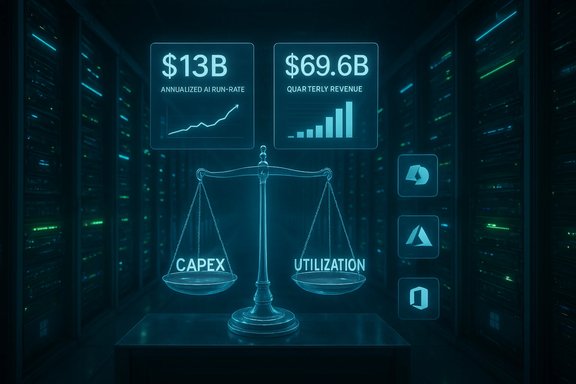
Microsoft’s fiscal narrative over the past year has been straightforward in one sense: double‑digit revenue growth anchored by cloud and a rapid enterprise adoption of AI features, matched by an unprecedented capital program to expand AI‑capable data centers. The company reported $69.6 billion in revenue for the quarter ended December 31, 2024, with Azure and other cloud services growing roughly 31%, and public commentary from management stated an annualized AI revenue run‑rate exceeding $13 billion. At the same time, Microsoft publicly signaled and executed a fiscal‑year infrastructure program in the tens of billions—commonly summarized in press coverage as an ~$80 billion capex plan for FY25—creating a near‑term profile of elevated cash outlays and margin pressure.
For long‑term, diversified investors, Microsoft still fits as a core holding if position sizes reflect the premium you’re paying and you accept that payoffs may come over multiple quarters to multiple years. For yield‑oriented investors, Microsoft’s modest dividend is a bonus, not the investment’s core thesis. For traders, near‑term price moves will be dominated by quarterly signals: Azure growth, cloud margins, capex cadence, and any commentary on supplier pricing and utilization.
Conclusion: Microsoft’s strategic trade—front‑loading infrastructure to avoid capacity constraints and to embed AI across its massive distribution—remains a defensible, high‑quality play on enterprise AI. The raw numbers behind the Seeking Alpha optimism are real and verifiable. The deciding variable is execution timing: if utilization, custom silicon and seat monetization accelerate, Microsoft reaps outsized benefits; if not, investors should expect a multi‑quarter grading period before the payoff becomes clear. The company remains a top‑tier platform, but today’s valuation prices in a lot of execution. Watch the outcomes, not the slogans.
Source: Seeking Alpha Microsoft: The Ride Couldn't Last Forever (NASDAQ:MSFT)
 Background
Microsoft’s fiscal narrative over the past year has been straightforward in one sense: double‑digit revenue growth anchored by cloud and a rapid enterprise adoption of AI features, matched by an unprecedented capital program to expand AI‑capable data centers. The company reported $69.6 billion in revenue for the quarter ended December 31, 2024, with Azure and other cloud services growing roughly 31%, and public commentary from management stated an annualized AI revenue run‑rate exceeding $13 billion. At the same time, Microsoft publicly signaled and executed a fiscal‑year infrastructure program in the tens of billions—commonly summarized in press coverage as an ~$80 billion capex plan for FY25—creating a near‑term profile of elevated cash outlays and margin pressure. Why this matters now
Two numbers drive the investor debate: the reported AI annualized revenue run‑rate (a top‑level signal of monetization) and the cadence of capital expenditures (the financing and timing of capacity build). Convert those into a simple metric set—AI revenue per deployed rack, capex per rack, and utilization of GPUs—and you have the operating algebra that will determine whether Microsoft’s strategy is valorized or penalized by the market. Those are empirical questions that show up in quarters, and they’re the best way to move from narrative to evidence.What the Seeking Alpha thesis actually argued
The Seeking Alpha analysis positioned Microsoft as a defensible way to own enterprise AI upside: a platform owner with hundreds of millions of Office seats, deep enterprise relationships, and a product strategy that converts compute into seat‑based monetization (Copilot, Microsoft 365 add‑ons, GitHub Copilot, Azure AI inference). The author’s core claim: Microsoft is willingly accepting near‑term gross‑margin dilution by aggressively building capacity now to avoid being supply constrained later, because embedding AI into productivity suites should raise long‑term ARPU and stickiness more reliably than raw compute sells. That case rests on Microsoft’s distribution, annuity economics, and balance‑sheet optionality.Why the argument resonated — and where it needs execution
The structural logic is compelling. Embedding AI into Microsoft 365 and Windows turns compute into productized productivity features with recurring revenue and higher switching costs than one‑off inference transactions. Multi‑year enterprise contracts and a growing Remaining Performance Obligation (RPO) give forward revenue visibility that can justify front‑loaded infrastructure investment. But this is an execution story: the firm must (a) convert pilots into paid seats, (b) preserve or restore cloud gross margins as owned capacity replaces leased capacity, and (c) deliver on custom silicon timelines to meaningfully change the unit cost of inference and training.Verifying the load‑bearing facts
This section lays out the core empirical facts you need to reconcile with the Seeking Alpha optimism—and cites independent, high‑quality sources.Revenue and Azure growth
Microsoft reported $69.6 billion in revenue for the December 31, 2024 quarter, up about 12% year‑over‑year, with Azure and other cloud services growing approximately 31%. Management highlighted Microsoft Cloud revenue of roughly $40.9 billion for the quarter. These figures are direct from Microsoft’s earnings release and were widely reported by major outlets.AI revenue run‑rate
CEO Satya Nadella stated that Microsoft’s AI business had surpassed an annualized revenue run‑rate of roughly $13 billion—an explicit management disclosure used to signal early monetization traction across Copilot seats and Azure AI services. This number has been reiterated in the company’s public comment and in earnings materials. Treat the run‑rate as an early‑stage signal: informative about momentum, but not a substitute for durable unit economics.Capital expenditures: magnitude and cadence
Microsoft’s capex pattern has shifted materially. Company disclosures show quarters where capital spending including finance leases reached the low‑ to mid‑$20‑billion range (figures such as $21.4B, $22.6B and $24.2B were reported across successive quarters), and management publicly framed FY25 as a year of massive AI‑capable data center investment with a target often discussed in the press as roughly $80B for the fiscal year. Those capex numbers are reported in Microsoft’s investor materials and confirmed by multiple financial press outlets. Note: different press pieces use different definitions (cash paid vs. additions to PP&E vs. capex including leases), which explains some variation in the headline amounts.Cloud gross margins and margin pressure
Microsoft explicitly reported that Microsoft Cloud gross margin percentage decreased to about 70%, attributing the decline to scaling AI infrastructure. The company tied margin compression to the economics of leased GPUs and higher short‑term cost of inference while owned assets and custom silicon are ramped. This is a measurable, disclosed movement and is central to the “short‑term pain” side of the thesis.Copilot pricing and monetization mechanics
Microsoft announced commercial pricing for Microsoft 365 Copilot at roughly $30 per user per month (with enterprise bundle and seat‑minimum caveats in some segments). Seat‑based pricing is one of the primary levers the company is using to convert AI capabilities into recurring, high‑margin revenue. The pricing announcement and product availability details are published on Microsoft’s official blogs and product pages.Custom silicon: Maia and Cobalt
Microsoft has publicly unveiled custom silicon efforts—chips such as Maia (AI accelerator) and Cobalt (Arm‑based server CPU)—and described a “systems” approach that pairs chip design with custom server boards and racks. Independent technical outlets documented the Maia/Cobalt announcements and early deployment plans; those sources also raise realistic skepticism about the difficulty of scaling new silicon, toolchain readiness, and yield challenges. Custom silicon offers real optionality, but mass production timelines and yield are execution risks, not certainties.The risks that make “the ride” fragile
The Seeking Alpha piece flagged the major dangers; here they are framed with specificity and empirical context.- Utilization risk and stranded capacity. Building GPU‑dense racks before enterprise demand fully materializes creates the possibility of underutilized, highly amortized capacity—fixed costs that will depress gross margins until utilization improves. Analysts and channel checks have repeatedly cited utilization as a near‑term risk, and the company itself has acknowledged demand can outstrip near‑term supply.
- Supplier concentration (NVIDIA exposure). High‑end accelerators remain concentrated among a few vendors—chiefly NVIDIA—so Microsoft’s cost of inference and training is sensitive to external pricing and supply dynamics until its own accelerators meaningfully scale. This exposure was widely discussed in earnings calls and press commentary.
- Custom silicon timeline risk. Designing and mass‑producing large, monolithic AI accelerators is hard: yield problems, tooling gaps, software ecosystem maturity (frameworks, kernels, runtime), and integration across racks can all delay cost benefits. Public reporting suggests next‑generation Maia production and broader internal adoption could be pushed into 2026 for larger volume, extending the period where leased GPUs and higher operating costs remain material. Treat any roadmap for silicon as optionality until volume economics are demonstrated.
- Monetization gap: pilots vs scale conversions. Moving from pilot projects and early seat adoption to broad enterprise licensing across thousands of seats is a governance and change‑management exercise. Seat conversion rates, per‑seat ARPU lift, churn, and upgrade economics are measurable KPIs investors should demand to validate the thesis. These conversion dynamics are slower in practice than theorists assume.
- Regulatory and competitive pressure. Competition from Google Cloud and AWS on the cloud and from other model and compute providers in AI can compress pricing, while regulatory interventions around bundling or data practices could alter the effective economics of Copilot bundling. The competitive landscape also includes lower‑cost model providers (e.g., emerging Chinese models like DeepSeek) that can change buyers’ price‑sensitivity in certain markets.
Why Microsoft’s strengths still matter
Despite these risks, the structural advantages cited by the Seeking Alpha piece are real and enduring.- Distribution and entrenchment. Microsoft sits at the endpoint and the productivity layer: Office + Teams + Windows + Azure identity and management layers form a rare cross‑product network effect that raises switching costs when AI features are embedded. That distribution lowers the marginal cost of converting seats into paid Copilot users.
- Diversified monetization vectors. Microsoft is not dependent on a single revenue vector. Seat pricing (Copilot) creates recurring annuities while Azure inference consumption captures variable spend. That dual‑lever model increases optionality for monetization even if one vector lags.
- Balance‑sheet and contract optionality. Large RPO values and strong enterprise bookings provide forward visibility that can justify up‑front infrastructure investment; a robust balance sheet gives Microsoft the luxury to time capex and leasing to market conditions.
Practical KPIs to watch (for investors, CIOs, and partners)
Measure outcomes, not rhetoric. The most informative, load‑bearing metrics are:- Copilot monetization metrics — adoption rates, seats billed, average revenue per seat, per‑seat uplift and churn.
- Azure AI (inference) consumption — percent of Azure growth attributable to AI services and absolute inference run‑rate.
- Cloud gross margin and the Microsoft Cloud gross margin percentage (trendline vs guidance).
- Capex composition — cash paid for PP&E vs. additions to property and equipment vs. capex including finance leases.
- Utilization signals — commentary on GPU rack utilization, the mix of owned vs leased GPU capacity, and any disclosure on units/racks deployed.
- Custom silicon ramp signals — sample‑server deployment counts, performance per watt claims validated by third‑party benchmarks, and vendor foundry timelines.
Scenario analysis — how outcomes diverge
- Bull case: Copilot adoption accelerates materially; custom silicon begins to reduce per‑inference costs within a year; utilization improves; cloud margins recover. Microsoft re‑rates higher on a durable AI monetization multiple.
- Base case: AI revenue grows solidly but custom silicon is later than expected; margins recover slowly as owned assets displace leased capacity; returns are positive but the valuation stays range‑bound.
- Bear case: Seat conversion disappoints, utilization remains suboptimal, third‑party suppliers hold pricing power, and regulatory/competitive shocks erode pricing power—leading to prolonged margin compression and multiple contraction.
What this means for Windows users, IT leaders and developers
For everyday Windows users, the immediate effect is incremental product improvements: AI‑driven features, smarter search and summarization in Office and Windows, and tighter integrations across cloud services. For IT leaders, Copilot adoption is a procurement, governance, and change‑management program—not simply a feature toggle. License modeling, data residency, inference economics, and security must be part of the business case. Developers and partners should optimize for cost‑efficient inference patterns, telemetry for observability, and hybrid deployment models that let sensitive workloads remain on‑prem while less sensitive inference uses public cloud. These are operational realities that shape adoption speed.The investment takeaway: measured optimism, not blind conviction
Microsoft is plausibly one of the best ways to own enterprise AI exposure at scale: it combines distribution, annuity economics, and balance‑sheet optionality. That makes the thesis credible. But the valuation premium investors pay today is a bet on disciplined execution across multiple fronts—seat conversion, utilization, capex efficiency, and custom silicon ramp.For long‑term, diversified investors, Microsoft still fits as a core holding if position sizes reflect the premium you’re paying and you accept that payoffs may come over multiple quarters to multiple years. For yield‑oriented investors, Microsoft’s modest dividend is a bonus, not the investment’s core thesis. For traders, near‑term price moves will be dominated by quarterly signals: Azure growth, cloud margins, capex cadence, and any commentary on supplier pricing and utilization.
Final assessment
The Seeking Alpha thesis that “the ride couldn’t last forever” is an apt rhetorical frame: Microsoft’s premium valuation required a chain of deliverables to validate it, and the company openly accepted short‑term margin pressure to secure future product momentum. The key facts—$69.6B quarterly revenue with Azure growth ~31%, a reported AI run‑rate north of $13B, and a material capex program running into the tens of billions—are verifiable in company filings and major press coverage. But the thesis is execution‑sensitive: timing of custom silicon, GPU supplier dynamics, utilization, and seat conversion rates will decide whether the near‑term pain is a prudent prepayment or an extended drag on margins and multiples. Invest accordingly, watch the scoreboard of KPIs closely, and treat Microsoft as a high‑quality—but not risk‑free—way to own the enterprise AI transition.Conclusion: Microsoft’s strategic trade—front‑loading infrastructure to avoid capacity constraints and to embed AI across its massive distribution—remains a defensible, high‑quality play on enterprise AI. The raw numbers behind the Seeking Alpha optimism are real and verifiable. The deciding variable is execution timing: if utilization, custom silicon and seat monetization accelerate, Microsoft reaps outsized benefits; if not, investors should expect a multi‑quarter grading period before the payoff becomes clear. The company remains a top‑tier platform, but today’s valuation prices in a lot of execution. Watch the outcomes, not the slogans.
Source: Seeking Alpha Microsoft: The Ride Couldn't Last Forever (NASDAQ:MSFT)
