

Microsoft sits at the center of a debate that has animated investors and IT professionals for months: is the company being undervalued on earnings and book-value metrics while simultaneously being priced for perfection on revenue multiples because the market is betting on AI and cloud monetization? Recent automated industry snapshots — notably one circulated by Benzinga — crystallize that paradox and invite a deeper, more methodical look at Microsoft’s position versus its software‑industry peers. This piece rechecks the headline claims, verifies the key numbers against audited and market sources, and expands the narrative to explain what really matters when comparing Microsoft to other software firms in 2026.
Microsoft’s business architecture is intentionally broad and strategically important for any comparison: the company reports results across three primary segments — Productivity and Business Processes (Office, Microsoft 365, Dynamics, LinkedIn), Intelligent Cloud (Azure, server products, enterprise services) and More Personal Computing (Windows, Surface, Xbox, search advertising). That structural diversity makes single‑metric comparisons brittle; a platform‑scale cloud vendor trades on different economics and capital needs than a niche SaaS security vendor. The Benzinga snapshot that sparked renewed conversation used aggregated headline multiples and dollar metrics to show Microsoft appearing both cheap and expensive depending on the lens — a useful starting point, but one that requires methodological scrutiny. reviewers widely caution that automated tables sometimes mix timeframes (quarter vs TTM vs fiscal year) and cohort types (hyperscalers, platform SaaS, security vendors, fast‑growing micro‑cap SaaS). That blending can produce misleading “industry averages.” Several independent reviews recommend normalizing timeframes and segmenting peers by business model before drawing conclusions.
Independent press coverage of the October–December 2025 quarter reported revenue near $81.3 billion and robust cloud segment results, while also documenting market reaction to heightened AI spending. These stories underscore the scale and the tension: record top‑line growth but intense capital deployment for AI infrastructure.
For investors, the right posture is constructive but conditional: Microsoft has the assets, portfolio breadth, and capital to win at scale, but investors should demand evidence — consistent, recurring commercial metrics tied to AI features (Copilot seat ARPU, attach rates, Azure AI margin recovery) — before concluding that a P/S premium is fully justified. For IT leaders and product strategists, Microsoft’s scale makes it a strategic counterparty for AI deployment, but account teams and procurement should continue to evaluate best‑of‑breed vendors where specialist capabilities deliver differentiated value.
Finally, methodological rigor matters more than ever: segment your peer set, normalize timeframes, and reconcile aggregator outputs with primary filings. That disciplined approach separates useful signals from noise and is the best defense against hasty, headline‑driven conclusions.
Source: Benzinga Exploring The Competitive Space: Microsoft Versus Industry Peers In Software - Microsoft (NASDAQ:MSFT)
 Background
Microsoft’s business architecture is intentionally broad and strategically important for any comparison: the company reports results across three primary segments — Productivity and Business Processes (Office, Microsoft 365, Dynamics, LinkedIn), Intelligent Cloud (Azure, server products, enterprise services) and More Personal Computing (Windows, Surface, Xbox, search advertising). That structural diversity makes single‑metric comparisons brittle; a platform‑scale cloud vendor trades on different economics and capital needs than a niche SaaS security vendor. The Benzinga snapshot that sparked renewed conversation used aggregated headline multiples and dollar metrics to show Microsoft appearing both cheap and expensive depending on the lens — a useful starting point, but one that requires methodological scrutiny. reviewers widely caution that automated tables sometimes mix timeframes (quarter vs TTM vs fiscal year) and cohort types (hyperscalers, platform SaaS, security vendors, fast‑growing micro‑cap SaaS). That blending can produce misleading “industry averages.” Several independent reviews recommend normalizing timeframes and segmenting peers by business model before drawing conclusions.Snapshot: it)
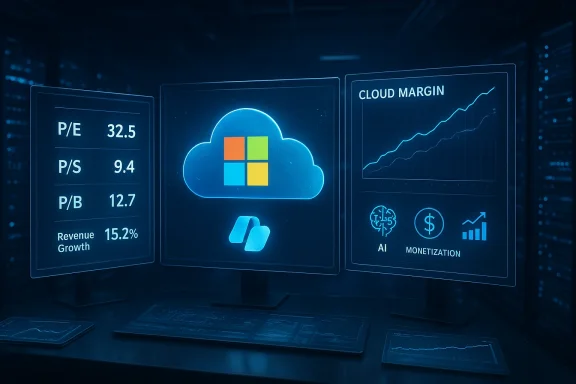
The automated Benzinga output summarized Microsoft with these headline signals:- Lower P/E and lower P/B than the blended industry mean, implying relative undervaluation on earnings and book value.
- Higher P/S, implying the market is attributing a premium to Microsoft’s revenue — often interpreted as a bet on AI and Azure monetization.
- Large absolute EBITDA and gross‑profit dollars, reflecting the company’s scale.
- A low debt‑to‑equity ratio, reported in the snapshot as conservative (values in syndicated feeds varied).
- Modest ROE relative to some peers, reflecting Microsoft’s large equity base and capital allocation choices.
Financial Reality Check — Verified Numbers and Divergrn the Benzinga snapshot into a disciplined analysis, I verified key claims against company disclosures and reputable market-data providers.
Revenue, gross profit, and Azure trends
Microsoft’s FY25 results and Q4 disclosures confirm very large absolute profit dollars and strong cloud momentum: FY25 revenue exceeded $280 billion and Microsoft Cloud revenue accelerated, with Microsoft reporting meaningful growth in cloud and AI‑related workloads in its FY25 Q4 metrics. Microsoft’s investor relations materials explicitly note the cloud gross‑margin pressure from AI infrastructure while documenting the scale of the cloud business.Independent press coverage of the October–December 2025 quarter reported revenue near $81.3 billion and robust cloud segment results, while also documenting market reaction to heightened AI spending. These stories underscore the scale and the tension: record top‑line growth but intense capital deployment for AI infrastructure.
Price multiples (P/E, P/B, P/S)
Different data vendors show slightly different current multiples for Microsoft because multiples change daily with price and some providers report trailing versus forward ratios. Recent snapshot data from market aggregators put Microsoft’s P/S in the low double‑digits (MacroTrends and other aggregators reported P/S around 11–13 in early 2026), consistent with the Benzinga narrative that Microsoft’s P/S is above a blended software mean. P/E and P/B likewise sit within mid‑30s and high single‑digit/low‑double figures depending on the exact data cut. Because these numbers move with the market, use them as directional anchors rather than immutable truths.Debt‑to‑Equity: numbers diverge across sources
One key point in the Benzinga piece — a “low” debt‑to‑equity ratio — is directionally correct, but vendors disagree on the precise figure and on which liabilities are being counted.- MacroTrends and some historical providers report debt/equity in ranges that can appear low on a TTM basis; MacroTrends recorded a Debt/Equity ratio series that swung depending on reporting date (values near 0.1–0.8 depending on the date and definition used).
- Market‑data sites that compute debt vs total shareholder equity using consolidated balance sheet totals show debt/equity around 0.2–0.3 as of late January 2026.
Segmenting the Peer Set: the single most important methodological step
A simple industry average dilutes meaning. The software sector contains at least three investment cohorts that demand different valuation lenses:- Hyperscalers/platforms: Microsoft, Amazon (AWS), Google (Alphabet), Oracle (to an extent). These firms require capital intensity to build datacenter scale and are valued on a combination of revenue, operating margins, and EV/EBITDA.
- Large platform SaaS: Salesforce, ServiceNow, Adobe — subscription economics, high gross margins, and retention metrics dominate valuation.
- Security & infrastructure specialists: Palo Alto Networks, Fortinet — differentiated margin profiles and addressable market dynamics.
Competitive Strengths: Where Microsoft’s competitive edge is real and verifiable
- Absolute profit generation (scale matters). Microsoft produces enormous absolute EBITDA and gross profit dollars that dwarf most software peers — a strategic advantage when investing in multiyear AI infrastructure and M&A. The FY25 figures show operating income and net income growing substantially year‑over‑year. These dollars provide discretionary room to invest aggressively in AI while maintaining corporate flexibility and shareholder returns.
- Distribution and embeddedness. MicrosWindows, Microsoft 365, Azure, and developer tools gives it multiple channels to embed AI features like Copilot broadly across user bases. That embedment can accelerate monetization if product‑level attach rates and ARPU (average revenue per user) respond as management expects. Forum analysts emphasize monitoring Copilot attach rates and ARPU as early signals for monetization.
- Balance sheet flexibility. Even after massive AI spending, Microsoft’s balance sheet and cash flows allow the company to underwrite large capex cycles without undue reliance on debt financing. This grants both patience and optionality in competitive capital races. The exact leverage ratio varies by data feed, but the consensus narrative is that Microsoft is not balance‑sheet constrained relative to peers.
- Enterprise stickiness and annuity mix. Microsoft reports a high commercial annuity mix, with a large share of cloud revenue recurring and high remaining performance obligations, providing durable visibility into future revenue. Management disclosed a sizable remaining performance obligation and strong commercial bookings growth in FY25.
Real Risks and Execution Questions
- Capital intensity and timing risk. Building AI datacenter capacity — GPUs, specialized infrastructure, and power/cooling at scale — is expensive. Microsoft’s recent quarters show major jumps in capex tied to AI infrastructure, which can suppress gross margins in the near term. Market reaction to Q4 results highlighted investor concern about the timing of ROI on that spon lags, margins and multiples could compress substantially.
- Methodology and metric‑mix pitfalls. Public automated comparisons often omit whether EBITDA and gross‑profit figures are quarterly or annual. Treating quarterly dollars as annual totals inflatversely, mixing TTM multiples with single‑quarter metrics distorts ratios. Independent forum reviewers urge investors to reconcile aggregator outputs with SEC filings (10‑Q/10‑K) before relying on headlines.
- Competition at multiple fronts. Microsoft competes with hyperscalers (AWS, Google Cloud) on cloud prich security vendors on discrete enterprise spend, and with SaaS vendors in productivity and vertical workflows. Multi‑cloud adoption and specialist vendors capturing wallet share in niche areas can limit Microsoft’s addressable share in particular accounts.
- Supply constraints and geopolitical exposure for hardware. GPU and specialized silicon supply chains are finite; supply shocks or geopolitical disruptions could slow AI deployment or raise marginal costs. Analysts have repeatedly called out GPU supply and custom silicon as a near‑term constraint to AI scale.
- Regulatory and partner concentration risks. Large AI partnerships (for example with OpenAI) and regulatory scrutiny on data, antitrust, and AI safety create execution and governance risks. The market has been sensitive to any changes in those relationships or to apparent concentration of revenue streams. News coverage of the Q4 period noted how investor sentiment can swing on concentration concerns.
How to Compare Microsoft and Peers Properly — A Practical Checklist
- Segment peers by business model before calculating benchmarks: hyperscalers, platform SaaS, security/infrastructure, and high‑growth small SaaS.
- Normalize timeframes: compare fiscal‑year vs fiscal‑year, or TTM vs TTM — never mix single‑quarter dollars with annual ratios.
- Prefer EV/EBITDA and FCF yield for mega‑cap platforms; use EV/Revenue for smaller, high‑growth SaaS names.
- Track operational KPIs for Microsoft specifically: Azure sequential growth, AI workload mix, Copilot attach rates and ARPU, capex as percent of revenue, cloud gross‑margin conversion.
- Reconcile aggregator outputs with primary filings (Microsoft 10‑Q/10‑K and investor slides) and flag any number that cannot be traced to an audited base. Forum analysts emphasize this as essential; failing to do so invites mispricing and poor strategic decisions.
A Closer Look at Peers and Relative Positioning
The Benzinga set blended both platform and non‑platform peers (examples cited across syndicated feeds include Oracle, ServiceNow, Palo Alto Networks, Fortinet). That blending produces an industry mean skewed by inclusion of high‑multiple microcaps and security specialists. Microsoft’s premium P/S relative to that blended mean can be rational if Microsoft’s AI investments yield higher ARPU and margins — but that is a conditional conclusion, not a settled fact. Forum contributors urge cohort‑appropriate comparisons: Md Google on cloud and platform economics; Microsoft vs Adobe/ServiceNow/Salesforce on productivity/multitenant SaaS economics; Microsoft vs Palo Alto/Fortinet on security spend penetration.Scenario Planning: How Microsoft’s Multiple Could Re‑rate
- Upside scenario: AI monetization accelerates. Copilot attach rates and ARPU rise; Azure AI workloads scale with improving gross margins due to efficiency gains. P/S premium is earned; P/E and EV/EBITDA hold or expand. Microsoft’s cash generation funds expansion without leverage stress.
- Base scenario: Steady high‑teens growth with elevated capex that temporarily compresses margins. Multiples trade in a stable band reflecting platform quality as AI monetization emerges slowly.
- Downside scenario: Monetization lags and capex remains elevated longer than markets expect. Azurehyperscaler price competition compress multiples; investor sentiment turns cautious and P/S and P/E compress. Supply disruptions or regulatory headwinds could exacerbate the downside.
Practical Takeaways for Investors and IT Decision Makers
- Treat automated tables as hypotheses, not conclusions. Reconcile headline numbers with Microsoft’s investor relations releases and SEC filings before making investment or strategic judgments. The community guidance is unanimous on this point.
- Focus on operational leading indicators for Microsoft rather than static headline multiples alone: Azure sequential growth, cloud gross margin percent, Copilot seat growth and ARPU, capex cadence and guidance, and remaining performance obligations.
- Use cohort‑appropriate comparators when benchmarking Microsoft. Comparing Microsoft’s P/S to a blended software mean that includes rapidly growing microcaps is a recipe for misinterpretation.
- Acknowledge the path dependency of Microsoft’s valuation: the market is explicitly pricing a large, uncertain prize tied to AI monetization. That premium is sensible if Microsoft converts AI features into durable, high‑margin revenue streams; if not, multiples are vulnerable.
Conclusion
The Benzinga automated snapshot accomplished a useful task: it showed why Microsoft can look cheap on some metrics and expensive on others. But automated snapshots must be read with discipline. When you peel back the layers — verify report bases, segment peers, and triangulate numbers against audited filings and multiple reputable data sources — a clearer picture emerges: Microsoft is uniquely positioned by scale, cash generation, distribution, and balance‑sheet strength to pursue AI and cloud monetization aggressively, but that positioning is conditional on successful execution and favorable timing of returns on vast capital outlays.For investors, the right posture is constructive but conditional: Microsoft has the assets, portfolio breadth, and capital to win at scale, but investors should demand evidence — consistent, recurring commercial metrics tied to AI features (Copilot seat ARPU, attach rates, Azure AI margin recovery) — before concluding that a P/S premium is fully justified. For IT leaders and product strategists, Microsoft’s scale makes it a strategic counterparty for AI deployment, but account teams and procurement should continue to evaluate best‑of‑breed vendors where specialist capabilities deliver differentiated value.
Finally, methodological rigor matters more than ever: segment your peer set, normalize timeframes, and reconcile aggregator outputs with primary filings. That disciplined approach separates useful signals from noise and is the best defense against hasty, headline‑driven conclusions.
Source: Benzinga Exploring The Competitive Space: Microsoft Versus Industry Peers In Software - Microsoft (NASDAQ:MSFT)
