

Microsoft’s latest automated comparative snapshot — circulated by Benzinga and picked up across investor forums — frames the company as a paradox: huge absolute profitability and cash flow paired with valuation and efficiency metrics that, on a blended industry basis, look both conservative and stretched at the same time.
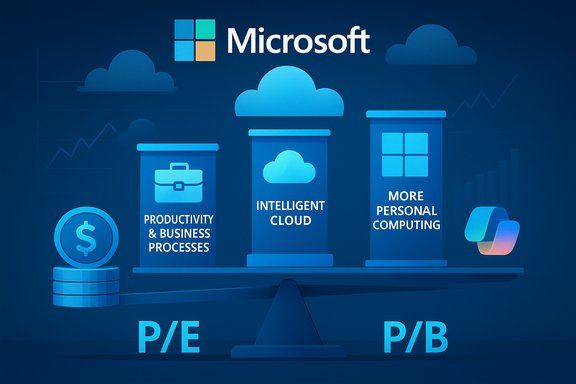
Microsoft is organized into three reporting pillars: Productivity & Business Processes, Intelligent Cloud, and More Personal Computing. Each pillar has distinct margin, growth, and capital‑intensity characteristics, which means aggregate metrics (one P/E, one growth rate) can be misleading unless peers and timeframes are normalized.
The automated Benzinga table that prompted the recent conversation lists Microsoft with a trailing P/E ~ 35, P/B ~ 10, P/S ~ 12.5, ROE ~ 7.8%, and very large absolute EBITDA and gross‑profit dollars in the tens of billions. The same snapshot also reports quarterly EBITDA ≈ $48.06B and quarterly gross profit ≈ $53.63B (which ties to the company’s most recent quarter reporting), and high‑teens revenue growth on a year‑over‑year basis. These headline statistics are directionally consistent with public filings and mainstream market data — but the devil is in the details: time‑bases (single quarter vs TTM vs fiscal year), cohort selection (hyperscalers vs small SaaS), and differing definitions of leverage (total debt divided by shareholders’ equity vs other variants) materially change the interpretation.
The counter‑case is timing and margin conversion: sustained capex, supplier and energy constraints, competitive pricing pressure, or slower Copilot adoption could compress margins and force valuation multiple contraction. Investors should therefore treat the P/S premium as contingent on successful execution, while treating EBITDA and gross profit dominance as an unambiguous competitive advantage in the near term.
Practical takeaways:
Source: Benzinga Comparative Study: Microsoft And Industry Competitors In Software Industry - Microsoft (NASDAQ:MSFT)
 Background / Overview
Microsoft is organized into three reporting pillars: Productivity & Business Processes, Intelligent Cloud, and More Personal Computing. Each pillar has distinct margin, growth, and capital‑intensity characteristics, which means aggregate metrics (one P/E, one growth rate) can be misleading unless peers and timeframes are normalized.The automated Benzinga table that prompted the recent conversation lists Microsoft with a trailing P/E ~ 35, P/B ~ 10, P/S ~ 12.5, ROE ~ 7.8%, and very large absolute EBITDA and gross‑profit dollars in the tens of billions. The same snapshot also reports quarterly EBITDA ≈ $48.06B and quarterly gross profit ≈ $53.63B (which ties to the company’s most recent quarter reporting), and high‑teens revenue growth on a year‑over‑year basis. These headline statistics are directionally consistent with public filings and mainstream market data — but the devil is in the details: time‑bases (single quarter vs TTM vs fiscal year), cohort selection (hyperscalers vs small SaaS), and differing definitions of leverage (total debt divided by shareholders’ equity vs other variants) materially change the interpretation.
Reading the headline metrics — what matters and what can mislead
Valuation multiples: P/E, P/B and P/S
- Microsoft’s trailing P/E shown in the Benzinga snapshot (~34.99) is in line with mainstream market quotes for late‑2025 and reflects investor willingness to pay for stable earnings plus optionality from AI/cloud monetization. This trailing P/E is confirmed by major market data services.
- Price/Book (P/B ≈ 10): for a platform business with large intangible assets and recurring revenue, P/B is a blunt tool. A low‑double‑digit P/B can appear conservative next to hyper‑growth SaaS names that trade on future earnings rather than current book value.
- Price/Sales (P/S ≈ 12.5) is high versus a blended “software” average because the market is placing a revenue premium on large platform vendors that can monetize AI and cloud usage at scale. That premium is investable only if AI/cross‑sell monetization converts to durable ARPU and margin expansion.
Profitability and scale: EBITDA and gross profit
- Microsoft’s quarterly EBITDA ≈ $48.06B and quarterly gross profit ≈ $53.63B are accurate when the table uses a single‑quarter basis; annualized or TTM figures will be markedly larger. Mainstream aggregators and the company’s earnings releases support these single‑period figures for the most recent reported quarter.
- Comparing raw EBITDA or gross profit dollars across companies of wildly different scale is misleading. Microsoft’s tens‑of‑billions of EBITDA represent financial firepower — the ability to fund capex, R&D, and shareholder returns — rather than a pure signal of faster percentage growth.
Growth: percentage vs absolute dollars
- Microsoft’s reported revenue growth in the high‑teens is exceptional for a company with hundreds of billions in revenue; however, it will almost always look lower than the mean of a peer set that includes many small SaaS firms growing 20–100% annually. Normalizing by revenue scale and business model yields a more meaningful comparison. The company’s FY‑end reporting corroborates high‑teens growth on an annualized basis.
Return on Equity (ROE) and capital efficiency
- Microsoft’s ROE (mid‑single digits to high‑single digits in the Benzinga snapshot) appears low versus a blended peer average. That can reflect a very large equity base (cash, retained earnings) rather than operational underperformance. For capital‑intensive businesses, ROE is less informative than ROIC, free‑cash‑flow conversion, or EV/EBITDA. Forum analysts recommend using cohort‑appropriate measures rather than raw ROE across a heterogeneous software peer set.
Verifying Benzinga’s numbers — what independent sources show
Key Benzinga figures (P/E ~ 34.99; P/B ~ 10.07; P/S ~ 12.50; quarterly EBITDA ≈ $48.06B; quarterly gross profit ≈ $53.63B; revenue growth ~ 18.4%) match the following independent data points:- Market‑data pages (e.g., Yahoo Finance) list Microsoft’s trailing P/E ≈ 34.99, P/S ≈ 12.50, and P/B ≈ 10.07 on contemporaneous quotes — confirming the valuation snapshot Benzinga used.
- Financial aggregators (Morningstar/GuruFocus) report quarterly EBITDA ≈ $48.06B and quarterly gross profit ≈ $53.63B for the most recent quarter (which matches the single‑quarter base in the Benzinga table). Trailing‑12‑month (TTM) numbers are larger and must be treated separately.
- Microsoft’s own FY25 quarterly and annual earnings release (June 30, 2025) confirms fiscal year revenue ≈ $281.7B and the company’s segment breakdowns, which validate the scale and growth statements used in the automated snapshot. The investor release also contains balance‑sheet figures used to compute leverage metrics if normalized the way the company presents them.
Debt‑to‑equity: a case study in metric definition and why it matters
Benzinga’s brief reported a debt‑to‑equity figure of ~0.17 for Microsoft; other data providers (and Microsoft’s investor summary tables) report different ratios depending on the numerator and timing (e.g., total debt divided by total shareholders’ equity vs total liabilities divided by equity). Yahoo Finance shows total debt/equity as a percent that converts roughly to a D/E of ~0.33 depending on the most‑recent quarter and whether short‑term and long‑term debt are included in the numerator. Why the gap exists:- Different providers compute leverage using different definitions (net debt vs gross debt; total liabilities vs interest‑bearing debt).
- Timing mismatches (company press release vs stock‑quote snapshots vs trailing reporting) change the denominator or numerator.
- Some automated engines annualize or adjust balance‑sheet items differently (currency effects, reclassifications), producing divergent headline D/E ratios.
Segment and cohort normalization — an essential checklist
Comparing Microsoft to a heterogenous "software" peer set is only useful if you first group competitors by model and scale. Practical rules for meaningful comparison:- Normalize timeframes: compare fiscal‑year vs fiscal‑year or TTM vs TTM — do not mix single quarters with annual aggregates.
- Segment peers by business model:
- Hyperscalers and cloud platforms (Microsoft, AWS, Google Cloud).
- Large enterprise platform/SaaS (Oracle, SAP).
- Security/infrastructure software (Palo Alto Networks, Fortinet, Qualys).
- High‑growth pure SaaS (ServiceNow, Monday.com, UiPath).
- Bundling/OS/hardware players (Microsoft’s More Personal Computing cohort).
- This avoids averaging apples and oranges.
- Prefer multiples by cohort:
- Use EV/EBITDA and FCF yield for large platforms.
- Use EV/Revenue for smaller, high‑growth SaaS names.
- Model dollar sensitivity: a 1% revenue swing at Microsoft equals far more absolute dollars than at a $1B‑revenue SaaS firm. Quantify absolute $ impact, not just percentage.
Strengths: why Microsoft still stands out
- Massive cash generation and profitability: Absolute EBITDA and gross‑profit dollars are unmatched among software peers. This funds capex, R&D, acquisitions, and shareholder returns, giving Microsoft strategic optionality.
- Diversified, sticky revenue mix: subscription revenue (Microsoft 365), platform revenue (Azure), and consumer/hardware (Windows, Surface, Xbox) balance volatility and create cross‑sell opportunities. The FY25 investor release highlights this three‑pillar model and its segment growth.
- Strategic AI positioning: embedding Copilot into productivity suites and offering model hosting through Azure gives Microsoft multiple monetization paths for AI—both seat‑based and consumption‑based. Forum analyses and the company’s disclosures identify Copilot attach rates and Azure AI workloads as decisive early indicators of monetization success.
- Conservative balance‑sheet posture: Microsoft’s leverage is moderate compared with many leveraged growth firms, giving financial flexibility for large multi‑year AI capex programs. The company’s balance sheet supports opportunistic M&A and smoothing of capital expenditures.
Risks and execution challenges
- Capital intensity of AI scale‑up: building and operating AI‑scale data centers is expensive. Sustained capex can compress gross and operating margins before ARPU uplift materializes. Independent reporting has flagged pauses or re‑evaluations of certain data‑center deals, a tactical sign investors should watch.
- Valuation complacency: a mid‑30s P/E and a P/S premium price in expectations that AI monetization and Azure ARPU expansion will materialize. Execution delays or margin pressure could prompt multiple contraction.
- Competitive pressure and multi‑cloud adoption: AWS and Google Cloud remain vigorous competitors on price and tooling. Best‑of‑breed vendors (security, workflow automation) continue to capture pockets of enterprise spend, limiting wallet share per customer.
- Metric‑mismatch risks: automated tables that mix quarters, TTM, and fiscal figures create misleading industry averages — analysts should verify everything against audited filings before drawing investment conclusions. Benzinga’s automated snapshot is a good screen but requires reconciliation.
Tactical investor checklist — what to watch next
- Track Azure sequential growth and the mix between AI and non‑AI workloads. AI workload share is key to the P/S premium being justified.
- Monitor Copilot attach rates, ARPU, and renewals for Microsoft 365 customers. These are early indicators of monetization beyond base subscription revenues.
- Watch capex guidance and GPU/custom‑silicon supply clarity; supply and procurement constraints materially affect margin timing.
- Reconcile any headline metric with primary sources: prefer Microsoft’s investor releases and SEC filings for audited figures over automated aggregators when building financial models.
Strengths vs. competitors — a short comparative map
- Microsoft vs. hyperscalers (AWS, Google Cloud): Microsoft matches scale and enterprise distribution and is differentiated by its Office/M365 ecosystem and enterprise relationships. Hyperscalers still compete intensely on infrastructure price and tooling.
- Microsoft vs. large enterprise software (Oracle): Microsoft’s cloud and productivity suite create cross‑sell and platform lock‑in opportunities Oracle cannot easily replicate; Oracle competes on database, verticals, and on‑prem transformation.
- Microsoft vs. security/infrastructure vendors (Palo Alto Networks, Fortinet): These firms are narrower in scope but sometimes trade at higher growth multiples because of focused revenue expansion; Microsoft’s scale makes percentage growth lower but absolute dollars much larger. Comparing EBITDA or gross profit without scaling will mislead.
- Microsoft vs. pure SaaS high‑growth names (ServiceNow, Monday.com, UiPath): Smaller SaaS vendors may exhibit higher percent growth, but their absolute revenue and EBITDA are tiny relative to Microsoft. Investors should use EV/Revenue and cohort‑appropriate metrics.
Flagging unverifiable or context‑dependent claims
- Any automated “industry average” that blends hyperscalers, legacy on‑prem vendors, and tiny SaaS companies should be treated with caution — such averages inflate growth and P/S benchmarks. Benzinga’s table is a useful screen, but it does not replace primary‑source reconciliation.
- Debt‑to‑equity claims can differ materially across data sources. When a headline D/E (e.g., 0.17) does not match a market‑data vendor (e.g., 0.33 converted from Yahoo’s percent), the discrepancy is usually definitional or timing‑based; always reconcile to the company’s audited balance sheet.
- Any projection about future AI revenue or Copilot monetization should be treated as forward guidance or analyst inference until confirmed by recurring commercial metrics in audited filings. Forum reviews and investor guidance emphasize this as the single largest execution risk.
Strategic verdict — balancing opportunity and execution risk
Microsoft is best described as “quality at scale.” The company combines an unmatched distribution and recurring‑revenue franchise with enormous absolute cash flow that funds multi‑year investments in cloud and AI. The bull case is straightforward: if Microsoft converts AI investments into durable, incremental ARPU and margin expansion (Copilot + Azure AI + higher per‑customer consumption), the current valuation will look conservative.The counter‑case is timing and margin conversion: sustained capex, supplier and energy constraints, competitive pricing pressure, or slower Copilot adoption could compress margins and force valuation multiple contraction. Investors should therefore treat the P/S premium as contingent on successful execution, while treating EBITDA and gross profit dominance as an unambiguous competitive advantage in the near term.
Conclusion
The Benzinga automated comparative snapshot is a valuable screening tool that draws attention to an important paradox: Microsoft trades like a mature platform on some metrics (ROE, P/E) but commands a revenue premium that assumes successful AI monetization. That premium can be rational if Azure AI workloads and Copilot attach rates scale as hoped; it becomes vulnerable if capex overruns, supplier bottlenecks, or competitive pressure slow monetization.Practical takeaways:
- Use segment‑level and cohort‑normalized comparisons rather than blended industry averages.
- Reconcile every headline ratio to audited company statements and clarify the timebase (quarter vs TTM vs fiscal).
- Monitor early AI monetization indicators (Azure AI mix, Copilot ARPU/attach) and capex cadence as the decisive next readouts for the sustainability of Microsoft’s premium valuation.
Source: Benzinga Comparative Study: Microsoft And Industry Competitors In Software Industry - Microsoft (NASDAQ:MSFT)
