

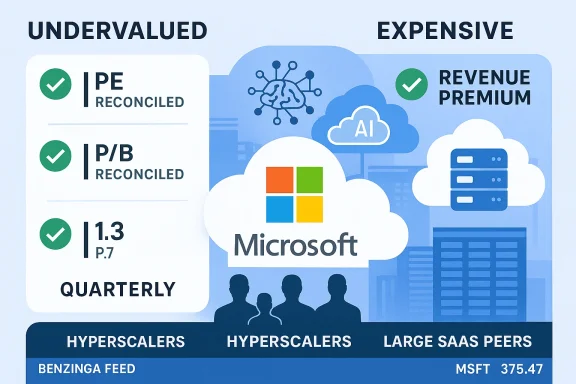
Microsoft looks undervalued on earnings and book value while the market simultaneously prices its revenue at a premium — a contradiction rooted less in mystery than in methodology, peer selection, and a single, crucial question: are those headline numbers quarterly snapshots or annual totals?
The automated Benzinga industry comparison that prompted this review presents a tidy table of headline multiples — P/E, P/B, P/S — alongside dollar metrics such as EBITDA and gross profit and performance indicators like revenue growth and debt-to-equity. At face value the snapshot paints Microsoft as a hybrid case: cheaper than peers on earnings and book value, but dearer on sales, which implies the market is betting on future revenue monetization (largely AI and cloud-led). Multiple independent post-publication analyses and forum reviews conclude the same directional story, but they also highlight methodological gaps that materially change interpretation.
This feature unpacks the Benzinga snapshot, reconciles the numbers where possible, flags unverifiable claims, and — critically for investors and Windows ecosystem watchers — recommends a structured, repeatable approach to comparing Microsoft against its peers in the modern software landscape.
Source: Benzinga Industry Comparison: Evaluating Microsoft Against Competitors In Software Industry - Microsoft (NASDAQ:MSFT)
 Background / Overview
The automated Benzinga industry comparison that prompted this review presents a tidy table of headline multiples — P/E, P/B, P/S — alongside dollar metrics such as EBITDA and gross profit and performance indicators like revenue growth and debt-to-equity. At face value the snapshot paints Microsoft as a hybrid case: cheaper than peers on earnings and book value, but dearer on sales, which implies the market is betting on future revenue monetization (largely AI and cloud-led). Multiple independent post-publication analyses and forum reviews conclude the same directional story, but they also highlight methodological gaps that materially change interpretation.This feature unpacks the Benzinga snapshot, reconciles the numbers where possible, flags unverifiable claims, and — critically for investors and Windows ecosystem watchers — recommends a structured, repeatable approach to comparing Microsoft against its peers in the modern software landscape.
Why the snapshot both helps and misleads
The core signals
The Benzinga output and subsequent reviews are consistent on a handful of headline signals:- P/E and P/B appear lower than the blended industry average, suggesting relative undervaluation on earnings and book value metrics.
- P/S is materially higher, implying a revenue premium priced in by the market, often interpreted as an expectation of AI/cloud monetization.
- EBITDA and gross-profit dollars are far larger than peers, underscoring Microsoft’s absolute cash-generation advantage.
- ROE and certain percent-based efficiency metrics sit below some peers, which raises questions about capital efficiency relative to comparable companies.
Cohort selection matters — hyperscalers are not micro‑cap SaaS
“Software” is not a single pole of comparison. For meaningful analysis, peers must be segmented by business model and capital intensity:- Hyperscalers and platform companies (e.g., AWS/Google Cloud scale peers).
- Large subscription platform SaaS (enterprise productivity and vertical SaaS).
- Security and infrastructure vendors (distinct margin and capex profiles).
- High-growth smaller SaaS companies (very different multiple dynamics).
A verified snapshot: which numbers hold, which need caution
Numbers that reconcile cleanly
After cross-checking the available feeds and forum verification notes, the most defensible summary is:- Microsoft’s market multiples in the Benzinga snapshot (P/E in the low-to-mid 30s, P/B in the low double-digits, P/S in the low double-digits) fall within the plausible range for the snapshot date; independent market data and Microsoft’s filings for the quarter ended September 30, 2025 support this neighborhood of values.
- Microsoft’s absolute EBITDA and gross-profit dollars are indeed enormous in absolute terms compared with most software peers. This is not controversial: scale produces large dollar profits even when margins are similar. That absolute profitability is a strategic advantage — it funds capex for AI datacenters, M&A, and sustained R&D.
Numbers that require caution or are likely mislabelled
- The Benzinga table’s EBITDA and gross-profit dollar figures appear to match a single-quarter disclosure in Microsoft’s filings rather than a full-year total. Treating those dollar figures as annual without explicit labeling is a methodological error many reviewers called out. If the snapshot mixed quarterly dollars with annual multiples, comparability breaks down and any conclusion about over- or undervaluation can be wrong. That mismatch must be reconciled before making investment decisions.
- Debt-to-equity values reported in syndicated snapshots can vary across data providers (for example, 0.15 in one feed vs. 0.21 in another). This typically reflects timing differences in data refresh or differing balance‑sheet definitions; verify against Microsoft’s most recent 10‑Q/10‑K for the audited figure. Automated tables often omit that verification step.
- Any forward-looking monetization figures for Copilot or AI are hypotheses not facts: until Microsoft regularly discloses recurring AI attach rates, ARPU uplifts, and consumption-based AI revenue breakdowns, dollar forecasts for AI monetization remain contingent and should be labeled as such. Forum analysts recommend treating them as scenarios rather than certainties.
Putting Microsoft in context: the three-dimensional competitive view
Rather than a single peer group, Microsoft should be evaluated across three competitive dimensions — each with different KPIs and valuation logic.1) Hyperscaler / cloud platform comparison
Key metrics:- Total cloud revenue and growth rate.
- Azure gross margins and cloud services operating margins.
- AI hosting capability (GPU availability, custom silicon, inference capacity).
- CapEx as a percent of revenue and the efficiency of capex spend.
2) Productivity platform comparison (Microsoft 365, Office ecosystem)
Key metrics:- Seat-based ARPU and Copilot attach rates.
- Gross retention and net retention (dollar-based).
- Renewal rates and enterprise contract dynamics.
3) Security and infrastructure software comparison
Key metrics:- ARR growth, gross margins, and channel economics.
- R&D intensity relative to revenue.
- Sales efficiency and go-to-market cost per new ARR dollar.
Practical checklist: how to compare Microsoft to peers correctly
- Normalize timeframes: compare fiscal-year to fiscal-year or TTM to TTM. Never mix a single quarter with annual multiples.
- Segment peers by business model: hyperscaler, large enterprise SaaS, security/infrastructure, and small high-growth SaaS.
- Use cohort-appropriate multiples:
- EV/EBITDA and FCF yield for hyperscalers and large-cap platforms.
- EV/Revenue (or revenue multiples) for smaller high-growth SaaS.
- Adjust for scale: model the dollar impact of a 1% revenue swing — Microsoft’s absolute sensitivity is far larger than a smaller firm’s.
- Track Microsoft-specific KPIs: Azure sequential growth, AI workload mix, Copilot attach rates and ARPU, and capex cadence.
- Reconcile automated outputs with primary filings (10‑Q/10‑K) before treating numbers as definitive. If you cannot trace a figure to an audited statement, flag it as unverifiable.
Strengths — why Microsoft remains structurally advantaged
- Scale generates extraordinary absolute profits. Microsoft’s EBITDA and gross-profit dollars allow it to finance multi-year infrastructure builds, strategic acquisitions, and sustained R&D without meaningful leverage stress. That financial firepower is a strategic moat.
- Diversified, sticky revenue mix. Microsoft blends subscription revenue (Microsoft 365), platform cloud (Azure), LinkedIn, consumer franchises (Windows, Xbox), and advertising. That diversity reduces single-market dependency and smooths revenue volatility.
- AI optionality is embedded in platform distribution. Copilot integrations across Office, GitHub Copilot traction in developer workflows, and Azure AI services create multiple monetization pathways: seat attachments, consumption-based AI revenue, and marketplace economics. If adoption accelerates, the revenue premium becomes justified.
- Prudent balance sheet and capital allocation. Microsoft’s conservative debt posture gives management flexibility to invest aggressively in strategic areas while maintaining shareholder returns. This lowers execution risk during downturns.
Risks and red flags investors and technologists must watch
- Methodology / comparability risk. Blended averages and mixed timeframes make automated snapshots noisy. If Microsoft’s EBITDA or gross profit numbers are mislabelled (quarter vs. annual), valuation conclusions may be invalid. Always verify the reporting basis.
- Execution risk on AI monetization. A central premise behind Microsoft’s revenue premium is that AI will materially lift ARPU and cloud consumption. If Copilot attach rates or Azure AI workloads lag, the market may re-rate revenue multiples downward. Expect a volatile path as enterprise adoption and pricing mix evolve.
- Cloud competition and margin pressure. AWS and Google Cloud run aggressive price/performance plays and feature rollouts. Persistent price pressure or faster-than-expected margin compression in infrastructure services would meaningfully affect Microsoft’s hyperscaler economics.
- Supply and capex constraints. GPU shortages, custom silicon supply issues, or elevated capex for AI infrastructure could delay margin recovery or force Microsoft into higher capital intensity for longer than markets expect.
- Regulatory and antitrust scrutiny. Large platforms face increased regulatory risk across jurisdictions. Outcomes from regulatory proceedings could alter Microsoft’s business model or M&A prospects in material ways.
How to read the headline multiples today (actionable interpretation)
- A lower P/E and P/B relative to a blended industry does not automatically equal “undervalued” — it may reflect stable earnings or conservative accounting in the face of a growth transition. Investigate the earnings cadence and book value drivers before concluding undervaluation.
- A higher P/S signals a market expectation: either higher future margins/ARPU or faster revenue acceleration. For Microsoft, this expectation is commonly tied to successful AI monetization. Treat this as a conditional premium — it is earned only if operational KPIs (Azure margins, Copilot ARPU) improve.
- Use EV/EBITDA and FCF yield for platform comparisons and EV/Revenue for smaller high-growth peers. Don’t compare Microsoft’s dollar EBITDA with a smaller SaaS vendor’s annual EBITDA without normalizing for scale and timeframe.
Verification checklist — what you should confirm before acting on the snapshot
- Confirm whether EBITDA and gross-profit figures are quarterly, TTM, or annual. If not stated, treat them as unverified.
- Cross-check debt-to-equity on the latest Microsoft 10‑Q/10‑K for the audited ratio rather than a syndicated feed.
- Request or identify Copilot attach-rate disclosures, Azure AI consumption details, or other recurring AI metrics to validate the revenue-premium thesis. If those metrics are absent, treat AI monetization forecasts as scenarios, not facts.
- Segment the peer set into hyperscaler, platform SaaS, and security peers before recalculating industry medians; use cohort-specific multiples.
Strategic scenarios: upside, base, downside
- Upside scenario
- Azure gross margins improve as AI hosting scales efficiently.
- Copilot attach rates and ARPU rise materially, producing recurring, high‑margin revenue.
- P/S and P/E multiples expand as the market rewards monetization.
- Microsoft funds expansion from cash without leverage strain.
- Base scenario
- Revenue growth remains solid but moderates; capex temporarily compresses margins.
- AI workloads normalize, and free cash flow recovers.
- Multiples trade in a stable band reflecting platform quality and predictable cash generation.
- Downside scenario
- AI monetization lags; capex remains elevated; hyperscaler competition compresses Azure margins.
- Supply shocks for GPUs or silicon constraints exacerbate margin pressure.
- P/S and P/E re-rate downward until monetization clarity returns.
Conclusion — how to use the Benzinga snapshot responsibly
Automated snapshots like Benzinga’s are valuable hypothesis generators: they highlight where to dig deeper and which KPIs to monitor. But their convenience comes with clear caveats. In Microsoft’s case, the apparent contradiction — cheap on earnings/book value but expensive on revenue — is a legitimate market signal that hinges on AI and cloud monetization expectations. That signal is real, but interpreting it correctly requires:- rigorous timeframe normalization,
- cohort-appropriate peer selection,
- reconciliation with primary filings, and
- an explicit distinction between verified historical figures and forward-looking monetization scenarios.
Source: Benzinga Industry Comparison: Evaluating Microsoft Against Competitors In Software Industry - Microsoft (NASDAQ:MSFT)
