

Microsoft’s recent positioning against a crowded field of software peers is less a single verdict than a layered set of signals — strong absolute profitability and cash generation, a market that prices its revenue at a premium, and headline ratios that require careful normalization to be meaningful for investors and technologists alike.
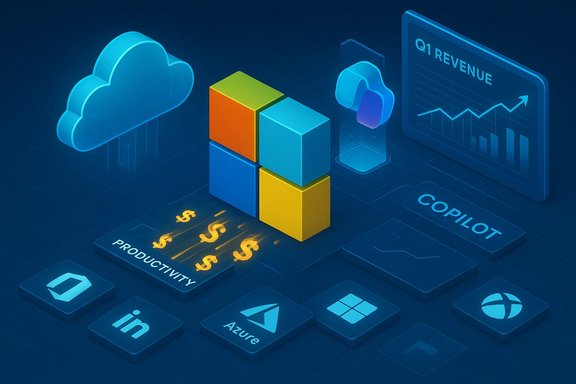
Microsoft’s business sits on three pillars: Productivity and Business Processes (Microsoft 365, Office, Dynamics, LinkedIn), Intelligent Cloud (Azure infrastructure, Windows Server, SQL Server), and More Personal Computing (Windows client, Surface, Xbox, search/advertising). This mix creates a hybrid profile: parts of the company behave like a high‑margin subscription SaaS business while other parts act as a hyperscale cloud operator with heavy capital intensity. Treating Microsoft as a simple “software” comparand in a blended peer set risks mixing apples and oranges — a point raised repeatedly in post‑publication analyses of the automated Benzinga snapshot.
The snapshot that prompted the industry comparison lists a set of headline multiples and dollar metrics: a mid‑30s trailing Price/Earnings (P/E), a high single‑digit to low‑double Price/Book (P/B), a double‑digit Price/Sales (P/S), modest Return on Equity (ROE), and very large EBITDA and gross‑profit dollars. The Benzinga table and ensuing commentary are valuable as a quick screen, but they do not, on their own, reconcile period bases (quarter vs TTM vs fiscal year) or cohort composition — two methodological details that materially affect interpretation.
(Verified figures cited in this analysis were cross‑checked against Microsoft’s quarterly SEC filing for the period ended September 30, 2025 and independent financial data snapshots contemporaneous with the Benzinga snapshot.
Source: Benzinga Industry Comparison: Evaluating Microsoft Against Competitors In Software Industry - Microsoft (NASDAQ:MSFT)
 Background
Microsoft’s business sits on three pillars: Productivity and Business Processes (Microsoft 365, Office, Dynamics, LinkedIn), Intelligent Cloud (Azure infrastructure, Windows Server, SQL Server), and More Personal Computing (Windows client, Surface, Xbox, search/advertising). This mix creates a hybrid profile: parts of the company behave like a high‑margin subscription SaaS business while other parts act as a hyperscale cloud operator with heavy capital intensity. Treating Microsoft as a simple “software” comparand in a blended peer set risks mixing apples and oranges — a point raised repeatedly in post‑publication analyses of the automated Benzinga snapshot.The snapshot that prompted the industry comparison lists a set of headline multiples and dollar metrics: a mid‑30s trailing Price/Earnings (P/E), a high single‑digit to low‑double Price/Book (P/B), a double‑digit Price/Sales (P/S), modest Return on Equity (ROE), and very large EBITDA and gross‑profit dollars. The Benzinga table and ensuing commentary are valuable as a quick screen, but they do not, on their own, reconcile period bases (quarter vs TTM vs fiscal year) or cohort composition — two methodological details that materially affect interpretation.
Overview: What the Benzinga Snapshot Shows
The automated Benzinga comparison positions Microsoft with these headline characteristics (the snapshot’s own numbers vary slightly across syndicated feeds, but the direction is consistent):- P/E and P/B below the “industry average” reported in the table, suggesting relative undervaluation on earnings and book value metrics.
- P/S above the blended industry mean, indicating the market attributes a revenue premium to Microsoft — likely a bet on AI and cloud monetization.
- ROE lower than the blended average, implying lower percent returns on equity versus some peers (though ROE alone is an incomplete lens for Microsoft).
- Extremely high EBITDA and gross‑profit dollars, far above the listed peers in absolute terms.
- Revenue growth in the high‑teens for the referenced period — notable for a multi‑hundred‑billion revenue company.
Why Methodology Matters: Timeframes, Cohorts, and Absolute vs Relative Metrics
The timeframe problem
Automated aggregations commonly mix different reporting bases. A single‑period (quarterly) EBITDA or gross‑profit figure will be numerically much smaller than an annual or trailing‑twelve‑months (TTM) number, yet both can appear side‑by‑side when data feeds are combined without explicit normalization. Analysts flagged precisely this issue with the Benzinga snapshot: the EBITDA and gross‑profit dollars cited for Microsoft align with a quarterly disclosure (Q1 of Microsoft’s fiscal year that ends in September timeframe), not the full fiscal year totals, which leads to enormous seeming discrepancies unless the reporting basis is noted. The company’s own filings for the quarter ended September 30, 2025, show gross margin and operating‑income figures that map to the Benzinga table when treated as a quarterly snapshot.Cohort selection — don’t blend hyperscalers with micro‑cap SaaS
“Software” is a broad label. Within that label are:- Hyperscalers and platform companies (Microsoft, AWS/Amazon, Google/Alphabet, Oracle in parts),
- Large subscription platform SaaS vendors (ServiceNow, Salesforce),
- Security and infrastructure vendors (Palo Alto Networks, Fortinet),
- High‑growth smaller SaaS firms (Monday.com, UiPath).
Absolute dollars vs. efficiency metrics
Microsoft’s absolute EBITDA and gross‑profit dollars matter in a different way from percentage margins and growth rates. High absolute profit dollars give Microsoft the strategic ability to invest intensely in AI datacenters, buy talent, and conduct large acquisitions without the leverage pressures smaller firms face. But absolute dollars do not substitute for growth efficiency metrics (margin expansion, ARR dynamics, retention rates) when comparing future return potential.Verifying the Key Figures (cross‑checked)
Any meaningful industry comparison must validate numbers with primary sources. Two independent checks provide a grounded basis:- Microsoft’s quarterly SEC filing for the period ended September 30, 2025 (Q1 FY2026 reporting cadence) documents revenue of roughly $77.7 billion and a gross profit figure consistent with the Benzinga snapshot’s $53.63 billion when interpreted as a single‑quarter result. That filing also discusses gross‑margin dynamics and the impact of scaling AI infrastructure on margin percentage.
- Independent market data snapshots from reputable aggregators (market pages and financial data services) list trailing P/E ratios in the mid‑30s and Price/Book in the low‑double digits at the time of the snapshot, consistent with the mid‑30s P/E cited by Benzinga. These public market snapshots confirm the headline multiples even as they remind readers that market multiples move daily with price and earnings updates.
Deep Dive: Strengths Highlighted by the Comparison
1. Unmatched cash generation and absolute profitability
Microsoft’s scale produces EBITDA and gross‑profit dollars that far exceed most pure‑software peers. That firepower finances multi‑year capital projects (AI datacenters, GPUs, custom silicon), consistent R&D investment, acquisitions, and shareholder returns without heavy reliance on leverage. This strategic optionality is one of Microsoft’s clearest competitive advantages.2. Diversified, sticky revenue mix
Subscriptions (Microsoft 365), platform revenues (Azure), professional networking (LinkedIn) and consumer franchises (Windows, Xbox) create multiple durable revenue streams. This diversity reduces single‑market exposure and supports consistent recurring revenue economics. The combination of subscription stickiness and hyperscale distribution is a rare profile in the software universe.3. Strategic AI positioning
Microsoft’s investments around Copilot integrations, Azure AI services, and partnerships with model vendors create multiple monetization paths: seat‑based attachments, consumption‑based cloud AI, and platform marketplace economics. If adoption and ARPU uplifts follow through, the market’s premium on revenue (P/S) will be justified. Forum analyses emphasize that Copilot attach rates and Azure AI workload mix are leading indicators to watch.4. Conservative balance‑sheet posture
Reported debt‑to‑equity metrics in the low‑teens to low‑0.2 range (depending on the snapshot and definition) give Microsoft flexibility to underwrite heavy capex without dangerous leverage. This reduces financing risk for capital‑intensive AI scale‑up.Key Weaknesses, Risks, and What Could Go Wrong
1. Valuation complacency: P/S premium is conditional
A double‑digit P/S premium effectively prices in AI monetization and higher ARPU from cloud services. If Copilot adoption lags or Azure AI margins remain pressured by sustained capex, that premium could compress quickly. Investors are paying for execution; execution risk is nontrivial.2. Capital intensity and timing risk
Scaling AI infrastructure is expensive and power‑hungry. Sustained capex can compress gross and operating margins in advance of any ARPU uplift. Microsoft has the balance sheet to fund these investments, but timing and margin recovery are execution issues. Analysts highlight the need to monitor capex guidance and GPU supply constraints as proximate risks.3. Competitive pressure from hyperscalers and best‑of‑breed vendors
AWS and Google Cloud remain aggressive on price and features. Meanwhile, specialized SaaS and security vendors capture enterprise wallet share within niches. Multi‑cloud adoption by customers can limit Azure wallet share in some accounts. Microsoft’s broad portfolio is a strength, but it also means the firm competes on multiple fronts simultaneously.4. Metric‑mix and interpretation pitfalls
ROE looks low relative to some peers, but that can reflect Microsoft’s large equity base and capital allocation choices (cash balances, buybacks timing, intangible assets). ROE is useful, but it must be read with ROIC, FCF conversion, and balance‑sheet nuances in mind. Automated snapshots that don’t disclose denominator definitions or period bases can mislead investors.Practical Investor Checklist: How to Compare Microsoft To Peers Properly
- Normalize the timeframe: always compare fiscal‑year vs fiscal‑year or TTM vs TTM. Avoid mixing single‑quarter figures with annualized figures without explicit labeling.
- Segment peers by business model:
- Hyperscalers and platforms (AWS/Google Cloud),
- Platform SaaS (Microsoft, Oracle, SAP),
- Security/infrastructure (Palo Alto, Fortinet),
- High‑growth pure SaaS (ServiceNow, Monday.com).
- Prefer EV/EBITDA and FCF yield for mega‑cap platforms rather than P/S, which can be noisy for scale players. Use EV/Revenue for smaller, growth SaaS names.
- Track the right operational KPIs for Microsoft: Azure sequential growth and AI workload mix, Copilot attach rates and ARPU, capex as a percent of revenue, and gross‑margin conversion. These are decisive for whether P/S premiums are earned.
- Reconcile aggregator outputs with primary filings (10‑Q/10‑K, investor releases). If a number cannot be traced to an audited base or a company report, flag it as unverifiable until proven otherwise.
Competitor Snapshot: Where Microsoft Stands Relative to Common Peers
The Benzinga comparison included a blended peer set (Oracle, ServiceNow, Palo Alto Networks, Fortinet, and others), and reported industry averages that were skewed by including micro‑cap high‑growth companies. A more instructive approach is to view Microsoft across three competitive dimensions:- As a hyperscaler: compare Azure to AWS and Google Cloud on total cloud revenue, AI hosting capability, and cloud margins.
- As a productivity platform: compare Microsoft 365 economics and renewals to enterprise SaaS leaders evaluating retention and ARPU uplift from Copilot-like features.
- As a security and infrastructure participant: recognize that specialized security vendors compete for discrete pockets of enterprise spend and often enjoy different margin structures.
Verification Caveats and Unverifiable Claims
- The automated Benzinga snapshot is useful but does not explicitly state whether EBITDA and gross‑profit figures are quarterly or annual. Several independent forum reviews and the company’s SEC filing indicate that those dollar figures line up with the quarterly results for a specific quarter (Q1 on a fiscal basis), not the annual totals; treating them as annual without confirmation is a methodological error. Flag any headline that cannot be traced clearly to the underlying reporting basis.
- Projections about AI revenue or Copilot monetization remain forward‑looking. While Copilot adoption is a strategic lever, any dollar forecasts for AI monetization should be labeled as contingent forward guidance until management consistently discloses recurring commercial metrics at scale. Forum analysts advise treating these projections as hypotheses, not facts, until substantiated by recurring disclosures.
Strategic Scenarios — Upside, Base, Downside
- Upside: Azure gross margins improve as AI infrastructure efficiencies scale; Copilot attach rates and ARPU materially lift subscription revenue; P/S premium is earned and multiples expand. Microsoft’s cash generation funds expansion without leverage stress.
- Base: High‑teens revenue growth continues; capex temporarily compresses margins but FCF recovers as AI workloads normalize; multiples trade in a stable band reflecting platform quality.
- Downside: AI monetization lags; capex remains elevated; hyperscaler competition and price pressure compress Azure margins; P/S and P/E multiples re‑rate downward. Regulatory headwinds or supply shocks for GPUs could exacerbate the downside.
Conclusion: A Nuanced, Actionable Takeaway for Investors and Enthusiasts
The Benzinga automated industry comparison is a practical screen that explains why Microsoft looks both expensive and cheap depending on which lens you pick:- It looks cheap on earnings and book value relative to a blended software mean (lower P/E and P/B).
- It looks expensive on revenue (higher P/S), which is a market bet on AI and cloud monetization.
- Its absolute EBITDA and gross‑profit dollars are unmatched and justify strategic optionality.
- Interpretation hinges on methodology: confirm whether headline dollars are quarterly or annual, cohort‑normalize peers, and prioritize operational KPIs (Azure AI mix, Copilot adoption, capex cadence) over headline multiples alone.
(Verified figures cited in this analysis were cross‑checked against Microsoft’s quarterly SEC filing for the period ended September 30, 2025 and independent financial data snapshots contemporaneous with the Benzinga snapshot.
Source: Benzinga Industry Comparison: Evaluating Microsoft Against Competitors In Software Industry - Microsoft (NASDAQ:MSFT)
