

Akii’s launch of AI Search Tracker stakes a clear claim in the shifting discovery landscape: brands need dedicated intelligence to measure how generative AI assistants describe, recommend, or omit them — and the company says its new platform does exactly that.
Search is evolving from ranked lists of links to synthesized assistant answers that often end the session without a click. This “zero‑click AI economy” creates a visibility problem for brands: traditional analytics and SEO rank trackers can show stable rankings and falling organic traffic at the same time, because users are receiving complete responses from AI assistants and never visiting the source site. Akii positions AI Search Tracker as a purpose‑built tool to measure brand presence, portrayal, and gaps inside the outputs of major assistants such as ChatGPT, Google AI, Perplexity, and Microsoft Copilot.
Akii bundles the tracker into a broader suite (including tools named AI Brand Audit, Competitor Intelligence, Website Optimizer, and AI Engage) and describes an operational flow that generates industry‑specific prompts, queries target assistants, extracts mentions and citations, and aggregates the results in a dashboard for teams to act on. The company frames the product as an essential complement to SEO tools — not a replacement — because the unit of optimization has changed from individual pages to brand understanding.
Two practical implications follow from Akii’s described approach:
Key methodological elements buyers must insist on:
However, language coverage alone is not sufficient; methodology must account for:
That said, the promise of AI visibility tracking comes with important caveats. Buyers must demand reproducibility, time‑stamped logs, prompt transparency, model identifiers, and clear provenance methods. Claims about proxy networks or “AI training” campaigns should be treated as vendor‑asserted until fully documented. Where remediation advice relies on simulated behavior or proxy‑driven campaigns, legal, ethical and long‑term platform risk must be explicitly addressed.
For organizations facing unexplained traffic declines or suspicious shifts in brand visibility, AI Search Tracker and similar AEO tools offer practical, prioritized diagnostics. The prudent approach is to pilot these tools with strict audit requirements, focus on business outcomes rather than headline scores, and integrate visibility efforts with structured data, canonical fact sheets, and high‑quality third‑party placements to build durable provenance. The era of AI‑first discovery demands new metrics — but those metrics must be transparent, auditable, and firmly connected to measurable business impact.
Source: Programming Insider Akii Unveils AI Search Tracker to Monitor Brand Performance in AI Search Results
 Background / Overview
Search is evolving from ranked lists of links to synthesized assistant answers that often end the session without a click. This “zero‑click AI economy” creates a visibility problem for brands: traditional analytics and SEO rank trackers can show stable rankings and falling organic traffic at the same time, because users are receiving complete responses from AI assistants and never visiting the source site. Akii positions AI Search Tracker as a purpose‑built tool to measure brand presence, portrayal, and gaps inside the outputs of major assistants such as ChatGPT, Google AI, Perplexity, and Microsoft Copilot.Akii bundles the tracker into a broader suite (including tools named AI Brand Audit, Competitor Intelligence, Website Optimizer, and AI Engage) and describes an operational flow that generates industry‑specific prompts, queries target assistants, extracts mentions and citations, and aggregates the results in a dashboard for teams to act on. The company frames the product as an essential complement to SEO tools — not a replacement — because the unit of optimization has changed from individual pages to brand understanding.
Why traditional analytics no longer tell the full story
The mechanics of classical SEO — keyword ranking, SERP placement, backlink profiles — assume users click from a search results page to a destination. Assistant‑style interfaces break that assumption. When an AI assistant synthesizes an answer and the user is satisfied, the session may end with no referral, no click, and no direct signal in analytics platforms.- Clickless answers remove referral data that traditionally measured visibility and intent.
- AI responses can cite sources inconsistently or provide no explicit attribution at all, making provenance murky.
- Assistants synthesize signals across many pages and signals, meaning entity-level reputation and representation can matter more than a single optimized URL.
Inside the AI Search Tracker dashboard
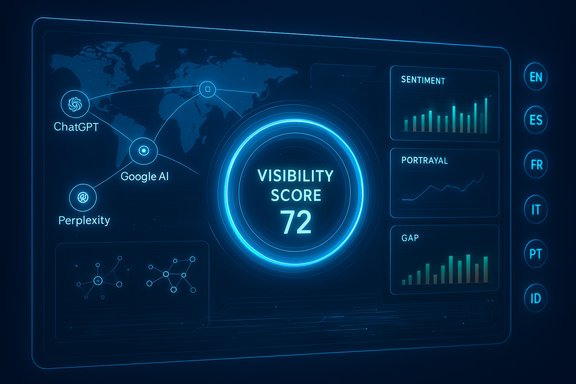
Akii describes the Tracker dashboard as translating opaque assistant behavior into a small set of actionable signals. Three of the platform’s core outputs are repeatedly emphasized in the product materials:Visibility Score
A single, high‑level metric that aggregates how often a brand appears across selected assistants for the topics that matter most to the organization. The score is intended to be a simple executive KPI that answers: Are assistants recommending or mentioning my brand for priority intents?Context and Portrayal Analysis
Beyond frequency, the tracker analyzes how a brand is described. That includes sentiment, whether the brand is recommended versus merely mentioned, and the specific attributes assistants surface (price, features, positioning). This matters because being mentioned in a negative or inaccurate way can be as damaging as absence. Akii stresses that visibility without correct portrayal is an incomplete outcome.Gap Analysis (Prompt & Intent Level)
AI Search Tracker surfaces prompts and intents where the brand is missing or under‑represented. For example, a brand may appear in general category queries but vanish when queries specify enterprise buyers, regional needs, or specific use cases. The platform’s reported prompt‑level diagnostics are designed to pinpoint those precise failure modes so teams can close the gaps.How Akii says the system operates (and what is vendor‑asserted)
Akii outlines a four‑step operational pipeline:- Define brands and primary topics to monitor.
- Generate representative prompts using an internal LLM.
- Execute queries against target AI platforms and collect outputs.
- Extract mentions, citations and competitor signals and surface trends and gaps in the dashboard.
Two practical implications follow from Akii’s described approach:
- Sampling realism matters. Geographic presence, IP origin, and session context can all affect how assistants respond. Using a proxy network is one tactic to replicate distributed user signals, but the legal and ethical posture of proxy‑driven scraping must be clarified by any vendor offering it.
- Prompt generation and normalization are central. Assistants are highly sensitive to wording, persona and conversation history. The quality and scope of the prompt bank determine whether the sample is representative or biased.
Methodology, transparency and the reproducibility bar
Akii’s architecture mirrors what multiple entrants in the emergent Answer Engine Optimization (AEO) category describe: generate standardized prompts, sample outputs across assistants, extract provenance, and aggregate into scores. That pipeline is plausible and operationally useful — but the credibility of any such tracker depends on a set of methodological disclosures most vendors do not fully publish at launch.Key methodological elements buyers must insist on:
- Prompt corpus and normalization rules. Which prompts were used, how many variants per intent, and what conversational context was controlled? Without this, scores are hard to reproduce.
- Sample size, cadence and geographic coverage. How many queries per assistant, per intent? Were locales, languages and regional model behaviors accounted for? A small or skewed sample can yield misleading trendlines.
- Model/versioning and time‑stamping. Assistants update frequently. A tracker must record model identifiers (or API versions) and timestamps for each sampled output so comparisons remain valid over time.
- Provenance extraction heuristics. When assistants provide explicit citations, attribution is straightforward. Where outputs are citation‑less, vendors must explain their heuristics and confidence thresholds for inferring sources; otherwise the tracker risks false positives.
- Legal and compliance posture. Are queries executed via official APIs or by simulated browsing? If the latter, what provider terms might be implicated and what proxy sourcing, consent, and compliance artefacts does the vendor provide?
Strengths and practical value
Despite methodological caveats, Akii’s product pitch has several legitimate strengths for brands that are already seeing the effects of assistant‑led discovery:- Unified cross‑engine visibility. Having a single dashboard that samples ChatGPT, Google AI, Perplexity and Copilot reduces the manual burden of checking multiple assistant outputs and highlights cross‑platform differences at a glance.
- Prompt‑level diagnostics. Knowing the exact intents you “win” or “lose” lets content, SEO and PR teams prioritize targeted updates rather than broad, unfocused efforts.
- Competitive benchmarking. The ability to see which competitors appear more often in assistant outputs surfaces publisher or content strategies that may be overperforming and worth emulating or countering.
- Closed‑loop remediation. Akii pairs detection with remediation pathways (AI Engage, Website Optimizer) intended to translate visibility gaps into concrete actions — e.g., updating canonical pages, syndicating authoritative fact sheets, or adjusting structured data. That workflow orientation is attractive to teams that need to move from insight to execution.
Risks, limitations and ethical considerations
Akii’s tracker — like all tools in this nascent category — faces several structural risks and ethical questions buyers must evaluate before adoption.- Reproducibility and volatility. Models and retrieval layers can change overnight. A tracker that does not account for versioning, or that fails to rebaseline after major assistant updates, can produce misleading longitudinal trends.
- Provenance fragility. When assistants do not publish citations, inferred provenance is a heuristic. That inference can produce false attributions, and vendors must provide uncertainty estimates for such matches.
- Potential for manipulation. Automated “education” campaigns — syndicating canonical content at scale or using proxy‑based simulated browsing to influence retrieval signals — can create authority illusions. Platform providers are actively rolling out anti‑manipulation defenses; what works today could be disallowed tomorrow. Buyers should treat remediation recommendations that rely heavily on simulated behavior with skepticism and demand disclosure of tactics.
- Legal and terms‑of‑service exposure. High‑volume, automated querying or scraping of assistant interfaces may breach vendor terms. If a vendor relies on proxy networks to simulate queries, customers should require legal and compliance assurances and documentation.
- Attribution and measurement noise. Even when an assistant cites a brand, downstream analytics may not attribute the session correctly. Measuring actual business impact requires careful A/B tests and instrumentation beyond citation counts.
- Privacy and regulatory risk. Any approach that logs user interactions, stores query payloads, or links to GA4/analytics needs a clear privacy and retention policy. GDPR/CCPA impacts and data‑processing agreements must be explicit.
Multilingual and regional coverage: a necessary but tricky promise
Akii highlights monitoring across seven languages (English, German, Spanish, French, Italian, Portuguese and Indonesian), which is an important capability because assistant behavior varies by language and region. Multilingual monitoring is crucial for global brands that must ensure consistent positioning across markets.However, language coverage alone is not sufficient; methodology must account for:
- Locale‑specific prompt banks and vernacular phrasing.
- Regionally targeted sampling (IP origin, locale settings, cultural variants).
- Differences in which assistants are dominant in each market.
Practical pilot playbook — how to test AI Search Tracker (recommended 90‑day experiment)
- Identify 10–20 high‑value intents (purchase decisions, enterprise buyer queries, regional queries).
- Request raw, time‑stamped logs from the vendor for each sampled output, including the exact prompt and assistant model identifier where available.
- Run a 30‑day baseline: collect the vendor’s visibility signals while instrumenting server logs and analytics to capture downstream behavior.
- Implement small, targeted remediation actions (one canonical fact sheet, an FAQ rewrite, or updated structured data) scoped to individual intents.
- Re‑sample for 30 days and compare visibility plus downstream KPIs (CTR, session quality, conversions) for treated vs. holdout intents.
- Validate provenance: for instances where the assistant cited a source, verify whether the cited page actually contains the excerpt used by the assistant.
- Request a rebaseline policy: how does the vendor handle model updates and score recalibration?
Buying checklist — what to demand from a vendor
- Exportable, time‑stamped raw logs for every sampled output (prompt, assistant output, model/version, locale, and timestamp).
- The full prompt corpus and normalization rules used in sampling.
- Sample sizes and cadence per intent, per language, and per assistant.
- A clear description of provenance heuristics and confidence thresholds.
- Legal and compliance documentation explaining query execution methods and any proxy usage.
- Demonstrable case studies that tie visibility changes to downstream business KPIs.
How Akii fits into the evolving AEO market
Akii joins several startups and vendor efforts forming the Answer Engine Optimization (AEO) category — tools designed to measure and influence how brands appear inside assistant outputs rather than classic search engine results. Industry coverage treats these products as complementary to traditional SEO platforms; the new priority is reputation, narrative pull‑through and provenance, not just keyword rankings. Buyers should expect competition among vendors and rapid iteration in features, but the core challenge remains the same: making a brand discoverable and accurately represented in opaque retrieval and summarization systems.Conclusion
Akii’s AI Search Tracker appropriately addresses a real and growing problem: as AI assistants become primary discovery surfaces, brands must know whether they are being recommended, how they are being described, and where gaps exist. The product’s dashboard outputs — Visibility Score, portrayal analysis, and prompt‑level gap diagnostics — map directly to the operational needs of SEO, content, and communications teams.That said, the promise of AI visibility tracking comes with important caveats. Buyers must demand reproducibility, time‑stamped logs, prompt transparency, model identifiers, and clear provenance methods. Claims about proxy networks or “AI training” campaigns should be treated as vendor‑asserted until fully documented. Where remediation advice relies on simulated behavior or proxy‑driven campaigns, legal, ethical and long‑term platform risk must be explicitly addressed.
For organizations facing unexplained traffic declines or suspicious shifts in brand visibility, AI Search Tracker and similar AEO tools offer practical, prioritized diagnostics. The prudent approach is to pilot these tools with strict audit requirements, focus on business outcomes rather than headline scores, and integrate visibility efforts with structured data, canonical fact sheets, and high‑quality third‑party placements to build durable provenance. The era of AI‑first discovery demands new metrics — but those metrics must be transparent, auditable, and firmly connected to measurable business impact.
Source: Programming Insider Akii Unveils AI Search Tracker to Monitor Brand Performance in AI Search Results
