
Akrites, launched by the Linux Foundation on June 25, 2026, is a new industry-backed program to coordinate confidential vulnerability remediation and disclosure for critical open source software as AI tools accelerate both bug discovery and exploit development across the software supply chain. The premise is blunt: open source security no longer fails only when nobody finds the flaw. It now fails when too many actors find the same flaw, too quickly, and push maintainers into a disclosure and patching process built for a slower era.
That makes Akrites less a shiny new security product than an admission of structural debt. The world’s software dependency graph has been treated as common infrastructure, but its incident response model still often resembles a group chat, a private email thread, and a maintainer trying to triage reports after work. AI did not create that contradiction. It simply made it impossible to keep ignoring.
The most important thing about Akrites is not that the Linux Foundation has gathered another coalition of famous logos. The important thing is what those logos are implicitly conceding: vulnerability discovery is no longer the scarce resource.
For decades, the industry’s open source security model rested on a rough balance. Attackers, researchers, vendors, and maintainers all had limited time and limited expertise. A severe bug in a widely used library might still sit undiscovered for years, but once it surfaced, the challenge was usually to verify it, fix it, disclose it responsibly, and get downstream users to update before the bug became widely weaponized.
AI disturbs that bargain. Frontier models and specialized security agents can inspect huge codebases, reason across unfamiliar APIs, generate proof-of-concept exploit paths, and help less experienced operators do work that once required a small cadre of domain specialists. The result is not magic omniscience, and not every AI-generated report is useful. But the slope of the curve has changed.
That is why the Linux Foundation’s language around Akrites focuses on AI-assisted vulnerability discovery rather than generic supply chain hygiene. This is not merely another SBOM program, another compliance dashboard, or another attempt to convince enterprises to inventory their dependencies. Akrites is about the messy middle of security response: who gets the report, who validates it, who talks to maintainers, who prepares the fix, who keeps the embargo intact, and who prevents five parallel patches from becoming five new problems.
That middle layer has always been underfunded because it is hard to productize. Companies like buying scanners, dashboards, and certificates. They are less accustomed to funding the social machinery that turns a vulnerability into a safe upstream fix. Akrites is a bet that, in the AI era, the social machinery is now critical infrastructure.
That matters because the current disclosure environment often punishes the very people it depends on. A maintainer may receive several reports about the same flaw from different companies. One report may include a patch, another may include an exploit sketch, another may be partly wrong, and another may demand a public advisory by an arbitrary deadline. Even when every participant is acting responsibly, the process can become exhausting.
AI raises the volume. Some reports are better than the old stereotype of machine-generated security spam, but the overall stream is larger. A maintainer still has to distinguish a real vulnerability from a hallucinated one, a theoretical weakness from an exploitable defect, and a safe fix from a patch that breaks downstream users. For small projects, this is not incident response. It is an unfunded second job.
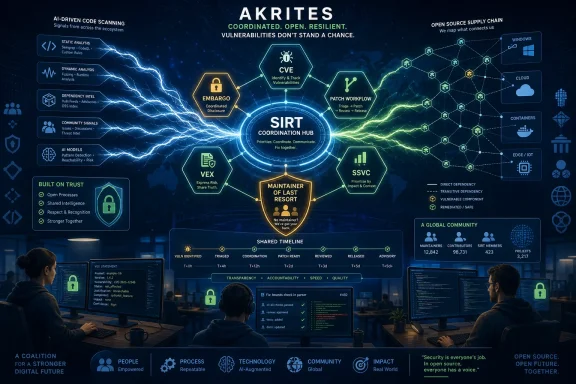
Akrites’ proposed shared Security Incident Response Team is meant to absorb some of that load. In theory, the SIRT becomes the trusted intermediary that receives reports, validates the issue, coordinates remediation, and works with upstream projects on the maintainers’ terms. The goal is not to seize control from maintainers, but to give them a stable counterpart that can handle the industrial-scale parts of the process.
That distinction is crucial. Open source communities are rightly suspicious of “help” that arrives as corporate control in softer language. A program that routes around maintainers, forks projects, or imposes vendor deadlines would deepen the trust problem. Akrites is explicitly presenting itself as upstream-first: fixes should return to the original project, through the original project’s process, without fragmenting the ecosystem.
The promise is attractive because the alternative is bleak. If maintainers cannot cope with the incoming wave of AI-assisted findings, the industry will not stop finding bugs. It will route around them, patch privately, fork quietly, or leave customers to sort through competing advisories. That is how common infrastructure becomes a private patchwork.
Software security failures are often described as technical incidents because that is the easiest layer to see. A buffer overflow, deserialization bug, authentication bypass, dependency confusion risk, or memory-safety flaw gives the incident a name and a patch. But the harder failures are usually procedural. The wrong people were notified. The report sat unread. The patch landed without enough context. The advisory was unclear. Downstream vendors did not know whether they were exposed. Users were told to update, but not which systems mattered first.
Akrites is trying to standardize that choreography. A confidentiality-first CVD process gives participants a shared expectation about how sensitive information moves. Severity scoring and exploit prediction tools help sort urgency. VEX statements can clarify whether a known vulnerability actually affects a given product. SSVC-style decision support can help organizations move beyond abstract severity numbers and toward operational choices.
That sounds bureaucratic, and in one sense it is. But good bureaucracy is exactly what incident response needs when the blast radius spans banks, hospitals, telecom networks, cloud platforms, governments, and AI labs. The open source ecosystem already has plenty of clever people. What it lacks is a reliable, resourced, and repeatable path from discovery to deployed fix.
The uncomfortable part is that open source has long benefited from being both radically decentralized and economically central. Decentralization helped it scale creatively. Economic centrality made it indispensable. Security response now sits at the point where those virtues collide. Akrites is one attempt to preserve upstream autonomy while adding something closer to institutional muscle.
That phrase should make every enterprise architect pause. Modern software depends on layers of code that few organizations can name from memory and fewer still could maintain under pressure. Some of that code is healthy, active, and professionally governed. Some is effectively abandoned, even as it remains buried in containers, appliances, CI pipelines, developer tools, and production services.
The industry usually discovers this asymmetry during a crisis. A component turns out to be everywhere. The original maintainer is unavailable, burned out, retired, or never expected their weekend project to become part of national infrastructure. Vendors scramble. Security teams ask whether they are exposed. Developers discover that the dependency arrived through another dependency. Executives ask why nobody owned the risk.
A maintainer-of-last-resort model does not solve every one of those problems, but it addresses a gap the market has been slow to fill. Somebody has to be able to coordinate a fix for a critical package when there is nobody on the other end. Not a permanent corporate takeover, not an opportunistic fork, but a credible emergency mechanism that gets a supported version patched and gives downstream users a path forward.
This is where Akrites could matter most for WindowsForum’s readers, even though the initiative is not Windows-specific. Windows desktops, Windows Server estates, Azure workloads, developer workstations, GitHub Actions pipelines, WSL environments, Kubernetes clusters, Python tools, Node packages, Java dependencies, Rust crates, and container images all draw from the same open source commons. The boundary between “Linux problem” and “Windows environment” vanished years ago.
For IT pros, the question is no longer whether open source is present. It is whether anyone can coordinate the security of the components your business inherited indirectly. Akrites is a sign that the biggest consumers of open source have finally become nervous enough to fund part of the answer.
That gives Microsoft a complicated role. GitHub is where much of the world’s open source collaboration happens. Azure runs enormous volumes of Linux and open source workloads. Windows developers increasingly rely on package managers, containers, language ecosystems, and CI/CD pipelines that are open source by default. Microsoft customers expect all of that to work without needing to become experts in every upstream project.
Participation in Akrites therefore aligns with Microsoft’s practical interests. A coordinated upstream fix is cheaper and safer than each cloud provider or enterprise vendor carrying its own private patch. Better disclosure coordination reduces the chance that GitHub-hosted projects are overwhelmed by low-quality or duplicative reports. Security improvements in core ecosystems reduce support risk for customers who may never realize which open source package sits beneath their stack.
It also reflects a broader evolution in the company’s security posture. Microsoft has spent years positioning itself as a security vendor, cloud platform, developer platform, and AI company at once. Those roles converge around supply chain security. If AI-assisted tools can discover vulnerabilities faster, then Microsoft and GitHub need mechanisms that prevent discovery from becoming chaos.
That is especially relevant as AI coding tools become a normal part of development. The same class of systems that can help find vulnerabilities can also generate code, triage issues, propose patches, and accelerate review. The industry is heading toward a world where AI agents participate across the software lifecycle. In that world, trusted coordination becomes more important, not less, because speed without governance becomes another failure mode.
The mix of backers reveals the shape of the risk. Cloud providers depend on open source to operate hyperscale infrastructure. Banks depend on open source for application platforms, cryptography, data processing, developer tooling, and internal systems. Telecoms depend on open source across network infrastructure and service platforms. AI companies depend on open source frameworks, runtimes, compilers, drivers, model tooling, and deployment stacks. Security vendors depend on it both as substrate and as telemetry surface.
No single one of those sectors can solve upstream vulnerability response alone. A bank may discover a flaw in a library it uses, but it may not have the community standing to land a fix safely. A cloud provider may have deep engineering resources, but private remediation at cloud scale can diverge from what upstream users need. An AI lab may generate powerful vulnerability findings, but flooding maintainers with them is not a public service. A security vendor may identify risks across ecosystems, but may not be trusted by every maintainer.
Akrites attempts to pool those resources into a common channel. That is why its narrowness matters. It is not trying to become the universal open source governance layer. It is trying to coordinate serious vulnerability remediation and disclosure for critical projects. In an ecosystem allergic to centralization, a focused mandate is a survival strategy.
The crowded-field problem remains real. OpenSSF, Alpha-Omega, Chainguard’s Athena effort, IBM and Red Hat’s Project Lightwell, vendor security teams, language foundations, package repositories, and independent auditors all operate in overlapping territory. Akrites will have to prove that it reduces friction rather than adding another meeting, another badge, another intake form, and another acronym.
Private patching feels responsible in the short term. A vendor finds a severe flaw, patches its own copy, protects its customers, and avoids public panic. But if the fix does not flow upstream, the broader ecosystem remains exposed. Worse, other vendors may produce slightly different fixes, some incomplete, some incompatible, and some never disclosed clearly. Users then face a mess of version numbers, advisories, and mitigation claims.
Forking can be legitimate. Open source gives communities the right to take code in new directions, and abandoned projects sometimes need successors. But emergency security forks are a symptom of coordination failure. They imply that the normal path back to the project is too slow, too uncertain, or unavailable.
Akrites is trying to make the upstream path viable under pressure. That requires more than technical skill. It requires trust from maintainers who may worry that corporate participants will use security as leverage. It requires restraint from companies that may be tempted to prioritize customer optics over ecosystem health. It requires confidentiality practices strong enough to keep embargoed details from leaking before fixes are ready.
This is a difficult balance. Too much secrecy can leave downstream defenders unprepared. Too much disclosure can hand attackers a roadmap. Too much corporate involvement can alienate communities. Too little resourcing can leave maintainers drowning. Akrites’ success will depend on whether it can operate in that narrow channel without becoming either toothless or domineering.
When AI systems can help identify candidate flaws at scale, the number of latent vulnerabilities moving toward discovery increases. When those systems can assist exploit development, the gap between “bug found” and “bug usable” narrows. When public patches can be analyzed automatically, the interval between commit and exploit can shrink further. The phrase “patch gap” used to describe the lag between available fixes and deployed fixes. Now the gap begins earlier, at the moment multiple parties independently learn enough to act.
This is why Akrites’ backers talk about measuring success in deployment, not merely publication. A patch that exists upstream but never reaches production systems is a moral victory with limited operational value. Enterprise IT already knows this from bitter experience. Patch Tuesday is not just the day Microsoft releases fixes; it is the beginning of testing, staging, compatibility review, emergency exceptions, maintenance windows, and sometimes rollback planning.
Open source vulnerabilities complicate that rhythm. There may be no single vendor dashboard. The affected component may be embedded inside a commercial product, container image, developer tool, appliance, or internal application. The advisory may name a library while the security team thinks in terms of business services. Akrites can help upstream coordination, but downstream deployment remains the hard last mile.
That last mile is where Windows administrators and enterprise defenders should pay attention. A better upstream fix is necessary but insufficient. Organizations still need dependency visibility, asset inventory, SBOMs that are usable rather than decorative, build pipelines that can update safely, and governance that can translate upstream advisories into business risk. Akrites may reduce chaos at the source. It will not patch your environment for you.
Akrites does not erase that imbalance. But its funding model, through Linux Foundation channels and with Alpha-Omega seed support, reflects a more mature view of the problem. Security is not just a matter of exhorting maintainers to be more responsible. It is a matter of paying for the work the modern economy requires.
This is a shift from charity framing to infrastructure framing. Charity says maintainers deserve help because they are overburdened volunteers. Infrastructure says maintainers deserve support because the systems they maintain carry public and commercial risk. The second argument is harder to ignore in boardrooms.
The challenge is making sure the money reaches the work. Open source security funding can disappear into reports, governance overhead, temporary audits, and short-lived campaigns. The valuable work is often patient and unglamorous: reviewing dangerous code paths, improving test coverage, modernizing release processes, hardening build systems, writing advisories, triaging reports, and mentoring new maintainers. Akrites will be judged not by the prestige of its founding roster but by whether it produces timely, trusted fixes in projects that otherwise would have struggled.
There is also a political economy problem. Large companies want coordination, but they do not all want the same outcomes. Cloud providers, AI labs, banks, and security vendors have different incentives around disclosure timing, customer notification, liability, and competitive positioning. A shared SIRT can reduce fragmentation only if participants accept common rules when those rules are inconvenient.
A typical Windows estate now includes developer machines running Git, Python, Node.js, Java, Go, Rust, Docker, Kubernetes tools, package managers, SSH clients, CI agents, and open source build dependencies. It includes servers running commercial applications that bundle open source libraries. It includes Azure resources built from Linux images and container stacks. It includes security tools that parse open source telemetry and business applications that depend on open source frameworks.
The result is that a critical upstream flaw can become a Windows operational problem quickly. Not because Windows itself is vulnerable, but because the organization’s software supply chain crosses operating system lines constantly. The admin who owns endpoint policy, the developer who owns a package manifest, the platform engineer who owns container baselines, and the security analyst who owns exposure management are all looking at different fragments of the same dependency graph.
Akrites’ upstream emphasis is therefore relevant to Windows professionals. If it works, the fixes that eventually arrive in your tools, packages, containers, and vendor products should be less fragmented and better coordinated. If it fails, Windows environments will still inherit the downstream confusion: competing advisories, delayed patches, unclear exposure, and emergency mitigation work driven by incomplete information.
This is also a reminder that Microsoft’s open source strategy has security consequences. GitHub is not just a developer social network. It is part of the world’s vulnerability disclosure nervous system. Azure is not just a Windows cloud. It is an enormous Linux and open source platform. Windows administrators who understand that reality will make better decisions than those still dividing the world into proprietary and open source camps.
The first test will be maintainer trust. If maintainers see Akrites as a corporate reporting funnel that reduces noise and brings useful patches, it can become valuable. If they see it as another external process demanding attention, it will struggle. Open source communities do not adopt governance because a foundation announces it. They adopt it because it proves useful under pressure.
The second test will be operational speed. A single coordinated process is helpful only if it moves faster than the fragmented process it replaces. AI-assisted discovery compresses timelines, and Akrites will have to validate findings, coordinate fixes, preserve confidentiality, and support disclosure without becoming a bottleneck. Centralization can reduce duplication, but it can also create queues.
The third test will be downstream clarity. Upstream remediation is the right place to start, but enterprise defenders need usable signals. They need to know whether a vulnerability affects them, which versions are safe, whether mitigations exist, whether exploitability is likely, and what to prioritize when everything looks urgent. Standards like VEX and SSVC help, but only if the information is timely and trusted.
The fourth test will be abandoned or under-maintained projects. The maintainer-of-last-resort role sounds noble, but it is legally, socially, and technically complicated. Who decides a project is critical? Who decides a maintainer is unreachable? Who reviews the emergency patch? How long does support continue? These questions cannot be solved by branding. They will be answered case by case, and those cases will define Akrites more than the launch announcement.
Akrites is a bet that the open source world can keep its upstream model while adding the incident-response discipline demanded by AI-speed vulnerability discovery. If it succeeds, maintainers gain a buffer, enterprises gain cleaner fixes, and the industry buys time to modernize the rest of the patch pipeline. If it fails, the future still arrives: more automated discovery, more disclosure pressure, more abandoned components exposed as hidden infrastructure, and more Windows, Linux, cloud, and developer teams learning that the commons they depend on needs more than gratitude.
That makes Akrites less a shiny new security product than an admission of structural debt. The world’s software dependency graph has been treated as common infrastructure, but its incident response model still often resembles a group chat, a private email thread, and a maintainer trying to triage reports after work. AI did not create that contradiction. It simply made it impossible to keep ignoring.
 The AI Security Boom Has Turned Open Source Into a Race Against Coordination
The most important thing about Akrites is not that the Linux Foundation has gathered another coalition of famous logos. The important thing is what those logos are implicitly conceding: vulnerability discovery is no longer the scarce resource.For decades, the industry’s open source security model rested on a rough balance. Attackers, researchers, vendors, and maintainers all had limited time and limited expertise. A severe bug in a widely used library might still sit undiscovered for years, but once it surfaced, the challenge was usually to verify it, fix it, disclose it responsibly, and get downstream users to update before the bug became widely weaponized.
AI disturbs that bargain. Frontier models and specialized security agents can inspect huge codebases, reason across unfamiliar APIs, generate proof-of-concept exploit paths, and help less experienced operators do work that once required a small cadre of domain specialists. The result is not magic omniscience, and not every AI-generated report is useful. But the slope of the curve has changed.
That is why the Linux Foundation’s language around Akrites focuses on AI-assisted vulnerability discovery rather than generic supply chain hygiene. This is not merely another SBOM program, another compliance dashboard, or another attempt to convince enterprises to inventory their dependencies. Akrites is about the messy middle of security response: who gets the report, who validates it, who talks to maintainers, who prepares the fix, who keeps the embargo intact, and who prevents five parallel patches from becoming five new problems.
That middle layer has always been underfunded because it is hard to productize. Companies like buying scanners, dashboards, and certificates. They are less accustomed to funding the social machinery that turns a vulnerability into a safe upstream fix. Akrites is a bet that, in the AI era, the social machinery is now critical infrastructure.
Maintainers Needed Fewer Bug Reports, Not Louder Alarms
The open source maintainer’s inbox has become the place where vendor ambition, researcher incentives, compliance anxiety, and now AI automation collide. Akrites is built around a simple proposition: maintainers should receive a coordinated signal, not a chorus of overlapping warnings.That matters because the current disclosure environment often punishes the very people it depends on. A maintainer may receive several reports about the same flaw from different companies. One report may include a patch, another may include an exploit sketch, another may be partly wrong, and another may demand a public advisory by an arbitrary deadline. Even when every participant is acting responsibly, the process can become exhausting.
AI raises the volume. Some reports are better than the old stereotype of machine-generated security spam, but the overall stream is larger. A maintainer still has to distinguish a real vulnerability from a hallucinated one, a theoretical weakness from an exploitable defect, and a safe fix from a patch that breaks downstream users. For small projects, this is not incident response. It is an unfunded second job.
Akrites’ proposed shared Security Incident Response Team is meant to absorb some of that load. In theory, the SIRT becomes the trusted intermediary that receives reports, validates the issue, coordinates remediation, and works with upstream projects on the maintainers’ terms. The goal is not to seize control from maintainers, but to give them a stable counterpart that can handle the industrial-scale parts of the process.
That distinction is crucial. Open source communities are rightly suspicious of “help” that arrives as corporate control in softer language. A program that routes around maintainers, forks projects, or imposes vendor deadlines would deepen the trust problem. Akrites is explicitly presenting itself as upstream-first: fixes should return to the original project, through the original project’s process, without fragmenting the ecosystem.
The promise is attractive because the alternative is bleak. If maintainers cannot cope with the incoming wave of AI-assisted findings, the industry will not stop finding bugs. It will route around them, patch privately, fork quietly, or leave customers to sort through competing advisories. That is how common infrastructure becomes a private patchwork.
Akrites Is a Governance Project Wearing a Security Jacket
Akrites uses the familiar vocabulary of vulnerability management: CVE, CWE, CVSS, EPSS, SSVC, VEX, traffic light protocol markings, coordinated vulnerability disclosure, and embargo discipline. Those standards matter, but they are not the heart of the story. The heart of the story is governance.Software security failures are often described as technical incidents because that is the easiest layer to see. A buffer overflow, deserialization bug, authentication bypass, dependency confusion risk, or memory-safety flaw gives the incident a name and a patch. But the harder failures are usually procedural. The wrong people were notified. The report sat unread. The patch landed without enough context. The advisory was unclear. Downstream vendors did not know whether they were exposed. Users were told to update, but not which systems mattered first.
Akrites is trying to standardize that choreography. A confidentiality-first CVD process gives participants a shared expectation about how sensitive information moves. Severity scoring and exploit prediction tools help sort urgency. VEX statements can clarify whether a known vulnerability actually affects a given product. SSVC-style decision support can help organizations move beyond abstract severity numbers and toward operational choices.
That sounds bureaucratic, and in one sense it is. But good bureaucracy is exactly what incident response needs when the blast radius spans banks, hospitals, telecom networks, cloud platforms, governments, and AI labs. The open source ecosystem already has plenty of clever people. What it lacks is a reliable, resourced, and repeatable path from discovery to deployed fix.
The uncomfortable part is that open source has long benefited from being both radically decentralized and economically central. Decentralization helped it scale creatively. Economic centrality made it indispensable. Security response now sits at the point where those virtues collide. Akrites is one attempt to preserve upstream autonomy while adding something closer to institutional muscle.
The “Maintainer of Last Resort” Idea Is the Quietly Radical Part
The most striking part of Akrites may not be the shared SIRT or the standardized disclosure process. It is the promise to act, when necessary, as a maintainer of last resort for critical packages with no active maintainer.That phrase should make every enterprise architect pause. Modern software depends on layers of code that few organizations can name from memory and fewer still could maintain under pressure. Some of that code is healthy, active, and professionally governed. Some is effectively abandoned, even as it remains buried in containers, appliances, CI pipelines, developer tools, and production services.
The industry usually discovers this asymmetry during a crisis. A component turns out to be everywhere. The original maintainer is unavailable, burned out, retired, or never expected their weekend project to become part of national infrastructure. Vendors scramble. Security teams ask whether they are exposed. Developers discover that the dependency arrived through another dependency. Executives ask why nobody owned the risk.
A maintainer-of-last-resort model does not solve every one of those problems, but it addresses a gap the market has been slow to fill. Somebody has to be able to coordinate a fix for a critical package when there is nobody on the other end. Not a permanent corporate takeover, not an opportunistic fork, but a credible emergency mechanism that gets a supported version patched and gives downstream users a path forward.
This is where Akrites could matter most for WindowsForum’s readers, even though the initiative is not Windows-specific. Windows desktops, Windows Server estates, Azure workloads, developer workstations, GitHub Actions pipelines, WSL environments, Kubernetes clusters, Python tools, Node packages, Java dependencies, Rust crates, and container images all draw from the same open source commons. The boundary between “Linux problem” and “Windows environment” vanished years ago.
For IT pros, the question is no longer whether open source is present. It is whether anyone can coordinate the security of the components your business inherited indirectly. Akrites is a sign that the biggest consumers of open source have finally become nervous enough to fund part of the answer.
Microsoft and GitHub Are Not Bystanders in This Story
Microsoft’s presence among the founding participants is not incidental. The company is no longer merely a proprietary software vendor that occasionally consumes open source. Through GitHub, Azure, Windows Subsystem for Linux, Visual Studio Code, .NET, TypeScript, and its cloud security business, Microsoft sits across the open source supply chain as host, consumer, contributor, and commercial beneficiary.That gives Microsoft a complicated role. GitHub is where much of the world’s open source collaboration happens. Azure runs enormous volumes of Linux and open source workloads. Windows developers increasingly rely on package managers, containers, language ecosystems, and CI/CD pipelines that are open source by default. Microsoft customers expect all of that to work without needing to become experts in every upstream project.
Participation in Akrites therefore aligns with Microsoft’s practical interests. A coordinated upstream fix is cheaper and safer than each cloud provider or enterprise vendor carrying its own private patch. Better disclosure coordination reduces the chance that GitHub-hosted projects are overwhelmed by low-quality or duplicative reports. Security improvements in core ecosystems reduce support risk for customers who may never realize which open source package sits beneath their stack.
It also reflects a broader evolution in the company’s security posture. Microsoft has spent years positioning itself as a security vendor, cloud platform, developer platform, and AI company at once. Those roles converge around supply chain security. If AI-assisted tools can discover vulnerabilities faster, then Microsoft and GitHub need mechanisms that prevent discovery from becoming chaos.
That is especially relevant as AI coding tools become a normal part of development. The same class of systems that can help find vulnerabilities can also generate code, triage issues, propose patches, and accelerate review. The industry is heading toward a world where AI agents participate across the software lifecycle. In that world, trusted coordination becomes more important, not less, because speed without governance becomes another failure mode.
The Coalition Is Broad Because the Risk Is Shared
Akrites launches with cloud providers, AI labs, telecoms, financial institutions, open source security firms, and infrastructure vendors on the same side of the table. That breadth is easy to dismiss as press-release theater. It should not be.The mix of backers reveals the shape of the risk. Cloud providers depend on open source to operate hyperscale infrastructure. Banks depend on open source for application platforms, cryptography, data processing, developer tooling, and internal systems. Telecoms depend on open source across network infrastructure and service platforms. AI companies depend on open source frameworks, runtimes, compilers, drivers, model tooling, and deployment stacks. Security vendors depend on it both as substrate and as telemetry surface.
No single one of those sectors can solve upstream vulnerability response alone. A bank may discover a flaw in a library it uses, but it may not have the community standing to land a fix safely. A cloud provider may have deep engineering resources, but private remediation at cloud scale can diverge from what upstream users need. An AI lab may generate powerful vulnerability findings, but flooding maintainers with them is not a public service. A security vendor may identify risks across ecosystems, but may not be trusted by every maintainer.
Akrites attempts to pool those resources into a common channel. That is why its narrowness matters. It is not trying to become the universal open source governance layer. It is trying to coordinate serious vulnerability remediation and disclosure for critical projects. In an ecosystem allergic to centralization, a focused mandate is a survival strategy.
The crowded-field problem remains real. OpenSSF, Alpha-Omega, Chainguard’s Athena effort, IBM and Red Hat’s Project Lightwell, vendor security teams, language foundations, package repositories, and independent auditors all operate in overlapping territory. Akrites will have to prove that it reduces friction rather than adding another meeting, another badge, another intake form, and another acronym.
The Forking Problem Is Really a Trust Problem
The Akrites announcement repeatedly emphasizes fixing vulnerabilities upstream rather than creating fragmented patches or forks. That language is more than community etiquette. It points at one of the deepest risks in supply chain security.Private patching feels responsible in the short term. A vendor finds a severe flaw, patches its own copy, protects its customers, and avoids public panic. But if the fix does not flow upstream, the broader ecosystem remains exposed. Worse, other vendors may produce slightly different fixes, some incomplete, some incompatible, and some never disclosed clearly. Users then face a mess of version numbers, advisories, and mitigation claims.
Forking can be legitimate. Open source gives communities the right to take code in new directions, and abandoned projects sometimes need successors. But emergency security forks are a symptom of coordination failure. They imply that the normal path back to the project is too slow, too uncertain, or unavailable.
Akrites is trying to make the upstream path viable under pressure. That requires more than technical skill. It requires trust from maintainers who may worry that corporate participants will use security as leverage. It requires restraint from companies that may be tempted to prioritize customer optics over ecosystem health. It requires confidentiality practices strong enough to keep embargoed details from leaking before fixes are ready.
This is a difficult balance. Too much secrecy can leave downstream defenders unprepared. Too much disclosure can hand attackers a roadmap. Too much corporate involvement can alienate communities. Too little resourcing can leave maintainers drowning. Akrites’ success will depend on whether it can operate in that narrow channel without becoming either toothless or domineering.
AI Has Made Disclosure Timelines Feel Outdated
Traditional vulnerability disclosure timelines were built around assumptions that AI is now challenging. They assumed that finding a bug required substantial effort, that weaponization took time, and that defenders could often use an embargo window to prepare patches before public exploitation became widespread. Those assumptions are not dead, but they are less reliable.When AI systems can help identify candidate flaws at scale, the number of latent vulnerabilities moving toward discovery increases. When those systems can assist exploit development, the gap between “bug found” and “bug usable” narrows. When public patches can be analyzed automatically, the interval between commit and exploit can shrink further. The phrase “patch gap” used to describe the lag between available fixes and deployed fixes. Now the gap begins earlier, at the moment multiple parties independently learn enough to act.
This is why Akrites’ backers talk about measuring success in deployment, not merely publication. A patch that exists upstream but never reaches production systems is a moral victory with limited operational value. Enterprise IT already knows this from bitter experience. Patch Tuesday is not just the day Microsoft releases fixes; it is the beginning of testing, staging, compatibility review, emergency exceptions, maintenance windows, and sometimes rollback planning.
Open source vulnerabilities complicate that rhythm. There may be no single vendor dashboard. The affected component may be embedded inside a commercial product, container image, developer tool, appliance, or internal application. The advisory may name a library while the security team thinks in terms of business services. Akrites can help upstream coordination, but downstream deployment remains the hard last mile.
That last mile is where Windows administrators and enterprise defenders should pay attention. A better upstream fix is necessary but insufficient. Organizations still need dependency visibility, asset inventory, SBOMs that are usable rather than decorative, build pipelines that can update safely, and governance that can translate upstream advisories into business risk. Akrites may reduce chaos at the source. It will not patch your environment for you.
The Security Industry Is Finally Pricing Maintainer Labor
For years, open source security discussions have circled the same uncomfortable fact: the people maintaining critical components are often not the people capturing the economic value of those components. Enterprises built revenue-generating systems on free infrastructure, then acted surprised when unpaid maintainers lacked enterprise-grade incident response capacity.Akrites does not erase that imbalance. But its funding model, through Linux Foundation channels and with Alpha-Omega seed support, reflects a more mature view of the problem. Security is not just a matter of exhorting maintainers to be more responsible. It is a matter of paying for the work the modern economy requires.
This is a shift from charity framing to infrastructure framing. Charity says maintainers deserve help because they are overburdened volunteers. Infrastructure says maintainers deserve support because the systems they maintain carry public and commercial risk. The second argument is harder to ignore in boardrooms.
The challenge is making sure the money reaches the work. Open source security funding can disappear into reports, governance overhead, temporary audits, and short-lived campaigns. The valuable work is often patient and unglamorous: reviewing dangerous code paths, improving test coverage, modernizing release processes, hardening build systems, writing advisories, triaging reports, and mentoring new maintainers. Akrites will be judged not by the prestige of its founding roster but by whether it produces timely, trusted fixes in projects that otherwise would have struggled.
There is also a political economy problem. Large companies want coordination, but they do not all want the same outcomes. Cloud providers, AI labs, banks, and security vendors have different incentives around disclosure timing, customer notification, liability, and competitive positioning. A shared SIRT can reduce fragmentation only if participants accept common rules when those rules are inconvenient.
Windows Shops Cannot Treat This as Someone Else’s Linux Problem
The name Linux Foundation may tempt some Windows-first organizations to file Akrites under “open source news” and move on. That would be a mistake. The Windows enterprise is now deeply entangled with open source at every layer except perhaps the kernel itself, and even there the boundary is porous through virtualization, WSL, containers, and cloud-hosted Linux workloads.A typical Windows estate now includes developer machines running Git, Python, Node.js, Java, Go, Rust, Docker, Kubernetes tools, package managers, SSH clients, CI agents, and open source build dependencies. It includes servers running commercial applications that bundle open source libraries. It includes Azure resources built from Linux images and container stacks. It includes security tools that parse open source telemetry and business applications that depend on open source frameworks.
The result is that a critical upstream flaw can become a Windows operational problem quickly. Not because Windows itself is vulnerable, but because the organization’s software supply chain crosses operating system lines constantly. The admin who owns endpoint policy, the developer who owns a package manifest, the platform engineer who owns container baselines, and the security analyst who owns exposure management are all looking at different fragments of the same dependency graph.
Akrites’ upstream emphasis is therefore relevant to Windows professionals. If it works, the fixes that eventually arrive in your tools, packages, containers, and vendor products should be less fragmented and better coordinated. If it fails, Windows environments will still inherit the downstream confusion: competing advisories, delayed patches, unclear exposure, and emergency mitigation work driven by incomplete information.
This is also a reminder that Microsoft’s open source strategy has security consequences. GitHub is not just a developer social network. It is part of the world’s vulnerability disclosure nervous system. Azure is not just a Windows cloud. It is an enormous Linux and open source platform. Windows administrators who understand that reality will make better decisions than those still dividing the world into proprietary and open source camps.
The Hard Part Starts After the Announcement
Akrites arrives with the right vocabulary and the right anxiety. That does not guarantee success. The history of software supply chain security is full of well-intentioned initiatives that produced frameworks, checklists, and logos while attackers continued exploiting boring gaps.The first test will be maintainer trust. If maintainers see Akrites as a corporate reporting funnel that reduces noise and brings useful patches, it can become valuable. If they see it as another external process demanding attention, it will struggle. Open source communities do not adopt governance because a foundation announces it. They adopt it because it proves useful under pressure.
The second test will be operational speed. A single coordinated process is helpful only if it moves faster than the fragmented process it replaces. AI-assisted discovery compresses timelines, and Akrites will have to validate findings, coordinate fixes, preserve confidentiality, and support disclosure without becoming a bottleneck. Centralization can reduce duplication, but it can also create queues.
The third test will be downstream clarity. Upstream remediation is the right place to start, but enterprise defenders need usable signals. They need to know whether a vulnerability affects them, which versions are safe, whether mitigations exist, whether exploitability is likely, and what to prioritize when everything looks urgent. Standards like VEX and SSVC help, but only if the information is timely and trusted.
The fourth test will be abandoned or under-maintained projects. The maintainer-of-last-resort role sounds noble, but it is legally, socially, and technically complicated. Who decides a project is critical? Who decides a maintainer is unreachable? Who reviews the emergency patch? How long does support continue? These questions cannot be solved by branding. They will be answered case by case, and those cases will define Akrites more than the launch announcement.
The Signal Windows Admins Should Take From Akrites
Akrites is not something most IT departments will directly operate tomorrow, but it is a warning flare for anyone responsible for enterprise reliability. The software supply chain is moving from a discovery-constrained world to a coordination-constrained one. That changes where organizations should invest.- Organizations should assume that open source vulnerabilities will be found faster and disclosed under more pressure than their current patch workflows were designed to handle.
- Security teams should treat upstream remediation quality as a practical risk factor, not an abstract community concern.
- Windows environments should inventory open source exposure across developer tools, containers, CI/CD systems, cloud workloads, and bundled application dependencies.
- Patch management programs should measure how quickly fixes reach deployed systems, not merely whether advisories have been acknowledged.
- Procurement and vendor-risk teams should ask suppliers how they consume upstream open source fixes and how quickly they ship them to customers.
- Developers and platform teams should reduce dependency sprawl where possible, because every unnecessary component is another place where coordinated disclosure may become an emergency.
Akrites is a bet that the open source world can keep its upstream model while adding the incident-response discipline demanded by AI-speed vulnerability discovery. If it succeeds, maintainers gain a buffer, enterprises gain cleaner fixes, and the industry buys time to modernize the rest of the patch pipeline. If it fails, the future still arrives: more automated discovery, more disclosure pressure, more abandoned components exposed as hidden infrastructure, and more Windows, Linux, cloud, and developer teams learning that the commons they depend on needs more than gratitude.
References
- Primary source: devops.com
Published: 2026-06-26T00:20:30.746048
Akrites: The Latest Attempt to Protect Open-Source From AI Attacks Has Arrived - DevOps.com
Akrites is the latest attempt to get ahead of AI‑accelerated software supply chain risks by hardening critical open source projects.devops.com - Independent coverage: securitybrief.asia
Published: 2026-06-25T21:20:30.723570
Linux Foundation launches Akrites to fix open source flaws
Backed by Amazon, Google and Microsoft, the scheme aims to speed fixes for flaws that could ripple through banks, hospitals and power grids. securitybrief.asia
- Related coverage: prnewswire.com
Linux Foundation and Industry Leaders Launch Akrites to Defend Critical Open Source Software Against AI-Enabled Cyber Threats
Amazon Web Services, Anthropic, Chainguard, Cisco, Citi, Endor Labs, Ericsson, Google, IBM, JPMorganChase, Microsoft and GitHub, NVIDIA, OpenAI, RapidFort, Red... www.prnewswire.com
- Related coverage: linuxfoundation.org
Linux Foundation Announces $12.5 Million in Grant Funding from Leading Organizations to Advance Open Source Security
Linux Foundation Announces $12.5 Million in Grant Funding from Leading Organizations to Advance Open Source Securitywww.linuxfoundation.org - Related coverage: itpro.com
Big tech is clamping down on open source ‘AI slop’ reports | IT Pro
Firms including Microsoft, OpenAI, and Google have pledged funding to bolster open source security and cut down on AI slop reports.www.itpro.com - Related coverage: first.org
Lessons From Funding Open Source Security Over the Past 3 Years, What's Ahead
PDF documentwww.first.org