

Alaska Airlines has reimagined the travel‑discovery funnel as an emotional, conversational experience—launching Alaska Inspires, a customer‑facing natural‑language search built on Microsoft Foundry and Azure OpenAI that the carrier says reduced trip‑planning time, raised conversion and delivered high guest satisfaction.
Travel research is often a slog: long lists of destinations, price‑focused tactics, and generic route maps that fail to answer the real question many travelers have—where will I actually want to go? Alaska Airlines quantified that friction. The airline found guests were spending roughly 40 hours researching trips to new destinations, and that its longstanding interactive route tool — the “Where We Fly” map — registered engagement from fewer than 1% of visitors. Those findings framed a product problem, not merely a marketing one. At the same time, Alaska’s innovation team argued the gap was emotional and motivational: travelers want inspiration, confidence and personalization, not another table of fares. Bernadette Berger, Alaska’s Director of Innovation, has publicly described the low usage of the traditional route map and the need for new, empathy‑driven discovery interfaces—an observation echoed in industry coverage of the carrier’s subsequent product experiments such as the “Vibe Quiz.”
Alaska’s approach—centering emotion, integrating loyalty, and combining grounded generative models with familiar development tooling—offers a pragmatic blueprint for travel discovery in the generative‑AI era. The next phase will separate novelty from durable business impact: those who pair solid engineering controls, transparent governance and multi‑path resilience with the inspirational UX will win.
Key load‑bearing sources referenced in reporting and analysis above include Alaska Airlines’ and Microsoft’s published customer story with explicit pilot metrics, industry reporting on Alaska’s Vibe Quiz and innovation strategy, and independent forum and expert analyses that emphasize governance, resilience and the operational tradeoffs of Foundry‑style platforms.
Source: Microsoft Alaska Airlines inspires destination discovery with Microsoft Foundry | Microsoft Customer Stories
 Background
Travel research is often a slog: long lists of destinations, price‑focused tactics, and generic route maps that fail to answer the real question many travelers have—where will I actually want to go? Alaska Airlines quantified that friction. The airline found guests were spending roughly 40 hours researching trips to new destinations, and that its longstanding interactive route tool — the “Where We Fly” map — registered engagement from fewer than 1% of visitors. Those findings framed a product problem, not merely a marketing one. At the same time, Alaska’s innovation team argued the gap was emotional and motivational: travelers want inspiration, confidence and personalization, not another table of fares. Bernadette Berger, Alaska’s Director of Innovation, has publicly described the low usage of the traditional route map and the need for new, empathy‑driven discovery interfaces—an observation echoed in industry coverage of the carrier’s subsequent product experiments such as the “Vibe Quiz.” Overview of Alaska Inspires and the underlying platform
What Alaska built
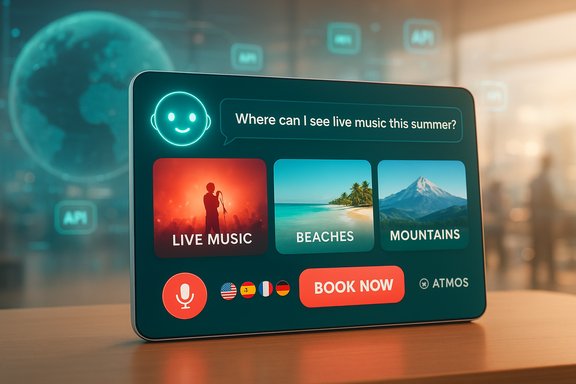
Alaska Inspires is presented as the world’s first customer‑facing natural‑language search tool from an airline, letting travelers type or speak their intent — for example, “Where can I see live music this summer?” — and receive destination recommendations the user can compare, personalize and then book. The interface supports voice input and more than 90 languages, and it’s integrated with Alaska’s Atmos Loyalty Program so recommendations can factor in points and status. The feature is powered by Azure OpenAI models deployed through Microsoft Foundry, with a retrieval‑augmented generation (RAG) architecture that grounds model responses in Alaska’s real‑time APIs and product data.The Microsoft stack in brief
- Azure OpenAI in Foundry Models: model hosting and tuning within Microsoft Foundry’s enterprise model catalog and operational controls.
- Retrieval‑Augmented Generation (RAG): pulls authoritative data from airline APIs before composing natural‑language responses.
- Copilot / GitHub Copilot: used by the product teams for rapid prototyping and engineering workflows.
Measured results and independent reporting
Alaska and Microsoft published concrete pilot metrics that are headline‑worthy:- 7.16% conversion rate for Alaska Inspires, outperforming a standard 5% booking widget benchmark.
- 75% reduction in time spent planning a destination.
- 90% guest satisfaction, with 87% of users saying they’ll try the tool again.
- The solution also earned the 2024 Future Travel Experience “Most Innovative Airline Initiative” award.
Why this matters: product, business and SEO implications
Alaska’s approach illustrates a broader shift in travel commerce from product‑centric to experience‑centric discovery. Several business and technical implications deserve attention:- Higher‑value discovery: by turning “I want to go somewhere” into “I want to do X” (music, diving, food), the funnel captures intent earlier and with more purchase‑intent downstream—hence the boost in conversion.
- SEO and organic reach: natural‑language, long‑form queries and conversational results align well with modern search intent patterns, making Alaska’s pages more discoverable and shareable—particularly if the airline amplifies user stories and social snippets from “Vibe Quiz” outputs.
- Revenue without discounting: Alaska’s team reports conversion comparable to fare sales and points to opportunity to grow bookings without lowering prices—valuable in a margin‑sensitive industry.
Technical and operational design: what Alaska did well
Alaska’s case exemplifies several engineering and product choices that accelerated value:- Fast prototyping: the airline scaled Alaska Inspires in less than six months, leveraging existing Azure and GitHub tooling to iterate quickly.
- Grounded responses: using RAG to fetch live route, pricing and loyalty data before returning a recommendation reduces hallucination risk and preserves transactional accuracy.
- Loyalty integration: tying recommendations to Atmos points and status helps convert inspiration into purchases and strengthens the loyalty lifecycle.
- Multimodal input: voice and multi‑language support expand accessibility and align with mobile‑first, conversational usage patterns.
Critical analysis — strengths
- User‑first framing: reframing discovery as emotional and experiential rather than analytical is a sound UX pivot. The early satisfaction numbers (90%+) suggest the experience resonates when executed well.
- Measured business impact: a step‑change in conversion (from 5% to 7.16%) is meaningful at scale for an airline with millions of visits. That delta compounds quickly into meaningful revenue uplift.
- Balanced architecture: combining generative models with RAG and API‑level data access preserves accuracy for booking decisions while still allowing natural language interaction.
- Speed to market: shipping in under six months demonstrates how modern toolchains (Foundry, Copilot, GitHub workflows) can compress product cycles when governance and data plumbing are in place.
Critical analysis — risks and open questions
The initiative is promising, but the evidence and broader ecosystem raise several substantive risks and caveats.1) Hallucination and data safety
Generative models can invent plausible‑sounding but incorrect content. Alaska mitigates this with RAG (grounding answers in API responses), but RAG is not a silver bullet: the retrieval step itself must be accurate, up‑to‑date and auditable. Operational controls are required to ensure pricing, availability and loyalty information are never misrepresented. Microsoft’s story describes those guardrails; independent guidance on enterprise AI urges continuous monitoring, human‑in‑the‑loop checks and model evaluation.2) Vendor concentration and resilience
Hosting booking and customer‑facing systems on a hyperscaler edge has enormous benefits—but also real operational concentration risks. Recent incidents tied to global edge services demonstrate how a configuration or control‑plane fault can cascade across many tenants, temporarily taking online check‑in and mobile apps offline. Airlines, which must reliably move passengers through time‑sensitive operations, have limited tolerance for those outages. Best practices include multi‑path ingress, out‑of‑band admin consoles and regional fallbacks—measures highlighted in post‑incident analyses of cloud edge failures.3) Economics and model cost volatility
Generative AI at scale involves nontrivial inference costs. Alaska’s conversion lift may justify the investment, but long‑term TCO will depend on model pricing, invocation volumes, caching strategies and prompt engineering to reduce token usage. Microsoft and partners can offset complexity, but customers must validate vendor‑reported ROI claims against independent telemetry and realistic traffic projections.4) Data privacy and transparency
Personalized recommendations tied to loyalty status rely on PII and behavioral data. This requires clear consent flows, strong data residency and access controls, and transparent explanations when the system uses profile signals to prioritize recommendations. Regulatory regimes (including emerging AI rules) increase scrutiny on automated personalization that impacts purchasing decisions or consumer choice.5) Measurement validity and sample bias
Early pilot numbers are encouraging, but they’re also vendor‑published. Independent validation—A/B tests with traffic‑safe splits, conversion lift by cohort, and holdout groups—is necessary to ensure claims (7.16% conversion, 75% time saved, 90% satisfaction) generalize across the broader customer base. Industry analysts and procurement teams typically request raw KPI definitions, telemetry examples and methodology before embedding these numbers in business cases.Practical recommendations for airlines and travel platforms
- Build RAG with verifiable retrieval: store retrieval logs and citations for every generated recommendation so outputs can be audited.
- Canary and gate model updates: stage model and prompt changes globally only after regional canaries and business‑critical flow tests.
- Multi‑path ingress and management fallbacks: ensure the public ingress and admin consoles are not fronted exclusively by a single global edge control plane.
- Cost forecasting and throttling: implement token budgets per session and cached canonical answers for high‑volume queries to control variable inference costs.
- Privacy by design: map data flows, minimize PII in prompts, and offer opt‑out for highly personalized results.
- Independent validation: require a data sample and telemetry export from vendors to validate performance claims and reproduce results.
Competitive and market implications
Alaska’s move is likely to catalyze rapid product iterations across travel players. Expect several near‑term outcomes:- Direct competitors will experiment with conversational discovery interfaces that integrate loyalty and experiences.
- OTAs and meta‑search engines will adapt by exposing richer signals (local events, experiential tags) to keep their relevance in the inspiration phase.
- Merchants and DMOs (destination marketing organizations) will seek structured connectors so airlines can surface up‑to‑date, partner‑verified experiences in RAG stores.
Governance and ethical considerations
Making inspiration persuasive brings responsibility. Airlines and platform providers must:- Disclose when content is AI‑generated and show the data sources used to make recommendations.
- Avoid nudges that exploit behavioral vulnerabilities—e.g., urgency messages tied to fabricated scarcity.
- Ensure pricing and availability used in recommendations are real‑time and auditable, to prevent consumer harm and regulatory exposure.
- Maintain a documented risk assessment and incident response plan for model failures and misleading outputs.
Final assessment
Alaska Airlines’ Alaska Inspires is a clear and credible example of how generative AI can reshape discovery for experience‑based commerce. The product solves a real behavioral problem (too many hours spent researching, too few inspired clicks on route maps) and backs claims with measurable pilot metrics. Microsoft Foundry’s orchestration plus RAG‑grounding addresses important technical hazards and accelerates time‑to‑value. That said, the program surfaces hard enterprise questions that go beyond a single product: resilience when critical systems depend on hyperscaler control planes, durable governance to prevent hallucinations, predictable cost models for large‑scale inference, and independent validation of vendor‑reported KPIs. The industry should treat vendor case studies as evidence of potential—useful and instructive—but always demand the operational and audit artifacts that prove results at scale.Alaska’s approach—centering emotion, integrating loyalty, and combining grounded generative models with familiar development tooling—offers a pragmatic blueprint for travel discovery in the generative‑AI era. The next phase will separate novelty from durable business impact: those who pair solid engineering controls, transparent governance and multi‑path resilience with the inspirational UX will win.
Key load‑bearing sources referenced in reporting and analysis above include Alaska Airlines’ and Microsoft’s published customer story with explicit pilot metrics, industry reporting on Alaska’s Vibe Quiz and innovation strategy, and independent forum and expert analyses that emphasize governance, resilience and the operational tradeoffs of Foundry‑style platforms.
Source: Microsoft Alaska Airlines inspires destination discovery with Microsoft Foundry | Microsoft Customer Stories
