

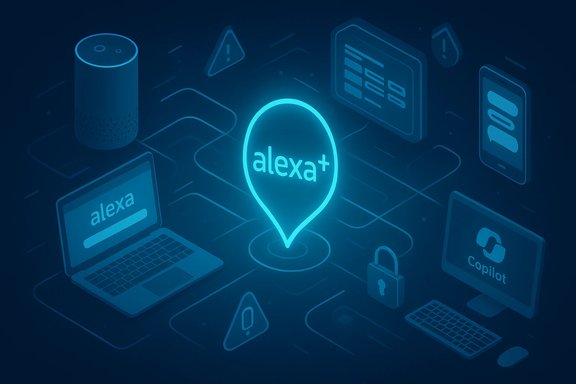
Amazon’s push to move Alexa from a simple voice assistant to a subscription‑tiered, agentic web service has already started reshaping the smart‑home and desktop landscape — and not entirely in ways Amazon expected. The Alexa+ rollout (including a full web client at alexa.com) promises powerful new workflows: document understanding, multi‑step automation, and cross‑surface continuity between Echo devices, mobile apps, and the browser. But early adopters and Amazon’s own internal testers have flagged reliability, privacy, and authorization gaps, and some Prime members report being upgraded automatically into Alexa+ with little practical notice — a change that has prompted a wave of backlash across forums and social media.
Background
Alexa’s next act: Alexa+, alexa.com, and the agentic assistant model
Alexa’s evolution into Alexa+ is a conscious pivot from a reactive voice interface toward a proactive, task‑oriented assistant. The new stack bundles generative models, persistent conversational context, and a developer SDK — including a “Web Action” capability that lets the assistant interact with websites when APIs aren’t available. Amazon has launched a web client at alexa.com (and a progressive web app experience) so the assistant can run in browsers, accept document and image uploads, and execute scripted workflows that affect smart‑home devices and commerce flows. Amazon positions Alexa+ as free for Prime members or available to non‑Prime users for $19.99/month.The user reaction: convenience, confusion, and friction
Many users and early access testers praise Alexa+ for being more conversational and capable than legacy Alexa. The desktop web client in particular appeals to power users who want a single smart‑home cockpit and a keyboard‑friendly interface for multi‑step tasks such as itinerary parsing or complex reservations. But multiple community threads and trade reports also document misfires: slower response times for routine device commands, generative errors when the assistant is asked to act, and, crucially, examples where agentic actions produced unintended real‑world conseqs — whether anecdotal or widespread — have amplified user wariness about giving the assistant more control over locks, switches, cameras, and purchases.What the reporting says — a concise summary of the two items you provided
- The seczine.com piece highlights how Amazon’s Alexa+ upgrade and the introduction of alexa.com have provoked a backlash among Prime subscribersthat some Prime members were moved into Alexa+ without a clear opt‑in and that agentic features have produced reliability and safety concerns. The article emphasizes subscription friction, smart‑home risk surfaces, and gaps in authorization and rollback protections.
- The Yahoo! Tech (Windows Central) commentary argues that PC hardware is in a golden age — thinner laptops, faster silicon, better displays — while Windows itself feels increasingly worse, cluttered by AI features and marketing claims that alienate longtime users. The piece critiques Microsoft’s aggressive Copilot/AI integration, describes a trust deficit around telemetry and account sign‑in flows, and frames a broader UX and engineering mismatch: great hardware, messy software.
Deep dive: Alexa+ — promises, mechanics, and measurable claims
What Alexa+ actually delivers
- A multi‑surface conversational UI available on Echo devices, the redesigned Alexa mobile app, and a web client at alexa.com.
- Agentic capabilities: the ability to run scripted “Web Actions,” fill forms, book services, and complete multi‑step workflows on behalf of a user.
- Document, image, and email ingestion to extract itineraries, build shopping lists, and perform richer tasks.
- Developer SDKs aimed at making partner integrations easier and supporting idempotent, auditable workflows.
- Pricing: included for Amazon Prime subscribers or $19.99/month for non‑Prime users.
Verifying the most important technical claims
- Pricing and Prime inclusion: Amazon publicly lists Alexa+ as free for Prime members and $19.99/month for others; trade coverage confirms those figures.
- Web client capabilities (document ingestion, smart‑home controls): Amazon’s announcement and early reviews confirm a chat UI, persistent context, and file upload support for richer tasks. Independent coverage describes alexa.com as a modern chatbot‑style product.
- Agentic Web Action SDK: Technical details and developer guidance indicate Alexa+ can drive web workflows where APIs do not exisre is clear because browser sessions are exposed to different threats than closed speaker devices. This capability is verifiable in Amazon’s developer communications and reporting by third‑party outlets.
Risk analysis: what can go wrong with agentic assistants on Windows and the web?
Security and attack surface expansion
- Browsers are more exposed than closed device environments. A malicious actor who compromises a desktop browser session (via malware, XSS, or credential theft) could potentially escalate to Alexa+ flows that control locks, cameras, or ordering flows unless per‑action authentication and strict context partitioning exist. Treat any web client that can trigger physical actions as a privileged client.
- The Web Action model inherently requires durable credentials, cross‑site state, and often pokies) to operate. Those elements are common targets for CSRF and session‑hijacking exploits; secure SDKs must make these failure modes explicit and provide developer controls for reauthentication and explicit approval prompts. Independent verification of these protections is limited in public documentation.
Privacy and data residency concerns
- Alexa+ accepts document and image uploads; absent a clear local‑processing guarantee, those uploaded artifactsin the cloud and could be retained for model improvement unless Amazon explicitly discloses retention and opt‑out policies. For privacy‑sensitive households or corporate settings, this matters. Amazon’s messaging favors cloud processing for scale; users should treat alexa.com like any cloud‑first assistant until proven otherwise.
Reliability and the consequences of hallucination
- Generative models still hallucinate. When an assistant is allowed to act, an incorrect inference may lead to financial or safety harms (mistaken purchases, incorrect scheduling, or misapplied device commands). The probability of error is real and, combined with agentic execution, multiplies potential impact. Early reports of slower response times and misapplied smart‑home commands underline the risk.
Subscription model and user control friction
- Bundling Alexa+ with Prime at no incremental price for members seems consumer‑friendly initially, but automatic upgrades or hard opt‑ins can create perception problems. Several community reports indicate Prime accounts were moved into Alexa+ with only a notification rather than an explicit opt‑in, stoking privacy and control complaints. Whechange management is a public‑relations and potentially regulatory risk.
Practical guidance for Windows users, power users, and administrators
- Security posture: treat the browser session as an elevated client. Use dees for alexa.com, enable strong session protections (frequent reauthentication for privileged actions), and lock down credentials with a password manager and multi‑factor authentication.
- Smart‑home policy: require explicit confirmations for any action changing locks, thermostats, or power states. Disable agentic actions for devices that control critical systems (e.g., HVAC for medically dependent residents, or power for aquariums) until proofs of rollback and testable throttles exist.
- Data hygiene: avoid uploading highly sensitive documents to alexa.com unless retention and training policies are explicit and acceptable. Use auto‑delete and minimize long‑term storage of transcripts and uploads.
- Corporate settings: treat alexa.com as a consumer client and restrict it from corporate networks where possible. Update DLP, network segmentation, and endpoint protections to reduce the risk of cross‑site automation abuse.
The Windows paradox: why hardware is thriving while the OS faces a credibility crisis
The hardware boom
CES 2026 and industry reporting show a clear upswing in PC design: sleeker chassis, powerful and efficient silicon (including Arm and hybrid AI chips), brighter and faster displays, and real gains in battery life. Vendors are shipping creative form factors (rollable displays, compact AI‑first laptops), and silicon progress continues to make previously niche use cases broadly practical. The net result: PC hardware has arguably never felt better.Windows’ AI bloat and user alienation
At the same time, Windows has doubled down on Copilot and AI integration across UI surfaces. The result, as influential commentary notes, is a growing mismatch between user expectations (stability, predictability, control) and platform direction (agentic AI, cloud dependency, more telemetry). Longtime Windows users complain about UI clutter, perceived forced account sign‑ins, and the perception that Copilot features sometimes introduce bugs rather than fixes. The critique is less about AI as a capability and more about how it’s being delivered — which priorities Microsoft chooses, and whether opt‑in controls and meaningful privacy choices are front‑and‑center.Why this matters for WindowsForum readers
WindowsForum readers — many of whom manage mixed hardware fleets, gaming rigs, and productivity workstations — should note the following practical realities:- When an OS begins to assume agentic responsibilities (recall, file indexing + automated actions), trust becomes an explicit product requirement. Without trust, users will disable features, move to other platforms, or adopt stricter corporate policies.
- Procurement decisions should be workload‑driven. If your workflows rely on legacy desktop applications, heavy GPU compute, or stringent privacy controls, hardware advances mean less if the OS stacks impose cloud‑only dependencies for core capabilities.
Cross‑referencing and verification: what we checked and what remains uncertain
- Alexa+ pricing, the alexa.com web client launch, and early access details are confirmed by Amazon’s official announcements and trade coverage by outlets that covered the product launch. These claims are well supported.
- Reports of internal beta instability (erratic behavior, device mishaps) are present in multiple community and trade writeups, and Amazon has acknowledged staged rollout practices; however, individual anecdotal incidents cited in the press remain partly unverified and should be treated as cautionary signals rather than conclusive proof of widespread production instability. Independent corroboration exists but is incomplete.
- The claim that Prime Video’s Windows app has been crashing for many users was confirmed as a visible cluster of community reports; technical vectors (WebView2 mismatches, DRM/codec and driver regressions, or a buggy Store binary) are plausible and consistent with Windows app architecture. Public telemetry or a company‑level admission was not present at the time of reporting, so the root cause remained unconfirmed.
- The Windows Central opinion about AI clutter in Windows is an editorial assessment and reflects a broad industry and community sentiment; it’s corroboratedetailing Copilot feature rollouts and privacy debates around account‑linking for advanced features. Editorial claims about user sentiment are inherently qualitative, but multiple outlets and forum conversations validate the underlying trend.
What Amazon and Microsoft should do next — constructive prescriptions
For Amazon (Alexa+ / alexa.com)
- Publish an actionable security and privacy whitepaper for alexa.com that details per‑action authorization, retention policies for uploaded materials, and the architecture of the Web Action SDK — including examples of idempotent flows and reauthentication requirements.
- Add strong, explicit in‑product controls for agentic actions: default require per‑action confirmation for purchases, device controls, and recurring automations; provide family and admin roles to manage cross‑profile permissions.
- Offer an opt‑out or delayed upgrade path that requires explicit user consent before switching experiences for Prime members, and communicate rollout details proactively to avoid perceptions of heavy‑handed upgrades.
For Microsoft (Windows + Copilot)
- Make the account‑linking path and data‑access requirements for Copilot features transparent and reversible during initial setup and ongoing use. Provide a strong offline/local account option that preserves core OS functionality without mandatory cloud entanglement.
- Prioritize reliability and rollbacks when adding AI features into core experiences. Staged releases should include visible telemetry dashboards (for enterprise customers) to track regressions that affect stability or security.
- Expose clear, readable privacy settings for each Copilot feature with one‑click disable and an explanation of what data the feature uses and how it’s stored.
Final assessment — the practical takeaway
The two stories you provided — Amazon’s Alexa+ upgrade and the critical view of Windows — are linked by a single structural tension: the rapid arrival of powerful new capabilities (generative AI and better hardware) is colliding with the slower, harder work of building trustworthy, resilient, and privacy‑respecting platform experiences.- Alexa+ and alexa.com demonstrate a credible technical leap toward agentic assistants that can do rather than just say. That leap opens real value for task automation and desktop productivity. But agentic capability multiplies risk: reliability, authorization, privacy, and the integrity of web sessions are immediate focal points. Amazon must prove its guardrails through transparent documentation, stronger per‑action controls, and careful rollout management or risk user distrust and regulatory pushback.
- Windows finds itself in a paradoxical position: hardware is spectacular, but the software experience — particularly where it bleeds into AI and cloud services — is creating a credibility deficit among power users and administrators. Microsoft can reconcile this only by making AI features truly optional and by giving users clearer control, better reliability, and plain‑English explanations about data use.
The future these products promise is compelling. The immediate work needed is to match that promise with clear, verifiable safety, privacy, and reliability commitments — and with a much better set of opt‑in controls so users keep agency over their devices and data.
Source: seczine.com https://seczine.com/hacking/2026/01...pc-hardware-never-felt-better-170000083.html]
