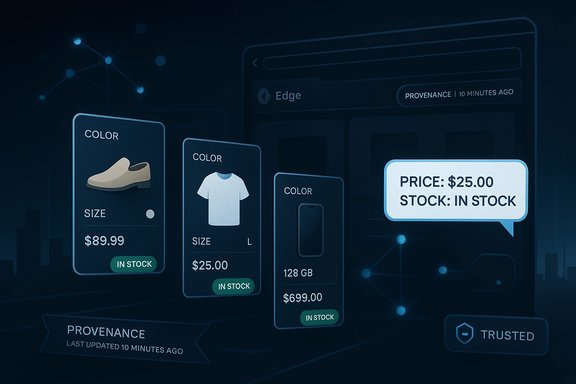
Algolia’s new partnership with Microsoft signals a decisive shift in how product data will power the next generation of AI-native shopping — moving real-time, retailer-approved attributes (pricing, inventory, enriched metadata) into agentic surfaces like Copilot, Bing Shopping, and Edge so merchants can influence what customers see when purchases begin off-site.
The retail discovery funnel is changing. Where shoppers once began with on-site search, marketplaces, or search engines, increasing portions of product research and even purchase intent now originate inside conversational AI and agent-driven surfaces. Platforms are racing to make those surfaces shoppable: Microsoft’s recent agentic commerce announcements (Brand Agents, Copilot Checkout, catalog enrichment templates) turn Copilot from a purely advisory assistant into a discovery-plus-transaction surface, with payment partners and merchant integrations to match. Algolia’s role in this landscape is straightforward in its pitch: provide canonical, low-latency product feeds and attribute enrichment that keep agent responses grounded in authoritative SKU-level data, reducing stale prices, out-of-stock recommendations, and the hallucination risk of unverified crawled data. The company’s Jan. 12, 2026 collaboration announcement with Microsoft frames Algolia as the real-time data plane feeding Microsoft’s agentic shopping surfaces. At the same time, platform-level commerce moves are tangible. Microsoft launched Copilot Checkout and related retail templates at NRF 2026 and announced partnerships with payments and commerce providers — Shopify, PayPal, Stripe, and a raft of retailers — to let customers discover and purchase inside Copilot without a redirect. Those moves make product feed accuracy and timeliness strategic infrastructure for any merchant that wants to remain discoverable and competitive off-site.
The partnership is more than a technology integration; it’s an industry signal that product data is now strategic infrastructure for AI-native commerce. For Windows and Edge teams, and for retailers rethinking distribution strategy, the immediate imperative is operational: get your catalogs right, instrument agent-originated telemetry, and build governance into your agentic commerce playbook.
Conclusion
The Algolia–Microsoft tie-up reframes product data as a competitive asset: freshness, richness, and auditable provenance power agentic discovery and make conversational AI truly shoppable. The path from demo to durable channel will require discipline — precise feeds, measurement transparency, and contractual clarity on checkout orchestration — but the opportunity is real. Retailers who treat agentic channels as first-class distribution surfaces, and who demand transparent reporting and clear governance, will convert early technical promise into measurable business outcomes.
Source: HPCwire Algolia Collaborates with Microsoft to Drive Real-Time Product Data to Shopping Experiences - BigDATAwire
 Background / Overview
The retail discovery funnel is changing. Where shoppers once began with on-site search, marketplaces, or search engines, increasing portions of product research and even purchase intent now originate inside conversational AI and agent-driven surfaces. Platforms are racing to make those surfaces shoppable: Microsoft’s recent agentic commerce announcements (Brand Agents, Copilot Checkout, catalog enrichment templates) turn Copilot from a purely advisory assistant into a discovery-plus-transaction surface, with payment partners and merchant integrations to match. Algolia’s role in this landscape is straightforward in its pitch: provide canonical, low-latency product feeds and attribute enrichment that keep agent responses grounded in authoritative SKU-level data, reducing stale prices, out-of-stock recommendations, and the hallucination risk of unverified crawled data. The company’s Jan. 12, 2026 collaboration announcement with Microsoft frames Algolia as the real-time data plane feeding Microsoft’s agentic shopping surfaces. At the same time, platform-level commerce moves are tangible. Microsoft launched Copilot Checkout and related retail templates at NRF 2026 and announced partnerships with payments and commerce providers — Shopify, PayPal, Stripe, and a raft of retailers — to let customers discover and purchase inside Copilot without a redirect. Those moves make product feed accuracy and timeliness strategic infrastructure for any merchant that wants to remain discoverable and competitive off-site. What Algolia and Microsoft are actually doing
Real-time enriched attributes: the technical core
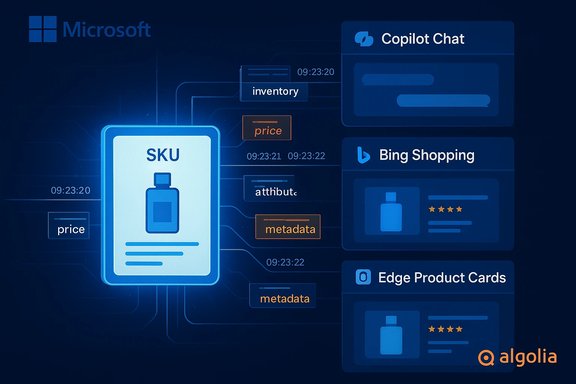
Algolia’s public materials describe a pipeline that enriches product attributes (titles, specs, materials, sizes, normalized SKUs), adds operational signals (live inventory, pricing), and exposes that data in a retrieval-friendly format so agents can surface authoritative product entries with provenance. The collaboration promises a feed-to-agent path where Algolia supplies the canonical record and Microsoft consumes it to ground Copilot and Bing Shopping responses. Key technical capabilities involved:- Near-real-time inventory and pricing updates to avoid surfacing stale offers.
- Attribute enrichment (image-extracted metadata, normalized SKUs, fit and variant details) to improve natural-language matching.
- Provenance metadata enabling Copilot to point to a canonical SKU and merchant when answering queries or initiating delegated checkouts.
Integration surface: Copilot, Bing Shopping, and Edge
The partnership scopes Algolia data into multiple Microsoft surfaces:- Copilot: agentic interactions and in-chat recommendations where a grounded SKU record prevents hallucinations.
- Bing Shopping: enriched merchant listings and comparison cards driven by fresher feeds.
- Microsoft Edge: in-browser product cards and proactive copilot nudges that rely on accurate price and inventory signals.
Pilots and early customers
Algolia named a roster of early pilot partners — Frasers Group, JTV, Little Sleepies, Shoe Carnival & Shoe Station — who are testing how aligned product attributes and real-time signals affect discoverability and agentic recommendations. Public NRF programming confirmed overlapping participants and a shared industry conversation around agentic retail.Why this matters: strategic implications for retailers and retail media
Extending merchandising off-property
For the past decade retail media primarily meant site-centric placements: sponsored listings and promotional real estate inside marketplaces and retailer sites. Agentic surfaces change the geometry of ad inventory: prominence becomes conversational placement or recommendation priority inside an assistant’s response. A real-time, merchant-approved data feed gives retailers the chance to extend merchandising strategies into those new, previously external surfaces. Algolia positions this integration as a way for merchants to preserve or extend merchandising parity off-site.Reducing friction and protecting conversion
Out-of-stock recommendations and stale prices are conversion-killers. Microsoft and Algolia both highlight the risk reduction from fresher feeds: fewer disappointed shoppers, fewer contested transactions, and stronger trust in agent-driven recommendations. That improvement is the immediate practical win sellers can measure if their feeds and operational systems keep up.New measurement and attribution opportunities — and caveats
If Copilot surfaces products from multiple merchants in a single conversational answer, retail media can potentially be sold as agentic placements. But the economics hinge on measurement: merchants will only buy agentic placements at scale if platforms provide clear, auditable attribution and transparency about placement rules and sponsored vs. organic recommendations. Algolia and Microsoft both speak to intentions for richer reporting, but the real-world economics will depend on what measurement hooks Microsoft exposes and how placement disclosures are handled.Verifying the claims and numbers (what’s validated, what varies)
Algolia’s press release and corporate materials state that Algolia powers roughly 1.75 trillion searches a year for more than 18,000 businesses — figures also reflected in recent company releases and trade coverage. Those numbers are verifiable across Algolia’s official newsroom and business reporting. Microsoft’s agentic commerce moves — Copilot Checkout, Brand Agents, and catalog enrichment templates — are confirmed in Microsoft and partner press materials and multiple trade reports, with payments partners (PayPal, Stripe) and commerce partners (Shopify, Etsy) participating in initial rollouts. These announcements were a central theme at NRF 2026 coverage. The statement in Algolia’s release that “nearly 60% of U.S. consumers now use AI tools for shopping” is an example of a vendor-cited stat that should be treated cautiously. Industry research varies:- Adobe’s consumer survey found roughly 38% of U.S. consumers had used generative AI in their shopping process (with broader intent figures higher).
- Capgemini and other industry reports indicate substantially higher adoption metrics (figures near the 50–60% range appear in some industry tracking).
Strengths: why this integration makes technical and business sense
- Technical fit: Algolia’s retrieval stack (hybrid keyword + vector search, real-time indexing, merchandising rules) addresses core pain points for agents: relevance, freshness, and provenance. For agentic answers, an auditable canonical SKU is invaluable.
- Operational upside: Real-time inventory and pricing reduce the risk of recommending unavailable items, a measurable trust and conversion improvement for merchants.
- Distribution leverage: Microsoft’s Copilot and Edge surfaces reach users at the browser and OS level, giving merchants potential exposure outside traditional sites and marketplaces. Early integrations with Shopify, PayPal, and Stripe make onboarding and payment orchestration more tractable.
- Retail media evolution: If measurement and disclosure are handled transparently, agentic placements could become a new, valuable ad inventory channel for brands and performance advertisers.
Risks, trade-offs, and governance challenges
1) Measurement opacity and vendor narratives
Vendor pilot claims of conversion uplifts are promising but often come from controlled tests or early pilot data. Independent, third-party verification will be essential before merchants reallocate significant retail-media budgets to agentic placements. Expect variability by category, SKU type, and merchant readiness.2) Delegated checkout liability and dispute handling
Copilot Checkout aims to keep merchants as the merchant of record, but delegated checkouts and tokenized settlement introduce operational changes: new fraud flows, chargeback handling, and reconciliation processes. Contracts with payment partners must clearly allocate responsibility for disputes and fraud. PayPal and Stripe participation reduces friction, but they also introduce their own rules and protections that merchants must reconcile with existing policies.3) Governance, disclosure, and consumer trust
Agentic placements are not page positions — shoppers need clear signals distinguishing sponsored placement from organic recommendation. Lack of standardized labeling or opaque placement rules will attract scrutiny and could erode trust if not handled transparently. Merchants and platforms must codify disclosure norms for agentic responses.4) Small merchant readiness and operational load
Smaller retailers stand to gain discoverability if they maintain accurate, real-time feeds, but many lack the PIM, inventory sync, and feed hygiene required. Without that readiness, they risk negative experiences and contested transactions. The integration shifts the burden onto merchants to be operationally disciplined.5) Platform concentration and dependence
As agentic discovery grows, control over the shopping funnel can shift toward platforms that own the assistant surface. Retailers depending on off-site discoverability must balance the benefit of new reach against potential dependency on a platform’s rules, fee structures, and measurement. Diversification and contractual clarity with platform partners are critical.Practical checklist for retailers, retail media teams, and Windows/Edge-focused infrastructure teams
Immediate technical and operational to-dos
- Audit and normalize product identifiers (GTIN, SKU), variant mapping, and canonical URLs.
- Implement near-real-time inventory sync (sub-minute to minute-level cadence where possible) and test price rollback scenarios.
- Harden PIM-to-feed pipelines: automated validation rules, error queues, and human review thresholds for high-impact SKUs.
- Add provenance fields to product records (last-updated timestamp, source system, confidence scores) so agent surfaces can display or rely on verifiable metadata.
- Instrument event telemetry for agent-originated sessions (click-throughs, conversions, returns) with UTM-like tagging or equivalent event IDs.
Governance & commercial controls
- Negotiate delegation terms for delegated checkout and fraud/dispute allocation before enrolling high-value SKUs.
- Insist on placement transparency and measurement SLAs if buying agentic inventory; require access to raw event logs or sampling windows where possible.
- Define opt-in/opt-out policies for brand agents and catalog enrichment writebacks; require human-in-the-loop review for automated catalog edits on sensitive categories.
Retail media & measurement
- Design A/B tests that isolate agentic placement exposure and measure incremental lift, conversion rate, and return behavior.
- Demand standardized reporting exports with provenance links so you can cross-check agent-initiated conversions back to SKU and merchant record.
- Avoid paying for volume without attribution: require conversion windows, view-through definitions, and anti-fraud checks in partner contracts.
How to think about ROI and pilot design
- Start with low-risk SKUs: stable inventory, simple returns, and clear margin structures. Use these to validate discovery-to-conversion funnel behaviors.
- Time-box pilots and require pre-defined telemetry: impressions, agent recommendations, click-throughs, add-to-cart, completed purchases, return rates, and chargebacks.
- Treat pilot numbers as directional; demand independent validation or third-party auditing for large spend shifts into agentic retail media.
The Windows/Edge angle: why Edge teams should care now
Edge is where Copilot’s browser-integrated shopping features land for many users. For Windows and Edge-centric infrastructure teams:- Ensure corporate and consumer privacy settings are compatible with Copilot Mode and Page Context behaviors if you provide managed devices.
- Document how agent-originated telemetry is captured and routed for enterprise accounts to avoid unintended data leakage.
- For partners building in-store or kiosk experiences, validate Copilot integration pathways and consent flows to ensure a consistent, secure UX across devices.
Final assessment — pragmatic optimism with disciplined governance
Algolia’s collaboration with Microsoft is a technically sensible and timely answer to a real operational gap: agentic discoveries need canonical, auditable product data. The integration addresses a core problem — stale, crawler-derived data dominating off-site discovery — and offers merchants a path to regain control over how their products are represented in conversational surfaces. Algolia’s positioning as a scalable retrieval and enrichment layer matches Microsoft’s need for canonical product feeds as Copilot becomes both guide and checkout surface. But the promise is conditional. The value realized by any merchant will depend on three factors:- Feed discipline: high-quality, normalized, real-time product data is non-negotiable.
- Measurement transparency: platforms must provide auditable attribution and placement clarity before merchants scale media spend into agentic inventory.
- Contractual clarity on delegated checkout and liability: payment and dispute flows need to be agreed in advance.
The partnership is more than a technology integration; it’s an industry signal that product data is now strategic infrastructure for AI-native commerce. For Windows and Edge teams, and for retailers rethinking distribution strategy, the immediate imperative is operational: get your catalogs right, instrument agent-originated telemetry, and build governance into your agentic commerce playbook.
Conclusion
The Algolia–Microsoft tie-up reframes product data as a competitive asset: freshness, richness, and auditable provenance power agentic discovery and make conversational AI truly shoppable. The path from demo to durable channel will require discipline — precise feeds, measurement transparency, and contractual clarity on checkout orchestration — but the opportunity is real. Retailers who treat agentic channels as first-class distribution surfaces, and who demand transparent reporting and clear governance, will convert early technical promise into measurable business outcomes.
Source: HPCwire Algolia Collaborates with Microsoft to Drive Real-Time Product Data to Shopping Experiences - BigDATAwire