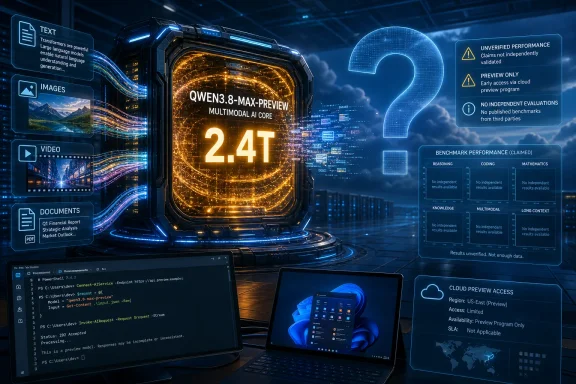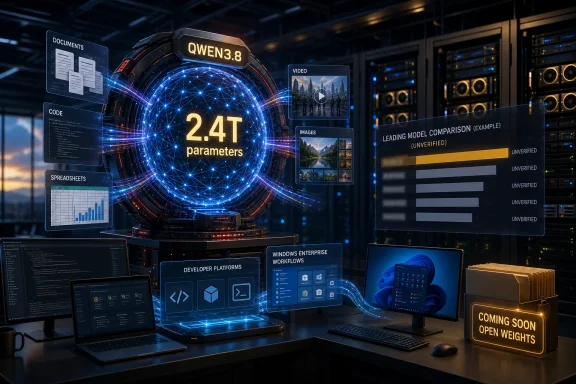
Announced July 19 at the World Artificial Intelligence Conference in Shanghai, Qwen3.8 is Alibaba’s first Qwen system above the trillion-parameter threshold that the company says can handle images, video, documents, and text. As reported by SiliconANGLE and the South China Morning Post, the preview is available through Alibaba’s Token Plan subscription service and its Qoder and QoderWork developer platforms, with a temporary 90% price reduction.
For Windows developers and IT teams, the immediate takeaway is not that a 2.4T model is suddenly ready to run on a workstation. It is that Alibaba is putting a new frontier-scale option into its hosted developer stack while promising that open weights will follow “soon.” Until those weights, licensing terms, serving requirements, and real evaluation results arrive, Qwen3.8 remains a cloud preview with an unusually ambitious headline.
Alibaba’s ranking claim has no public scorecard behind it
Alibaba’s Qwen team described Qwen3.8 as “second only” to Claude Fable 5, Anthropic’s newly released fifth-generation flagship. Anthropic positions Fable 5 for difficult coding, knowledge work, multimodal document understanding, and long-running agent tasks, and it is available through Anthropic’s own services as well as Microsoft Foundry, AWS, and Google Cloud.
But Alibaba did not publish a direct comparison against Fable 5, task-level benchmark scores, or results from an independent leaderboard. SiliconANGLE noted that the company also omitted an activated-parameter count, a meaningful missing detail for a model that may use a mixture-of-experts architecture. Total parameters alone are an incomplete measure of cost, latency, memory requirements, or practical capability.
That is a conspicuous departure from Alibaba’s approach with Qwen3.7-Max in May, when the company published a fuller collection of performance results. A preview designation can reasonably explain incomplete documentation, especially if the model is still changing, but it cannot validate a ranking claim by itself.
The distinction matters because frontier-model comparisons have become less about a single generalized intelligence score and more about narrow workloads: repository-scale coding, tool use, multilingual reasoning, visual document extraction, agent reliability, and inference cost. A model that excels at one may still be the wrong choice for a Windows automation pipeline, a PowerShell-heavy support assistant, or an internal RAG deployment tied to Microsoft 365 data.
Multimodal scale is the product story, not a parameter count
Qwen3.8’s 2.4 trillion parameters make for an eye-catching number, but the more consequential claim is multimodality at that scale. Alibaba says the preview can process video, images, and documents alongside text, placing it squarely in the market for systems that need to interpret a PDF, inspect a spreadsheet screenshot, summarize a meeting recording, and generate an action plan in one workflow.
That is relevant to organizations building on Windows because the most valuable AI workflows increasingly begin with messy enterprise artifacts rather than clean text prompts. Think SharePoint libraries full of PDFs, Teams recordings, Excel workbooks, scanned invoices, software telemetry dashboards, or screenshots attached to help-desk tickets. A model’s ability to reason across those inputs can matter more than its performance on a conventional coding benchmark.
Still, Alibaba has not yet provided the technical detail needed to evaluate those multimodal capabilities. There is no published context-window figure in the announcement, no stated maximum video duration, no account of supported file formats, and no disclosure of how the model handles document layouts, charts, tables, or multilingual optical character recognition.
For administrators, that missing material is not academic. Before a model is allowed near internal documents, buyers will need clarity on data retention, geographic processing, tenant isolation, logging controls, API terms, and whether sensitive prompts can be excluded from training. A benchmark win, if Alibaba eventually demonstrates one, would not answer those deployment questions.
“Open weights soon” is a promise, not a self-hosting plan
Alibaba has built much of Qwen’s developer appeal around open-weight releases. That strategy has made its model family a familiar option for teams using local runtimes, custom inference servers, and on-premises AI stacks rather than relying entirely on U.S. hyperscaler APIs.
But open weights are not the same as local accessibility. Even if Qwen3.8’s weights are released, a 2.4 trillion-parameter model would be far beyond the practical reach of a typical Windows 11 PC, even one equipped with a high-end consumer GPU. Quantization can reduce memory needs, and sparse architectures can lower active compute, but neither changes the fundamental infrastructure question at this scale.
The likely near-term audience for Qwen3.8 is therefore hosted inference customers and organizations with serious GPU capacity, not enthusiasts expecting to load it into a desktop tool. Local developers may eventually see distilled versions, smaller siblings, or community quantizations, but Alibaba has not announced any of those.
The promised release also lacks a date and license. Those terms will determine whether Qwen3.8 becomes useful for commercial products, internal enterprise deployments, model fine-tuning, or redistribution through third-party runtimes. “Open” can describe many very different degrees of access, and IT buyers should wait for the actual terms rather than infer them from Qwen’s prior releases.
A Chinese frontier-model race is moving into the trillion-parameter tier
The timing is not accidental. Beijing-based Moonshot AI released its 2.8 trillion-parameter Kimi K3 model only three days before Alibaba’s Qwen3.8 preview, according to SiliconANGLE. Together, the announcements show Chinese AI vendors competing openly at a scale that until recently was associated largely with the biggest U.S. model labs.
Alibaba’s objective is broader than winning a leaderboard argument. Qwen supports the company’s cloud strategy, developer ecosystem, coding tools, and AI-agent ambitions. Putting Qwen3.8 into Token Plan, Qoder, and QoderWork immediately gives Alibaba a way to gather real workload feedback while framing the model as a premium option for developers.
For customers outside China, availability will be as important as raw capability. Anthropic says Claude Fable 5 is available through Microsoft Foundry, which makes it a comparatively straightforward option for organizations already standardized on Azure governance, identity, procurement, and compliance controls. Alibaba will need to show comparable integration and support paths if it wants Qwen3.8 to become more than a model watched closely by researchers and developers.
The preview is nonetheless worth tracking. Alibaba has now set a very specific bar for itself: publish the benchmarks, explain the architecture and activated-parameter count, state the terms for open weights, and demonstrate whether Qwen3.8’s multimodal and agent capabilities hold up beyond a launch-day claim. Until then, the model’s most credible achievement is not a disputed No. 2 ranking — it is forcing the next round of frontier AI competition to be measured in trillions.
Update: Additional details (July 20, 2026)
Prameya News reports that Alibaba specifically positions Qwen3.8-Max-Preview as an improvement over Qwen3.7-Max for full-stack software development, complex reasoning, data analysis, and agent-style office work. Those workload claims were not itemized in the initial announcement coverage and remain vendor assertions pending published methodology or independent testing.
The report also describes Qoder’s broader delivery options as including desktop, IDE-plugin, command-line, and workplace-oriented tools. That makes Qoder—not the 2.4-trillion parameter count—the practical access point to watch for developers evaluating Qwen3.8 in Windows-based coding workflows.
Alibaba Qwen 3.8 model goes head to head with Claude Fable 5 in fierce technology war - Prameya News
References
- Alibaba previews Qwen3.8, claims it’s second only to Claude Fable 5 - SiliconANGLE SiliconANGLE · 2026-07-19T22:20:36+00:00
- Alibaba previews Qwen3.8, claiming its strength trails only Anthropic’s Fable 5 - South China Morning Post South China Morning Post · 2026-07-19T13:20:24+00:00
- www-cdn.anthropic.com www-cdn.anthropic.com