

AllRize’s launch of AllRize 3.0 marks a deliberate push to make Microsoft’s Copilot-era productivity stack the backbone of modern law practice management, packaging CRM, matter management, document handling and accounting inside a single, Dynamics 365–native SaaS platform designed for mid‑sized firms.
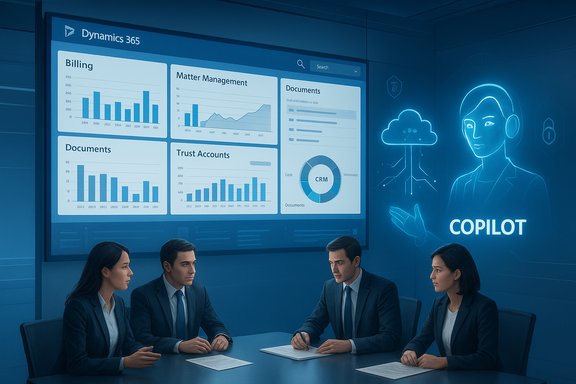
AllRize positions AllRize 3.0 as an AI‑first, modular law practice management suite built natively on Microsoft Dynamics 365 and designed to integrate tightly with Microsoft 365 productivity apps — Word, Excel, Outlook and Teams. The vendor says the platform can be deployed module‑by‑module (Marketing, CRM, Matter Management, Document Management, Accounting) or as a full unified system, with Microsoft Dataverse as the shared data plane.
The product announcement emphasizes three commercial themes: remove administrative friction that consumes fee-earner time, reduce billing leakage via automated capture, and provide enterprise‑grade security and compliance guided by Microsoft cloud controls. The message is consistent with recent industry trends that favor Microsoft‑native legal technologies because they reduce integration friction and preserve tenant‑level governance.
Two independent technical implications worth noting and verifying before procurement:
However, the uplift is not automatic. Realizing value requires disciplined governance, human oversight of AI outputs, careful cost modeling for Copilot and inference consumption, and clear contractual safeguards about data portability and retraining. Independent research into enterprise generative‑AI pilots shows that technology alone rarely produces measurable P&L impact unless integration, training and governance are executed well. Firms should treat AllRize 3.0 as a platform that offers powerful building blocks, and evaluate it with the same rigor applied to any major SaaS procurement: technical proof, legal/compliance review, financial stress testing and an operational pilot with measurable KPIs.
Buyers should approach with both optimism and rigor: demand tenant‑level Copilot processing confirmations, agent lifecycle demonstrations, consumption modeling and export/migration guarantees. When those boxes are ticked, AllRize 3.0 can move from promising vendor pitch to a pragmatic tool for reducing administrative drag and enabling lawyers to spend more time on client advocacy.
Source: LawSites AllRize Announces 3.0 Release Of Its AI-Powered Law Practice Management Platform
 Background / Overview
AllRize positions AllRize 3.0 as an AI‑first, modular law practice management suite built natively on Microsoft Dynamics 365 and designed to integrate tightly with Microsoft 365 productivity apps — Word, Excel, Outlook and Teams. The vendor says the platform can be deployed module‑by‑module (Marketing, CRM, Matter Management, Document Management, Accounting) or as a full unified system, with Microsoft Dataverse as the shared data plane.The product announcement emphasizes three commercial themes: remove administrative friction that consumes fee-earner time, reduce billing leakage via automated capture, and provide enterprise‑grade security and compliance guided by Microsoft cloud controls. The message is consistent with recent industry trends that favor Microsoft‑native legal technologies because they reduce integration friction and preserve tenant‑level governance.
What’s new in AllRize 3.0
Revolutionary billing without the stopwatch
AllRize 3.0 claims to “move beyond manual timekeeping” by auto‑generating draft time entries from tasks, calendar items, and activity signals across office productivity apps, then sending real‑time alerts and weekly reminders so attorneys can review and approve entries. If implemented as advertised, this addresses a perennial pain point—lost billable time caused by late or incomplete time capture.- Auto‑draft time entries created from calendar, task and application events.
- Real‑time alerts for missed capture and end‑of‑week reconciliation prompts.
- Audit‑ready trails to support fee verification and collections.
AI‑powered document management
The platform integrates a Copilot‑enabled document assistant for drafting, summarization and contract comparison. AllRize says the system will flag risky clauses, produce summary digests and assist with review workflows—reducing the time lawyers spend on rote drafting and initial contract triage. These features mirror capabilities Microsoft surfaces via Copilot integrations inside Word and SharePoint, and they become more valuable when grounded in a firm’s Dataverse/SharePoint corpus.- Drafting assistance and style‑consistent templates.
- Contract comparison, clause risk scoring and summary generation.
- Search and retrieval powered by tenant knowledge sources.
Integrated accounting and mission‑critical compliance
AllRize 3.0 adds an enhanced financial module described as capable of managing both operating and trust accounts with features such as three‑way reconciliation, robust audit trails and automated compliance safeguards. For firms with trust accounting obligations, these controls are non‑negotiable; AllRize emphasizes audit readiness and granular transaction visibility in its announcement.Enterprise‑grade security and AI‑powered compliance
The platform is built on Microsoft’s cloud security stack and claims to offer enterprise encryption, role‑based access controls and AI monitors that surface potential exposures of PII or HIPAA data. The vendor’s Microsoft‑native architecture is an explicit security proposition: tenant governance controls such as sensitivity labels, conditional access and audit logging can be reused to secure matter data. However, effective protection still depends on correct tenant configuration and operational controls.Agentic automation (Copilot + agents)
AllRize signals support for agentic automation patterns layered on Copilot and Dynamics—workflows that can orchestrate multi‑step tasks such as intake → conflict check → matter creation → template population. The architecture echoes Microsoft’s agent model (Copilot Studio, Agent 365, and Dataverse MCP servers) that treats agents like auditable IT services. Agent support promises scale and repeatability, but it also introduces governance, identity and lifecycle responsibilities for each agent.Technical validation: verifying the core claims
Multiple independent signals in the available materials confirm the vendor’s central technical claims: AllRize is Dynamics 365‑native, integrates Copilot features, and is hosted on Azure with Dataverse as the shared data layer. These points are consistently repeated in product materials and coverage about AllRize’s 2025 positioning. The vendor also publicized awards and recognition that corroborate market traction for its Microsoft‑centric approach.Two independent technical implications worth noting and verifying before procurement:
- Copilot integration does not automatically mean tenant‑local processing: Copilot features can operate with different processing modes and connectors; buyers must confirm in‑tenant or in‑country processing commitments for sensitive matter data. Microsoft has introduced in‑country processing options for Copilot in specific markets, but availability and tenant eligibility vary. Ask for tenant‑level confirmations and configuration walkthroughs.
- Agentic automation depends on identity, managed agent IDs and the Model Context Protocol to be safe and auditable. Microsoft’s control surfaces (Agent 365, Copilot Studio, Work IQ) provide mechanisms to govern agents, but firms must require the vendor to demonstrate how agents are registered, logged and permissioned in your tenant. Do not accept vague assurances—insist on a technical tour of agent lifecycle controls.
Strengths — why AllRize 3.0 will appeal to Microsoft‑centric firms
- Seamless Microsoft integration: For firms standardized on Microsoft 365 and Azure, a Dynamics‑native platform reduces custom connectors, preserves tenant governance and minimizes identity friction. This is a major procurement advantage when compared with point solutions that require complex bridging.
- Single data plane (Dataverse): Consolidating CRM, matter, documents and accounting into Dataverse enables consistent reporting, shared metadata and fewer brittle integrations. That simplifies analytics, compliance reporting and firm‑level KPIs.
- Modularity and phased deployment: The ability to adopt modules incrementally (e.g., start with billing and matter management, then add document and accounting) lowers migration risk and helps manage change. This reduces the up‑front project scope while preserving long‑term consolidation benefits.
- Operational automation potential: Copilot‑driven drafting and agentic workflows can take repetitive, low‑value work off lawyers’ plates, freeing them for higher‑value client work. When coupled with good human‑in‑the‑loop controls, this can be a genuine productivity multiplier.
- Vendor support posture: AllRize emphasizes “white‑glove” onboarding, migration and training—important for mid‑market firms that lack large IT teams and benefit from vendor delivery commitments. Vendor professional services can markedly reduce implementation friction.
Risks, caveats and the governance checklist
No platform eliminates legal, compliance and operational risk. The new AI‑first features introduce both technical and professional‑responsibility considerations.1. Model risk and hallucinations
Generative and agentic models can produce incorrect or misleading outputs. For legal work—where competence and ethical obligations matter—any AI output touching legal reasoning must be verified by a qualified human. Firms should require configurable human‑in‑the‑loop checkpoints and full prompt/response logging for defensibility.2. Licensing and Copilot consumption costs
Copilot and model inference are often licensed separately and may be consumption‑based. If Copilot features are broadly enabled across many fee‑earners, model consumption can materially increase TCO. Demand clear licensing scenarios, projected consumption modeling and cost‑control mechanisms before signing. Independent analysis shows Copilot consumption can surprise budgets if not scoped.3. Vendor lock‑in and portability
A Dynamics‑native solution simplifies current operations for Microsoft‑centric firms but raises migration complexity if the firm later needs to exit. Confirm data export formats (Dataverse exports, document extraction), ownership of any custom agents, and contractual clauses for migration assistance. Negotiate migration SLAs and IP clarity upfront.4. Implementation and scale risk
Pilot success does not guarantee enterprise‑scale reliability across offices or jurisdictions. Ask for references, delivery playbooks, and proof points showing multi‑office rollouts, cross‑jurisdiction tax/trust compliance, and post‑go‑live managed services. Validate SLAs for uptime, backups and disaster recovery.5. Privacy, retention and regulatory exposures
Even with Azure controls, tenant configuration determines actual protection. Confirm how AllRize handles retention, Purview sensitivity labels, tenant‑level DLP, and whether the vendor or third parties can access matter data for training or diagnostics. Request written guarantees about not using tenant matter data for model retraining unless explicitly contracted.Practical buyer checklist — what to demand in an evaluation
- Technical tenant walkthrough: A live demo in a tenant‑like environment showing Dataverse mapping, SharePoint integration, Outlook/Teams flows and sample Copilot prompts.
- Copilot processing commitments: Written confirmation of where Copilot inference runs (in‑tenant, in‑country, or cross‑region) and how sensitive data is protected.
- Agent governance demo: Show how agents are registered, how identities are managed, what logs are produced and how rollbacks and human approvals work.
- Trust accounting proofs: Reconciliation workflows, three‑way reconciliation examples and audit trail samples for trust ledgers. Ask for a sample audit package.
- Licensing & TCO model: A stress‑tested cost model including Copilot consumption, model inference, storage, Dataverse row counts and professional services hours.
- Security controls evidence: Pen test reports, SOC/ISO attestations, encryption key management approach, and how Purview labels/DLP are enforced in practice.
- Migration & exit terms: Data export formats, agent code ownership, migration hours and financial remediation clauses.
Implementation playbook — pilot to production
Pilot (0–12 weeks)
- Identify a single high‑value use case (e.g., time capture + billing reconciliation) and a representative user cohort (3–10 fee earners).
- Enable Copilot features in monitor‑only mode where possible; collect prompt/response telemetry and validate outputs against human baseline documents.
- Test trust accounting flows in a sandbox with sample reconciliations and simulated audits.
Scale (3–9 months)
- Roll out additional modules incrementally: matter management → document automation → accounting.
- Implement governance: agent identity registration, conditional access rules, Purview labels mapped to matter sensitivity tiers.
Operate (ongoing)
- Feed agent telemetry into SIEM for anomaly detection; maintain an AgentOps runbook with escalation paths and a kill switch for misbehaving agents.
- Run quarterly Cost & Consumption reviews and enforce quotas or chargeback to control Copilot spend.
Pricing, licensing and total cost considerations
Copilot and model usage are increasingly a significant component of SaaS TCO. While AllRize bundles product modules and professional services, the incremental cost of Copilot entitlements, Azure model inference and Dataverse storage can be material. Build three scenarios (low, medium, high) for model consumption and compute their impact on annual subscription costs. Insist that the vendor provide historical consumption profiles from comparable customers to validate assumptions. Independent vendor and platform reporting consistently warns that consumption‑based AI costs can surprise buyers if not modeled.Competitive landscape — where AllRize fits
AllRize competes in a crowded legal‑tech field that includes legacy practice management systems, specialist document automation vendors and other Microsoft‑centric entrants. Its distinguishing bet is the Microsoft‑native stack combined with Copilot and agentic automation, which is attractive to firms that already use Microsoft 365 at scale. That said, firms that prefer platform neutrality or that are heavily invested in non‑Microsoft clouds will find different tradeoffs. Independent market commentary notes that awards and recognition (such as practice management innovation honors) validate momentum but are not a substitute for long‑term operational proof points.Final assessment — strengths, realistic outcomes and a cautious roadmap
AllRize 3.0 bundles a compelling set of ideas: Dynamics 365 as the data plane, Copilot‑driven drafting and agentic workflows, and an integrated accounting module designed for trust compliance. For mid‑sized law firms that have standardized on Microsoft, AllRize’s Microsoft‑native architecture reduces friction and accelerates secure deployments. When paired with strong governance, careful pilots and consumption controls, firms can expect meaningful administrative savings and reduced billing leakage over time.However, the uplift is not automatic. Realizing value requires disciplined governance, human oversight of AI outputs, careful cost modeling for Copilot and inference consumption, and clear contractual safeguards about data portability and retraining. Independent research into enterprise generative‑AI pilots shows that technology alone rarely produces measurable P&L impact unless integration, training and governance are executed well. Firms should treat AllRize 3.0 as a platform that offers powerful building blocks, and evaluate it with the same rigor applied to any major SaaS procurement: technical proof, legal/compliance review, financial stress testing and an operational pilot with measurable KPIs.
Conclusion
AllRize 3.0 stakes a credible claim as a modern, Microsoft‑native law practice management platform designed for the Copilot era. Its tight Dynamics 365 integration, modular design and Copilot/agent features address real pain points—billing leakage, document drudgery and fragmented systems—while promising to fold legal workflows into tenant‑governed Microsoft controls. For firms committed to the Microsoft ecosystem, AllRize 3.0 merits a close technical trial that focuses on billing capture accuracy, trust accounting robustness, Copilot processing controls and agent governance.Buyers should approach with both optimism and rigor: demand tenant‑level Copilot processing confirmations, agent lifecycle demonstrations, consumption modeling and export/migration guarantees. When those boxes are ticked, AllRize 3.0 can move from promising vendor pitch to a pragmatic tool for reducing administrative drag and enabling lawyers to spend more time on client advocacy.
Source: LawSites AllRize Announces 3.0 Release Of Its AI-Powered Law Practice Management Platform
